 \n\nLet's stop lying to ourselves about the world we've built.\n\nI'm not saying that with anger for the sake of anger. I'm saying it because I've watched enough of this reality to finally admit something I used to ignore: what we call *\"normal\"* is costing us our humanity. And the more we pretend that this is simply *\"the way the world works,\"* the more we participate in a silent agreement that leaves **millions living without dignity**.\n\nI didn't arrive here through rebellion or ideology. I arrived here because I kept noticing a pattern I could no longer unsee. We live surrounded by abundance—food, technology, comfort, innovation, knowledge. Humanity has never had more capability than we do now. And yet dignity is treated like a luxury. Safety is conditional. And worth? Worth is measured by how much a person can endure, produce, or sacrifice for systems that do not love them back.\n\nThis is the part I can't pretend not to see anymore.\n\nSomewhere along the way, we replaced the idea of being human with the idea of being *\"useful.\"* We built a world where people are valued for what they can do, not for who they are. A world where suffering is romanticized as hard work, exhaustion is virtue, and needing rest or help is weakness. We applaud those who \"push through\" and quietly judge those who fall apart under the weight. We've normalized emotional numbness as resilience, burnout as ambition, and self-abandonment as discipline.\n\nAnd then we wonder why so many feel disconnected, anxious, or lost.\n\nI used to think the problem was just unfairness or inequality. But it goes deeper. It's a confusion at the root of our culture: we have mistaken survival strategies for identity. We treat struggle as character. We treat burnout as success. We treat constant productivity as proof of value. We've turned the human spirit into a performance metric.\n\nIt's not that ambition is wrong. Growth isn't the enemy. Progress is not the issue. But somewhere along the way, we began worshipping the outcomes instead of the people living through them. We praise the ones who \"win\" at the economic game as if they are a higher form of human. We look at wealth as evidence of virtue, intelligence, superiority—even destiny. As if comfort is earned by character, and hardship is a personal failure. As if dignity must be deserved.\n\nY'all lying and playing...\n\n**Because if dignity must be _earned_, then we are not a society—we are a _competition disguised as one_.**\n\nAnd here's the truth that keeps echoing in me: a truly developed world would not require a person to earn the right to be treated with dignity.\n\nWe rarely say this out loud, but we live in a culture that teaches: *\"Your worth is what you can produce. Your value is how much you can endure. Your success is how much you can accumulate.\"* This story trains us to see ourselves as instruments, not beings. It conditions us to ask \"How can I become more valuable?\" instead of \"Do I feel alive in my own life?\"\n\nIf dignity is reserved for the lucky, the relentless, or the already advantaged, then what we call “progress” is just privilege with better PR.\n\nAnd if we can build rockets, cure diseases, and automate half of life, then we are capable of building a world where people don't have to suffer to be seen as worthy.\n\nSo why don't we?\n\nBecause the _current_ story benefits from staying in place. It keeps us striving, comparing, competing, and never questioning. If we stay busy chasing worth, we don't ask who decided the rules. We don't ask who benefits from the exhaustion. We don't ask why we treat basic human needs like privileges.\n\nThe conditioning runs deep. And the most effective conditioning is the kind people defend as *\"normal.\"*\n\nIt's uncomfortable to admit that we built a world that does not align with human well-being. It's uncomfortable to question the story we were raised inside. But discomfort is not a sign that we are wrong. It's a sign that something true is being touched.\n\nThere is nothing *\"natural\"* about a society where people feel they must prove their right to exist.\n\nThis system is not ancient or inevitable. It is a story—repeated long enough to feel like truth. But stories can evolve. Stories can be rewritten. And maybe the real work of this time is not to achieve more, but to remember what we lost while chasing what we were told matters.\n\nUnderneath all of the noise, I believe most people want the same simple things: to feel safe, to feel valued, to feel connected, to feel like their life matters beyond output. The problem is not that humanity is broken. The problem is that we have been living inside a narrative that is too small for the human soul.\n\nProgress cannot be measured by speed if we are running in the wrong direction.\n\nSo here is the discomfort I am sitting with: if a society can produce extraordinary wealth, but cannot guarantee dignity, safety, or belonging for the people who make that society function, then what exactly are we calling \"advanced\"?\n\n**The world we built is impressive, but it is not yet humane.**\n\nAnd it won't become humane until we remember that systems exist to serve people—not the other way around.\n\nChanging this won't begin with policies, debates, revolutions, or new ideologies. It begins with honesty. It begins with the courage to stop pretending everything is fine. It begins with noticing where the story of worthiness has shaped our identity. It begins with questioning the voice inside us that says, *\"I must do more to be enough.\"*\n\nYou don't have to reject ambition. You don't have to abandon progress. You don't have to \"opt out of society.\" This isn't about becoming less—it's about becoming human again.\n\nWhat if the measure of a good life wasn't how much you achieve, but how deeply you feel alive while living it? What if the measure of a society wasn't wealth, but how safe people feel to be fully themselves? What if progress wasn't defined by power, but by the presence of compassion?\n\nThese questions don't require permission. They only require _willingness_.\n\nI'm not asking you to agree with me. I'm asking you to sit with the discomfort that rises when you stop pretending everything is fine. You don't need to fix the world or fix yourself. Just stop lying to yourself about what you already know feels wrong.\n\nWhat now? \n\nStop performing “fine.” Stop playing along. Pick one place in your life where you’ve been betraying yourself for acceptance, productivity, or status — and refuse to continue the lie. Change one behavior in the direction of dignity. If you won’t fight for your own humanity, why would the system ever offer it to you?\n\nYour life is the first place the new story must become real — and others follow what they can feel, not what they are told.\n\n---\n\n## Related... if you want to keep going...\n\n- [Love Is the Final Revolution](/p/love-is-the-final-revolution) — After nearly losing myself to global chaos, I found the most radical act isn't outrage — it's love. A reflection on politics, fear, and why building a home rooted in kindness may be the ultimate rebellion.\n\n- [The Paradox of Modernity: Progress Without Peace](/p/the-paradox-of-modernity-progress-without-peace) — We are living in the most advanced moment in human history. And yet, we are also arguably the most confused, alienated, addicted, manipulated, and emotionally starved generation ever to exist.\n\n- [What Are We Even Calling Democracy Anymore?](/p/what-are-we-even-calling-democracy) — A raw reflection on the state of democracy, the gap between rhetoric and reality, and the need for genuine systemic change.\n\n- [Good Sheep](/p/good-sheep) — How we've been conditioned to love our own systematic exploitation — from theme parks to algorithmic playlists, we pay premium prices to be herded through corporate processing systems while calling it freedom.\n\n- [If Your Politics Obsess Over Control, You're Not Well](/p/fear-control-politics) — Analysis of how fear and trauma manifest in control-based political ideologies. Explores the relationship between personal insecurity and authoritarian policy positions.\n\n- [Transforming My Life Through the Application of What I Value](/p/transforming-life-through-values) — Personal story of four years of therapy and habit changes. Shows how aligning daily actions with core values led to improved mental health and relationships.\n\n- [On the Application of Empathy and Compassion](/p/on-the-application-of-empathy-and-compassion) — How learning empathy and compassion transformed my approach to conflict, relationships, and self-understanding.",
"content_text": "A call to build a society where safety, dignity, and love are non-negotiable for all.",
"summary": "A call to build a society where safety, dignity, and love are non-negotiable for all.",
"date_published": "2025-11-07T15:29:00.000Z",
"date_modified": "2025-11-07T15:29:00.000Z",
"authors": [
{
"name": "Antonio Rodriguez Martinez",
"url": "https://antoniwan.online"
}
],
"tags": [
"politics",
"culture",
"integration-growth",
"dignity",
"worth",
"society",
"systems",
"compassion",
"humanity",
"values",
"social-justice",
"systemic-critique",
"transformation",
"consciousness",
"politics",
"culture",
"authenticity",
"purpose",
"meaning",
"collective-healing",
"revolution",
"love",
"empathy",
"mental-health",
"self-reflection",
"truth",
"freedom",
"intentional-living"
],
"image": "https://notes.antoniwan.online/images/2025/trillion.avif"
},
{
"id": "https://notes.antoniwan.online/p/una-invitacion-al-fin-de-la-adoracion-de-la-riqueza-y-al-comienzo-de-un-futuro-humano/",
"url": "https://notes.antoniwan.online/p/una-invitacion-al-fin-de-la-adoracion-de-la-riqueza-y-al-comienzo-de-un-futuro-humano/",
"title": "Una Invitación al Fin de la Adoración de la Riqueza — y al Comienzo de un Futuro Humano",
"content_html": "
\n\nLet's stop lying to ourselves about the world we've built.\n\nI'm not saying that with anger for the sake of anger. I'm saying it because I've watched enough of this reality to finally admit something I used to ignore: what we call *\"normal\"* is costing us our humanity. And the more we pretend that this is simply *\"the way the world works,\"* the more we participate in a silent agreement that leaves **millions living without dignity**.\n\nI didn't arrive here through rebellion or ideology. I arrived here because I kept noticing a pattern I could no longer unsee. We live surrounded by abundance—food, technology, comfort, innovation, knowledge. Humanity has never had more capability than we do now. And yet dignity is treated like a luxury. Safety is conditional. And worth? Worth is measured by how much a person can endure, produce, or sacrifice for systems that do not love them back.\n\nThis is the part I can't pretend not to see anymore.\n\nSomewhere along the way, we replaced the idea of being human with the idea of being *\"useful.\"* We built a world where people are valued for what they can do, not for who they are. A world where suffering is romanticized as hard work, exhaustion is virtue, and needing rest or help is weakness. We applaud those who \"push through\" and quietly judge those who fall apart under the weight. We've normalized emotional numbness as resilience, burnout as ambition, and self-abandonment as discipline.\n\nAnd then we wonder why so many feel disconnected, anxious, or lost.\n\nI used to think the problem was just unfairness or inequality. But it goes deeper. It's a confusion at the root of our culture: we have mistaken survival strategies for identity. We treat struggle as character. We treat burnout as success. We treat constant productivity as proof of value. We've turned the human spirit into a performance metric.\n\nIt's not that ambition is wrong. Growth isn't the enemy. Progress is not the issue. But somewhere along the way, we began worshipping the outcomes instead of the people living through them. We praise the ones who \"win\" at the economic game as if they are a higher form of human. We look at wealth as evidence of virtue, intelligence, superiority—even destiny. As if comfort is earned by character, and hardship is a personal failure. As if dignity must be deserved.\n\nY'all lying and playing...\n\n**Because if dignity must be _earned_, then we are not a society—we are a _competition disguised as one_.**\n\nAnd here's the truth that keeps echoing in me: a truly developed world would not require a person to earn the right to be treated with dignity.\n\nWe rarely say this out loud, but we live in a culture that teaches: *\"Your worth is what you can produce. Your value is how much you can endure. Your success is how much you can accumulate.\"* This story trains us to see ourselves as instruments, not beings. It conditions us to ask \"How can I become more valuable?\" instead of \"Do I feel alive in my own life?\"\n\nIf dignity is reserved for the lucky, the relentless, or the already advantaged, then what we call “progress” is just privilege with better PR.\n\nAnd if we can build rockets, cure diseases, and automate half of life, then we are capable of building a world where people don't have to suffer to be seen as worthy.\n\nSo why don't we?\n\nBecause the _current_ story benefits from staying in place. It keeps us striving, comparing, competing, and never questioning. If we stay busy chasing worth, we don't ask who decided the rules. We don't ask who benefits from the exhaustion. We don't ask why we treat basic human needs like privileges.\n\nThe conditioning runs deep. And the most effective conditioning is the kind people defend as *\"normal.\"*\n\nIt's uncomfortable to admit that we built a world that does not align with human well-being. It's uncomfortable to question the story we were raised inside. But discomfort is not a sign that we are wrong. It's a sign that something true is being touched.\n\nThere is nothing *\"natural\"* about a society where people feel they must prove their right to exist.\n\nThis system is not ancient or inevitable. It is a story—repeated long enough to feel like truth. But stories can evolve. Stories can be rewritten. And maybe the real work of this time is not to achieve more, but to remember what we lost while chasing what we were told matters.\n\nUnderneath all of the noise, I believe most people want the same simple things: to feel safe, to feel valued, to feel connected, to feel like their life matters beyond output. The problem is not that humanity is broken. The problem is that we have been living inside a narrative that is too small for the human soul.\n\nProgress cannot be measured by speed if we are running in the wrong direction.\n\nSo here is the discomfort I am sitting with: if a society can produce extraordinary wealth, but cannot guarantee dignity, safety, or belonging for the people who make that society function, then what exactly are we calling \"advanced\"?\n\n**The world we built is impressive, but it is not yet humane.**\n\nAnd it won't become humane until we remember that systems exist to serve people—not the other way around.\n\nChanging this won't begin with policies, debates, revolutions, or new ideologies. It begins with honesty. It begins with the courage to stop pretending everything is fine. It begins with noticing where the story of worthiness has shaped our identity. It begins with questioning the voice inside us that says, *\"I must do more to be enough.\"*\n\nYou don't have to reject ambition. You don't have to abandon progress. You don't have to \"opt out of society.\" This isn't about becoming less—it's about becoming human again.\n\nWhat if the measure of a good life wasn't how much you achieve, but how deeply you feel alive while living it? What if the measure of a society wasn't wealth, but how safe people feel to be fully themselves? What if progress wasn't defined by power, but by the presence of compassion?\n\nThese questions don't require permission. They only require _willingness_.\n\nI'm not asking you to agree with me. I'm asking you to sit with the discomfort that rises when you stop pretending everything is fine. You don't need to fix the world or fix yourself. Just stop lying to yourself about what you already know feels wrong.\n\nWhat now? \n\nStop performing “fine.” Stop playing along. Pick one place in your life where you’ve been betraying yourself for acceptance, productivity, or status — and refuse to continue the lie. Change one behavior in the direction of dignity. If you won’t fight for your own humanity, why would the system ever offer it to you?\n\nYour life is the first place the new story must become real — and others follow what they can feel, not what they are told.\n\n---\n\n## Related... if you want to keep going...\n\n- [Love Is the Final Revolution](/p/love-is-the-final-revolution) — After nearly losing myself to global chaos, I found the most radical act isn't outrage — it's love. A reflection on politics, fear, and why building a home rooted in kindness may be the ultimate rebellion.\n\n- [The Paradox of Modernity: Progress Without Peace](/p/the-paradox-of-modernity-progress-without-peace) — We are living in the most advanced moment in human history. And yet, we are also arguably the most confused, alienated, addicted, manipulated, and emotionally starved generation ever to exist.\n\n- [What Are We Even Calling Democracy Anymore?](/p/what-are-we-even-calling-democracy) — A raw reflection on the state of democracy, the gap between rhetoric and reality, and the need for genuine systemic change.\n\n- [Good Sheep](/p/good-sheep) — How we've been conditioned to love our own systematic exploitation — from theme parks to algorithmic playlists, we pay premium prices to be herded through corporate processing systems while calling it freedom.\n\n- [If Your Politics Obsess Over Control, You're Not Well](/p/fear-control-politics) — Analysis of how fear and trauma manifest in control-based political ideologies. Explores the relationship between personal insecurity and authoritarian policy positions.\n\n- [Transforming My Life Through the Application of What I Value](/p/transforming-life-through-values) — Personal story of four years of therapy and habit changes. Shows how aligning daily actions with core values led to improved mental health and relationships.\n\n- [On the Application of Empathy and Compassion](/p/on-the-application-of-empathy-and-compassion) — How learning empathy and compassion transformed my approach to conflict, relationships, and self-understanding.",
"content_text": "A call to build a society where safety, dignity, and love are non-negotiable for all.",
"summary": "A call to build a society where safety, dignity, and love are non-negotiable for all.",
"date_published": "2025-11-07T15:29:00.000Z",
"date_modified": "2025-11-07T15:29:00.000Z",
"authors": [
{
"name": "Antonio Rodriguez Martinez",
"url": "https://antoniwan.online"
}
],
"tags": [
"politics",
"culture",
"integration-growth",
"dignity",
"worth",
"society",
"systems",
"compassion",
"humanity",
"values",
"social-justice",
"systemic-critique",
"transformation",
"consciousness",
"politics",
"culture",
"authenticity",
"purpose",
"meaning",
"collective-healing",
"revolution",
"love",
"empathy",
"mental-health",
"self-reflection",
"truth",
"freedom",
"intentional-living"
],
"image": "https://notes.antoniwan.online/images/2025/trillion.avif"
},
{
"id": "https://notes.antoniwan.online/p/una-invitacion-al-fin-de-la-adoracion-de-la-riqueza-y-al-comienzo-de-un-futuro-humano/",
"url": "https://notes.antoniwan.online/p/una-invitacion-al-fin-de-la-adoracion-de-la-riqueza-y-al-comienzo-de-un-futuro-humano/",
"title": "Una Invitación al Fin de la Adoración de la Riqueza — y al Comienzo de un Futuro Humano",
"content_html": " \n\n*A line in the sand.*\n\nIf you're reading anything I wrote before this date, do it at your own risk.\n\nIt was honest, but incomplete — pieces of me scattered across insight, intellect, and instinct, not yet fully connected.\n\nThe air feels different now.\n\nI'm done performing — even for myself.\n\nFor a long time, I mistook talking about growth for actually growing. I could map my patterns, write about them, even predict them. It felt like self-awareness, but it wasn't. It was distance disguised as clarity. I was narrating evolution instead of living it.\n\nThe truth is simple: **I built an identity around insight because it was safer than feeling.**\n\nMy reflex was to stay in my head — analyze, articulate, manage the moment. Even when life was gentle. Reflection became a shield; awareness, a performance.\n\nRecently something shifted. I saw the reflex as it happened — the urge to explain instead of let something land. For once, I didn't feed it. I stayed. It was small, but real. And it told me the truth:\n\nI've been performing growth instead of living it.\n\nNot anymore.\n\nThere's a difference between understanding and integrating — between naming the path and walking it. I'm done mistaking articulation for embodiment.\n\nI don't need to sound wise.\n\nI need to be here.",
"content_text": "A line in the sand. Moving from performing growth to living it, from articulation to embodiment, from insight to integration.",
"summary": "A line in the sand. Moving from performing growth to living it, from articulation to embodiment, from insight to integration.",
"date_published": "2025-11-06T12:00:00.000Z",
"date_modified": "2025-11-06T12:00:00.000Z",
"authors": [
{
"name": "Antonio Rodriguez Martinez",
"url": "https://antoniwan.online"
}
],
"tags": [
"integration-growth",
"metaspace",
"authenticity",
"self-awareness",
"personal-growth",
"transformation",
"consciousness",
"embodiment",
"integration",
"self-reflection",
"vulnerability",
"growth",
"performance",
"truth",
"presence",
"awareness",
"healing"
],
"image": "https://notes.antoniwan.online/images/2025/line-on-sand.avif"
},
{
"id": "https://notes.antoniwan.online/p/intelligence-burns/",
"url": "https://notes.antoniwan.online/p/intelligence-burns/",
"title": "Intelligence Burns",
"content_html": "
\n\n*A line in the sand.*\n\nIf you're reading anything I wrote before this date, do it at your own risk.\n\nIt was honest, but incomplete — pieces of me scattered across insight, intellect, and instinct, not yet fully connected.\n\nThe air feels different now.\n\nI'm done performing — even for myself.\n\nFor a long time, I mistook talking about growth for actually growing. I could map my patterns, write about them, even predict them. It felt like self-awareness, but it wasn't. It was distance disguised as clarity. I was narrating evolution instead of living it.\n\nThe truth is simple: **I built an identity around insight because it was safer than feeling.**\n\nMy reflex was to stay in my head — analyze, articulate, manage the moment. Even when life was gentle. Reflection became a shield; awareness, a performance.\n\nRecently something shifted. I saw the reflex as it happened — the urge to explain instead of let something land. For once, I didn't feed it. I stayed. It was small, but real. And it told me the truth:\n\nI've been performing growth instead of living it.\n\nNot anymore.\n\nThere's a difference between understanding and integrating — between naming the path and walking it. I'm done mistaking articulation for embodiment.\n\nI don't need to sound wise.\n\nI need to be here.",
"content_text": "A line in the sand. Moving from performing growth to living it, from articulation to embodiment, from insight to integration.",
"summary": "A line in the sand. Moving from performing growth to living it, from articulation to embodiment, from insight to integration.",
"date_published": "2025-11-06T12:00:00.000Z",
"date_modified": "2025-11-06T12:00:00.000Z",
"authors": [
{
"name": "Antonio Rodriguez Martinez",
"url": "https://antoniwan.online"
}
],
"tags": [
"integration-growth",
"metaspace",
"authenticity",
"self-awareness",
"personal-growth",
"transformation",
"consciousness",
"embodiment",
"integration",
"self-reflection",
"vulnerability",
"growth",
"performance",
"truth",
"presence",
"awareness",
"healing"
],
"image": "https://notes.antoniwan.online/images/2025/line-on-sand.avif"
},
{
"id": "https://notes.antoniwan.online/p/intelligence-burns/",
"url": "https://notes.antoniwan.online/p/intelligence-burns/",
"title": "Intelligence Burns",
"content_html": " \n\nPeople say they love intelligent people… until they actually have to deal with one.\n\nIMHO, people think “intelligence” and only want wisdom, not friction. Illumination, not combustion. The aesthetic, not the realness. They want the glow of insight, not the fire of confrontation.\n\nFor years, I gave people both. I was fast, sharp, analytical to a fault. I wielded my mind like a blade and called it honesty—never cruelty, but rarely compassion. Empathy is the last thing I’ve been integrating into my life. Granted, this is my deepest flaw, but hey… most of my upbringing was self-defense dressed as intellect. A trauma response with a high IQ. A burning sword that burned down bridges, solved a lot too. Thankfully, some friends, family and a few associates stuck with me, lol.\n\nYou might not relate or understand what I mean, but picture this: you’re talking to a self-proclaimed “perfectionist,” and within seconds you notice they’re anything _but._ Or someone who keeps repeating the same cycles, self-sabotaging—_te mataste tú mismo_ (you killed yourself)—and you can see the pattern in real time. Do I call it out or nah? Can they handle the heat? Probably not. That’s what people don’t get—intelligence isn’t just thought speed; it’s a flood of information. Patterns, causes, outcomes—loading in real time. And when your inner system runs hot like that, the flood feels like heat. Let’s not pretend most people are built for that temperature.\n\nThe truth is, being “smart” isn’t glamorous. It’s exhausting. It’s a constant loop of observation and restraint—watching the world lag two beats behind your thoughts, holding your tongue so people don’t think you’re condescending when you’re just processing faster. That restraint breeds loneliness, cynicism, and sometimes danger. If not checked and reined, it will make you wrong, _a lot_, too. And if you’re like me—someone who actually _enjoys_ hours of reading, learning, integrating new paradigms, building new skills like you’re popping pills—it’s worse.\n\nEventually I realized: intelligence without direction is friendly fire.\n\nIntellect without empathy is like heat without aim—it burns everything, even inward.\n\nSo now I treat it like **Cyclops** from the X-Men. The power’s still there; the heat hasn’t gone anywhere. But I wear a visor. I choose where I aim. I decide when it’s safe to remove the filter. I used to scorch people in arguments, thinking I was “helping.” Now, I pause. I breathe. I aim. I learned to contain it. I aim before I fire. That’s maturity in my book—same fire, better target selection, or none at all. Sometimes the most intelligent move is restraint.\n\nI don’t try to “fit in” anymore. I look for people and environments built for my temperature—the ones who don’t flinch when I get passionate, who can spar without taking it personal, who know fire can forge, not just burn. Everybody else gets the smile-and-wave treatment.\n\nThat’s it. No moral, no lecture. Just calibration.\n\nBeing intelligent isn’t about being right—it’s about being responsible for your power.\n\nNot just bright—precise.\n\nNot just smart—steady.\n\nThey want your light? Fine.\n\nBut remember... **intelligence fucking burns.**",
"content_text": "On intelligence as heat: power without empathy burns. Choosing aim, restraint, and environments built for your temperature—responsibility over being right.",
"summary": "On intelligence as heat: power without empathy burns. Choosing aim, restraint, and environments built for your temperature—responsibility over being right.",
"date_published": "2025-10-31T00:00:00.000Z",
"date_modified": "2025-10-31T00:00:00.000Z",
"authors": [
{
"name": "Antonio Rodriguez Martinez",
"url": "https://antoniwan.online"
}
],
"tags": [
"psychology",
"integration-growth",
"intelligence",
"empathy",
"restraint",
"responsibility",
"power",
"self-mastery",
"emotional-intelligence",
"personal-growth",
"communication",
"relationships",
"philosophy"
],
"image": "https://notes.antoniwan.online/images/2025/intelligence-burn.avif"
},
{
"id": "https://notes.antoniwan.online/p/empathy-as-a-shield/",
"url": "https://notes.antoniwan.online/p/empathy-as-a-shield/",
"title": "Empathy as a Shield",
"content_html": "
\n\nPeople say they love intelligent people… until they actually have to deal with one.\n\nIMHO, people think “intelligence” and only want wisdom, not friction. Illumination, not combustion. The aesthetic, not the realness. They want the glow of insight, not the fire of confrontation.\n\nFor years, I gave people both. I was fast, sharp, analytical to a fault. I wielded my mind like a blade and called it honesty—never cruelty, but rarely compassion. Empathy is the last thing I’ve been integrating into my life. Granted, this is my deepest flaw, but hey… most of my upbringing was self-defense dressed as intellect. A trauma response with a high IQ. A burning sword that burned down bridges, solved a lot too. Thankfully, some friends, family and a few associates stuck with me, lol.\n\nYou might not relate or understand what I mean, but picture this: you’re talking to a self-proclaimed “perfectionist,” and within seconds you notice they’re anything _but._ Or someone who keeps repeating the same cycles, self-sabotaging—_te mataste tú mismo_ (you killed yourself)—and you can see the pattern in real time. Do I call it out or nah? Can they handle the heat? Probably not. That’s what people don’t get—intelligence isn’t just thought speed; it’s a flood of information. Patterns, causes, outcomes—loading in real time. And when your inner system runs hot like that, the flood feels like heat. Let’s not pretend most people are built for that temperature.\n\nThe truth is, being “smart” isn’t glamorous. It’s exhausting. It’s a constant loop of observation and restraint—watching the world lag two beats behind your thoughts, holding your tongue so people don’t think you’re condescending when you’re just processing faster. That restraint breeds loneliness, cynicism, and sometimes danger. If not checked and reined, it will make you wrong, _a lot_, too. And if you’re like me—someone who actually _enjoys_ hours of reading, learning, integrating new paradigms, building new skills like you’re popping pills—it’s worse.\n\nEventually I realized: intelligence without direction is friendly fire.\n\nIntellect without empathy is like heat without aim—it burns everything, even inward.\n\nSo now I treat it like **Cyclops** from the X-Men. The power’s still there; the heat hasn’t gone anywhere. But I wear a visor. I choose where I aim. I decide when it’s safe to remove the filter. I used to scorch people in arguments, thinking I was “helping.” Now, I pause. I breathe. I aim. I learned to contain it. I aim before I fire. That’s maturity in my book—same fire, better target selection, or none at all. Sometimes the most intelligent move is restraint.\n\nI don’t try to “fit in” anymore. I look for people and environments built for my temperature—the ones who don’t flinch when I get passionate, who can spar without taking it personal, who know fire can forge, not just burn. Everybody else gets the smile-and-wave treatment.\n\nThat’s it. No moral, no lecture. Just calibration.\n\nBeing intelligent isn’t about being right—it’s about being responsible for your power.\n\nNot just bright—precise.\n\nNot just smart—steady.\n\nThey want your light? Fine.\n\nBut remember... **intelligence fucking burns.**",
"content_text": "On intelligence as heat: power without empathy burns. Choosing aim, restraint, and environments built for your temperature—responsibility over being right.",
"summary": "On intelligence as heat: power without empathy burns. Choosing aim, restraint, and environments built for your temperature—responsibility over being right.",
"date_published": "2025-10-31T00:00:00.000Z",
"date_modified": "2025-10-31T00:00:00.000Z",
"authors": [
{
"name": "Antonio Rodriguez Martinez",
"url": "https://antoniwan.online"
}
],
"tags": [
"psychology",
"integration-growth",
"intelligence",
"empathy",
"restraint",
"responsibility",
"power",
"self-mastery",
"emotional-intelligence",
"personal-growth",
"communication",
"relationships",
"philosophy"
],
"image": "https://notes.antoniwan.online/images/2025/intelligence-burn.avif"
},
{
"id": "https://notes.antoniwan.online/p/empathy-as-a-shield/",
"url": "https://notes.antoniwan.online/p/empathy-as-a-shield/",
"title": "Empathy as a Shield",
"content_html": " \n\nHero Image by [Nik](https://unsplash.com/@helloimnik?utm_source=medium&utm_medium=referral) on [Unsplash](https://unsplash.com?utm_source=medium&utm_medium=referral)\n\nDo you ever run into one of those clown-ass lifted trucks, barreling down the road with aggressive swagger? The kind with \"Glock\" and \"Don't Tread on Me\" stickers, maybe a thin blue line flag—jacked up so high the owner probably needs a ladder to climb in. So practical. So battle-ready. And of course, spotless—a truck that's never hauled anything heavier than its owner's ego. *\\*sarcastic eye roll\\**\n\nThen comes the instant irony: \"Back the Blue\" while driving like a sociopathic maniac. It fries your brain. *\"Wait—if these people worship law enforcement, why don't they follow the law to the letter? Why do they drive like wannabe terrorists?\"*\n\nOr picture yourself at the beach, at a quiet hiking trail, and someone—*a fellow Hispanic probably*—starts blasting music you didn't ask for and don't want. *\"For fuck's sake… how can one be so selfish or clueless?\"* And off the mind goes.\n\nThe smallest signs of __perceived__ arrogance or carelessness could send me spiraling. Five minutes gone, easy—*thinking about cults, politics, weak men compensating, disrespect, the decay of humanity, whatever*. My body tightens, my mind churns, and then the realization: *this is poison*. Literal poison. *Even if I'm \"right,\" I'm still wrong, because I just wasted energy I'll never get back.*\n\nThe problem wasn't the truck, or the guy, or the noise. *The problem was me—bleeding life on shit I couldn't control*. That's when **empathy** stopped being \"soft\" and started looking like armor.\n\nFlip it: *maybe you're the one sneering at a Prius covered in peace-and-love stickers, role-playing Punisher 3.0 in your head*. Same spiral, just inverted. (And let's be real, Frank Castle would look at our cosplay rage and possibly tell us to grow the fuck up. Then he'd walk off without a second thought.)\n\nPoint is: We've all been there. But we don't have to stay there.\n\n## Empathy as Armor\n\n**Empathy** doesn't mean agreeing, excusing, or endorsing. It means not letting strangers hijack your brain. That's it. The lifted truck, the Prius, the 2 a.m. mumble rap—none of it has to pierce your **peace**.\n\n**Empathy** reframes. Instead of villains or masterminds of vulgar idiocy out to ruin your day, you see humans shaped by circumstances you'll never know. **Empathy** doesn't excuse them—it just keeps us from bleeding out on BS we can't cash in.\n\n**Judgment** is expensive. It burns energy like jet fuel. It hands control of your mood to people you'll never see again. *Think about how insane that is—you're letting some random stranger in a truck dictate your state for the next hour*. That's not **justice**. That's self-sabotage.\n\n*Who made me judge, jury, executioner? Nobody*. And every time I swing that hammer, I'm burning my own fuel.\n\nEmpathy, then, is frugality for the soul. Not surrender—protection. Soft without breaking. Absorbing without being pierced.\n\nJudgment sets you on fire. Empathy makes you fireproof.\n\n## Bias: The Hidden Fuel\n\nHere's the kicker—those spirals, those \"WTF is wrong with people?\" moments? They're just bias putting on costumes.\n\nBias isn't academic—it's primal. Conscious bias is when you know you're judging, like deciding the guy in the lifted truck is compensating for something. Unconscious bias is sneakier—it's the knee-jerk reaction, the irritation that hits before you even notice it.\n\nAnd when empathy drops out, bias goes full display. We stop seeing humans and start seeing enemies. Not neighbors. Not fellow men. Just villains in our own cheap little drama.\n\nSo let's call it:\n- **Bias** = the brain's lazy filter, distorting reality.\n- **Judgment** = swinging that filter like a hammer.\n- **Empathy** = the countermeasure. The extinguisher. The reminder: \"I don't know their story—and I don't need to.\"\n\nWithout empathy, bias weaponizes judgment. And then we're not just wasting energy—we're wounding each other.\n\nMarcus Aurelius said: \"You have power over your mind — not outside events. Realize this, and you will find strength.\"\n\n> You have power over your mind — not outside events. Realize this, and you will find strength.\n\nModern translation? Stop letting clowns in traffic and randos at the beach hijack your peace.\n\nBias will always flare up. Judgment will always tempt. But empathy—that's the armor. That's how you walk through lifted trucks, blasting speakers, and clown-world nonsense without burning alive.\n\nYou don't win by burning hotter. You win by refusing to burn at all.\n\nEmpathy makes you fireproof.",
"content_text": "How empathy serves as protective armor against judgment, bias, and emotional spirals.",
"summary": "How empathy serves as protective armor against judgment, bias, and emotional spirals.",
"date_published": "2025-08-24T17:30:07.300Z",
"date_modified": "2025-08-24T17:30:07.300Z",
"authors": [
{
"name": "Antonio Rodriguez Martinez",
"url": "https://antoniwan.online"
}
],
"tags": [
"psychology",
"integration-growth",
"metaspace",
"empathy",
"psychology",
"mental-health",
"consciousness",
"emotional-regulation",
"personal-growth",
"self-reflection",
"healing",
"bias",
"judgment",
"inner-peace",
"emotional-intelligence",
"self-awareness",
"mindfulness",
"resilience",
"transformation",
"philosophy",
"stoicism"
],
"image": "https://notes.antoniwan.online/images/waaaat.jpg"
},
{
"id": "https://notes.antoniwan.online/p/the-rhythm-of-grief-summer-days-and-letting-go/",
"url": "https://notes.antoniwan.online/p/the-rhythm-of-grief-summer-days-and-letting-go/",
"title": "The Rhythm of Grief - Summer Days and Letting Go",
"content_html": "
\n\nHero Image by [Nik](https://unsplash.com/@helloimnik?utm_source=medium&utm_medium=referral) on [Unsplash](https://unsplash.com?utm_source=medium&utm_medium=referral)\n\nDo you ever run into one of those clown-ass lifted trucks, barreling down the road with aggressive swagger? The kind with \"Glock\" and \"Don't Tread on Me\" stickers, maybe a thin blue line flag—jacked up so high the owner probably needs a ladder to climb in. So practical. So battle-ready. And of course, spotless—a truck that's never hauled anything heavier than its owner's ego. *\\*sarcastic eye roll\\**\n\nThen comes the instant irony: \"Back the Blue\" while driving like a sociopathic maniac. It fries your brain. *\"Wait—if these people worship law enforcement, why don't they follow the law to the letter? Why do they drive like wannabe terrorists?\"*\n\nOr picture yourself at the beach, at a quiet hiking trail, and someone—*a fellow Hispanic probably*—starts blasting music you didn't ask for and don't want. *\"For fuck's sake… how can one be so selfish or clueless?\"* And off the mind goes.\n\nThe smallest signs of __perceived__ arrogance or carelessness could send me spiraling. Five minutes gone, easy—*thinking about cults, politics, weak men compensating, disrespect, the decay of humanity, whatever*. My body tightens, my mind churns, and then the realization: *this is poison*. Literal poison. *Even if I'm \"right,\" I'm still wrong, because I just wasted energy I'll never get back.*\n\nThe problem wasn't the truck, or the guy, or the noise. *The problem was me—bleeding life on shit I couldn't control*. That's when **empathy** stopped being \"soft\" and started looking like armor.\n\nFlip it: *maybe you're the one sneering at a Prius covered in peace-and-love stickers, role-playing Punisher 3.0 in your head*. Same spiral, just inverted. (And let's be real, Frank Castle would look at our cosplay rage and possibly tell us to grow the fuck up. Then he'd walk off without a second thought.)\n\nPoint is: We've all been there. But we don't have to stay there.\n\n## Empathy as Armor\n\n**Empathy** doesn't mean agreeing, excusing, or endorsing. It means not letting strangers hijack your brain. That's it. The lifted truck, the Prius, the 2 a.m. mumble rap—none of it has to pierce your **peace**.\n\n**Empathy** reframes. Instead of villains or masterminds of vulgar idiocy out to ruin your day, you see humans shaped by circumstances you'll never know. **Empathy** doesn't excuse them—it just keeps us from bleeding out on BS we can't cash in.\n\n**Judgment** is expensive. It burns energy like jet fuel. It hands control of your mood to people you'll never see again. *Think about how insane that is—you're letting some random stranger in a truck dictate your state for the next hour*. That's not **justice**. That's self-sabotage.\n\n*Who made me judge, jury, executioner? Nobody*. And every time I swing that hammer, I'm burning my own fuel.\n\nEmpathy, then, is frugality for the soul. Not surrender—protection. Soft without breaking. Absorbing without being pierced.\n\nJudgment sets you on fire. Empathy makes you fireproof.\n\n## Bias: The Hidden Fuel\n\nHere's the kicker—those spirals, those \"WTF is wrong with people?\" moments? They're just bias putting on costumes.\n\nBias isn't academic—it's primal. Conscious bias is when you know you're judging, like deciding the guy in the lifted truck is compensating for something. Unconscious bias is sneakier—it's the knee-jerk reaction, the irritation that hits before you even notice it.\n\nAnd when empathy drops out, bias goes full display. We stop seeing humans and start seeing enemies. Not neighbors. Not fellow men. Just villains in our own cheap little drama.\n\nSo let's call it:\n- **Bias** = the brain's lazy filter, distorting reality.\n- **Judgment** = swinging that filter like a hammer.\n- **Empathy** = the countermeasure. The extinguisher. The reminder: \"I don't know their story—and I don't need to.\"\n\nWithout empathy, bias weaponizes judgment. And then we're not just wasting energy—we're wounding each other.\n\nMarcus Aurelius said: \"You have power over your mind — not outside events. Realize this, and you will find strength.\"\n\n> You have power over your mind — not outside events. Realize this, and you will find strength.\n\nModern translation? Stop letting clowns in traffic and randos at the beach hijack your peace.\n\nBias will always flare up. Judgment will always tempt. But empathy—that's the armor. That's how you walk through lifted trucks, blasting speakers, and clown-world nonsense without burning alive.\n\nYou don't win by burning hotter. You win by refusing to burn at all.\n\nEmpathy makes you fireproof.",
"content_text": "How empathy serves as protective armor against judgment, bias, and emotional spirals.",
"summary": "How empathy serves as protective armor against judgment, bias, and emotional spirals.",
"date_published": "2025-08-24T17:30:07.300Z",
"date_modified": "2025-08-24T17:30:07.300Z",
"authors": [
{
"name": "Antonio Rodriguez Martinez",
"url": "https://antoniwan.online"
}
],
"tags": [
"psychology",
"integration-growth",
"metaspace",
"empathy",
"psychology",
"mental-health",
"consciousness",
"emotional-regulation",
"personal-growth",
"self-reflection",
"healing",
"bias",
"judgment",
"inner-peace",
"emotional-intelligence",
"self-awareness",
"mindfulness",
"resilience",
"transformation",
"philosophy",
"stoicism"
],
"image": "https://notes.antoniwan.online/images/waaaat.jpg"
},
{
"id": "https://notes.antoniwan.online/p/the-rhythm-of-grief-summer-days-and-letting-go/",
"url": "https://notes.antoniwan.online/p/the-rhythm-of-grief-summer-days-and-letting-go/",
"title": "The Rhythm of Grief - Summer Days and Letting Go",
"content_html": " \n\nIt's been several weeks since I returned my daughter to her mother, with whom she lives during the school year. We spent what I consider the most beautiful 85 days of summer together. We did what we wanted, when we wanted—always together.\n\nBut when it ended, the silence and emptiness left behind tore through me. Still does.\n\nI've never felt grief like this before—not even when we first began our geographically separated parenting arrangement years ago. The strange thing is, the more healed I become, the more I love, the deeper our bond grows… the more it hurts to let her go. Each time, it cuts deeper. It cuts true.\n\nIt feels unnatural—I sense it in every fiber of my body. She's fine, happy, nurtured, safe with her mother. That gives me peace of mind, but I remain here with the silence, the emptiness, the melancholy. It's not pain, not joy, not stress, not peace. It's just hurt. Lingering. Grief. It feels like somebody died. And in a way, someone did.\n\nBecause even though we FaceTime almost every day—sometimes multiple times a day—I'm not living life with her. She has her own world there, growing and evolving, and I'm missing it. Each summer, during those 80+ days, I get to meet her again. But the version of her I knew before is gone. She comes alive to me again just in time to leave. And then that version dies, too.\n\nThis is the rhythm her mother and I created. It's the best we could design. But it means I grieve every time. And apparently, each time cuts harder. I hope not. But maybe this is what it means to love profoundly—strength through suffering.\n\nThis is the closest I've ever felt to death—not pain, but the ache of emptiness, of nothingness. The hurt of watching love pass like a season. My therapist calls this 'situational depression'. The more you know...",
"content_text": "A reflection on the profound grief that accompanies co-parenting transitions, the deepening love that makes goodbyes harder, and finding strength through the rhythm of seasonal separation.",
"summary": "A reflection on the profound grief that accompanies co-parenting transitions, the deepening love that makes goodbyes harder, and finding strength through the rhythm of seasonal separation.",
"date_published": "2025-08-23T15:20:00.000Z",
"date_modified": "2025-08-23T15:20:00.000Z",
"authors": [
{
"name": "Antonio Rodriguez Martinez",
"url": "https://antoniwan.online"
}
],
"tags": [
"parenting",
"integration-growth",
"psychology",
"co-parenting",
"grief",
"family-dynamics",
"emotional-pain",
"consciousness",
"healing",
"resilience",
"love",
"fatherhood",
"children",
"family",
"emotional-regulation",
"self-reflection",
"personal-growth",
"transformation"
],
"image": "https://notes.antoniwan.online/images/i-lose-mia.avif"
},
{
"id": "https://notes.antoniwan.online/p/why-electric-cars-cant-look-like-electric-cars/",
"url": "https://notes.antoniwan.online/p/why-electric-cars-cant-look-like-electric-cars/",
"title": "Why Electric Cars Can't Look Like Electric Cars",
"content_html": "
\n\nIt's been several weeks since I returned my daughter to her mother, with whom she lives during the school year. We spent what I consider the most beautiful 85 days of summer together. We did what we wanted, when we wanted—always together.\n\nBut when it ended, the silence and emptiness left behind tore through me. Still does.\n\nI've never felt grief like this before—not even when we first began our geographically separated parenting arrangement years ago. The strange thing is, the more healed I become, the more I love, the deeper our bond grows… the more it hurts to let her go. Each time, it cuts deeper. It cuts true.\n\nIt feels unnatural—I sense it in every fiber of my body. She's fine, happy, nurtured, safe with her mother. That gives me peace of mind, but I remain here with the silence, the emptiness, the melancholy. It's not pain, not joy, not stress, not peace. It's just hurt. Lingering. Grief. It feels like somebody died. And in a way, someone did.\n\nBecause even though we FaceTime almost every day—sometimes multiple times a day—I'm not living life with her. She has her own world there, growing and evolving, and I'm missing it. Each summer, during those 80+ days, I get to meet her again. But the version of her I knew before is gone. She comes alive to me again just in time to leave. And then that version dies, too.\n\nThis is the rhythm her mother and I created. It's the best we could design. But it means I grieve every time. And apparently, each time cuts harder. I hope not. But maybe this is what it means to love profoundly—strength through suffering.\n\nThis is the closest I've ever felt to death—not pain, but the ache of emptiness, of nothingness. The hurt of watching love pass like a season. My therapist calls this 'situational depression'. The more you know...",
"content_text": "A reflection on the profound grief that accompanies co-parenting transitions, the deepening love that makes goodbyes harder, and finding strength through the rhythm of seasonal separation.",
"summary": "A reflection on the profound grief that accompanies co-parenting transitions, the deepening love that makes goodbyes harder, and finding strength through the rhythm of seasonal separation.",
"date_published": "2025-08-23T15:20:00.000Z",
"date_modified": "2025-08-23T15:20:00.000Z",
"authors": [
{
"name": "Antonio Rodriguez Martinez",
"url": "https://antoniwan.online"
}
],
"tags": [
"parenting",
"integration-growth",
"psychology",
"co-parenting",
"grief",
"family-dynamics",
"emotional-pain",
"consciousness",
"healing",
"resilience",
"love",
"fatherhood",
"children",
"family",
"emotional-regulation",
"self-reflection",
"personal-growth",
"transformation"
],
"image": "https://notes.antoniwan.online/images/i-lose-mia.avif"
},
{
"id": "https://notes.antoniwan.online/p/why-electric-cars-cant-look-like-electric-cars/",
"url": "https://notes.antoniwan.online/p/why-electric-cars-cant-look-like-electric-cars/",
"title": "Why Electric Cars Can't Look Like Electric Cars",
"content_html": " \n\nimport ImageRotator from '../../components/ImageRotator.astro';\n\nI recently read a New York Times article called 🙄 _\"Make Cars Beautiful Again.\"_ It made a simple point: even though electric vehicles (EVs) could be designed in radically different ways, they aren't—because U.S. safety regulations were written for cars with giant gas engines from the 1920s.\n\nThink about it:\n\n- EVs don’t need front grilles.\n- They don’t need massive hoods.\n- Motors can be tucked under the floor or attached to each wheel.\n\nSo... why does my neighbor’s Tesla still look like a Honda Civic cosplaying as a spaceship?\n\nInternal combustion engines dictated the classic car look: long hoods, grilles for airflow, transmission tunnels down the middle. They’re big, hot, centralized machines that need a lot of structural support.\n\nElectric motors are tiny, cool-running, and flexible. You could design cars like Lego sets: motors near the wheels, batteries under the floor, cabins pushed forward. The design language could have changed overnight. But it hasn’t.\n\n
 \n\nFor weeks, I've been drowning in the world's problems — and almost forgot to love my own life. My thoughts, writings, and ramblings have been almost entirely consumed by problems—both microscopic and massive. From dissecting my own self-sabotaging tendencies and the constant work of staying open to feedback, to learning about the ongoing civil war in Sudan, the reality that Israel has universal healthcare- and we don't..., the Gaza crisis, and the tangled mess that our own government officials describe and prescribe… somewhere in that constant stream of madness, I got lost in the sauce.\n\nI almost lost myself—lost the version of me I'd worked so hard to rebuild. I drifted from focusing on my values, on all the kindness in the world, and began living in an on/off state of anger, fear, and worry. My brain spent entire days agonizing over things completely beyond my control. My girlfriend would kiss me and say, \"You were gone.\" My 5-year-old would call out, \"Papá, papáaaa, PAPÁ! ¿Dónde estabas?\" And I would answer, \"Disculpa, estaba en mi mente.\" Thank the Universe I'm in a receptive era, because my girls noticed—and they called me back.\n\nI could even see the change in my own writing data. Since stopping my self-help routines, spiritual guidance practices, and cognitive behavioral therapy assignments in favor of \"studying and learning more about real life,\" I'd turned my attention toward the cruelty of capitalism — the way it quietly bleeds the most vulnerable dry. One day I read about a single mother who had her credit card limit lowered without warning, leaving her unable to pay for groceries. It hit me hard because I'd been there. In March 2020, at the start of the pandemic, every bank I dealt with clipped my credit limits down to exactly what I had spent — overnight. AMEX sent me a letter \"in good faith\" offering me the _chance_ to pay off nearly $10,000 immediately to avoid further restrictions. As I dug into the story, I found I wasn't alone — millions were going through the same thing at the exact same moment. That was when I started digging into the dual economies: the one we live in, and the parallel one of insider trading and closed-door deals. My curiosity led me deep into U.S. politics, tracing our mess back to its roots. But I barely scratched the surface, and the bias in every source I read made me doubt it all.\n\nIn simple terms, it wrecked me.\n\nAnd yet, after tumbling down that rabbit hole, I can say with confidence: the thing that saved me was **love**. Self-love. Love for my family and friends. Redirecting my energy, focus, mind, and body into the people and moments I can actually touch with my five senses. That's what pulled me out of the black hole of despair.\n\nIt took real shadow work to realize that presence, rooted in love and kindness, is the only sustainable way to face the cruelty of our human systems. My daughter's laughter, my girlfriend's affection, my ex-wife's empathy, nourishing my body and mind, and creating a home where kindness is our default — that is what I _can_ do. Love is, ultimately, the most revolutionary force we have.\n\n> **Love is, ultimately, the most revolutionary force we have.**\n\nAs a parent, I believe raising my children with kindness, empathy, restraint, self-care, and self-respect is the most meaningful revolutionary act available to me. To move through life from a place of love is to resist every system that seeks to dehumanize.\n\nWhen I think back on those weeks when I felt like I couldn't breathe, I see now that I was missing love — and the safety it brings. Our governments and systems remind us daily that we are expendable, just fuel for war machines and profit engines. **But at home, we can create a sanctuary that defies that message.**\n\nBy living and modeling love, abundance, respect, and compassion — by truly listening to one another — we enact the most radical form of resistance. We teach our children justice, fairness, and care. We live out the real commandment of Christ: _Ama. Ama a tu prójimo._ Love. Love thy neighbor.\n\nIt reminds me of that moment in _V for Vendetta_ when Evey finally understands what V was trying to teach her — that when you are grounded in love, in your values, in your humanity, there is nothing left to take from you. Fear dissolves. Even the threat of death loses its power, because love gives life meaning beyond survival. That's why systems built on fear cannot coexist with a home or a heart rooted in love. Love makes us ungovernable in the best way — not because we reject all authority, but because we refuse to be ruled by fear.\n\nBecause love terrifies the powerful. It can't be taxed, sanctioned, or legislated away. It doesn't need permission, and it multiplies every time it's given. In a world built to keep us afraid and divided, the simple act of loving — fully, openly, without condition — is the loudest rebellion we can stage.\n\nThat's the revolution. *Love is the final revolution!*\n\n---\n\n**More Materials:**\n\n- Sudan's Civil War\n- Trump Statement on U.S. Preparedness\n- Millions see credit card limits cut and accounts closed during COVID-19 pandemic\n- WHO: Universal Health Coverage — context for Israel/U.S. healthcare gap.\n- **Matthew 22:39 (NIV)** — _\"And the second is like it: 'Love your neighbor as yourself.'\"_\n- **1 Corinthians 13:13 (NIV)** — _\"And now these three remain: faith, hope and love. But the greatest of these is love.\"_\n- **John 15:12** — _\"My command is this: Love each other as I have loved you.\"_\n- Martin Luther King Jr., _Strength to Love_ — sermons framing love as a weapon against injustice.\n- Google Search on The Power of Love in Social Justice Movements — historical examples of love-driven activism.\n- _V for Vendetta_ (2005), Dir. James McTeigue — scene where Evey Hammond, after enduring captivity, realizes that love and a grounded sense of self make one fearless, even in the face of death.\n- Does V for Vendetta Hold Up?",
"content_text": "After nearly losing myself to global chaos, I found the most radical act isn't outrage — it's love. A reflection on politics, fear, and why building a home rooted in kindness may be the ultimate rebellion.",
"summary": "After nearly losing myself to global chaos, I found the most radical act isn't outrage — it's love. A reflection on politics, fear, and why building a home rooted in kindness may be the ultimate rebellion.",
"date_published": "2025-08-13T12:20:00.000Z",
"date_modified": "2025-08-13T12:20:00.000Z",
"authors": [
{
"name": "Antonio Rodriguez Martinez",
"url": "https://antoniwan.online"
}
],
"tags": [
"politics",
"integration-growth",
"love",
"revolution",
"politics",
"fear",
"parenting",
"consciousness",
"healing",
"transformation",
"values",
"empathy",
"compassion",
"social-justice",
"collective-healing",
"mental-health",
"self-care",
"presence",
"mindfulness",
"resilience",
"authenticity",
"purpose",
"radical-love",
"political-awakening",
"systemic-critique",
"fear-dissolution",
"love-as-resistance"
],
"image": "https://notes.antoniwan.online/images/guy-fawkes-family-love.avif"
},
{
"id": "https://notes.antoniwan.online/p/quien-soy-hoy-reporte-de-progreso-de-recuperacion/",
"url": "https://notes.antoniwan.online/p/quien-soy-hoy-reporte-de-progreso-de-recuperacion/",
"title": "Quién Soy Hoy: Un Reporte de Progreso de Recuperación",
"content_html": "
\n\nFor weeks, I've been drowning in the world's problems — and almost forgot to love my own life. My thoughts, writings, and ramblings have been almost entirely consumed by problems—both microscopic and massive. From dissecting my own self-sabotaging tendencies and the constant work of staying open to feedback, to learning about the ongoing civil war in Sudan, the reality that Israel has universal healthcare- and we don't..., the Gaza crisis, and the tangled mess that our own government officials describe and prescribe… somewhere in that constant stream of madness, I got lost in the sauce.\n\nI almost lost myself—lost the version of me I'd worked so hard to rebuild. I drifted from focusing on my values, on all the kindness in the world, and began living in an on/off state of anger, fear, and worry. My brain spent entire days agonizing over things completely beyond my control. My girlfriend would kiss me and say, \"You were gone.\" My 5-year-old would call out, \"Papá, papáaaa, PAPÁ! ¿Dónde estabas?\" And I would answer, \"Disculpa, estaba en mi mente.\" Thank the Universe I'm in a receptive era, because my girls noticed—and they called me back.\n\nI could even see the change in my own writing data. Since stopping my self-help routines, spiritual guidance practices, and cognitive behavioral therapy assignments in favor of \"studying and learning more about real life,\" I'd turned my attention toward the cruelty of capitalism — the way it quietly bleeds the most vulnerable dry. One day I read about a single mother who had her credit card limit lowered without warning, leaving her unable to pay for groceries. It hit me hard because I'd been there. In March 2020, at the start of the pandemic, every bank I dealt with clipped my credit limits down to exactly what I had spent — overnight. AMEX sent me a letter \"in good faith\" offering me the _chance_ to pay off nearly $10,000 immediately to avoid further restrictions. As I dug into the story, I found I wasn't alone — millions were going through the same thing at the exact same moment. That was when I started digging into the dual economies: the one we live in, and the parallel one of insider trading and closed-door deals. My curiosity led me deep into U.S. politics, tracing our mess back to its roots. But I barely scratched the surface, and the bias in every source I read made me doubt it all.\n\nIn simple terms, it wrecked me.\n\nAnd yet, after tumbling down that rabbit hole, I can say with confidence: the thing that saved me was **love**. Self-love. Love for my family and friends. Redirecting my energy, focus, mind, and body into the people and moments I can actually touch with my five senses. That's what pulled me out of the black hole of despair.\n\nIt took real shadow work to realize that presence, rooted in love and kindness, is the only sustainable way to face the cruelty of our human systems. My daughter's laughter, my girlfriend's affection, my ex-wife's empathy, nourishing my body and mind, and creating a home where kindness is our default — that is what I _can_ do. Love is, ultimately, the most revolutionary force we have.\n\n> **Love is, ultimately, the most revolutionary force we have.**\n\nAs a parent, I believe raising my children with kindness, empathy, restraint, self-care, and self-respect is the most meaningful revolutionary act available to me. To move through life from a place of love is to resist every system that seeks to dehumanize.\n\nWhen I think back on those weeks when I felt like I couldn't breathe, I see now that I was missing love — and the safety it brings. Our governments and systems remind us daily that we are expendable, just fuel for war machines and profit engines. **But at home, we can create a sanctuary that defies that message.**\n\nBy living and modeling love, abundance, respect, and compassion — by truly listening to one another — we enact the most radical form of resistance. We teach our children justice, fairness, and care. We live out the real commandment of Christ: _Ama. Ama a tu prójimo._ Love. Love thy neighbor.\n\nIt reminds me of that moment in _V for Vendetta_ when Evey finally understands what V was trying to teach her — that when you are grounded in love, in your values, in your humanity, there is nothing left to take from you. Fear dissolves. Even the threat of death loses its power, because love gives life meaning beyond survival. That's why systems built on fear cannot coexist with a home or a heart rooted in love. Love makes us ungovernable in the best way — not because we reject all authority, but because we refuse to be ruled by fear.\n\nBecause love terrifies the powerful. It can't be taxed, sanctioned, or legislated away. It doesn't need permission, and it multiplies every time it's given. In a world built to keep us afraid and divided, the simple act of loving — fully, openly, without condition — is the loudest rebellion we can stage.\n\nThat's the revolution. *Love is the final revolution!*\n\n---\n\n**More Materials:**\n\n- Sudan's Civil War\n- Trump Statement on U.S. Preparedness\n- Millions see credit card limits cut and accounts closed during COVID-19 pandemic\n- WHO: Universal Health Coverage — context for Israel/U.S. healthcare gap.\n- **Matthew 22:39 (NIV)** — _\"And the second is like it: 'Love your neighbor as yourself.'\"_\n- **1 Corinthians 13:13 (NIV)** — _\"And now these three remain: faith, hope and love. But the greatest of these is love.\"_\n- **John 15:12** — _\"My command is this: Love each other as I have loved you.\"_\n- Martin Luther King Jr., _Strength to Love_ — sermons framing love as a weapon against injustice.\n- Google Search on The Power of Love in Social Justice Movements — historical examples of love-driven activism.\n- _V for Vendetta_ (2005), Dir. James McTeigue — scene where Evey Hammond, after enduring captivity, realizes that love and a grounded sense of self make one fearless, even in the face of death.\n- Does V for Vendetta Hold Up?",
"content_text": "After nearly losing myself to global chaos, I found the most radical act isn't outrage — it's love. A reflection on politics, fear, and why building a home rooted in kindness may be the ultimate rebellion.",
"summary": "After nearly losing myself to global chaos, I found the most radical act isn't outrage — it's love. A reflection on politics, fear, and why building a home rooted in kindness may be the ultimate rebellion.",
"date_published": "2025-08-13T12:20:00.000Z",
"date_modified": "2025-08-13T12:20:00.000Z",
"authors": [
{
"name": "Antonio Rodriguez Martinez",
"url": "https://antoniwan.online"
}
],
"tags": [
"politics",
"integration-growth",
"love",
"revolution",
"politics",
"fear",
"parenting",
"consciousness",
"healing",
"transformation",
"values",
"empathy",
"compassion",
"social-justice",
"collective-healing",
"mental-health",
"self-care",
"presence",
"mindfulness",
"resilience",
"authenticity",
"purpose",
"radical-love",
"political-awakening",
"systemic-critique",
"fear-dissolution",
"love-as-resistance"
],
"image": "https://notes.antoniwan.online/images/guy-fawkes-family-love.avif"
},
{
"id": "https://notes.antoniwan.online/p/quien-soy-hoy-reporte-de-progreso-de-recuperacion/",
"url": "https://notes.antoniwan.online/p/quien-soy-hoy-reporte-de-progreso-de-recuperacion/",
"title": "Quién Soy Hoy: Un Reporte de Progreso de Recuperación",
"content_html": " \n\nSoy un boricua de 38 años en recuperación del narcisismo, documentando cómo se ve reconstruir un ser humano desde cero.\n\nEsa es probablemente la introducción más honesta que puedo darte. No \"ingeniero de consciencia\" o \"pensador de sistemas\" o cualquiera de las otras etiquetas sofisticadas que me he probado. Solo: alguien que pasó décadas siendo emocionalmente inconsciente y ahora está aprendiendo a existir sin causar daño.\n\n## Por Qué Existe el Andamiaje\n\nSi has leído mis escritos, probablemente has notado el enfoque sistemático para todo—marcos para la empatía, analíticas para rastrear patrones, guías paso a paso para funciones humanas básicas. Esto no es porque me crea inteligente. Es porque estoy construyendo prótesis para partes de mi sistema emocional que nunca se desarrollaron correctamente.\n\nLas personas normales no necesitan instrucciones para la compasión. Yo sí. Las personas normales pueden confiar en sus instintos sobre las relaciones. Yo no—los míos todavía están calibrados para la manipulación y violaciones de límites. Así que construyo sistemas externos para hacer lo que las personas saludables hacen internamente.\n\nEl andamiaje sirve tres propósitos:\n\n1. **Contención** - Para no volver a caer en patrones viejos\n2. **Navegación** - Porque literalmente no sé cómo operan las personas emocionalmente saludables\n3. **Evidencia** - Porque mi cerebro todavía me miente sobre la realidad\n\n## Lo Que Esta Escritura Realmente Es\n\nEste blog no es compartir sabiduría. **Es documentación de supervivencia.**\n\nEscribo para procesar experiencias que no entiendo, para rastrear patrones que estoy tratando de cambiar, y para construir herramientas para problemas que todavía estoy aprendiendo a identificar. El análisis sistemático no es una actuación intelectual—es procesamiento externo para alguien cuyo procesamiento interno se siente roto.\n\nCuando escribo sobre regulación emocional o crianza consciente, no estoy enseñando. Estoy aprendiendo en voz alta. Cuando creo marcos para la empatía, no estoy ofreciendo soluciones—estoy construyendo rueditas de entrenamiento para mí mismo.\n\nEl hecho de que algo de esto termine siendo útil para otras personas es accidental. La función principal es ayudarme a dar sentido a experiencias que de otra manera abrumarían mi capacidad emocional aún en desarrollo.\n\n## Los Malentendidos\n\nLa gente a menudo malinterpreta este proceso. Mi hijastro piensa que estoy actuando inteligencia. Hasta yo a veces me deslizo en un tono de maestro que sugiere que tengo respuestas en lugar de solo mejores preguntas.\n\nPero esto es lo que realmente está pasando: soy un boricua de 38 años haciendo adolescencia emocional mientras trato de ser padre, mantener un trabajo asalariado, empezar un nuevo negocio, y mantener relaciones. Los análisis detallados y enfoques sistemáticos existen porque sin ellos, no puedo navegar situaciones humanas básicas.\n\nEs como alguien construyendo sistemas elaborados de GPS porque se pierde caminando al buzón, y todos pensando que está presumiendo su experiencia en navegación. Los sistemas existen porque me siento estúpido, no porque me sienta inteligente.\n\n## Cómo Se Ve la Recuperación\n\nLa recuperación del narcisismo y codependencia no se ve como iluminación repentina. Se ve como necesitar instrucciones para cosas que deberían ser intuitivas, construir rendición de cuentas externa porque no puedes confiar en tus impulsos, y documentar todo porque tu memoria no es confiable cuando hay emociones involucradas. Significa crear estructuras rígidas porque la flexibilidad todavía se siente peligrosa, y procesar públicamente porque el procesamiento privado se siente como esconderse.\n\nNo estoy orgulloso de necesitar tanto andamiaje. Solo estoy agradecido de que funcione.\n\nMis marcos principales se centran en activar 'grounding' en mi vida diaria. Cositas como mi cadena de brújula, rituales, cosas bien neuróticas. Pero me funciona, igual que esta escritura.\n\n## El Núcleo Creativo\n\nDebajo de todo el trabajo sistemático de auto-mejoramiento, siempre ha habido guitarra, escritura, y dibujo. Estas no son herramientas de recuperación—son solo... yo haciendo cosas. Han existido mucho antes del trabajo de consciencia y probablemente existirán mucho después.\n\nLa documentación de recuperación recibe más atención porque es más dramática, pero el trabajo creativo es donde vive mi verdadero yo. Es también donde me siento más normal—solo alguien haciendo arte, no alguien reconstruyendo su personalidad con piezas de repuesto.\n\n## Por Qué Sigo Escribiendo\n\nContinúo documentando este proceso por varias razones:\n\n1. **Me ayuda a procesar experiencias** que aún no entiendo\n2. **Crea rendición de cuentas** para los cambios que estoy tratando de hacer\n3. **Podría ser útil** para otras personas haciendo trabajo similar\n4. **Es honesto sobre cómo se ve la recuperación realmente** en lugar de las narrativas pulidas que usualmente están disponibles\n\nEsto no es porno de inspiración o literatura de sabiduría. Son notas de campo de alguien aprendiendo a ser humano a una edad vergonzosamente tardía.\n\n## Dónde Estoy Ahora\n\nHoy, puedo reconocer la manipulación antes de usarla. Puedo poner límites sin sentirme culpable. Puedo estar equivocado sin defender mi ego. Puedo pedir feedback sin tomarlo como un ataque.\n\nTodavía estoy perdido la mayor parte del tiempo. Todavía necesito marcos para situaciones emocionales básicas. Todavía proceso las cosas sistemáticamente porque el procesamiento intuitivo se siente poco confiable.\n\nPero ya no soy peligroso para estar cerca. Eso se siente como progreso.\n\n## Lo Que Este Blog Realmente Es\n\nEsta es documentación de recuperación disfrazada como contenido de desarrollo personal. Es el intento de una persona de construir herramientas para el trabajo de consciencia mientras descubre cómo funciona la consciencia realmente.\n\nSi lo encuentras útil, toma lo que funcione e ignora el resto. Si lo encuentras insufrible, probablemente tengas razón—todavía estoy aprendiendo cómo existir sin ser agotador.\n\nLa meta no es convertirme en alguien admirable. La meta es convertirme en alguien seguro. Para mi hija, para las personas que eligen estar en mi vida, y para mí mismo.\n\nTodo lo demás es solo documentación de ese proceso.\n\n---\n\n_Si estás haciendo trabajo de recuperación similar, tengo curiosidad sobre tu experiencia. ¿Qué andamiaje has construido que pensaste que era debilidad pero resultó ser sabiduría? ¿Cómo se ve aprender a ser humano para ti?_",
"content_text": "Por qué escribo, por qué necesito marcos sistemáticos para funciones humanas básicas, y cómo se ve la recuperación del narcisismo y codependencia en la práctica.",
"summary": "Por qué escribo, por qué necesito marcos sistemáticos para funciones humanas básicas, y cómo se ve la recuperación del narcisismo y codependencia en la práctica.",
"date_published": "2025-08-06T11:00:00.000Z",
"date_modified": "2025-08-06T11:00:00.000Z",
"authors": [
{
"name": "Antonio Rodriguez Martinez",
"url": "https://antoniwan.online"
}
],
"tags": [
"metaspace",
"integration-growth",
"auto-reflexión",
"recuperación",
"consciencia",
"autenticidad",
"escritura",
"crecimiento-personal",
"sanación",
"terapia",
"vulnerabilidad",
"transformación",
"metaspace",
"regulación-emocional",
"auto-conocimiento"
],
"image": "https://notes.antoniwan.online/images/lost-af.avif"
},
{
"id": "https://notes.antoniwan.online/p/who-i-am-today-a-recovery-progress-report/",
"url": "https://notes.antoniwan.online/p/who-i-am-today-a-recovery-progress-report/",
"title": "Who I Am Today: A Recovery Progress Report",
"content_html": "\n\nI'm a 38-year-old recovering narcissist documenting what it looks like to rebuild a human being from scratch.\n\nThat's probably the most honest introduction I can give you. Not \"consciousness engineer\" or \"systems thinker\" or any of the other sophisticated labels I've tried on. Just: someone who spent decades being emotionally unconscious and is now learning how to exist without causing damage.\n\n## Why the Scaffolding Exists\n\nIf you've read my writing, you've probably noticed the systematic approach to everything—frameworks for empathy, [analytics for tracking patterns](/brain-science/insights), step-by-step guides for basic human functions. This isn't because I think I'm smart. It's because I'm building prosthetics for parts of my emotional system that never developed properly.\n\nNormal people don't need instructions for compassion. I do. Normal people can trust their instincts about relationships. I can't—mine are still calibrated for manipulation and boundary violations. So I build external systems to do what healthy people do internally.\n\nThe scaffolding serves three purposes:\n\n1. **Containment** - So I don't slip back into old patterns\n2. **Navigation** - Because I literally don't know how emotionally healthy people operate\n3. **Evidence** - Because my brain still lies to me about reality\n\n## What This Writing Actually Is\n\nThis blog isn't wisdom-sharing. **It's survival documentation.**\n\nI write to process experiences I don't understand, to track patterns I'm trying to change, and to build tools for problems I'm still learning to identify. The systematic analysis isn't intellectual performance—it's external processing for someone whose internal processing feels broken.\n\nWhen I write about emotional regulation or conscious parenting, I'm not teaching. I'm learning out loud. When I create frameworks for empathy, I'm not offering solutions—I'm building training wheels for myself.\n\nThe fact that some of this ends up being useful to other people is accidental. The primary function is helping me make sense of experiences that would otherwise overwhelm my still-developing emotional capacity.\n\n## The Misunderstandings\n\nPeople often misread this process. My stepson thinks I'm performing intelligence. Even I sometimes slip into a teacherly tone that suggests I have answers rather than just better questions.\n\nBut here's what's actually happening: I'm a 38-year-old doing emotional adolescence while trying to be a father, hold down a salaried position, start a new business, and maintain relationships. The detailed analysis and systematic approaches exist because without them, I can't navigate basic human situations.\n\nIt's like someone building elaborate GPS systems because they get lost walking to the mailbox, and everyone thinking they're showing off their navigation expertise. The systems exist because I feel stupid, not because I feel smart.\n\n## What Recovery Looks Like\n\nRecovery from narcissism and codependency doesn't look like sudden enlightenment. It looks like needing instructions for things that should be intuitive, building external accountability because you can't trust your impulses, and documenting everything because your memory is unreliable when emotions are involved. It means creating rigid structures because flexibility still feels dangerous, and processing publicly because private processing feels like hiding.\n\nI'm not proud of needing this much scaffolding. I'm just grateful it works.\n\nMy main frameworks are centered around activating 'grounding' in my day-to-day life. Small things like my compass chain, rituals, very neurotic stuff. But it works for me, just like this writing.\n\n## The Creative Core\n\nUnderneath all the systematic self-improvement work, there's always been guitar, writing, and drawing. These aren't recovery tools—they're just... me making things. They've existed long before the consciousness work and will probably exist long after.\n\nThe recovery documentation gets more attention because it's more dramatic, but the creative work is where my actual self lives. It's also where I feel most normal—just someone making art, not someone rebuilding their personality from spare parts.\n\n## Why I Keep Writing\n\nI continue documenting this process for a few reasons:\n\n1. **It helps me process experiences** I don't yet understand\n2. **It creates accountability** for the changes I'm trying to make\n3. **It might be useful** to other people doing similar work\n4. **It's honest about what recovery actually looks like** instead of the polished narratives usually available\n\nThis isn't inspiration porn or wisdom literature. It's field notes from someone learning to be human at an embarrassingly late age.\n\n## Where I Am Now\n\nToday, I can recognize manipulation before I use it. I can set boundaries without feeling guilty. I can be wrong without defending my ego. I can ask for feedback without taking it as an attack.\n\nI'm still lost most of the time. I still need frameworks for basic emotional situations. I still process things systematically because intuitive processing feels unreliable.\n\nBut I'm no longer dangerous to be around. That feels like progress.\n\n## What This Blog Actually Is\n\nThis is recovery documentation disguised as personal development content. It's one person's attempt to build tools for consciousness work while figuring out how consciousness actually works.\n\nIf you find it useful, take what works and ignore the rest. If you find it insufferable, you're probably right—I'm still learning how to exist without being exhausting.\n\nThe goal isn't to become someone admirable. The goal is to become someone safe. For my daughter, for the people who choose to be in my life, and for myself.\n\nEverything else is just documentation of that process.\n\n---\n\n_If you're doing similar recovery work, I'm curious about your experience. What scaffolding have you built that you thought was weakness but turned out to be wisdom? What does learning to be human look like for you?_",
"content_text": "Why I write, why I need systematic frameworks for basic human functions, and what recovery from narcissism and codependency actually looks like in practice.",
"summary": "Why I write, why I need systematic frameworks for basic human functions, and what recovery from narcissism and codependency actually looks like in practice.",
"date_published": "2025-08-06T11:00:00.000Z",
"date_modified": "2025-08-06T11:00:00.000Z",
"authors": [
{
"name": "Antonio Rodriguez Martinez",
"url": "https://antoniwan.online"
}
],
"tags": [
"metaspace",
"integration-growth",
"self-reflection",
"recovery",
"consciousness",
"authenticity",
"writing",
"personal-growth",
"healing",
"therapy",
"vulnerability",
"transformation",
"metaspace",
"emotional-regulation",
"self-awareness"
],
"image": "https://notes.antoniwan.online/images/lost-af.avif"
},
{
"id": "https://notes.antoniwan.online/p/good-sheep/",
"url": "https://notes.antoniwan.online/p/good-sheep/",
"title": "Good Sheep",
"content_html": "
\n\nSoy un boricua de 38 años en recuperación del narcisismo, documentando cómo se ve reconstruir un ser humano desde cero.\n\nEsa es probablemente la introducción más honesta que puedo darte. No \"ingeniero de consciencia\" o \"pensador de sistemas\" o cualquiera de las otras etiquetas sofisticadas que me he probado. Solo: alguien que pasó décadas siendo emocionalmente inconsciente y ahora está aprendiendo a existir sin causar daño.\n\n## Por Qué Existe el Andamiaje\n\nSi has leído mis escritos, probablemente has notado el enfoque sistemático para todo—marcos para la empatía, analíticas para rastrear patrones, guías paso a paso para funciones humanas básicas. Esto no es porque me crea inteligente. Es porque estoy construyendo prótesis para partes de mi sistema emocional que nunca se desarrollaron correctamente.\n\nLas personas normales no necesitan instrucciones para la compasión. Yo sí. Las personas normales pueden confiar en sus instintos sobre las relaciones. Yo no—los míos todavía están calibrados para la manipulación y violaciones de límites. Así que construyo sistemas externos para hacer lo que las personas saludables hacen internamente.\n\nEl andamiaje sirve tres propósitos:\n\n1. **Contención** - Para no volver a caer en patrones viejos\n2. **Navegación** - Porque literalmente no sé cómo operan las personas emocionalmente saludables\n3. **Evidencia** - Porque mi cerebro todavía me miente sobre la realidad\n\n## Lo Que Esta Escritura Realmente Es\n\nEste blog no es compartir sabiduría. **Es documentación de supervivencia.**\n\nEscribo para procesar experiencias que no entiendo, para rastrear patrones que estoy tratando de cambiar, y para construir herramientas para problemas que todavía estoy aprendiendo a identificar. El análisis sistemático no es una actuación intelectual—es procesamiento externo para alguien cuyo procesamiento interno se siente roto.\n\nCuando escribo sobre regulación emocional o crianza consciente, no estoy enseñando. Estoy aprendiendo en voz alta. Cuando creo marcos para la empatía, no estoy ofreciendo soluciones—estoy construyendo rueditas de entrenamiento para mí mismo.\n\nEl hecho de que algo de esto termine siendo útil para otras personas es accidental. La función principal es ayudarme a dar sentido a experiencias que de otra manera abrumarían mi capacidad emocional aún en desarrollo.\n\n## Los Malentendidos\n\nLa gente a menudo malinterpreta este proceso. Mi hijastro piensa que estoy actuando inteligencia. Hasta yo a veces me deslizo en un tono de maestro que sugiere que tengo respuestas en lugar de solo mejores preguntas.\n\nPero esto es lo que realmente está pasando: soy un boricua de 38 años haciendo adolescencia emocional mientras trato de ser padre, mantener un trabajo asalariado, empezar un nuevo negocio, y mantener relaciones. Los análisis detallados y enfoques sistemáticos existen porque sin ellos, no puedo navegar situaciones humanas básicas.\n\nEs como alguien construyendo sistemas elaborados de GPS porque se pierde caminando al buzón, y todos pensando que está presumiendo su experiencia en navegación. Los sistemas existen porque me siento estúpido, no porque me sienta inteligente.\n\n## Cómo Se Ve la Recuperación\n\nLa recuperación del narcisismo y codependencia no se ve como iluminación repentina. Se ve como necesitar instrucciones para cosas que deberían ser intuitivas, construir rendición de cuentas externa porque no puedes confiar en tus impulsos, y documentar todo porque tu memoria no es confiable cuando hay emociones involucradas. Significa crear estructuras rígidas porque la flexibilidad todavía se siente peligrosa, y procesar públicamente porque el procesamiento privado se siente como esconderse.\n\nNo estoy orgulloso de necesitar tanto andamiaje. Solo estoy agradecido de que funcione.\n\nMis marcos principales se centran en activar 'grounding' en mi vida diaria. Cositas como mi cadena de brújula, rituales, cosas bien neuróticas. Pero me funciona, igual que esta escritura.\n\n## El Núcleo Creativo\n\nDebajo de todo el trabajo sistemático de auto-mejoramiento, siempre ha habido guitarra, escritura, y dibujo. Estas no son herramientas de recuperación—son solo... yo haciendo cosas. Han existido mucho antes del trabajo de consciencia y probablemente existirán mucho después.\n\nLa documentación de recuperación recibe más atención porque es más dramática, pero el trabajo creativo es donde vive mi verdadero yo. Es también donde me siento más normal—solo alguien haciendo arte, no alguien reconstruyendo su personalidad con piezas de repuesto.\n\n## Por Qué Sigo Escribiendo\n\nContinúo documentando este proceso por varias razones:\n\n1. **Me ayuda a procesar experiencias** que aún no entiendo\n2. **Crea rendición de cuentas** para los cambios que estoy tratando de hacer\n3. **Podría ser útil** para otras personas haciendo trabajo similar\n4. **Es honesto sobre cómo se ve la recuperación realmente** en lugar de las narrativas pulidas que usualmente están disponibles\n\nEsto no es porno de inspiración o literatura de sabiduría. Son notas de campo de alguien aprendiendo a ser humano a una edad vergonzosamente tardía.\n\n## Dónde Estoy Ahora\n\nHoy, puedo reconocer la manipulación antes de usarla. Puedo poner límites sin sentirme culpable. Puedo estar equivocado sin defender mi ego. Puedo pedir feedback sin tomarlo como un ataque.\n\nTodavía estoy perdido la mayor parte del tiempo. Todavía necesito marcos para situaciones emocionales básicas. Todavía proceso las cosas sistemáticamente porque el procesamiento intuitivo se siente poco confiable.\n\nPero ya no soy peligroso para estar cerca. Eso se siente como progreso.\n\n## Lo Que Este Blog Realmente Es\n\nEsta es documentación de recuperación disfrazada como contenido de desarrollo personal. Es el intento de una persona de construir herramientas para el trabajo de consciencia mientras descubre cómo funciona la consciencia realmente.\n\nSi lo encuentras útil, toma lo que funcione e ignora el resto. Si lo encuentras insufrible, probablemente tengas razón—todavía estoy aprendiendo cómo existir sin ser agotador.\n\nLa meta no es convertirme en alguien admirable. La meta es convertirme en alguien seguro. Para mi hija, para las personas que eligen estar en mi vida, y para mí mismo.\n\nTodo lo demás es solo documentación de ese proceso.\n\n---\n\n_Si estás haciendo trabajo de recuperación similar, tengo curiosidad sobre tu experiencia. ¿Qué andamiaje has construido que pensaste que era debilidad pero resultó ser sabiduría? ¿Cómo se ve aprender a ser humano para ti?_",
"content_text": "Por qué escribo, por qué necesito marcos sistemáticos para funciones humanas básicas, y cómo se ve la recuperación del narcisismo y codependencia en la práctica.",
"summary": "Por qué escribo, por qué necesito marcos sistemáticos para funciones humanas básicas, y cómo se ve la recuperación del narcisismo y codependencia en la práctica.",
"date_published": "2025-08-06T11:00:00.000Z",
"date_modified": "2025-08-06T11:00:00.000Z",
"authors": [
{
"name": "Antonio Rodriguez Martinez",
"url": "https://antoniwan.online"
}
],
"tags": [
"metaspace",
"integration-growth",
"auto-reflexión",
"recuperación",
"consciencia",
"autenticidad",
"escritura",
"crecimiento-personal",
"sanación",
"terapia",
"vulnerabilidad",
"transformación",
"metaspace",
"regulación-emocional",
"auto-conocimiento"
],
"image": "https://notes.antoniwan.online/images/lost-af.avif"
},
{
"id": "https://notes.antoniwan.online/p/who-i-am-today-a-recovery-progress-report/",
"url": "https://notes.antoniwan.online/p/who-i-am-today-a-recovery-progress-report/",
"title": "Who I Am Today: A Recovery Progress Report",
"content_html": "\n\nI'm a 38-year-old recovering narcissist documenting what it looks like to rebuild a human being from scratch.\n\nThat's probably the most honest introduction I can give you. Not \"consciousness engineer\" or \"systems thinker\" or any of the other sophisticated labels I've tried on. Just: someone who spent decades being emotionally unconscious and is now learning how to exist without causing damage.\n\n## Why the Scaffolding Exists\n\nIf you've read my writing, you've probably noticed the systematic approach to everything—frameworks for empathy, [analytics for tracking patterns](/brain-science/insights), step-by-step guides for basic human functions. This isn't because I think I'm smart. It's because I'm building prosthetics for parts of my emotional system that never developed properly.\n\nNormal people don't need instructions for compassion. I do. Normal people can trust their instincts about relationships. I can't—mine are still calibrated for manipulation and boundary violations. So I build external systems to do what healthy people do internally.\n\nThe scaffolding serves three purposes:\n\n1. **Containment** - So I don't slip back into old patterns\n2. **Navigation** - Because I literally don't know how emotionally healthy people operate\n3. **Evidence** - Because my brain still lies to me about reality\n\n## What This Writing Actually Is\n\nThis blog isn't wisdom-sharing. **It's survival documentation.**\n\nI write to process experiences I don't understand, to track patterns I'm trying to change, and to build tools for problems I'm still learning to identify. The systematic analysis isn't intellectual performance—it's external processing for someone whose internal processing feels broken.\n\nWhen I write about emotional regulation or conscious parenting, I'm not teaching. I'm learning out loud. When I create frameworks for empathy, I'm not offering solutions—I'm building training wheels for myself.\n\nThe fact that some of this ends up being useful to other people is accidental. The primary function is helping me make sense of experiences that would otherwise overwhelm my still-developing emotional capacity.\n\n## The Misunderstandings\n\nPeople often misread this process. My stepson thinks I'm performing intelligence. Even I sometimes slip into a teacherly tone that suggests I have answers rather than just better questions.\n\nBut here's what's actually happening: I'm a 38-year-old doing emotional adolescence while trying to be a father, hold down a salaried position, start a new business, and maintain relationships. The detailed analysis and systematic approaches exist because without them, I can't navigate basic human situations.\n\nIt's like someone building elaborate GPS systems because they get lost walking to the mailbox, and everyone thinking they're showing off their navigation expertise. The systems exist because I feel stupid, not because I feel smart.\n\n## What Recovery Looks Like\n\nRecovery from narcissism and codependency doesn't look like sudden enlightenment. It looks like needing instructions for things that should be intuitive, building external accountability because you can't trust your impulses, and documenting everything because your memory is unreliable when emotions are involved. It means creating rigid structures because flexibility still feels dangerous, and processing publicly because private processing feels like hiding.\n\nI'm not proud of needing this much scaffolding. I'm just grateful it works.\n\nMy main frameworks are centered around activating 'grounding' in my day-to-day life. Small things like my compass chain, rituals, very neurotic stuff. But it works for me, just like this writing.\n\n## The Creative Core\n\nUnderneath all the systematic self-improvement work, there's always been guitar, writing, and drawing. These aren't recovery tools—they're just... me making things. They've existed long before the consciousness work and will probably exist long after.\n\nThe recovery documentation gets more attention because it's more dramatic, but the creative work is where my actual self lives. It's also where I feel most normal—just someone making art, not someone rebuilding their personality from spare parts.\n\n## Why I Keep Writing\n\nI continue documenting this process for a few reasons:\n\n1. **It helps me process experiences** I don't yet understand\n2. **It creates accountability** for the changes I'm trying to make\n3. **It might be useful** to other people doing similar work\n4. **It's honest about what recovery actually looks like** instead of the polished narratives usually available\n\nThis isn't inspiration porn or wisdom literature. It's field notes from someone learning to be human at an embarrassingly late age.\n\n## Where I Am Now\n\nToday, I can recognize manipulation before I use it. I can set boundaries without feeling guilty. I can be wrong without defending my ego. I can ask for feedback without taking it as an attack.\n\nI'm still lost most of the time. I still need frameworks for basic emotional situations. I still process things systematically because intuitive processing feels unreliable.\n\nBut I'm no longer dangerous to be around. That feels like progress.\n\n## What This Blog Actually Is\n\nThis is recovery documentation disguised as personal development content. It's one person's attempt to build tools for consciousness work while figuring out how consciousness actually works.\n\nIf you find it useful, take what works and ignore the rest. If you find it insufferable, you're probably right—I'm still learning how to exist without being exhausting.\n\nThe goal isn't to become someone admirable. The goal is to become someone safe. For my daughter, for the people who choose to be in my life, and for myself.\n\nEverything else is just documentation of that process.\n\n---\n\n_If you're doing similar recovery work, I'm curious about your experience. What scaffolding have you built that you thought was weakness but turned out to be wisdom? What does learning to be human look like for you?_",
"content_text": "Why I write, why I need systematic frameworks for basic human functions, and what recovery from narcissism and codependency actually looks like in practice.",
"summary": "Why I write, why I need systematic frameworks for basic human functions, and what recovery from narcissism and codependency actually looks like in practice.",
"date_published": "2025-08-06T11:00:00.000Z",
"date_modified": "2025-08-06T11:00:00.000Z",
"authors": [
{
"name": "Antonio Rodriguez Martinez",
"url": "https://antoniwan.online"
}
],
"tags": [
"metaspace",
"integration-growth",
"self-reflection",
"recovery",
"consciousness",
"authenticity",
"writing",
"personal-growth",
"healing",
"therapy",
"vulnerability",
"transformation",
"metaspace",
"emotional-regulation",
"self-awareness"
],
"image": "https://notes.antoniwan.online/images/lost-af.avif"
},
{
"id": "https://notes.antoniwan.online/p/good-sheep/",
"url": "https://notes.antoniwan.online/p/good-sheep/",
"title": "Good Sheep",
"content_html": " \n\n> ## A Note Before We Begin\n> This essay might trigger you. If it does, please stop reading rather than lashing out at the messenger.\n> Let me be clear: I enjoyed my Universal Studios experience. My daughter loved it. We spent 9:30am to 5pm and only got on two rides - the second queue we waited in for over 40 minutes before the machine broke down right in front of us. I wish I was making this up for dramatic effect, but that's exactly what happened. My daughter still had a magical day, and I'm glad we went.\n> This essay is not about you or me personally. It's not about individual experiences or personal choices. It's not an attack on anyone who enjoys theme parks, fast food, or pre-recorded concerts. This is observational analysis - a report on systems and patterns that exist regardless of how any individual feels about them.\n> I'm not \"flaunting about being better\" or claiming moral superiority. I participate in these systems too. I've eaten the fast food, waited in the lines, enjoyed the algorithmic playlists. The point isn't to shame anyone for finding pleasure in these experiences - the point is to examine what these systems are doing to us collectively.\n> The fact that people derive genuine pleasure from these experiences doesn't invalidate the systemic critique. In fact, as you'll see, that pleasure is often part of the mechanism itself. We can acknowledge that something feels good while also examining what it's doing to us collectively.\n>So let's talk shop, shall we?\n\n## The Moment of Recognition\n\nThere I was, standing in a cattle chute disguised as a theme park line, having paid $36 just to park, waiting 2.5 hours for a 5-minute ride that turned out to be a glorified rocking chair with AR sprinkled on top. Thank the Universe this particular queue had air conditioning - in other parks you have to brave it out in the sun, and the little ones love that shit... oh wait, nevermind, parents just give them phones and tablets so they stay chill while slowly cooking. Which is a topic for yet another essay. When the third Universal employee asked if I'd checked my daughter's height - after I'd already said yes twice - something snapped into focus.\n\nWe are sheep. Not metaphorically. Literally.\n\nWe pay premium prices to be herded through corporate processing systems designed to extract maximum revenue from minimum experience. We accept treatment that would be considered borderline inhumane if applied to actual livestock. And somehow, we've been convinced this is normal. This is freedom. This is fun.\n\nBut the most disturbing part? People genuinely enjoy it. They leave Universal Studios happy. They post smiling photos on social media. They plan return visits. Just like they smile while consuming food that's slowly poisoning them, celebrate convenience that's destroying their health, and feel grateful for systems that are systematically degrading their bodies and minds.\n\nThe sheep machine isn't just processing our time and money - it's processing our bodies, our health, our very life force. And we've learned to love every minute of it.\n\nUniversal Studios was just the moment of clarity. The sheep machine is everywhere, and it's been running for over 150 years. And we've been conditioned to love our own systematic abuse.\n\n\n*Whenever you are ready Lord, take us all*\n\n## The Taste of Our Own Destruction\n\nWalk into any chain restaurant and taste the rancid oil they've been using for weeks. Feel that soggy texture, bite into that flavorless mass-produced burger, experience that chemical aftertaste that lingers for hours. Your body is literally telling you \"this is harmful.\" But we've been conditioned to accept systematic poisoning as normal food because it's cheap, fast, and convenient.\n\nWe pay money to consume something that actively degrades our health while calling it a \"meal.\" We smile while ingesting food-like products engineered in laboratories, optimized for shelf life and profit margins rather than nutrition or flavor. We feel grateful for the convenience of drive-throughs that serve us substances that barely qualify as edible.\n\nMeanwhile, a chef who sources quality ingredients, changes their oil regularly, takes time to develop flavors, creates dishes that nourish rather than just fill - we're told their prices are \"elitist\" and \"pretentious.\" But the elite will stay eating the healthy stuff, even if it's \"pretentious\", curious. The system has flipped the script: they've made us, the regular people, feel guilty for wanting actual quality and grateful for accepting systematic degradation. What would've taken Universal to give something, anything, to those people who waited there 2+ hours (?), no no no, pay me. We pay for that... Wild!!!\n\nThis is the sheep machine at its most literal. We're not just being processed like livestock - we're being treated and fed like livestock. Cheap, bulk, engineered for rapid growth and maximum throughput, with no regard for long-term health or wellbeing.\n\nThe expensive meal isn't overpriced - it's what things actually cost when you don't exploit workers, don't cut corners on ingredients, and don't optimize for profit over quality. The cheap food is artificially cheap because the real costs are hidden - environmental damage, worker exploitation, health consequences, cultural destruction of food traditions.\n\nBut wait - is fast food even cheap anymore? According to recent analysis, \"you'll be hard pressed to spend less than $20 no matter where you go\" to feed a family of four at fast food chains. At Chick-fil-A, \"two kids' meals and two adult meals, plus fries for everyone, the final price is $40.72 without including drinks\". A 2024 survey found that \"78% of consumers now consider fast food a 'luxury' purchase due to its increasing cost\".\n\nCompare this to home cooking: a family of four can eat well for approximately $1,360 monthly on a moderate grocery budget - that's about $45 per day for three meals for four people, or roughly $11.25 per meal. Meanwhile, \"the average cost of a fast food meal now tops $10 in all major cities\" - and that's per person, for one meal of questionable nutritional value.\n\nSo we're not even getting the \"cheap\" part anymore. We're paying premium prices for systematic poisoning while being told it's a good deal. McDonald's prices \"have doubled since 2014, with an average price increase of 100%\" while wages certainly haven't doubled.\n\nWe've been trained to think the exploitation price is the \"real\" price and the fair price is a ripoff. Just like we think 2-hour waits are normal and immediate access is a luxury upgrade. We, collectively, seem to keep lowering our standards???\n\n## The Pre-Recorded Reality\n\nAround the same time I was having my Universal revelation, electronic music producer Eric Prydz was playing a pre-recorded Logic session to 15,000 people at Sónar festival. His CDJ allegedly failed, leaving \"no choice\" but to play back a fully rendered set with pre-synced visuals. The crowd cheered anyway.\n\nThis incident perfectly captures something profound about our current moment. We've normalized the replacement of authentic human experience with corporate-optimized simulation. Pre-recorded sets with synchronized visuals aren't artistic choices - they're cost-optimization strategies. Instead of paying skilled VJs to create reactive, live experiences, promoters run the same visual show on repeat across entire tours. Artists sign off because it \"looks impressive\" and ensures nothing goes wrong.\n\nExcept everything has gone wrong. Live music used to be about risk, about reading the room, about something actually happening in real time. Now it's about syncing to a preset and cashing the check. We've traded spontaneity for efficiency, authenticity for scalability.\n\nAnd we applaud. Because we've been trained to mistake packaging for content, production value for genuine experience. The audience has been conditioned to derive pleasure from their own deception.\n\n## The Engineering of Systematic Self-Abuse\n\nThis didn't happen by accident. The systematic transformation of humans into willing participants in their own exploitation began in the 1880-1932s with American department stores. According to historian William Leach, there was a deliberate, coordinated effort by the \"captains of industry\" to detach consumer demand from needs (which can be satisfied) to wants (which remain perpetually unsatisfied).\n\nThink about the genius of this shift. If you're selling to human needs - food, shelter, clothing - there are natural limits. People get full, they have enough space, their clothes last. But if you can manufacture wants - status, identity, belonging, novelty - the market becomes infinite. You've created permanent dissatisfaction as a business model.\n\nThe food industry perfected this strategy. They shifted from selling nutrition (which satisfies hunger) to selling convenience, comfort, and identity. Fast food isn't about feeding people - it's about selling the idea that speed equals success, that processed equals progress, that artificial flavors equal authentic experience. They created permanent hunger for things that don't actually nourish.\n\nBy 1919, Edward Bernays - the \"father of public relations\" - was successfully applying psychology and sociology to manipulate public opinion in favor of products like cigarettes and soap. The techniques weren't subtle. They designed physical spaces to \"loosen shoppers' hold on reality and induce them into a trance-like state.\" Department stores became baroque palaces with vaulted ceilings, skylights, and gilded angels - architectural psychology designed to make rational decision-making more difficult. Feels familiar? Helloooooooo?! The same principles now govern food courts, restaurant chains, and grocery stores, what else?! Warm lighting to make processed food look appealing. Strategic placement of high-margin junk at eye level. Psychological pricing that makes $4.99 feel dramatically cheaper than $5.00 (Hello, _Black Friday or Amazon Prime day_!). Every aspect designed to override your body's natural ability to recognize what's actually good for you.\n\nAlfred Sloan at General Motors perfected the next phase with planned obsolescence and annual model changes. Why sell someone a car that lasts forever when you can sell them a new one every year? The shift was away from technological innovation toward manufacturing dissatisfaction with perfectly functional products.\n\nThe food industry adopted this model completely. Why make food that nourishes and satisfies when you can engineer products that trigger cravings for more? Why create meals that leave you feeling good when you can design food-like substances that create cycles of hunger, satisfaction, and renewed craving?\n\nThis is the foundation of everything that followed. We're dealing with intentionally designed systems that transform humans into profit-extraction units while making them grateful for the experience.\n\n## The Digital Perfection of Loving Your Chains\n\nModern capitalism has perfected sheep-herding through algorithmic manipulation that makes us feel empowered while being completely controlled. Spotify is the perfect example - users believe they're discovering music organically, but every \"recommendation\" is algorithmically steered to maximize engagement and revenue. The platform \"allows a consumer to feel they are in control of their listening experience even as the Spotify machine co-creates and co-controls it.\"\n\nDigital marketers have resolved what should be an obvious contradiction between consumer manipulation and consumer empowerment by simply declaring them to be the same thing. Through what they call \"hyper-relevance,\" they've created a \"fairytale vision of marketing where the algorithmic manipulation of consumers and consumer autonomy and empowerment become one and the same.\"\n\nThis is psychological warfare (at the very least, psy-experimentation without direct consent... if you wanna stay 'objective') disguised as convenience. Every swipe, click, and pause gets analyzed to predict and modify your future behavior. You think you're choosing what to watch, listen to, or buy, but you're actually being guided through an increasingly sophisticated maze designed to maximize extraction while maintaining the illusion of agency. Hell, I couldn't order my food at that place, I had to scan the thing, download the app, create an account, add my payment information to the app, then order, then I had to pick up the thing... $20 for pizza that costs $2 dollars to make (I MAKE PIZZA for my family reguarly), and on top of that $13 for a Bud Light... hello 1,000%+++ markup. Like... I don't even know.\n\nAnd here's the crucial part: it feels good. The algorithms are designed to provide genuine pleasure, real satisfaction, authentic-feeling discovery. Users love their Spotify recommendations, their Netflix suggestions, their Instagram feeds. The manipulation works precisely because it delivers actual enjoyment.\n\n> Users love their Spotify recommendations, their Netflix suggestions, their Instagram feeds. The manipulation works precisely because it delivers actual enjoyment.\n\nSocial media amplifies this through manufactured herding behaviors. Phrases like \"most popular,\" \"best-selling,\" and \"trending now\" aren't descriptions - they're herding commands. Influencer marketing creates artificial social proof, while user-generated content provides free labor for corporate messaging. We've become unpaid employees in our own manipulation, and we love it.\n\n## The Physical Infrastructure of Willing Compliance\n\nThe sheep-herding operates through physical infrastructure designed to process humans like livestock while making them grateful for the experience:\n\n**Queue Psychology**: We accept multi-hour waits as normal because everyone else is doing it. Disney perfected this by making the wait itself part of the \"experience\" - themed cattle chutes with estimated wait times that train us to accept delay as value. The psychology is simple: if you've already invested time, you're less likely to leave. But more importantly, the shared suffering creates artificial community and makes the eventual payoff feel earned.\n\n**Retail Flow Design**: Shopping centers are consciously designed to \"manipulate shoppers' behavior through the configuration of space\" and create \"symbolic landscapes that provoke associative moods and dispositions.\" IKEA's maze forces you through every department. Grocery stores put milk in the back so you walk past maximum products. Every aspect of retail space is engineered to reduce resistance to spending while making the experience feel pleasant and natural.\n\n**Subscription Treadmills**: We no longer own anything - just endless monthly payments for access to content, software, and services. Like livestock paying rent to graze, we're trapped in recurring revenue streams with no equity accumulation. Cancel your subscriptions and you lose access to everything immediately. But it feels convenient, modern, hassle-free.\n\n**Artificial Scarcity**: \"Limited time offers,\" \"while supplies last,\" \"exclusive access\" - these create urgency around abundant products. The scarcity is manufactured to trigger purchasing decisions before rational evaluation can occur. But it feels exciting, special, like you're getting access to something rare and valuable.\n\n## The Psychology of Perfect Sheep: When Abuse Feels Like Love\n\nThe most insidious aspect of modern sheep-herding is how it exploits fundamental human psychology while delivering genuine pleasure. This is what makes it so different from traditional abuse - and so much more effective.\n\nResearch shows that people engaging in self-destructive behavior \"face the contradictory reality of harming themselves while at the same time obtaining relief from this act.\" They get real pleasure from behavior that's ultimately destroying them because \"endorphins are released in response to self-harm... acting as natural painkillers and inducing pleasant feelings.\"\n\nThe sheep machine operates on exactly this principle - genuine pleasure masking systematic erosion of authentic experience.\n\n**Status Emulation Cycles**: There's an endless hierarchy where \"the poor strive to imitate the wealthy and the wealthy imitate celebrities.\" This creates perpetual dissatisfaction - nobody ever reaches the top, everyone just keeps consuming in pursuit of imaginary social advancement. Celebrity endorsements aren't about product quality; they're about selling the fantasy of elevated status. But participating in this system feels aspirational, hopeful, like you're improving yourself.\n\n**Herd Behavior Exploitation**: Humans naturally follow crowd behavior for safety. Capitalism weaponizes this instinct through social proof marketing, creating artificial crowds around products and brands. If everyone's buying it, it must be good. If everyone's waiting in line, it must be worth it. But following the herd feels safe, social, like you belong.\n\n**False Choice Architecture**: We're given multiple options that all lead to the same outcome - consumption. Whether you choose Target or Walmart, Apple or Samsung, Democrat or Republican, you're still participating in the same extraction system. The choices are real, but they're all variations on the same theme. But having choices feels empowering, democratic, free.\n\n**Individualism as Isolation**: Hyper-individualism prevents collective resistance. When everyone handles corporate abuse privately, there's no unified pushback. Each person suffers alone rather than recognizing shared exploitation. We compete with each other instead of recognizing our common situation. But individualism feels like personal responsibility, self-reliance, strength.\n\n## The Cognitive Dissonance of the \"Free\"\n\nThe most perfect sheep are those who believe they're wolves. Consider the \"Don't Tread On Me\" crowd filling theme park parking lots - people who get furious about government overreach while docilely accepting corporate overreach. They'll wait in line for hours, pay insane markups, get treated like livestock, and call it \"the American way.\" They would read this if they could and say I'm just salty about something or probably can't afford these things, \"that's nothing to me... you are just a whiner\" I would read in the comment sections, or worse...\n\nThis cognitive dissonance is deliberately cultivated. Capitalism has branded collective resistance as somehow un-American, while corporate manipulation gets framed as \"market freedom.\" The same people who would revolt against government-mandated 2-hour waits will cheerfully pay for the privilege when a corporation imposes them.\n\nThey'll rage about taxes while paying 1,200% markups on beer. They'll complain about government surveillance while carrying devices that track their every movement for corporate profit. They'll protest government control while accepting algorithmic manipulation of their thoughts and preferences.\n\nThe genius is making compliance feel like rebellion, making submission feel like choice. When people buy fast passes to skip the artificial lines, they're not escaping the system - they're paying extra to participate in a premium tier of the same exploitation while feeling superior to those who can't afford the upgrade.\n\n## When Does This Become Self-Abuse?\n\nLet's call this what it is: we've been conditioned into systematic self-destructive behavior. Not the clinical kind involving cutting or substance abuse, but what psychology defines as \"any behavior that is harmful or potentially harmful towards the person who engages in the behavior\" that becomes habitual.\n\nSelf-destructive behavior exists on a continuum and \"may be deliberate, born of impulse, or developed as a habit.\" What we're experiencing through the sheep machine is the habitual form - patterns so normalized we don't recognize them as harmful. The psychology literature shows that \"childhood trauma contributes to the initiation of self-destructive behavior, but lack of secure attachments helps maintain it.\"\n\nReplace \"childhood trauma\" with \"systematic corporate conditioning\" and \"lack of secure attachments\" with \"atomized individualism\" and you have a perfect description of our situation.\n\nConsider the psychological profile: People engage in self-destructive behavior because it \"may act as a temporary distraction or way of coping with emotional distress, pain, or discomfort. However, the distraction does not last, and self-destructive behavior can become a dangerous habit over time.\"\n\nSound familiar? We pay to wait in lines for hours because it temporarily distracts from the emptiness of our optimized lives. We consume pre-packaged experiences because they offer momentary relief from the anxiety of having to create meaning ourselves. We accept algorithmic curation because choosing feels overwhelming.\n\nThe sheep machine exploits the same psychological vulnerabilities that drive clinical self-destruction: the desire \"to feel something, especially if they feel numb or empty,\" \"to block out painful memories or emotions,\" and \"to release unpleasant emotions such as anger, hopelessness or depression.\"\n\n> BTW, whenever I bring this up in a group of normies, I will be attacked, I will trigger people, this topic is so touch-feely nasty, while we just should be objective and observe, and talk about what we see, experience, feel, think, a lot, plenty, we must talk about this shit!! \n\nBut here's the crucial difference: clinical self-destructive behavior is recognized as harmful and treated. When it's recognized right? We know how this song and dance goes. But ironically, Corporate-induced self-destructive behavior is celebrated as consumer choice and economic participation. What?!\n\nPsychological abuse is characterized by \"the systematic diminishment of another\" and often involves withholding as a form of control. The sheep machine operates exactly this way - systematically diminishing our **agency** while withholding authentic experience unless we pay increasingly steep prices for increasingly hollow substitutes.\n\nWhen you pay $13 for beer and wait 2.5 hours for a 5-minute ride, when you applaud pre-recorded concerts, when you let algorithms choose your music, you're engaging in conditioned self-destructive behavior. When you eat the lies our systems, governments, and world leaders tell us when we are WATCHING HISTORY UNFOLD FOR OURSELVES. The immediate \"relief\" - the brief entertainment, the social belonging, the decision fatigue reduction - masks the long-term harm to your autonomy, your time, and your capacity for authentic experience. \n\nEach acceptance of corporate overreach makes the next one easier. We're being slowly poisoned, and we've learned to call it dining. The food's getting worse, but we've forgotten what real nutrition tastes like.\n\nAlso, the \"if you don't like it, don't go\" defense misses the point entirely. This isn't about individual venues or personal preferences. It's about recognizing that we've built systems that systematically diminish human agency and dignity - including our most basic biological function of nourishing ourselves - then convinced people to celebrate their own diminishment.\n\n## The Evidence Is All Around Us\n\nBut how can it be abuse if everybody seems to be enjoying themselves? Look at the broader evidence:\n\n**Physical Health Crisis**: Obesity rates have tripled since 1980. Diabetes is now epidemic. Food allergies and autoimmune disorders are skyrocketing. We have more access to \"food\" than ever before while being more malnourished than previous generations. The average American consumes 150 pounds of sugar per year - our bodies literally can't process what we're putting into them.\n\n**Mental Health Crisis**: Teen depression rates have skyrocketed alongside smartphone adoption and social media engagement. Suicide rates are at historic highs. Anxiety disorders are epidemic. People report feeling more isolated despite being more \"connected\" than ever.\n\n**Attention Destruction**: Average attention spans have dropped from 12 seconds to 8 seconds since 2000. People can't sit through movies without checking their phones. We've been trained to crave constant stimulation while losing the capacity for sustained focus.\n\n**Relationship Dysfunction**: Dating apps have turned relationships into consumer experiences. People swipe through potential partners like they're browsing Netflix. Divorce rates remain high while marriage rates plummet. We're treating human connection like a product to be optimized.\n\n**Economic Slavery**: People work longer hours for less real purchasing power while celebrating \"side hustles\" and \"grinding.\" We've been convinced that having three jobs is entrepreneurship rather than exploitation.\n\n**Democratic Decay**: Political discourse has been reduced to team sports optimized for engagement. Complex issues get flattened into viral content. We're more politically active than ever while being less politically effective.\n\n**Metabolic Destruction**: Chronic inflammation from processed foods is now linked to virtually every major disease. Our gut microbiomes - the foundation of physical and mental health - have been decimated by antibiotics, preservatives, and artificial ingredients. We're literally changing the bacterial ecosystems that make us human.\n\nResearch on abuse victims shows they often \"do not characterize the mistreatment as abusive\" and may even \"exhibit higher than average rates of alexithymia (difficulty identifying and processing their own emotions).\" They've been conditioned to normalize the harm, to derive pleasure from their own exploitation.\n\nThat's exactly what we see everywhere. The manipulation works precisely because it delivers actual enjoyment while systematically eroding our capacity for authentic experience, just like how endorphins make self-harm feel good in the moment.\n\n## The Human Cost of Loving Your Chains\n\nConsider just Universal Studios: if 50,000 people visit daily, each waiting 2 hours per ride for 4 rides, that's 400,000 human-hours spent standing in lines daily. Annually, that's nearly 146 million human-hours of productive life surrendered to corporate processing efficiency.\n\nMultiply this across every theme park, concert venue, retail experience, and digital platform, and we're talking about billions of human-hours sacrificed to profit optimization. We're literally paying companies to waste our lives, and we're grateful for the opportunity.\n\nBut the psychological cost may be higher. When authentic experience gets replaced with optimized simulation, when spontaneity gets eliminated for efficiency, when human agency gets subsumed into algorithmic guidance, we lose something essential about what makes life worth living. We become consumers of our own existence rather than creators of it.\n\nThe most tragic part is how good it feels. The sheep machine has perfected the art of making systematic diminishment feel like enhancement, making control feel like choice, making exploitation feel like empowerment.\n\n## Why Individual Resistance Fails\n\nThe system has become sophisticated enough to monetize its own critique. Anti-consumerist sentiment gets packaged and sold back to us as \"mindful consumption\" and \"ethical brands.\" Even rebellion becomes a market segment.\n\nWhen you choose the \"authentic\" coffee shop over Starbucks, you're still participating in lifestyle branding consumption. When you \"vote with your wallet,\" you're accepting that citizenship has been replaced with consumership. When you buy \"sustainable\" products, you're still buying the solution to problems created by the same system.\n\nIndividual resistance is worse than useless - it's part of the system. It provides the illusion of choice while maintaining the fundamental structure. The sheep machine doesn't care which pasture you graze in, as long as you keep grazing. It doesn't care if you pay for fast passes or wait in regular lines, as long as you accept that artificial scarcity is normal.\n\nThe \"CCJ is just broke and bitter\" response is classic deflection - making it about individual criticism rather than systemic analysis. It's the same logic as \"if you don't like America, leave it\" - avoiding the actual points by attacking the messenger.\n\nThe fast-pass mentality perfectly illustrates the problem: \"I can afford to skip the abuse, so the abuse doesn't exist.\" But the fast-pass is part of the abuse system - paying extra to avoid the artificial suffering that shouldn't exist in the first place. It's like saying food poisoning isn't real because some people can afford organic groceries. Everybody should be eating organic (I truly could care less about organic or the labels, MAKE THE FOOD HEALTHY!!).\n\n## Too Much Individualism Is Wrecking Us\n\nHere's the deeper insight: hyper-individualism itself is one of the sheep machine's most effective tools. When everyone's focused on their individual experience, their personal brand, their own optimization, it becomes impossible to collectively say \"this is bullshit\" and actually do something about it. Divide & Conquer I believe they called it earlier in human history.\n\nThink about that Universal Studios line. Everyone in that 2.5-hour queue was probably having the same internal rage, but we're all trained to handle it individually. Maybe complain to customer service as individuals, maybe post about it online individually, but not to turn to the person next to us and say \"this is ridiculous, what if we all just left?\"\n\nWe've been atomized into individual consumers rather than a collective audience with shared standards. And companies love this because it's much easier to manage thousands of individual complaints than one unified \"this isn't acceptable\" response.\n\nThe irony is that the experiences themselves - live music, theme parks, shared cultural moments - are supposed to be communal. But we've been trained to experience them in isolation, even when we're surrounded by people having the exact same frustrations.\n\nIndividual resistance can't work because the system absorbs and neutralizes it. Personal opt-outs become market segments. Your rebellion gets packaged and sold back to you.\n\n## What Breaking Free Actually Looks Like\n\nReal resistance requires recognizing that this isn't about individual choices or personal preferences - it's about systematic conditioning into self-destructive behavior disguised as consumer empowerment. The sheep-herding infrastructure is too comprehensive for personal opt-outs to matter.\n\nThis means:\n\n**Collective Standards**: Agreeing as communities what treatment we won't accept, regardless of how good it makes us feel in the moment. Unions are the perfect example - workers coming together to say \"we won't accept unsafe conditions, poverty wages, or exploitation, no matter how the company frames it.\" They set collective standards that individual workers couldn't enforce alone.\n\n**Refusing Artificial Scarcity**: Recognizing when \"premium experiences\" are just ways to monetize problems that shouldn't exist\n\n**Demanding Genuine Value**: Rejecting the premise that we should pay premium prices for artificially degraded experiences - whether that's 2-hour waits or food that slowly poisons us\n\n**Reclaiming Time**: Treating our life-hours as precious and refusing to surrender them to corporate processing efficiency\n\n**Authentic Experience**: Seeking real human connection and creativity outside commercial channels - including real food made by real people who care about nutrition, not just profit\n\n**Shared Recognition**: Talking to each other about what we're experiencing instead of suffering in isolation\n\n**Supporting Real Craft**: Paying fair prices for genuine quality - whether that's a chef who sources good ingredients or an artist who creates live, unrepeatable experiences\n\n**Community Self-Reliance**: Creating alternatives like communal gardens where people grow real food together, share knowledge and labor, and build relationships outside the extraction economy. These gardens show what's possible when humans cooperate for mutual benefit rather than profit.\n\nThe sheep machine works because we've forgotten we have the power to walk away. To stop paying. To stop playing. These systems are the new Roman Colliseums, designed for... Anyways, when enough people stop accepting sheep treatment - even when it feels good, especially when it feels good - the whole system has to change. This is why the brigthest (and saddest, sadly, conscies does have a price) people I know are all advocating for macro approaches such as a general strike.\n\nCompanies can't run cattle chutes without cattle. They can't manufacture artificial scarcity without people accepting scarcity as normal. They can't extract premium prices for hollow experiences without people believing hollow experiences are worth premium prices. They can't poison us with engineered food-like products without us accepting that as normal nutrition.\n\nReal chefs, like real artists, like real craftspeople, like union organizers, like community gardeners, represent what we've lost - humans creating something meaningful with skill, care, and genuine value. They're not just making food or art or collective power; they're refusing to participate in the systematic degradation of human experience. They're showing us what authentic value looks like when it's not optimized for extraction.\n\n## The Choice We Face\n\nAnd these are just the examples off the top of my head - just the things I'm personally aware of because I'm only beginning to notice this pattern. I'm sure you're aware of much, much more. As someone from Borinquén, I'm also seeing how these same mechanisms of systematic exploitation mirror colonialism and its ongoing effects. The sheep machine isn't new - it's the latest evolution of systems designed to extract value while convincing the exploited that their exploitation is for their own good.\n\nThis is intense shit. Once you start seeing it, you can't unsee it.\n\nWe're at a crossroads. We can continue accepting that this is just how things work - that corporate extraction is the price of modern life, that artificial experiences are good enough, that our time and dignity are commodities to be optimized, that feeling good about our exploitation makes it less exploitative.\n\nOr we can remember that we're not actually sheep.\n\nWe can recognize that the $13 beer, the 2.5-hour wait, the pre-recorded concert, the algorithmic manipulation, the subscription treadmills, the rancid oil, the filthy cruise ship cabins, the TSA gaslighting, and the endless processing are not natural forces. They're design choices made by humans who profit from treating us like livestock while making us grateful for the experience.\n\n## Trust Your Gut and Stop Playing Along\n\nHere's my call to action: **trust your gut and stop playing along with this bullshit.**\n\nWhen something feels wrong, it probably is wrong. When you're being treated like cattle, you don't have to moo along. When a system demands you accept abuse with a smile, you can refuse to smile.\n\nThis isn't about cancelling a specific company or boycotting a particular brand. This is about cancelling EVERYTHING that treats you like livestock. This is about resisting the entire apparatus of systematic exploitation, no matter how much pleasure it promises, no matter how convenient it claims to be, no matter how normal everyone else thinks it is. Let's resist this nonsense! Stop waiting in those lines. Stop paying those markups. Stop accepting that abuse. Stop pretending that exploitation is empowerment. Stop being grateful for the privilege of being processed.\n\nYour instincts are right. Your body knows when food is poisoning it. Your mind knows when an experience is hollow. Your soul knows when you're being diminished rather than nourished.\n\nThe sheep machine only works with our consent. And consent can be withdrawn, even when - especially when - the abuse feels good.\n\nSo withdraw it. All of it. Trust yourself. Resist everything. We're not god-damned sheep.\n\n---\n\n## 📚 Research Sources & References\n\n### Academic & Theoretical Sources\n\nConsumer Capitalism - Wikipedia \nComprehensive overview of consumer capitalism theory, tracing origins from 1850s department stores through Edward Bernays' psychological manipulation techniques to modern mass-marketing systems designed to shift demand from needs to wants.\n\nManipulate to Empower: Hyper-relevance and the Contradictions of Marketing \nAcademic analysis of how digital marketers resolve the contradiction between consumer manipulation and empowerment by declaring them identical through \"hyper-relevance\" - essentially arguing that algorithmic control equals freedom.\n\nSelf-destructive Behavior - Wikipedia \nPsychological analysis of behavior patterns that are harmful to the person engaging in them, including how such behaviors can become habitual and often provide temporary relief while causing long-term harm.\n\nPsychological Abuse - Wikipedia \nDefinition and analysis of abuse that targets mental well-being through systematic diminishment, including how victims often don't recognize mistreatment as abusive and may have difficulty processing their own emotions.\n\nChildhood Origins of Self-destructive Behavior - PubMed \nClinical research showing how childhood trauma contributes to self-destructive behavior initiation while lack of secure attachments helps maintain such behaviors into adulthood.\n\n### Consumer Psychology & Behavior\n\nHerd Behavior - Wikipedia \nDetailed examination of how humans naturally follow crowd behavior and how this instinct gets weaponized through marketing, social media, and financial systems to drive consumption and compliance.\n\nConsumerism - Wikipedia \nHistorical development of consumerism from the Industrial Revolution through modern celebrity culture, including analysis of emulation cycles and the deliberate engineering of consumer behavior.\n\nWhat is Consumer Capitalism? - WorldAtlas \nAccessible explanation of how consumer capitalism deliberately shifted demand from satisfiable needs to insatiable wants, creating permanent dissatisfaction as a business model.\n\nHerding Instinct in Marketing \nPractical guide to how marketers exploit natural human herding instincts through social proof, scarcity tactics, and influencer marketing to drive sales and shape consumer behavior.\n\nOn Consumer Capitalism - The School of Life \nPhilosophical examination of how department stores were designed as \"baroque palaces of consumption\" to induce trance-like states and the historical development of retail psychology.\n\n### Self-Harm & Mental Health Research\n\nSelf-harm - Wikipedia \nComprehensive overview of intentional self-harmful behavior, including how victims often experience relief from such acts due to endorphin release, creating cycles of harmful behavior that feels good.\n\nWhat Are Self-Destructive Behaviors? - Healthline \nClinical explanation of behaviors that cause physical or emotional self-harm, including how they often serve as coping mechanisms that provide temporary relief while causing long-term damage.\n\nSelf-Destructive Behavior: What It Is & Why We Do It \nAnalysis of how self-destructive behaviors can become habitual responses to stress and emotional pain, often developing as maladaptive coping mechanisms.\n\n### Economic & Social Analysis\n\nConsumerism and Capitalism - Brookings Institution \nPolicy analysis of how modern capitalism has moved toward \"bigness\" and corporate concentration, with discussion of when consumerism becomes problematic versus beneficial.\n\nEconomic Hoarding - Wikipedia \nTechnical explanation of how artificial scarcity gets created through hoarding and speculation, demonstrating systematic manipulation of supply and demand for profit extraction.\n\n### Abuse Recognition & Control Mechanisms\n\nTypes and Indicators of Abuse - SCIE \nProfessional guidance on recognizing various forms of abuse, including psychological and emotional abuse that involves intimidation, coercion, and systematic control.\n\nEmotional and Psychological Abuse - WomensLaw.org \nLegal and psychological framework for understanding abuse that uses non-physical behaviors to control, isolate, or frighten victims, often breaking down self-esteem to create dependency.\n\n---\n\n## 🎯 Key Terms Glossary\n\n**Sheep Machine** - The systematic infrastructure of corporate manipulation designed to process humans like livestock while making them grateful for the experience.\n\n**Artificial Scarcity** - Manufactured limitations on abundant products/services to create urgency and justify premium pricing.\n\n**Hyper-Individualism** - Extreme focus on personal responsibility/choice that prevents collective resistance to systematic exploitation.\n\n**Algorithmic Manipulation** - Using data analysis to predict and modify human behavior while maintaining the illusion of user choice.\n\n**Queue Psychology** - The conditioning that makes people accept multi-hour waits as normal parts of \"experiences.\"\n\n**Status Emulation Cycles** - Endless hierarchies where people consume to chase imaginary social advancement that's always out of reach.\n\n**Corporate Processing** - Treating humans as units to be optimized for profit extraction rather than individuals deserving dignity.\n\n**Subscription Treadmills** - Recurring payment models that trap users in perpetual fees without ownership accumulation.\n\n**Fast-Pass Mentality** - Paying extra to avoid artificial suffering that shouldn't exist, while accepting the system that creates it.\n\n**Endorphin Exploitation** - Systems that provide genuine pleasure from ultimately harmful behaviors, masking long-term damage.",
"content_text": "How we've been conditioned to love our own systematic exploitation - from theme parks to algorithmic playlists, we pay premium prices to be herded through corporate processing systems while calling it freedom.",
"summary": "How we've been conditioned to love our own systematic exploitation - from theme parks to algorithmic playlists, we pay premium prices to be herded through corporate processing systems while calling it freedom.",
"date_published": "2025-08-03T17:25:00.000Z",
"date_modified": "2025-08-03T17:25:00.000Z",
"authors": [
{
"name": "Antonio Rodriguez Martinez",
"url": "https://antoniwan.online"
}
],
"tags": [
"culture",
"psychology",
"consumerism",
"corporate-manipulation",
"cultural-critique",
"psychology",
"systems",
"exploitation",
"modern-life",
"capitalism",
"abuse",
"conditioning",
"social-critique",
"behavioral-economics",
"digital-age",
"authenticity"
],
"image": "https://notes.antoniwan.online/images/good-sheep.avif"
},
{
"id": "https://notes.antoniwan.online/p/bend-dont-break-learning-to-flow-again/",
"url": "https://notes.antoniwan.online/p/bend-dont-break-learning-to-flow-again/",
"title": "Bend, Don't Break: Learning to Flow Again",
"content_html": "
\n\n> ## A Note Before We Begin\n> This essay might trigger you. If it does, please stop reading rather than lashing out at the messenger.\n> Let me be clear: I enjoyed my Universal Studios experience. My daughter loved it. We spent 9:30am to 5pm and only got on two rides - the second queue we waited in for over 40 minutes before the machine broke down right in front of us. I wish I was making this up for dramatic effect, but that's exactly what happened. My daughter still had a magical day, and I'm glad we went.\n> This essay is not about you or me personally. It's not about individual experiences or personal choices. It's not an attack on anyone who enjoys theme parks, fast food, or pre-recorded concerts. This is observational analysis - a report on systems and patterns that exist regardless of how any individual feels about them.\n> I'm not \"flaunting about being better\" or claiming moral superiority. I participate in these systems too. I've eaten the fast food, waited in the lines, enjoyed the algorithmic playlists. The point isn't to shame anyone for finding pleasure in these experiences - the point is to examine what these systems are doing to us collectively.\n> The fact that people derive genuine pleasure from these experiences doesn't invalidate the systemic critique. In fact, as you'll see, that pleasure is often part of the mechanism itself. We can acknowledge that something feels good while also examining what it's doing to us collectively.\n>So let's talk shop, shall we?\n\n## The Moment of Recognition\n\nThere I was, standing in a cattle chute disguised as a theme park line, having paid $36 just to park, waiting 2.5 hours for a 5-minute ride that turned out to be a glorified rocking chair with AR sprinkled on top. Thank the Universe this particular queue had air conditioning - in other parks you have to brave it out in the sun, and the little ones love that shit... oh wait, nevermind, parents just give them phones and tablets so they stay chill while slowly cooking. Which is a topic for yet another essay. When the third Universal employee asked if I'd checked my daughter's height - after I'd already said yes twice - something snapped into focus.\n\nWe are sheep. Not metaphorically. Literally.\n\nWe pay premium prices to be herded through corporate processing systems designed to extract maximum revenue from minimum experience. We accept treatment that would be considered borderline inhumane if applied to actual livestock. And somehow, we've been convinced this is normal. This is freedom. This is fun.\n\nBut the most disturbing part? People genuinely enjoy it. They leave Universal Studios happy. They post smiling photos on social media. They plan return visits. Just like they smile while consuming food that's slowly poisoning them, celebrate convenience that's destroying their health, and feel grateful for systems that are systematically degrading their bodies and minds.\n\nThe sheep machine isn't just processing our time and money - it's processing our bodies, our health, our very life force. And we've learned to love every minute of it.\n\nUniversal Studios was just the moment of clarity. The sheep machine is everywhere, and it's been running for over 150 years. And we've been conditioned to love our own systematic abuse.\n\n\n*Whenever you are ready Lord, take us all*\n\n## The Taste of Our Own Destruction\n\nWalk into any chain restaurant and taste the rancid oil they've been using for weeks. Feel that soggy texture, bite into that flavorless mass-produced burger, experience that chemical aftertaste that lingers for hours. Your body is literally telling you \"this is harmful.\" But we've been conditioned to accept systematic poisoning as normal food because it's cheap, fast, and convenient.\n\nWe pay money to consume something that actively degrades our health while calling it a \"meal.\" We smile while ingesting food-like products engineered in laboratories, optimized for shelf life and profit margins rather than nutrition or flavor. We feel grateful for the convenience of drive-throughs that serve us substances that barely qualify as edible.\n\nMeanwhile, a chef who sources quality ingredients, changes their oil regularly, takes time to develop flavors, creates dishes that nourish rather than just fill - we're told their prices are \"elitist\" and \"pretentious.\" But the elite will stay eating the healthy stuff, even if it's \"pretentious\", curious. The system has flipped the script: they've made us, the regular people, feel guilty for wanting actual quality and grateful for accepting systematic degradation. What would've taken Universal to give something, anything, to those people who waited there 2+ hours (?), no no no, pay me. We pay for that... Wild!!!\n\nThis is the sheep machine at its most literal. We're not just being processed like livestock - we're being treated and fed like livestock. Cheap, bulk, engineered for rapid growth and maximum throughput, with no regard for long-term health or wellbeing.\n\nThe expensive meal isn't overpriced - it's what things actually cost when you don't exploit workers, don't cut corners on ingredients, and don't optimize for profit over quality. The cheap food is artificially cheap because the real costs are hidden - environmental damage, worker exploitation, health consequences, cultural destruction of food traditions.\n\nBut wait - is fast food even cheap anymore? According to recent analysis, \"you'll be hard pressed to spend less than $20 no matter where you go\" to feed a family of four at fast food chains. At Chick-fil-A, \"two kids' meals and two adult meals, plus fries for everyone, the final price is $40.72 without including drinks\". A 2024 survey found that \"78% of consumers now consider fast food a 'luxury' purchase due to its increasing cost\".\n\nCompare this to home cooking: a family of four can eat well for approximately $1,360 monthly on a moderate grocery budget - that's about $45 per day for three meals for four people, or roughly $11.25 per meal. Meanwhile, \"the average cost of a fast food meal now tops $10 in all major cities\" - and that's per person, for one meal of questionable nutritional value.\n\nSo we're not even getting the \"cheap\" part anymore. We're paying premium prices for systematic poisoning while being told it's a good deal. McDonald's prices \"have doubled since 2014, with an average price increase of 100%\" while wages certainly haven't doubled.\n\nWe've been trained to think the exploitation price is the \"real\" price and the fair price is a ripoff. Just like we think 2-hour waits are normal and immediate access is a luxury upgrade. We, collectively, seem to keep lowering our standards???\n\n## The Pre-Recorded Reality\n\nAround the same time I was having my Universal revelation, electronic music producer Eric Prydz was playing a pre-recorded Logic session to 15,000 people at Sónar festival. His CDJ allegedly failed, leaving \"no choice\" but to play back a fully rendered set with pre-synced visuals. The crowd cheered anyway.\n\nThis incident perfectly captures something profound about our current moment. We've normalized the replacement of authentic human experience with corporate-optimized simulation. Pre-recorded sets with synchronized visuals aren't artistic choices - they're cost-optimization strategies. Instead of paying skilled VJs to create reactive, live experiences, promoters run the same visual show on repeat across entire tours. Artists sign off because it \"looks impressive\" and ensures nothing goes wrong.\n\nExcept everything has gone wrong. Live music used to be about risk, about reading the room, about something actually happening in real time. Now it's about syncing to a preset and cashing the check. We've traded spontaneity for efficiency, authenticity for scalability.\n\nAnd we applaud. Because we've been trained to mistake packaging for content, production value for genuine experience. The audience has been conditioned to derive pleasure from their own deception.\n\n## The Engineering of Systematic Self-Abuse\n\nThis didn't happen by accident. The systematic transformation of humans into willing participants in their own exploitation began in the 1880-1932s with American department stores. According to historian William Leach, there was a deliberate, coordinated effort by the \"captains of industry\" to detach consumer demand from needs (which can be satisfied) to wants (which remain perpetually unsatisfied).\n\nThink about the genius of this shift. If you're selling to human needs - food, shelter, clothing - there are natural limits. People get full, they have enough space, their clothes last. But if you can manufacture wants - status, identity, belonging, novelty - the market becomes infinite. You've created permanent dissatisfaction as a business model.\n\nThe food industry perfected this strategy. They shifted from selling nutrition (which satisfies hunger) to selling convenience, comfort, and identity. Fast food isn't about feeding people - it's about selling the idea that speed equals success, that processed equals progress, that artificial flavors equal authentic experience. They created permanent hunger for things that don't actually nourish.\n\nBy 1919, Edward Bernays - the \"father of public relations\" - was successfully applying psychology and sociology to manipulate public opinion in favor of products like cigarettes and soap. The techniques weren't subtle. They designed physical spaces to \"loosen shoppers' hold on reality and induce them into a trance-like state.\" Department stores became baroque palaces with vaulted ceilings, skylights, and gilded angels - architectural psychology designed to make rational decision-making more difficult. Feels familiar? Helloooooooo?! The same principles now govern food courts, restaurant chains, and grocery stores, what else?! Warm lighting to make processed food look appealing. Strategic placement of high-margin junk at eye level. Psychological pricing that makes $4.99 feel dramatically cheaper than $5.00 (Hello, _Black Friday or Amazon Prime day_!). Every aspect designed to override your body's natural ability to recognize what's actually good for you.\n\nAlfred Sloan at General Motors perfected the next phase with planned obsolescence and annual model changes. Why sell someone a car that lasts forever when you can sell them a new one every year? The shift was away from technological innovation toward manufacturing dissatisfaction with perfectly functional products.\n\nThe food industry adopted this model completely. Why make food that nourishes and satisfies when you can engineer products that trigger cravings for more? Why create meals that leave you feeling good when you can design food-like substances that create cycles of hunger, satisfaction, and renewed craving?\n\nThis is the foundation of everything that followed. We're dealing with intentionally designed systems that transform humans into profit-extraction units while making them grateful for the experience.\n\n## The Digital Perfection of Loving Your Chains\n\nModern capitalism has perfected sheep-herding through algorithmic manipulation that makes us feel empowered while being completely controlled. Spotify is the perfect example - users believe they're discovering music organically, but every \"recommendation\" is algorithmically steered to maximize engagement and revenue. The platform \"allows a consumer to feel they are in control of their listening experience even as the Spotify machine co-creates and co-controls it.\"\n\nDigital marketers have resolved what should be an obvious contradiction between consumer manipulation and consumer empowerment by simply declaring them to be the same thing. Through what they call \"hyper-relevance,\" they've created a \"fairytale vision of marketing where the algorithmic manipulation of consumers and consumer autonomy and empowerment become one and the same.\"\n\nThis is psychological warfare (at the very least, psy-experimentation without direct consent... if you wanna stay 'objective') disguised as convenience. Every swipe, click, and pause gets analyzed to predict and modify your future behavior. You think you're choosing what to watch, listen to, or buy, but you're actually being guided through an increasingly sophisticated maze designed to maximize extraction while maintaining the illusion of agency. Hell, I couldn't order my food at that place, I had to scan the thing, download the app, create an account, add my payment information to the app, then order, then I had to pick up the thing... $20 for pizza that costs $2 dollars to make (I MAKE PIZZA for my family reguarly), and on top of that $13 for a Bud Light... hello 1,000%+++ markup. Like... I don't even know.\n\nAnd here's the crucial part: it feels good. The algorithms are designed to provide genuine pleasure, real satisfaction, authentic-feeling discovery. Users love their Spotify recommendations, their Netflix suggestions, their Instagram feeds. The manipulation works precisely because it delivers actual enjoyment.\n\n> Users love their Spotify recommendations, their Netflix suggestions, their Instagram feeds. The manipulation works precisely because it delivers actual enjoyment.\n\nSocial media amplifies this through manufactured herding behaviors. Phrases like \"most popular,\" \"best-selling,\" and \"trending now\" aren't descriptions - they're herding commands. Influencer marketing creates artificial social proof, while user-generated content provides free labor for corporate messaging. We've become unpaid employees in our own manipulation, and we love it.\n\n## The Physical Infrastructure of Willing Compliance\n\nThe sheep-herding operates through physical infrastructure designed to process humans like livestock while making them grateful for the experience:\n\n**Queue Psychology**: We accept multi-hour waits as normal because everyone else is doing it. Disney perfected this by making the wait itself part of the \"experience\" - themed cattle chutes with estimated wait times that train us to accept delay as value. The psychology is simple: if you've already invested time, you're less likely to leave. But more importantly, the shared suffering creates artificial community and makes the eventual payoff feel earned.\n\n**Retail Flow Design**: Shopping centers are consciously designed to \"manipulate shoppers' behavior through the configuration of space\" and create \"symbolic landscapes that provoke associative moods and dispositions.\" IKEA's maze forces you through every department. Grocery stores put milk in the back so you walk past maximum products. Every aspect of retail space is engineered to reduce resistance to spending while making the experience feel pleasant and natural.\n\n**Subscription Treadmills**: We no longer own anything - just endless monthly payments for access to content, software, and services. Like livestock paying rent to graze, we're trapped in recurring revenue streams with no equity accumulation. Cancel your subscriptions and you lose access to everything immediately. But it feels convenient, modern, hassle-free.\n\n**Artificial Scarcity**: \"Limited time offers,\" \"while supplies last,\" \"exclusive access\" - these create urgency around abundant products. The scarcity is manufactured to trigger purchasing decisions before rational evaluation can occur. But it feels exciting, special, like you're getting access to something rare and valuable.\n\n## The Psychology of Perfect Sheep: When Abuse Feels Like Love\n\nThe most insidious aspect of modern sheep-herding is how it exploits fundamental human psychology while delivering genuine pleasure. This is what makes it so different from traditional abuse - and so much more effective.\n\nResearch shows that people engaging in self-destructive behavior \"face the contradictory reality of harming themselves while at the same time obtaining relief from this act.\" They get real pleasure from behavior that's ultimately destroying them because \"endorphins are released in response to self-harm... acting as natural painkillers and inducing pleasant feelings.\"\n\nThe sheep machine operates on exactly this principle - genuine pleasure masking systematic erosion of authentic experience.\n\n**Status Emulation Cycles**: There's an endless hierarchy where \"the poor strive to imitate the wealthy and the wealthy imitate celebrities.\" This creates perpetual dissatisfaction - nobody ever reaches the top, everyone just keeps consuming in pursuit of imaginary social advancement. Celebrity endorsements aren't about product quality; they're about selling the fantasy of elevated status. But participating in this system feels aspirational, hopeful, like you're improving yourself.\n\n**Herd Behavior Exploitation**: Humans naturally follow crowd behavior for safety. Capitalism weaponizes this instinct through social proof marketing, creating artificial crowds around products and brands. If everyone's buying it, it must be good. If everyone's waiting in line, it must be worth it. But following the herd feels safe, social, like you belong.\n\n**False Choice Architecture**: We're given multiple options that all lead to the same outcome - consumption. Whether you choose Target or Walmart, Apple or Samsung, Democrat or Republican, you're still participating in the same extraction system. The choices are real, but they're all variations on the same theme. But having choices feels empowering, democratic, free.\n\n**Individualism as Isolation**: Hyper-individualism prevents collective resistance. When everyone handles corporate abuse privately, there's no unified pushback. Each person suffers alone rather than recognizing shared exploitation. We compete with each other instead of recognizing our common situation. But individualism feels like personal responsibility, self-reliance, strength.\n\n## The Cognitive Dissonance of the \"Free\"\n\nThe most perfect sheep are those who believe they're wolves. Consider the \"Don't Tread On Me\" crowd filling theme park parking lots - people who get furious about government overreach while docilely accepting corporate overreach. They'll wait in line for hours, pay insane markups, get treated like livestock, and call it \"the American way.\" They would read this if they could and say I'm just salty about something or probably can't afford these things, \"that's nothing to me... you are just a whiner\" I would read in the comment sections, or worse...\n\nThis cognitive dissonance is deliberately cultivated. Capitalism has branded collective resistance as somehow un-American, while corporate manipulation gets framed as \"market freedom.\" The same people who would revolt against government-mandated 2-hour waits will cheerfully pay for the privilege when a corporation imposes them.\n\nThey'll rage about taxes while paying 1,200% markups on beer. They'll complain about government surveillance while carrying devices that track their every movement for corporate profit. They'll protest government control while accepting algorithmic manipulation of their thoughts and preferences.\n\nThe genius is making compliance feel like rebellion, making submission feel like choice. When people buy fast passes to skip the artificial lines, they're not escaping the system - they're paying extra to participate in a premium tier of the same exploitation while feeling superior to those who can't afford the upgrade.\n\n## When Does This Become Self-Abuse?\n\nLet's call this what it is: we've been conditioned into systematic self-destructive behavior. Not the clinical kind involving cutting or substance abuse, but what psychology defines as \"any behavior that is harmful or potentially harmful towards the person who engages in the behavior\" that becomes habitual.\n\nSelf-destructive behavior exists on a continuum and \"may be deliberate, born of impulse, or developed as a habit.\" What we're experiencing through the sheep machine is the habitual form - patterns so normalized we don't recognize them as harmful. The psychology literature shows that \"childhood trauma contributes to the initiation of self-destructive behavior, but lack of secure attachments helps maintain it.\"\n\nReplace \"childhood trauma\" with \"systematic corporate conditioning\" and \"lack of secure attachments\" with \"atomized individualism\" and you have a perfect description of our situation.\n\nConsider the psychological profile: People engage in self-destructive behavior because it \"may act as a temporary distraction or way of coping with emotional distress, pain, or discomfort. However, the distraction does not last, and self-destructive behavior can become a dangerous habit over time.\"\n\nSound familiar? We pay to wait in lines for hours because it temporarily distracts from the emptiness of our optimized lives. We consume pre-packaged experiences because they offer momentary relief from the anxiety of having to create meaning ourselves. We accept algorithmic curation because choosing feels overwhelming.\n\nThe sheep machine exploits the same psychological vulnerabilities that drive clinical self-destruction: the desire \"to feel something, especially if they feel numb or empty,\" \"to block out painful memories or emotions,\" and \"to release unpleasant emotions such as anger, hopelessness or depression.\"\n\n> BTW, whenever I bring this up in a group of normies, I will be attacked, I will trigger people, this topic is so touch-feely nasty, while we just should be objective and observe, and talk about what we see, experience, feel, think, a lot, plenty, we must talk about this shit!! \n\nBut here's the crucial difference: clinical self-destructive behavior is recognized as harmful and treated. When it's recognized right? We know how this song and dance goes. But ironically, Corporate-induced self-destructive behavior is celebrated as consumer choice and economic participation. What?!\n\nPsychological abuse is characterized by \"the systematic diminishment of another\" and often involves withholding as a form of control. The sheep machine operates exactly this way - systematically diminishing our **agency** while withholding authentic experience unless we pay increasingly steep prices for increasingly hollow substitutes.\n\nWhen you pay $13 for beer and wait 2.5 hours for a 5-minute ride, when you applaud pre-recorded concerts, when you let algorithms choose your music, you're engaging in conditioned self-destructive behavior. When you eat the lies our systems, governments, and world leaders tell us when we are WATCHING HISTORY UNFOLD FOR OURSELVES. The immediate \"relief\" - the brief entertainment, the social belonging, the decision fatigue reduction - masks the long-term harm to your autonomy, your time, and your capacity for authentic experience. \n\nEach acceptance of corporate overreach makes the next one easier. We're being slowly poisoned, and we've learned to call it dining. The food's getting worse, but we've forgotten what real nutrition tastes like.\n\nAlso, the \"if you don't like it, don't go\" defense misses the point entirely. This isn't about individual venues or personal preferences. It's about recognizing that we've built systems that systematically diminish human agency and dignity - including our most basic biological function of nourishing ourselves - then convinced people to celebrate their own diminishment.\n\n## The Evidence Is All Around Us\n\nBut how can it be abuse if everybody seems to be enjoying themselves? Look at the broader evidence:\n\n**Physical Health Crisis**: Obesity rates have tripled since 1980. Diabetes is now epidemic. Food allergies and autoimmune disorders are skyrocketing. We have more access to \"food\" than ever before while being more malnourished than previous generations. The average American consumes 150 pounds of sugar per year - our bodies literally can't process what we're putting into them.\n\n**Mental Health Crisis**: Teen depression rates have skyrocketed alongside smartphone adoption and social media engagement. Suicide rates are at historic highs. Anxiety disorders are epidemic. People report feeling more isolated despite being more \"connected\" than ever.\n\n**Attention Destruction**: Average attention spans have dropped from 12 seconds to 8 seconds since 2000. People can't sit through movies without checking their phones. We've been trained to crave constant stimulation while losing the capacity for sustained focus.\n\n**Relationship Dysfunction**: Dating apps have turned relationships into consumer experiences. People swipe through potential partners like they're browsing Netflix. Divorce rates remain high while marriage rates plummet. We're treating human connection like a product to be optimized.\n\n**Economic Slavery**: People work longer hours for less real purchasing power while celebrating \"side hustles\" and \"grinding.\" We've been convinced that having three jobs is entrepreneurship rather than exploitation.\n\n**Democratic Decay**: Political discourse has been reduced to team sports optimized for engagement. Complex issues get flattened into viral content. We're more politically active than ever while being less politically effective.\n\n**Metabolic Destruction**: Chronic inflammation from processed foods is now linked to virtually every major disease. Our gut microbiomes - the foundation of physical and mental health - have been decimated by antibiotics, preservatives, and artificial ingredients. We're literally changing the bacterial ecosystems that make us human.\n\nResearch on abuse victims shows they often \"do not characterize the mistreatment as abusive\" and may even \"exhibit higher than average rates of alexithymia (difficulty identifying and processing their own emotions).\" They've been conditioned to normalize the harm, to derive pleasure from their own exploitation.\n\nThat's exactly what we see everywhere. The manipulation works precisely because it delivers actual enjoyment while systematically eroding our capacity for authentic experience, just like how endorphins make self-harm feel good in the moment.\n\n## The Human Cost of Loving Your Chains\n\nConsider just Universal Studios: if 50,000 people visit daily, each waiting 2 hours per ride for 4 rides, that's 400,000 human-hours spent standing in lines daily. Annually, that's nearly 146 million human-hours of productive life surrendered to corporate processing efficiency.\n\nMultiply this across every theme park, concert venue, retail experience, and digital platform, and we're talking about billions of human-hours sacrificed to profit optimization. We're literally paying companies to waste our lives, and we're grateful for the opportunity.\n\nBut the psychological cost may be higher. When authentic experience gets replaced with optimized simulation, when spontaneity gets eliminated for efficiency, when human agency gets subsumed into algorithmic guidance, we lose something essential about what makes life worth living. We become consumers of our own existence rather than creators of it.\n\nThe most tragic part is how good it feels. The sheep machine has perfected the art of making systematic diminishment feel like enhancement, making control feel like choice, making exploitation feel like empowerment.\n\n## Why Individual Resistance Fails\n\nThe system has become sophisticated enough to monetize its own critique. Anti-consumerist sentiment gets packaged and sold back to us as \"mindful consumption\" and \"ethical brands.\" Even rebellion becomes a market segment.\n\nWhen you choose the \"authentic\" coffee shop over Starbucks, you're still participating in lifestyle branding consumption. When you \"vote with your wallet,\" you're accepting that citizenship has been replaced with consumership. When you buy \"sustainable\" products, you're still buying the solution to problems created by the same system.\n\nIndividual resistance is worse than useless - it's part of the system. It provides the illusion of choice while maintaining the fundamental structure. The sheep machine doesn't care which pasture you graze in, as long as you keep grazing. It doesn't care if you pay for fast passes or wait in regular lines, as long as you accept that artificial scarcity is normal.\n\nThe \"CCJ is just broke and bitter\" response is classic deflection - making it about individual criticism rather than systemic analysis. It's the same logic as \"if you don't like America, leave it\" - avoiding the actual points by attacking the messenger.\n\nThe fast-pass mentality perfectly illustrates the problem: \"I can afford to skip the abuse, so the abuse doesn't exist.\" But the fast-pass is part of the abuse system - paying extra to avoid the artificial suffering that shouldn't exist in the first place. It's like saying food poisoning isn't real because some people can afford organic groceries. Everybody should be eating organic (I truly could care less about organic or the labels, MAKE THE FOOD HEALTHY!!).\n\n## Too Much Individualism Is Wrecking Us\n\nHere's the deeper insight: hyper-individualism itself is one of the sheep machine's most effective tools. When everyone's focused on their individual experience, their personal brand, their own optimization, it becomes impossible to collectively say \"this is bullshit\" and actually do something about it. Divide & Conquer I believe they called it earlier in human history.\n\nThink about that Universal Studios line. Everyone in that 2.5-hour queue was probably having the same internal rage, but we're all trained to handle it individually. Maybe complain to customer service as individuals, maybe post about it online individually, but not to turn to the person next to us and say \"this is ridiculous, what if we all just left?\"\n\nWe've been atomized into individual consumers rather than a collective audience with shared standards. And companies love this because it's much easier to manage thousands of individual complaints than one unified \"this isn't acceptable\" response.\n\nThe irony is that the experiences themselves - live music, theme parks, shared cultural moments - are supposed to be communal. But we've been trained to experience them in isolation, even when we're surrounded by people having the exact same frustrations.\n\nIndividual resistance can't work because the system absorbs and neutralizes it. Personal opt-outs become market segments. Your rebellion gets packaged and sold back to you.\n\n## What Breaking Free Actually Looks Like\n\nReal resistance requires recognizing that this isn't about individual choices or personal preferences - it's about systematic conditioning into self-destructive behavior disguised as consumer empowerment. The sheep-herding infrastructure is too comprehensive for personal opt-outs to matter.\n\nThis means:\n\n**Collective Standards**: Agreeing as communities what treatment we won't accept, regardless of how good it makes us feel in the moment. Unions are the perfect example - workers coming together to say \"we won't accept unsafe conditions, poverty wages, or exploitation, no matter how the company frames it.\" They set collective standards that individual workers couldn't enforce alone.\n\n**Refusing Artificial Scarcity**: Recognizing when \"premium experiences\" are just ways to monetize problems that shouldn't exist\n\n**Demanding Genuine Value**: Rejecting the premise that we should pay premium prices for artificially degraded experiences - whether that's 2-hour waits or food that slowly poisons us\n\n**Reclaiming Time**: Treating our life-hours as precious and refusing to surrender them to corporate processing efficiency\n\n**Authentic Experience**: Seeking real human connection and creativity outside commercial channels - including real food made by real people who care about nutrition, not just profit\n\n**Shared Recognition**: Talking to each other about what we're experiencing instead of suffering in isolation\n\n**Supporting Real Craft**: Paying fair prices for genuine quality - whether that's a chef who sources good ingredients or an artist who creates live, unrepeatable experiences\n\n**Community Self-Reliance**: Creating alternatives like communal gardens where people grow real food together, share knowledge and labor, and build relationships outside the extraction economy. These gardens show what's possible when humans cooperate for mutual benefit rather than profit.\n\nThe sheep machine works because we've forgotten we have the power to walk away. To stop paying. To stop playing. These systems are the new Roman Colliseums, designed for... Anyways, when enough people stop accepting sheep treatment - even when it feels good, especially when it feels good - the whole system has to change. This is why the brigthest (and saddest, sadly, conscies does have a price) people I know are all advocating for macro approaches such as a general strike.\n\nCompanies can't run cattle chutes without cattle. They can't manufacture artificial scarcity without people accepting scarcity as normal. They can't extract premium prices for hollow experiences without people believing hollow experiences are worth premium prices. They can't poison us with engineered food-like products without us accepting that as normal nutrition.\n\nReal chefs, like real artists, like real craftspeople, like union organizers, like community gardeners, represent what we've lost - humans creating something meaningful with skill, care, and genuine value. They're not just making food or art or collective power; they're refusing to participate in the systematic degradation of human experience. They're showing us what authentic value looks like when it's not optimized for extraction.\n\n## The Choice We Face\n\nAnd these are just the examples off the top of my head - just the things I'm personally aware of because I'm only beginning to notice this pattern. I'm sure you're aware of much, much more. As someone from Borinquén, I'm also seeing how these same mechanisms of systematic exploitation mirror colonialism and its ongoing effects. The sheep machine isn't new - it's the latest evolution of systems designed to extract value while convincing the exploited that their exploitation is for their own good.\n\nThis is intense shit. Once you start seeing it, you can't unsee it.\n\nWe're at a crossroads. We can continue accepting that this is just how things work - that corporate extraction is the price of modern life, that artificial experiences are good enough, that our time and dignity are commodities to be optimized, that feeling good about our exploitation makes it less exploitative.\n\nOr we can remember that we're not actually sheep.\n\nWe can recognize that the $13 beer, the 2.5-hour wait, the pre-recorded concert, the algorithmic manipulation, the subscription treadmills, the rancid oil, the filthy cruise ship cabins, the TSA gaslighting, and the endless processing are not natural forces. They're design choices made by humans who profit from treating us like livestock while making us grateful for the experience.\n\n## Trust Your Gut and Stop Playing Along\n\nHere's my call to action: **trust your gut and stop playing along with this bullshit.**\n\nWhen something feels wrong, it probably is wrong. When you're being treated like cattle, you don't have to moo along. When a system demands you accept abuse with a smile, you can refuse to smile.\n\nThis isn't about cancelling a specific company or boycotting a particular brand. This is about cancelling EVERYTHING that treats you like livestock. This is about resisting the entire apparatus of systematic exploitation, no matter how much pleasure it promises, no matter how convenient it claims to be, no matter how normal everyone else thinks it is. Let's resist this nonsense! Stop waiting in those lines. Stop paying those markups. Stop accepting that abuse. Stop pretending that exploitation is empowerment. Stop being grateful for the privilege of being processed.\n\nYour instincts are right. Your body knows when food is poisoning it. Your mind knows when an experience is hollow. Your soul knows when you're being diminished rather than nourished.\n\nThe sheep machine only works with our consent. And consent can be withdrawn, even when - especially when - the abuse feels good.\n\nSo withdraw it. All of it. Trust yourself. Resist everything. We're not god-damned sheep.\n\n---\n\n## 📚 Research Sources & References\n\n### Academic & Theoretical Sources\n\nConsumer Capitalism - Wikipedia \nComprehensive overview of consumer capitalism theory, tracing origins from 1850s department stores through Edward Bernays' psychological manipulation techniques to modern mass-marketing systems designed to shift demand from needs to wants.\n\nManipulate to Empower: Hyper-relevance and the Contradictions of Marketing \nAcademic analysis of how digital marketers resolve the contradiction between consumer manipulation and empowerment by declaring them identical through \"hyper-relevance\" - essentially arguing that algorithmic control equals freedom.\n\nSelf-destructive Behavior - Wikipedia \nPsychological analysis of behavior patterns that are harmful to the person engaging in them, including how such behaviors can become habitual and often provide temporary relief while causing long-term harm.\n\nPsychological Abuse - Wikipedia \nDefinition and analysis of abuse that targets mental well-being through systematic diminishment, including how victims often don't recognize mistreatment as abusive and may have difficulty processing their own emotions.\n\nChildhood Origins of Self-destructive Behavior - PubMed \nClinical research showing how childhood trauma contributes to self-destructive behavior initiation while lack of secure attachments helps maintain such behaviors into adulthood.\n\n### Consumer Psychology & Behavior\n\nHerd Behavior - Wikipedia \nDetailed examination of how humans naturally follow crowd behavior and how this instinct gets weaponized through marketing, social media, and financial systems to drive consumption and compliance.\n\nConsumerism - Wikipedia \nHistorical development of consumerism from the Industrial Revolution through modern celebrity culture, including analysis of emulation cycles and the deliberate engineering of consumer behavior.\n\nWhat is Consumer Capitalism? - WorldAtlas \nAccessible explanation of how consumer capitalism deliberately shifted demand from satisfiable needs to insatiable wants, creating permanent dissatisfaction as a business model.\n\nHerding Instinct in Marketing \nPractical guide to how marketers exploit natural human herding instincts through social proof, scarcity tactics, and influencer marketing to drive sales and shape consumer behavior.\n\nOn Consumer Capitalism - The School of Life \nPhilosophical examination of how department stores were designed as \"baroque palaces of consumption\" to induce trance-like states and the historical development of retail psychology.\n\n### Self-Harm & Mental Health Research\n\nSelf-harm - Wikipedia \nComprehensive overview of intentional self-harmful behavior, including how victims often experience relief from such acts due to endorphin release, creating cycles of harmful behavior that feels good.\n\nWhat Are Self-Destructive Behaviors? - Healthline \nClinical explanation of behaviors that cause physical or emotional self-harm, including how they often serve as coping mechanisms that provide temporary relief while causing long-term damage.\n\nSelf-Destructive Behavior: What It Is & Why We Do It \nAnalysis of how self-destructive behaviors can become habitual responses to stress and emotional pain, often developing as maladaptive coping mechanisms.\n\n### Economic & Social Analysis\n\nConsumerism and Capitalism - Brookings Institution \nPolicy analysis of how modern capitalism has moved toward \"bigness\" and corporate concentration, with discussion of when consumerism becomes problematic versus beneficial.\n\nEconomic Hoarding - Wikipedia \nTechnical explanation of how artificial scarcity gets created through hoarding and speculation, demonstrating systematic manipulation of supply and demand for profit extraction.\n\n### Abuse Recognition & Control Mechanisms\n\nTypes and Indicators of Abuse - SCIE \nProfessional guidance on recognizing various forms of abuse, including psychological and emotional abuse that involves intimidation, coercion, and systematic control.\n\nEmotional and Psychological Abuse - WomensLaw.org \nLegal and psychological framework for understanding abuse that uses non-physical behaviors to control, isolate, or frighten victims, often breaking down self-esteem to create dependency.\n\n---\n\n## 🎯 Key Terms Glossary\n\n**Sheep Machine** - The systematic infrastructure of corporate manipulation designed to process humans like livestock while making them grateful for the experience.\n\n**Artificial Scarcity** - Manufactured limitations on abundant products/services to create urgency and justify premium pricing.\n\n**Hyper-Individualism** - Extreme focus on personal responsibility/choice that prevents collective resistance to systematic exploitation.\n\n**Algorithmic Manipulation** - Using data analysis to predict and modify human behavior while maintaining the illusion of user choice.\n\n**Queue Psychology** - The conditioning that makes people accept multi-hour waits as normal parts of \"experiences.\"\n\n**Status Emulation Cycles** - Endless hierarchies where people consume to chase imaginary social advancement that's always out of reach.\n\n**Corporate Processing** - Treating humans as units to be optimized for profit extraction rather than individuals deserving dignity.\n\n**Subscription Treadmills** - Recurring payment models that trap users in perpetual fees without ownership accumulation.\n\n**Fast-Pass Mentality** - Paying extra to avoid artificial suffering that shouldn't exist, while accepting the system that creates it.\n\n**Endorphin Exploitation** - Systems that provide genuine pleasure from ultimately harmful behaviors, masking long-term damage.",
"content_text": "How we've been conditioned to love our own systematic exploitation - from theme parks to algorithmic playlists, we pay premium prices to be herded through corporate processing systems while calling it freedom.",
"summary": "How we've been conditioned to love our own systematic exploitation - from theme parks to algorithmic playlists, we pay premium prices to be herded through corporate processing systems while calling it freedom.",
"date_published": "2025-08-03T17:25:00.000Z",
"date_modified": "2025-08-03T17:25:00.000Z",
"authors": [
{
"name": "Antonio Rodriguez Martinez",
"url": "https://antoniwan.online"
}
],
"tags": [
"culture",
"psychology",
"consumerism",
"corporate-manipulation",
"cultural-critique",
"psychology",
"systems",
"exploitation",
"modern-life",
"capitalism",
"abuse",
"conditioning",
"social-critique",
"behavioral-economics",
"digital-age",
"authenticity"
],
"image": "https://notes.antoniwan.online/images/good-sheep.avif"
},
{
"id": "https://notes.antoniwan.online/p/bend-dont-break-learning-to-flow-again/",
"url": "https://notes.antoniwan.online/p/bend-dont-break-learning-to-flow-again/",
"title": "Bend, Don't Break: Learning to Flow Again",
"content_html": " \n\nThere was a time — not long ago — when I thought I could optimize my way to being the near-perfect human. I had **33 core values** mapped out like some kind of life operating system. Accountability, Authenticity, Balance, Efficiency, Honesty, Integrity, Kindness, Responsibility... the whole fucking alphabet of human virtue.\n\n_Notably absent from this list: anything about money management, because apparently I can optimize everything except my ability to save cash. I'm a fucking wizard at spending it though. Priorities, right?_\n\nYes, I actually wrote this shit down. All 33 values, with definitions, cross-references, and implementation strategies. In my Obsidian vault. Color-coded. With tags. And backlinks to related concepts. Because apparently when you're having a philosophical crisis, the natural response is to create a relational database of your moral aspirations. I even had a fucking dashboard to track my daily alignment scores across all dimensions. I was basically running a performance management system for my soul.\n\n_Let's be clear about what \"near-perfect\" meant to me: someone who never made mistakes, never disappointed anyone, always had the right response, and could simultaneously embody contradictory virtues without breaking. Classic all-or-nothing thinking, catastrophizing, perfectionism, and control issues—the whole pathological buffet. I've been using cognitive behavioral therapy to untangle these thought patterns, and I'm still working on it. Turns out trying to be simultaneously perfect across 33 different dimensions is a recipe for cognitive dissonance and nervous system dysregulation._\n\n_But here's the truth that cuts through all the pathology: I just wanted to be strong, powerful, and healthy for my children. To be present. That desire was never the problem—it's the purest motivation I know. The problem was thinking I needed to systematize love into 33 perfect categories._\n\nThe thing is, I wasn't learning to bend. I was building a system so rigid that the smallest pressure would cause catastrophic failure. Every value was non-negotiable. Every principle was absolute. I thought strength meant never compromising, never adapting, never allowing any flexibility in my moral framework.\n\nI wasn't living naturally. Don't get me wrong—life was objectively beautiful. I'd laugh sometimes at how good I had it: single, healthy, eating well, treating myself and others with care. Dancing lessons, boxing, weightlifting, sprinting, basketball. Beach days, pool time, 9-mile hikes through trails. Tons of time with my children—games, movies, building this blog. Life was genuinely great.\n\nBut underneath all that beauty, I was performing a one-man show called \"The Nearly Ideal Father\" while my nervous system stayed locked in permanent emergency mode. I had built a moral structure so inflexible that any deviation felt like total system failure.\n\n## The Morning My Brain Short-Circuited\n\nPicture this: 5:30 AM, I spring out of bed like I'm supposed to (Self-discipline ✓). Start cooking breakfast for the kids (Parenthood ✓). My phone buzzes. Some triviality that feels dramatic to others, demanding to be treated with the full weight of my optimization protocols.\n\nMy high-IQ brain immediately fires up **all 33 optimization algorithms**:\n\n_Quick side note: Before I knew my actual IQ score, I thought all this mental noise was just me being crazy. Turns out when you have a brain that processes information rapidly, you get flooded with possibilities, connections, and \"what-ifs\" constantly. Learning to recognize this as cognitive abundance rather than mental chaos—and developing the skill to selectively attend to what actually matters—has been game-changing for emotional regulation. Now I know the difference between \"my brain offering 47 solutions\" and \"the one solution that actually serves love.\" But back then? Pure overwhelm._\n\n- **Honesty** demands I admit I fucked up completely\n- **Accountability** says I have to fix this immediately and prevent future failures\n- **Humility** forbids any defensive response\n- **Kindness** requires understanding their frustration\n- **Integrity** means taking full responsibility without excuses\n- **Vulnerability** says I should share how this criticism affects me\n- **Efficiency** demands I create a system so this never happens again\n\nBut wait. Let me run this through **Patience** instead. Maybe I should wait before responding, process this fully, not react from emotion. But **Responsibility** is screaming that every second I delay is another second I'm failing someone who depends on me. And **Growth** wants me to see this as a learning opportunity, extract maximum wisdom from the failure.\n\nMeanwhile, **Authenticity** is having a fucking breakdown because none of these responses feel genuine—they all feel like performance.\n\nMy nervous system? It's firing fight-or-flight while I'm standing in my kitchen at 5:30 AM running optimization algorithms. Heart rate spiking. Shoulders tensing. My body is screaming \"THREAT\" while my brain is calculating the optimal virtue-response matrix.\n\nI'm literally running 33 different near-perfectionist protocols while my 5-year-old daughter walks into the kitchen saying, \"Quiero jugo.\"\n\nAnd my brain goes: **DOES NOT COMPUTE.**\n\n**Presence** says drop everything and get her juice. But **Responsibility** hasn't finished processing the crisis. **Quality Time** supports the request, but **Efficiency** notes we're already behind schedule. **Spontaneity** loves responding to her need, but **Planning** knows this will mess up the morning routine.\n\nWho's deciding here? Which value gets priority? What's the fucking hierarchy when they all contradict each other?\n\nMy nervous system is now in full revolt—chest tight, breathing shallow, while I stand frozen like some kind of ethical robot with corrupted code. This is what happens when you build a system that can't bend: it breaks. Completely. Spectacularly.\n\nI looked at her. And something clicked. **Parenting** has an override function—it always did. She wasn't asking me to solve the world's problems. She was asking for juice.\n\nI got her the juice. She said nothing and went back to bed.\n\nThat's when I heard it: _snap_.\n\nNot out loud. Inside. The sound of my near-perfectionist operating system crashing. But also—the sound of something rigid finally learning to bend.\n\n## The Prison I Built with My Own Intelligence\n\nSix years ago, I started this journey chasing POWER and STRENGTH—capital letters, all caps, the whole masculine optimization fantasy. I thought the answer was becoming harder, more disciplined, more relentless. It took me years to discover that the sharpest strengths are actually kindness and restraint. And that real strength bends under pressure instead of snapping.\n\n_I'm now actually proficient with the longsword, but I practice with a weighted one—6 pounds, which is nuts considering the real thing only weighs 2-3 pounds. That's the type of crazy thinking I was going through. Sure, I needed cardio, I needed movement patterns that improved my athleticism for basketball. And yeah, after 200 hours swinging that sword, I legitimately developed POWER and skill. Most Sundays in the park, far away from people, under canopy—it's beautiful. Jajajaja. But even my training was infected with this \"more is better\" optimization madness—why train with historical accuracy when you can make it twice as hard?_\n\nSee, being smart isn't always a blessing when it comes to emotional shit. My brain loves systems, optimization, and having the \"right\" answer for everything. So when I decided to become a better man, I naturally approached it like a fucking software engineer—or let's be honest, like a mildly obsessive-compulsive person who happens to code for a living:\n\n1. Identify all possible human virtues (research phase: 47 hours)\n2. Select the optimal set (33 seemed comprehensive after extensive analysis)\n3. Create implementation frameworks (with backup protocols)\n4. Execute all protocols simultaneously with daily tracking\n5. Achieve Near-Perfect Human Status (timeline: 6 months, obviously)\n\n_Spoiler alert: it took almost 6 years until I felt whole. And even then, \"powerful\" turned out to be the wrong fucking goal._\n\nThe color-coding wasn't just aesthetic—it was necessity. Red for core values, blue for supporting principles, green for daily practices. I had conditional logic built into my moral system: \"If practicing Honesty conflicts with Kindness, default to Vulnerability unless children are present, then prioritize Protection.\" I'm not kidding. I literally wrote if-then statements for being human.\n\nWhat I didn't account for: **trying to be nearly perfectly honest while maintaining nearly perfect kindness while exercising nearly perfect patience while taking nearly perfect responsibility is literally impossible**.\n\nBut more than that—I was building something that couldn't adapt. A steel rod instead of a flexible branch. When life applied pressure, my system didn't bend gracefully. It cracked and broke.\n\nEvery interaction became a performance review against 33 different metrics. Every mistake triggered guilt across multiple value systems. Every decision required consulting my internal board of directors.\n\n**Who am I performing for?**\n\nHere's the brutal truth: when you grow up with emotional neglect, abuse, and narcissistic dynamics, your brain learns a fucked-up equation early on: _Performance = Love_. Skills = Acceptance. Actions = Worth. Your developing nervous system gets programmed to believe that being valued as a human requires constant proof of your value through achievement.\n\nMy brain literally didn't know the difference between \"being loved\" and \"earning approval through optimal behavior.\" I shut down my feelings in favor of skills and values because feelings were dangerous—they got you criticized, dismissed, or abandoned. But performing? Performing sometimes got you positive attention. Sometimes.\n\nSo the 33-value system wasn't just optimization—it was a trauma response. A desperate attempt to create a foolproof algorithm for being loveable. If I could just be perfectly accountable AND perfectly authentic AND perfectly kind AND perfectly responsible, then surely no one could find fault with me. Surely then I'd be safe from criticism, rejection, or abandonment.\n\nThe brain keeps seeking that pattern even after you've escaped the original toxic dynamics. Even when Mia Luna loves me unconditionally just for existing, part of my nervous system is still calculating: \"How do I optimize this interaction to ensure continued love?\" The performance never stops because the wounded kid inside is terrified that relaxing the show means losing everything.\n\n_Hell, even working on this essay with my AI editor, I can feel my nervous system tensing up—scanning for whether I'm being productive enough, creative enough, insightful enough. My body is literally trying to perform while we're just here making art with words. The pattern runs so deep that even collaboration triggers the optimization protocols._\n\nBut trauma responses that can't bend eventually break you. And that's exactly what happened.\n\nI wasn't practicing philosophy. I was performing philosophy while my nervous system slowly collapsed under the computational load of trying to be perfectly rigid across 33 dimensions simultaneously.\n\n## When Achievement Doesn't Bring Peace\n\nHere's the plot twist nobody warns you about: **I actually made it to the top of Maslow's pyramid**.\n\n
 \n
\n  \n\nI fucking love working on my blog.\n\nNot just the writing part — though brainstorming ideas and watching them come together is pretty satisfying. I'm talking about the **code**. The features. The endless tweaking and optimization. The pure, childlike joy of building something that works exactly how I want it to work.\n\nThis digital art project — code and content together — is how I view the world, linearly, through my life, my days, my experiences. I try to post what's most meaningful to me, along with the code updates that feel most meaningful. Git carries the history: the shedding, the adding, the crashes, the chaos.\n\nThis is my art.\n\n## This Is My Art\n\nLook, I'm a terrible painter. I can play music pretty well, and I'm a kickass cook because I focused on fundamentals instead of fancy shit. But my real art — the thing I'm actually good at — I don't know yet, but I intend to find out. I keep learning things every day. Learning about everything and anything. Aprendiendo de todo. We keep moving with intention, and this art project helps me channel a lot of energy.\n\nBuilding systems, thinking through hard problems in public — that's part of it. The technical work and the philosophical exploration, together.\n\nThis blog is both the canvas and the gallery. The code I write to make it work is one form of creative expression. The essays I publish about fatherhood, masculinity, and building better systems — that's the other form. They're not separate things. They're two parts of the same artistic practice.\n\nWhen I spend hours perfecting the reading progress indicator, that's craft. When I write about what it means to raise resilient children in a fractured world, that's also craft. Both require attention, intention, and the willingness to iterate until it's right.\n\nOther people might separate their \"real work\" from their creative expression. For me, building this platform and filling it with honest thinking about hard questions — that's the whole art project. We keep moving with intention.\n\n## Why Build When Ghost or WordPress Exists?\n\nFair question. Why spend hundreds of hours building a custom blog system when perfectly good solutions exist?\n\nBecause those solutions aren't **mine**. They're compromises. Built for everyone, which means they're not built for me. They solve 80% of problems for 80% of people, leaving me wrestling with the remaining 20% that matters most.\n\nWant dark mode that feels intentional instead of slapped-on? Need a category system that matches how my fractured brain actually organizes thoughts? Require reading indicators that don't lie about progress?\n\nWith my own system, I don't ask permission. I don't fight with themes. I don't install plugins that break everything else. I just build what I need.\n\n## The Stack That Doesn't Suck\n\nMy blog runs on Astro, TypeScript, and Tailwind CSS. Modern tools that get out of my way instead of creating more problems:\n\n- **Dynamic category filtering** with icons that actually mean something\n- **Multi-language support** for English and Spanish content (terrible implementation for now, but it's mine to improve)\n- **Reading progress indicators** that work correctly instead of lying\n- **SEO optimization** that doesn't feel like keyword-stuffing spam\n- **Dark mode** that respects system preferences but remembers manual overrides\n\nEach feature started as an itch I needed to scratch. Each one taught me something new about web development, user experience, or just how my own mind works.\n\n## Markdown: The Sweet Spot Between Power and Simplicity\n\nEverything is markdown files. No database. No admin panel. No WYSIWYG editor that mangles my HTML behind my back.\n\nJust clean, portable text files that I can edit anywhere, version control with Git, and deploy to any service that accepts static files.\n\nThe frontmatter system lets me add metadata without cluttering the content:\n\n```yaml\n\n---\ntitle: \"Post title that doesn't suck\"\ndescription: \"One line that captures the essence\"\npubDate: \"2025-01-29T00:00:00.000Z\"\ncategory: [\"systems-strategy\", \"diy-creation\"]\ntags: [\"astro\", \"typescript\", \"open-source\"]\nfeatured: true\n\n---\n```\n\nSimple. Portable. Future-proof.\n\n## Design That Serves the Words\n\nI spent weeks getting the typography right. Not because I'm a perfectionist, but because bad typography makes good ideas harder to absorb. And if you're going to share your thinking publicly, you owe it to readers to make it as clear as possible.\n\nOpen Sans for body text — readable at any size. Source Serif Pro for headings — weight and character without pretension. Fira Code for code blocks because if you're sharing your craft, make it look good.\n\nThe layout breathes without wasting space. Colors that work in both light and dark modes. No unnecessary animations or widgets that distract from what matters: the ideas.\n\nThis is part of the art too — making sure the technical decisions serve the content instead of getting in the way.\n\n## Performance That Actually Matters\n\n100/100 on PageSpeed Insights isn't vanity — it's respect for people's time and attention.\n\nStatic generation means everything loads instantly. Image optimization happens automatically. Bundle size stays tiny because I only ship what's needed.\n\nNo tracking scripts. No analytics that slow things down. No third-party widgets that break when their servers have problems.\n\nJust fast, clean, intentional web pages that work everywhere.\n\n## Open Source by Default\n\nThe whole thing is [open source on GitHub](https://github.com/antoniwan/notes). Not because I think it'll change the world, but because hoarding knowledge is pointless.\n\nIf someone wants to see how I built the reading progress indicator or category system, the code is right there. Take it. Improve it. Make it yours.\n\nIt's also my backup plan. If something happens to me, if I lose interest, if I move on — the code survives. The writing survives. The system keeps working without me.\n\n## What's Next\n\nI'm always tinkering. Always improving. Currently working on:\n\n- **Better search functionality** that finds what you're actually looking for\n- **Related posts algorithm** that surfaces genuinely relevant content instead of random suggestions\n- **Comment system** that doesn't suck (maybe Webmentions?)\n- **Performance optimizations** because fast can always be faster\n\n---\n\n_Want to see how it all works? Check out the [source code](https://github.com/antoniwan/notes) or just poke around this site. Everything you see was built with intention, iteration, and probably too much caffeine._",
"content_text": "Why I spend hundreds of hours building a custom blog when perfectly good solutions exist. Because this digital art project—code and content together—is how I view the world.",
"summary": "Why I spend hundreds of hours building a custom blog when perfectly good solutions exist. Because this digital art project—code and content together—is how I view the world.",
"date_published": "2025-07-29T22:00:00.000Z",
"date_modified": "2025-07-29T22:00:00.000Z",
"authors": [
{
"name": "Antonio Rodriguez Martinez",
"url": "https://antoniwan.online"
}
],
"tags": [
"systems-strategy",
"diy-creation",
"metaspace",
"art-expression",
"astro",
"typescript",
"web-development",
"open-source",
"diy-creation",
"systems-strategy",
"art-expression",
"metaspace",
"coding",
"personal-projects",
"digital-art",
"craftsmanship"
],
"image": "https://notes.antoniwan.online/images/how-i-view-the-world.avif"
},
{
"id": "https://notes.antoniwan.online/p/an-hour-of-hair-brushing-what-my-daughter-taught-me-about-time/",
"url": "https://notes.antoniwan.online/p/an-hour-of-hair-brushing-what-my-daughter-taught-me-about-time/",
"title": "An Hour of Hair Brushing: What My Daughter Taught Me About Time",
"content_html": "
\n\nI fucking love working on my blog.\n\nNot just the writing part — though brainstorming ideas and watching them come together is pretty satisfying. I'm talking about the **code**. The features. The endless tweaking and optimization. The pure, childlike joy of building something that works exactly how I want it to work.\n\nThis digital art project — code and content together — is how I view the world, linearly, through my life, my days, my experiences. I try to post what's most meaningful to me, along with the code updates that feel most meaningful. Git carries the history: the shedding, the adding, the crashes, the chaos.\n\nThis is my art.\n\n## This Is My Art\n\nLook, I'm a terrible painter. I can play music pretty well, and I'm a kickass cook because I focused on fundamentals instead of fancy shit. But my real art — the thing I'm actually good at — I don't know yet, but I intend to find out. I keep learning things every day. Learning about everything and anything. Aprendiendo de todo. We keep moving with intention, and this art project helps me channel a lot of energy.\n\nBuilding systems, thinking through hard problems in public — that's part of it. The technical work and the philosophical exploration, together.\n\nThis blog is both the canvas and the gallery. The code I write to make it work is one form of creative expression. The essays I publish about fatherhood, masculinity, and building better systems — that's the other form. They're not separate things. They're two parts of the same artistic practice.\n\nWhen I spend hours perfecting the reading progress indicator, that's craft. When I write about what it means to raise resilient children in a fractured world, that's also craft. Both require attention, intention, and the willingness to iterate until it's right.\n\nOther people might separate their \"real work\" from their creative expression. For me, building this platform and filling it with honest thinking about hard questions — that's the whole art project. We keep moving with intention.\n\n## Why Build When Ghost or WordPress Exists?\n\nFair question. Why spend hundreds of hours building a custom blog system when perfectly good solutions exist?\n\nBecause those solutions aren't **mine**. They're compromises. Built for everyone, which means they're not built for me. They solve 80% of problems for 80% of people, leaving me wrestling with the remaining 20% that matters most.\n\nWant dark mode that feels intentional instead of slapped-on? Need a category system that matches how my fractured brain actually organizes thoughts? Require reading indicators that don't lie about progress?\n\nWith my own system, I don't ask permission. I don't fight with themes. I don't install plugins that break everything else. I just build what I need.\n\n## The Stack That Doesn't Suck\n\nMy blog runs on Astro, TypeScript, and Tailwind CSS. Modern tools that get out of my way instead of creating more problems:\n\n- **Dynamic category filtering** with icons that actually mean something\n- **Multi-language support** for English and Spanish content (terrible implementation for now, but it's mine to improve)\n- **Reading progress indicators** that work correctly instead of lying\n- **SEO optimization** that doesn't feel like keyword-stuffing spam\n- **Dark mode** that respects system preferences but remembers manual overrides\n\nEach feature started as an itch I needed to scratch. Each one taught me something new about web development, user experience, or just how my own mind works.\n\n## Markdown: The Sweet Spot Between Power and Simplicity\n\nEverything is markdown files. No database. No admin panel. No WYSIWYG editor that mangles my HTML behind my back.\n\nJust clean, portable text files that I can edit anywhere, version control with Git, and deploy to any service that accepts static files.\n\nThe frontmatter system lets me add metadata without cluttering the content:\n\n```yaml\n\n---\ntitle: \"Post title that doesn't suck\"\ndescription: \"One line that captures the essence\"\npubDate: \"2025-01-29T00:00:00.000Z\"\ncategory: [\"systems-strategy\", \"diy-creation\"]\ntags: [\"astro\", \"typescript\", \"open-source\"]\nfeatured: true\n\n---\n```\n\nSimple. Portable. Future-proof.\n\n## Design That Serves the Words\n\nI spent weeks getting the typography right. Not because I'm a perfectionist, but because bad typography makes good ideas harder to absorb. And if you're going to share your thinking publicly, you owe it to readers to make it as clear as possible.\n\nOpen Sans for body text — readable at any size. Source Serif Pro for headings — weight and character without pretension. Fira Code for code blocks because if you're sharing your craft, make it look good.\n\nThe layout breathes without wasting space. Colors that work in both light and dark modes. No unnecessary animations or widgets that distract from what matters: the ideas.\n\nThis is part of the art too — making sure the technical decisions serve the content instead of getting in the way.\n\n## Performance That Actually Matters\n\n100/100 on PageSpeed Insights isn't vanity — it's respect for people's time and attention.\n\nStatic generation means everything loads instantly. Image optimization happens automatically. Bundle size stays tiny because I only ship what's needed.\n\nNo tracking scripts. No analytics that slow things down. No third-party widgets that break when their servers have problems.\n\nJust fast, clean, intentional web pages that work everywhere.\n\n## Open Source by Default\n\nThe whole thing is [open source on GitHub](https://github.com/antoniwan/notes). Not because I think it'll change the world, but because hoarding knowledge is pointless.\n\nIf someone wants to see how I built the reading progress indicator or category system, the code is right there. Take it. Improve it. Make it yours.\n\nIt's also my backup plan. If something happens to me, if I lose interest, if I move on — the code survives. The writing survives. The system keeps working without me.\n\n## What's Next\n\nI'm always tinkering. Always improving. Currently working on:\n\n- **Better search functionality** that finds what you're actually looking for\n- **Related posts algorithm** that surfaces genuinely relevant content instead of random suggestions\n- **Comment system** that doesn't suck (maybe Webmentions?)\n- **Performance optimizations** because fast can always be faster\n\n---\n\n_Want to see how it all works? Check out the [source code](https://github.com/antoniwan/notes) or just poke around this site. Everything you see was built with intention, iteration, and probably too much caffeine._",
"content_text": "Why I spend hundreds of hours building a custom blog when perfectly good solutions exist. Because this digital art project—code and content together—is how I view the world.",
"summary": "Why I spend hundreds of hours building a custom blog when perfectly good solutions exist. Because this digital art project—code and content together—is how I view the world.",
"date_published": "2025-07-29T22:00:00.000Z",
"date_modified": "2025-07-29T22:00:00.000Z",
"authors": [
{
"name": "Antonio Rodriguez Martinez",
"url": "https://antoniwan.online"
}
],
"tags": [
"systems-strategy",
"diy-creation",
"metaspace",
"art-expression",
"astro",
"typescript",
"web-development",
"open-source",
"diy-creation",
"systems-strategy",
"art-expression",
"metaspace",
"coding",
"personal-projects",
"digital-art",
"craftsmanship"
],
"image": "https://notes.antoniwan.online/images/how-i-view-the-world.avif"
},
{
"id": "https://notes.antoniwan.online/p/an-hour-of-hair-brushing-what-my-daughter-taught-me-about-time/",
"url": "https://notes.antoniwan.online/p/an-hour-of-hair-brushing-what-my-daughter-taught-me-about-time/",
"title": "An Hour of Hair Brushing: What My Daughter Taught Me About Time",
"content_html": " \n\nMy daughter has never cut her hair. She's five now, and it covers her entire back. When she stays with me, she refuses to brush it herself, so I do it for her. It takes about an hour every day.\n\nI used to feel guilty about the screen time. I'd put on TV or video games to keep her still while I worked through each section. I'd catch myself thinking about what else I could be doing — emails to answer, tasks to complete, maybe squeeze in a League of Legends match.\n\nBut I don't feel guilty anymore.\n\n## Why I Used to Fight It\n\nThe first time I noticed how tangled her hair had gotten, I felt this gut punch of shame. What kind of father lets his daughter's hair get this matted? Am I failing at something basic here?\n\nI assume her mom has this figured out — she's a woman, she's dealt with long hair her whole life. When my daughter comes to me, it's like I'm getting a test I never studied for. Do I even know how to take care of a little girl properly?\n\nThe hour felt like evidence of my inadequacy. If I were better at this, wouldn't it take less time? Wouldn't she sit still without the TV? Wouldn't I know the right products, the right techniques, the right everything?\n\nWe live in a culture that treats time like it needs to be optimized, and parenting gets pulled into this performance anxiety. Every moment should produce something measurable. Am I teaching her something valuable here? Am I modeling the right behavior? Is an hour of detangling really the best use of our limited time together?\n\nI bought into this completely. The shame spiral would start before I even picked up the brush: _You should have prevented this. You should be better at this. You should know what you're doing._\n\nBut my daughter's hair broke me out of this thinking. There's no hacking an hour of careful detangling. No productivity app that makes thick, curly hair cooperate faster. No YouTube tutorial that eliminates the need for patience and gentle persistence. The hour demands what it demands. Fighting that reality — or the shame around it — only makes it harder for both of us.\n\n## What Changed Everything\n\nOne day while brushing, this thought hit me: \"Like all things, this too will go away at some point.\"\n\nShe's five now. Soon she'll be six, then ten, then fifteen. One day she'll brush her own hair. One day she might cut it short. One day she'll move out. This hour we share has an expiration date.\n\nBut what really changed everything was understanding what it means to be a father. My baby girl is growing up, and she didn't choose to be in this world. Her mom and I — together or not — brought her here. Until she can brush her long, beautiful hair herself, we have to maintain it. That's what we do. Family. With love, with tender care, with presence. Nothing fancy, just the fundamentals.\n\nThat realization transforms everything. What felt like an obligation becomes a privilege. What seemed like inefficiency reveals itself as one of the purest forms of presence I've ever experienced. This presence becomes meditation disguised as chore work.\n\nAnd once you see it that way, everything shifts. What other \"chores\" fall into this category of caring for our loved ones? For our children? The people near us who give us joy and soften us? It's incredible how many moments of connection we miss when we're focused on efficiency instead of presence.\n\nI'm not distracted during this hour. I can't multitask — her hair requires my full attention.\n\n## What You Can't Measure\n\nProductivity culture trains us to measure everything: steps walked, calories burned, tasks completed, revenue generated, efficiency gained. Social media amplifies this into something even more toxic — endless feeds of perfectly curated lives, optimization hacks, and performance metrics for happiness itself.\n\nBut between those polished posts, the world keeps turning. Genocide, famine, war — all happening whether you engage with the content or not. Most of the \"engagement\" you're seeing isn't even human anymore; it's bot farms manufacturing outrage and connection while real humans try desperately to escape the slavery of their phones.\n\nThe noise is deafening. The metrics are meaningless. The optimization is empty.\n\nBut how do you measure an hour of brushing your daughter's hair?\n\nYou can't quantify the trust built when she sits still despite the tangles. You can't optimize the moment she unconsciously leans back against you. There's no KPI for the stories she tells while I work, or the way comfortable silence settles between us. The hour produces nothing measurable and everything meaningful.\n\nJoy comes from authenticity, not algorithms. I chose to be a parent. I want to brush this hair. Because this is what I value — time with my daughter, with my loved ones. Not because it will generate likes or optimize my parenting score, but because it's real.\n\nModern life moves at a relentless pace, but my daughter's hair forces me into a different rhythm entirely. I can't rush this. Pulling hard just makes it worse and breaks the trust. Speed becomes counterproductive. The only way through is patient, methodical, gentle persistence.\n\nOne section at a time. One tangle at a time. One stroke at a time.\n\n## What I'm Actually Learning\n\nThis isn't really about hair at all. It's about accepting rhythms that aren't my own. Her hair has its own timeline. Fighting it doesn't make it cooperate faster — it just makes the experience worse for both of us.\n\nIt's about finding the sacred in the ordinary. What looks like a simple chore from the outside becomes a daily ritual of connection from the inside. It's about letting go of false urgency. The world won't end if I spend an hour doing one thing slowly and well.\n\nIt's about recognizing privilege disguised as burden. Not every father gets this time with their daughter. Not every daughter trusts their father to be gentle with something so personal.\n\n## The Counter-Cultural Act of Sitting Still\n\nIn a world that always demands more — more efficiency, more productivity, more optimization — this hour teaches a different lesson: sometimes enough is enough. Sometimes the most radical thing you can do is sit still with your daughter and brush her hair for an hour. No agenda. No outcome to achieve. No metrics to improve.\n\nJust presence. Just gentleness. Just time.\n\nI started out thinking I was just helping my daughter with her hair. But really, she's been teaching me about time and connection.\n\nTime isn't just a resource to be spent or optimized. It's how relationships actually form. It's the substrate that trust is built on. It's how love manifests in the physical world — one patient stroke at a time, one gentle detangling session at a time.\n\nConnection doesn't happen in efficient bursts. It happens in the slow spaces, the repetitive rhythms, the unhurried presence. An hour spent fully present with your child — even if it's \"just\" brushing her hair — isn't time lost. It's time found.\n\nSo I'll keep brushing her hair as long as she'll let me. Not because I have to, but because I get to. Because like all things, this too will go away at some point. And I don't want to miss a single tangle.",
"content_text": "Sometimes the most radical thing you can do is sit still with your daughter and brush her hair for an hour.",
"summary": "Sometimes the most radical thing you can do is sit still with your daughter and brush her hair for an hour.",
"date_published": "2025-07-28T14:14:00.000Z",
"date_modified": "2025-07-28T14:14:00.000Z",
"authors": [
{
"name": "Antonio Rodriguez Martinez",
"url": "https://antoniwan.online"
}
],
"tags": [
"parenting",
"integration-growth",
"parenting",
"fatherhood",
"presence",
"time",
"mindfulness",
"connection",
"patience",
"family-dynamics",
"personal-growth",
"conscious-parenting",
"social-media",
"technology",
"authenticity",
"digital-detox",
"slow-living",
"ritual"
],
"image": "https://notes.antoniwan.online/images/mia-long-hair.webp"
},
{
"id": "https://notes.antoniwan.online/p/i-became-what-i-used-to-mock/",
"url": "https://notes.antoniwan.online/p/i-became-what-i-used-to-mock/",
"title": "I Became What I Used to Mock",
"content_html": "
\n\nMy daughter has never cut her hair. She's five now, and it covers her entire back. When she stays with me, she refuses to brush it herself, so I do it for her. It takes about an hour every day.\n\nI used to feel guilty about the screen time. I'd put on TV or video games to keep her still while I worked through each section. I'd catch myself thinking about what else I could be doing — emails to answer, tasks to complete, maybe squeeze in a League of Legends match.\n\nBut I don't feel guilty anymore.\n\n## Why I Used to Fight It\n\nThe first time I noticed how tangled her hair had gotten, I felt this gut punch of shame. What kind of father lets his daughter's hair get this matted? Am I failing at something basic here?\n\nI assume her mom has this figured out — she's a woman, she's dealt with long hair her whole life. When my daughter comes to me, it's like I'm getting a test I never studied for. Do I even know how to take care of a little girl properly?\n\nThe hour felt like evidence of my inadequacy. If I were better at this, wouldn't it take less time? Wouldn't she sit still without the TV? Wouldn't I know the right products, the right techniques, the right everything?\n\nWe live in a culture that treats time like it needs to be optimized, and parenting gets pulled into this performance anxiety. Every moment should produce something measurable. Am I teaching her something valuable here? Am I modeling the right behavior? Is an hour of detangling really the best use of our limited time together?\n\nI bought into this completely. The shame spiral would start before I even picked up the brush: _You should have prevented this. You should be better at this. You should know what you're doing._\n\nBut my daughter's hair broke me out of this thinking. There's no hacking an hour of careful detangling. No productivity app that makes thick, curly hair cooperate faster. No YouTube tutorial that eliminates the need for patience and gentle persistence. The hour demands what it demands. Fighting that reality — or the shame around it — only makes it harder for both of us.\n\n## What Changed Everything\n\nOne day while brushing, this thought hit me: \"Like all things, this too will go away at some point.\"\n\nShe's five now. Soon she'll be six, then ten, then fifteen. One day she'll brush her own hair. One day she might cut it short. One day she'll move out. This hour we share has an expiration date.\n\nBut what really changed everything was understanding what it means to be a father. My baby girl is growing up, and she didn't choose to be in this world. Her mom and I — together or not — brought her here. Until she can brush her long, beautiful hair herself, we have to maintain it. That's what we do. Family. With love, with tender care, with presence. Nothing fancy, just the fundamentals.\n\nThat realization transforms everything. What felt like an obligation becomes a privilege. What seemed like inefficiency reveals itself as one of the purest forms of presence I've ever experienced. This presence becomes meditation disguised as chore work.\n\nAnd once you see it that way, everything shifts. What other \"chores\" fall into this category of caring for our loved ones? For our children? The people near us who give us joy and soften us? It's incredible how many moments of connection we miss when we're focused on efficiency instead of presence.\n\nI'm not distracted during this hour. I can't multitask — her hair requires my full attention.\n\n## What You Can't Measure\n\nProductivity culture trains us to measure everything: steps walked, calories burned, tasks completed, revenue generated, efficiency gained. Social media amplifies this into something even more toxic — endless feeds of perfectly curated lives, optimization hacks, and performance metrics for happiness itself.\n\nBut between those polished posts, the world keeps turning. Genocide, famine, war — all happening whether you engage with the content or not. Most of the \"engagement\" you're seeing isn't even human anymore; it's bot farms manufacturing outrage and connection while real humans try desperately to escape the slavery of their phones.\n\nThe noise is deafening. The metrics are meaningless. The optimization is empty.\n\nBut how do you measure an hour of brushing your daughter's hair?\n\nYou can't quantify the trust built when she sits still despite the tangles. You can't optimize the moment she unconsciously leans back against you. There's no KPI for the stories she tells while I work, or the way comfortable silence settles between us. The hour produces nothing measurable and everything meaningful.\n\nJoy comes from authenticity, not algorithms. I chose to be a parent. I want to brush this hair. Because this is what I value — time with my daughter, with my loved ones. Not because it will generate likes or optimize my parenting score, but because it's real.\n\nModern life moves at a relentless pace, but my daughter's hair forces me into a different rhythm entirely. I can't rush this. Pulling hard just makes it worse and breaks the trust. Speed becomes counterproductive. The only way through is patient, methodical, gentle persistence.\n\nOne section at a time. One tangle at a time. One stroke at a time.\n\n## What I'm Actually Learning\n\nThis isn't really about hair at all. It's about accepting rhythms that aren't my own. Her hair has its own timeline. Fighting it doesn't make it cooperate faster — it just makes the experience worse for both of us.\n\nIt's about finding the sacred in the ordinary. What looks like a simple chore from the outside becomes a daily ritual of connection from the inside. It's about letting go of false urgency. The world won't end if I spend an hour doing one thing slowly and well.\n\nIt's about recognizing privilege disguised as burden. Not every father gets this time with their daughter. Not every daughter trusts their father to be gentle with something so personal.\n\n## The Counter-Cultural Act of Sitting Still\n\nIn a world that always demands more — more efficiency, more productivity, more optimization — this hour teaches a different lesson: sometimes enough is enough. Sometimes the most radical thing you can do is sit still with your daughter and brush her hair for an hour. No agenda. No outcome to achieve. No metrics to improve.\n\nJust presence. Just gentleness. Just time.\n\nI started out thinking I was just helping my daughter with her hair. But really, she's been teaching me about time and connection.\n\nTime isn't just a resource to be spent or optimized. It's how relationships actually form. It's the substrate that trust is built on. It's how love manifests in the physical world — one patient stroke at a time, one gentle detangling session at a time.\n\nConnection doesn't happen in efficient bursts. It happens in the slow spaces, the repetitive rhythms, the unhurried presence. An hour spent fully present with your child — even if it's \"just\" brushing her hair — isn't time lost. It's time found.\n\nSo I'll keep brushing her hair as long as she'll let me. Not because I have to, but because I get to. Because like all things, this too will go away at some point. And I don't want to miss a single tangle.",
"content_text": "Sometimes the most radical thing you can do is sit still with your daughter and brush her hair for an hour.",
"summary": "Sometimes the most radical thing you can do is sit still with your daughter and brush her hair for an hour.",
"date_published": "2025-07-28T14:14:00.000Z",
"date_modified": "2025-07-28T14:14:00.000Z",
"authors": [
{
"name": "Antonio Rodriguez Martinez",
"url": "https://antoniwan.online"
}
],
"tags": [
"parenting",
"integration-growth",
"parenting",
"fatherhood",
"presence",
"time",
"mindfulness",
"connection",
"patience",
"family-dynamics",
"personal-growth",
"conscious-parenting",
"social-media",
"technology",
"authenticity",
"digital-detox",
"slow-living",
"ritual"
],
"image": "https://notes.antoniwan.online/images/mia-long-hair.webp"
},
{
"id": "https://notes.antoniwan.online/p/i-became-what-i-used-to-mock/",
"url": "https://notes.antoniwan.online/p/i-became-what-i-used-to-mock/",
"title": "I Became What I Used to Mock",
"content_html": " \n\nI asked an AI to look at my writing and tell me what it saw. Four years of posts — 47 pieces about therapy, boundaries, conscious parenting, all that shit. Roughly 150,000 words documenting my journey from unconscious living to... whatever this is. Just wanted some feedback, you know?\n\nThen it said this: _\"You write as if everyone shares your therapeutic insights and spiritual inclinations.\"_ My instant reaction? **\"That's a fact. For me it's so obvious!!!\"** And right there — in those three exclamation marks — I saw it.\n\nHoly fuck. I've become one of _those_ people.\n\n## **The Thing I'm Still Trying to Figure Out**\n\nEighteen years. That's how long this took. Twelve years of therapy on and off, then six years of intensive work — CBT, spiritual wrestling, physical loneliness, celibacy, burned bridges, relationships torched in the name of \"growth.\"\n\nI thought I was getting healthier. And maybe I was. Maybe I am (I know I am!). But somewhere in there, I also became someone who talks about complex human and psychological concepts like they're as simple as making coffee.\n\nHell, I'm not even a psychologist or therapist — I'm just a goofy nerd who figured some shit out after a lifetime of fumbling through darkness, six years of intensive therapy, and more loneliness than I care to admit! And maybe that's exactly what my kids see — not a guru or expert, but just dad figuring things out alongside them.\n\nBut here's what's fucking with my head: This version of me — the one who's \"done the work\" — is actively disliked by some people I love. My stepson rolls his eyes at my \"therapy talk.\" My father can't stand my boundaries. My sister thinks I've become insufferable. Others — my girlfriend, my daughter — seem to love this version of me.\n\n**So which is it? Am I better or worse? More honest or more insufferable?**\n\n## **The Question That Made My Stomach Drop**\n\nThe AI asked me: \"Do you think you come across as humble?\" And I wanted to say yes. I work on humility. I value it. I think about it.\n\nBut the AI said: **\"No. I don't detect you as humble.\"** Ouch. But also... fuck. Accurate. It showed me my own words:\n\n> - \"For me it's so obvious!!!\"\n> - \"Obviously, taking responsibility is empowering\"\n> - \"Quality input equals quality output\"\n\nI write like someone who's figured it out talking to people who haven't. Even when I'm trying not to.\n\n**But here's what I don't understand:** How do you own what you've learned without sounding like you think you know everything? How do you share insights without talking down to people?\n\n## **What My Kids Are Teaching Me (That I Keep Forgetting, _and remembering..._)**\n\nMy 5-year-old daughter doesn't give a shit about my psychological frameworks. When she's having a meltdown, telling her \"feelings are temporary\" is about as helpful as explaining quantum physics to a goldfish.\n\nBut when I say, \"Wow, that sounds really hard. What can we do together?\" — that works.\n\n**The difference?** I'm not teaching from above. I'm sitting with her in the mess.\n\nWith my 20-year-old stepson, it's even clearer. He doesn't want my wisdom. He wants my presence. When I try to fix or advise, he shuts down. When I just... exist with him, things flow.\n\nAfter all those years of therapy and isolation, my kids became my greatest teachers about what actually matters. But I keep forgetting this lesson when I write.\n\n**Why is it so hard to remember that confusion (knowledge-seeking) connects better than certainty?**\n\n## **The Stuff I'm Still Working Through**\n\nI'm sitting here wondering: What else have I become unconscious of? Like, I used to get rage-filled when my therapist suggested my anger was a choice. I used to think boundaries were mean. I used to believe personal growth was navel-gazing bullshit for privileged people.\n\nNow those insights feel obvious to me. **But they're not obvious.** They cost me everything — relationships, comfort, years of my life sitting alone choosing growth over easy connection. I'd forgotten the years of sitting alone, choosing therapy over dating, choosing growth over comfort, choosing truth over the easy lies that kept me stuck. I'd forgotten how much these realizations once hurt.\n\n**How do I write about what I've learned without forgetting what it cost to learn it?**\n\n## **What I'm Trying to Figure Out**\n\nMaybe the real question isn't \"How do I stay humble?\" but \"How do I stay confused?\" Because when I look at my best writing, it's not when I'm sharing answers. It's when I'm wrestling with questions in real time. Like that piece where I wrote [\"You are joking, right?\"](/p/you-are-joking-right) — catching myself dismissing someone's feelings and realizing I'd been doing it my whole life. That was me learning, not teaching. Discovering, not explaining.\n\n**So here's what I'm experimenting with:** What if instead of saying \"Obviously, boundaries are acts of love,\" I said \"Something weird happened when I started setting boundaries — people got closer, not further away. Still trying to figure out why.\" Instead of \"Personal responsibility is empowering,\" what if I said \"I'm learning that taking responsibility for my shit, even when it sucks, somehow makes me feel more powerful. Counterintuitive as hell.\"\n\n**What if I led with confusion instead of conclusions?**\n\n## **The Part That Scares Me**\n\nThis whole realization happened because I was open to feedback. But what if I hadn't been? What if I'd dismissed the AI's observation the way my father dismisses mine? What if my stepson rolls his eyes because I'm doing to him what I do to my readers — assuming insights that took me years to integrate should be obvious to a 20-year-old?\n\n**What blind spots am I living in right now that I won't see for another four years?**\n\nThe scariest part isn't that I became unconscious. It's that unconsciousness feels like consciousness when you're in it. I genuinely thought I was being humble while writing from a place of assumed superiority.\n\n**How many times have I been certain I was right while being completely wrong?**\n\n## **What I'm Thinking About Now**\n\nI don't want to throw away what I've learned. Those eighteen years weren't wasted. The insights are real. The growth matters. But maybe the point isn't to stop growing or to dumb down what I know. Maybe it's to remember that I'm still growing. That there's still more confusion ahead. (Kinda obvious, no?! 🙃)\n\n**What if my greatest tool isn't my wisdom, but my memory of not having that wisdom?**\n\nWhat if the person reading this who thinks therapy is bullshit — what if they're me five years ago? What if instead of trying to convince them, I just... remember what it felt like to think that way? **What if instead of building bridges from my transformed self to their untransformed self, I built bridges from my current confusion to their current confusion?** Now I have very little clue what I'm referring to, but I'll figure it out, I need to keep asking questions and staying receptive.\n\n## **Questions I'm Sitting With**\n\n- Why do I assume my growth is obvious when it took me two decades to figure out?\n- How do I share what I've learned without forgetting what it was like to not know it?\n- What am I currently unconscious of that I'll cringe about in four years?\n- How do I write as a student instead of a teacher?\n- What would happen if I ended every post with questions instead of answers?\n\n## **What I'm Asking You**\n\nIf you've made it this far, maybe you see something I don't. Maybe you've become insufferable in your own transformation. Maybe you're rolling your eyes at me right now.\n\n- What have you integrated so deeply that you've forgotten it's not obvious to everyone?\n- What insights have become so natural that you can't remember what it was like to not know them?\n- Who were you before you knew what you know now, and how can you honor that person while helping others across the bridge?\n\nBecause I'm starting to think the world doesn't need more people who have figured it all out. **The world needs more people who remember what it's like to be figuring it out.** And I'm still figuring it out. _What don't I know that I don't know?_",
"content_text": "When an AI mirror shows you who you've become - a raw reflection on transformation, humility, and the unconscious arrogance of growth",
"summary": "When an AI mirror shows you who you've become - a raw reflection on transformation, humility, and the unconscious arrogance of growth",
"date_published": "2025-07-17T15:00:00.000Z",
"date_modified": "2025-07-17T15:00:00.000Z",
"authors": [
{
"name": "Antonio Rodriguez Martinez",
"url": "https://antoniwan.online"
}
],
"tags": [
"psychology",
"metaspace",
"integration-growth",
"self-reflection",
"transformation",
"humility",
"therapy",
"personal-growth",
"consciousness",
"ego",
"blind-spots",
"growth",
"authenticity",
"vulnerability",
"self-awareness",
"writing",
"feedback",
"metaspace"
],
"image": "https://notes.antoniwan.online/images/unclean-one.avif"
},
{
"id": "https://notes.antoniwan.online/p/the-paradox-of-modernity-progress-without-peace/",
"url": "https://notes.antoniwan.online/p/the-paradox-of-modernity-progress-without-peace/",
"title": "The Paradox of Modernity: Progress Without Peace",
"content_html": "
\n\nI asked an AI to look at my writing and tell me what it saw. Four years of posts — 47 pieces about therapy, boundaries, conscious parenting, all that shit. Roughly 150,000 words documenting my journey from unconscious living to... whatever this is. Just wanted some feedback, you know?\n\nThen it said this: _\"You write as if everyone shares your therapeutic insights and spiritual inclinations.\"_ My instant reaction? **\"That's a fact. For me it's so obvious!!!\"** And right there — in those three exclamation marks — I saw it.\n\nHoly fuck. I've become one of _those_ people.\n\n## **The Thing I'm Still Trying to Figure Out**\n\nEighteen years. That's how long this took. Twelve years of therapy on and off, then six years of intensive work — CBT, spiritual wrestling, physical loneliness, celibacy, burned bridges, relationships torched in the name of \"growth.\"\n\nI thought I was getting healthier. And maybe I was. Maybe I am (I know I am!). But somewhere in there, I also became someone who talks about complex human and psychological concepts like they're as simple as making coffee.\n\nHell, I'm not even a psychologist or therapist — I'm just a goofy nerd who figured some shit out after a lifetime of fumbling through darkness, six years of intensive therapy, and more loneliness than I care to admit! And maybe that's exactly what my kids see — not a guru or expert, but just dad figuring things out alongside them.\n\nBut here's what's fucking with my head: This version of me — the one who's \"done the work\" — is actively disliked by some people I love. My stepson rolls his eyes at my \"therapy talk.\" My father can't stand my boundaries. My sister thinks I've become insufferable. Others — my girlfriend, my daughter — seem to love this version of me.\n\n**So which is it? Am I better or worse? More honest or more insufferable?**\n\n## **The Question That Made My Stomach Drop**\n\nThe AI asked me: \"Do you think you come across as humble?\" And I wanted to say yes. I work on humility. I value it. I think about it.\n\nBut the AI said: **\"No. I don't detect you as humble.\"** Ouch. But also... fuck. Accurate. It showed me my own words:\n\n> - \"For me it's so obvious!!!\"\n> - \"Obviously, taking responsibility is empowering\"\n> - \"Quality input equals quality output\"\n\nI write like someone who's figured it out talking to people who haven't. Even when I'm trying not to.\n\n**But here's what I don't understand:** How do you own what you've learned without sounding like you think you know everything? How do you share insights without talking down to people?\n\n## **What My Kids Are Teaching Me (That I Keep Forgetting, _and remembering..._)**\n\nMy 5-year-old daughter doesn't give a shit about my psychological frameworks. When she's having a meltdown, telling her \"feelings are temporary\" is about as helpful as explaining quantum physics to a goldfish.\n\nBut when I say, \"Wow, that sounds really hard. What can we do together?\" — that works.\n\n**The difference?** I'm not teaching from above. I'm sitting with her in the mess.\n\nWith my 20-year-old stepson, it's even clearer. He doesn't want my wisdom. He wants my presence. When I try to fix or advise, he shuts down. When I just... exist with him, things flow.\n\nAfter all those years of therapy and isolation, my kids became my greatest teachers about what actually matters. But I keep forgetting this lesson when I write.\n\n**Why is it so hard to remember that confusion (knowledge-seeking) connects better than certainty?**\n\n## **The Stuff I'm Still Working Through**\n\nI'm sitting here wondering: What else have I become unconscious of? Like, I used to get rage-filled when my therapist suggested my anger was a choice. I used to think boundaries were mean. I used to believe personal growth was navel-gazing bullshit for privileged people.\n\nNow those insights feel obvious to me. **But they're not obvious.** They cost me everything — relationships, comfort, years of my life sitting alone choosing growth over easy connection. I'd forgotten the years of sitting alone, choosing therapy over dating, choosing growth over comfort, choosing truth over the easy lies that kept me stuck. I'd forgotten how much these realizations once hurt.\n\n**How do I write about what I've learned without forgetting what it cost to learn it?**\n\n## **What I'm Trying to Figure Out**\n\nMaybe the real question isn't \"How do I stay humble?\" but \"How do I stay confused?\" Because when I look at my best writing, it's not when I'm sharing answers. It's when I'm wrestling with questions in real time. Like that piece where I wrote [\"You are joking, right?\"](/p/you-are-joking-right) — catching myself dismissing someone's feelings and realizing I'd been doing it my whole life. That was me learning, not teaching. Discovering, not explaining.\n\n**So here's what I'm experimenting with:** What if instead of saying \"Obviously, boundaries are acts of love,\" I said \"Something weird happened when I started setting boundaries — people got closer, not further away. Still trying to figure out why.\" Instead of \"Personal responsibility is empowering,\" what if I said \"I'm learning that taking responsibility for my shit, even when it sucks, somehow makes me feel more powerful. Counterintuitive as hell.\"\n\n**What if I led with confusion instead of conclusions?**\n\n## **The Part That Scares Me**\n\nThis whole realization happened because I was open to feedback. But what if I hadn't been? What if I'd dismissed the AI's observation the way my father dismisses mine? What if my stepson rolls his eyes because I'm doing to him what I do to my readers — assuming insights that took me years to integrate should be obvious to a 20-year-old?\n\n**What blind spots am I living in right now that I won't see for another four years?**\n\nThe scariest part isn't that I became unconscious. It's that unconsciousness feels like consciousness when you're in it. I genuinely thought I was being humble while writing from a place of assumed superiority.\n\n**How many times have I been certain I was right while being completely wrong?**\n\n## **What I'm Thinking About Now**\n\nI don't want to throw away what I've learned. Those eighteen years weren't wasted. The insights are real. The growth matters. But maybe the point isn't to stop growing or to dumb down what I know. Maybe it's to remember that I'm still growing. That there's still more confusion ahead. (Kinda obvious, no?! 🙃)\n\n**What if my greatest tool isn't my wisdom, but my memory of not having that wisdom?**\n\nWhat if the person reading this who thinks therapy is bullshit — what if they're me five years ago? What if instead of trying to convince them, I just... remember what it felt like to think that way? **What if instead of building bridges from my transformed self to their untransformed self, I built bridges from my current confusion to their current confusion?** Now I have very little clue what I'm referring to, but I'll figure it out, I need to keep asking questions and staying receptive.\n\n## **Questions I'm Sitting With**\n\n- Why do I assume my growth is obvious when it took me two decades to figure out?\n- How do I share what I've learned without forgetting what it was like to not know it?\n- What am I currently unconscious of that I'll cringe about in four years?\n- How do I write as a student instead of a teacher?\n- What would happen if I ended every post with questions instead of answers?\n\n## **What I'm Asking You**\n\nIf you've made it this far, maybe you see something I don't. Maybe you've become insufferable in your own transformation. Maybe you're rolling your eyes at me right now.\n\n- What have you integrated so deeply that you've forgotten it's not obvious to everyone?\n- What insights have become so natural that you can't remember what it was like to not know them?\n- Who were you before you knew what you know now, and how can you honor that person while helping others across the bridge?\n\nBecause I'm starting to think the world doesn't need more people who have figured it all out. **The world needs more people who remember what it's like to be figuring it out.** And I'm still figuring it out. _What don't I know that I don't know?_",
"content_text": "When an AI mirror shows you who you've become - a raw reflection on transformation, humility, and the unconscious arrogance of growth",
"summary": "When an AI mirror shows you who you've become - a raw reflection on transformation, humility, and the unconscious arrogance of growth",
"date_published": "2025-07-17T15:00:00.000Z",
"date_modified": "2025-07-17T15:00:00.000Z",
"authors": [
{
"name": "Antonio Rodriguez Martinez",
"url": "https://antoniwan.online"
}
],
"tags": [
"psychology",
"metaspace",
"integration-growth",
"self-reflection",
"transformation",
"humility",
"therapy",
"personal-growth",
"consciousness",
"ego",
"blind-spots",
"growth",
"authenticity",
"vulnerability",
"self-awareness",
"writing",
"feedback",
"metaspace"
],
"image": "https://notes.antoniwan.online/images/unclean-one.avif"
},
{
"id": "https://notes.antoniwan.online/p/the-paradox-of-modernity-progress-without-peace/",
"url": "https://notes.antoniwan.online/p/the-paradox-of-modernity-progress-without-peace/",
"title": "The Paradox of Modernity: Progress Without Peace",
"content_html": " \n\nWe are living in the most advanced moment in human history. That statement is fact, not fantasy. By nearly every measurable indicator — lifespan, access to education, reduction in absolute poverty, technological capability, global connectivity — humanity has reached its peak.\n\nAnd yet, we are also arguably the most confused, alienated, addicted, manipulated, and emotionally starved generation ever to exist.\n\nThis is the paradox I cannot stop thinking about. And I've been there — I _am_ there.\n\nI _can_ doomscroll for hours. I _have_. I maintain ghost accounts on both the far left and far right corners of the digital spectrum. Not for trolling — for watching. Observing. Feeling. Consuming. These feeds are exquisitely addictive, intellectually seductive, morally triggering, and sometimes… fascinating. A study in the complexity and violence of the human condition. It's performance art, it's trauma cycles, it's algorithmic puppetry. It's culture war porn and dopamine crack served in 30-second doses. **And we can't look away.**\n\n**So where does that leave us?**\n\nWe've eradicated diseases but not despair. We've linked every human being on Earth but decoupled them from meaning. We've flooded the world with data but left it starving for wisdom. We know more, feel less, speak more, understand less.\n\nThis isn't a poetic lament. There is data.\n\nThe World Health Organization now classifies loneliness as a global health threat. Nearly **900,000 people die each year from social isolation**, a toll comparable to smoking or obesity. A Gallup/Meta study in 2024 found that **1 in 4 adults globally report feeling very or fairly lonely**, and among young adults, that number spikes. In the United States, 56% of people acknowledge being addicted to their devices. And it's not just tech — it's trust. Faith in institutions, governments, media, and even science is deteriorating.\n\nMeanwhile, the richest 1% of humanity has amassed nearly **\\$34 trillion** in new wealth since 2015 — enough to solve global poverty twenty times over. Corruption drains an estimated **\\$5 trillion annually** from the global economy. These aren't accidents or footnotes. These are structural features of our so-called progress.\n\nWe were promised a utopia of rational governance, efficient economies, and global understanding. What we got instead was a chaotic feedback loop of inequality, isolation, and emotional immaturity — all amplified by tools of godlike reach.\n\nWe are **brilliant, brutal, anxious, tribal, imaginative, insecure, generous, petty, transcendent, and terrified.** We are a contradiction. Our biology is ancient. Our tools are futuristic. Our values are unstable. Our leaders? Often emotionally underdeveloped actors playing at civilization while playing to a base that demands spectacle over substance.\n\nHumanity, at scale, is still a young species with fire in its hands and unresolved trauma in its bones. **When do we accept this? Truly, deeply accept that we are not morally evolved just because we can build neural networks and deliver groceries by drone?** When do we stop pretending that technological progress is synonymous with human maturity?\n\nThis is not a call for pessimism. It's a call for _clarity_. Because we cannot evolve if we don't acknowledge what we are. Yes — we are complex. Yes — we are violent. Yes — we are capable of unimaginable beauty and compassion, and also horrifying cruelty. Both are true. Always have been. We have to start being upfront about things, with integrity.\n\nWe've reached the point in our timeline where denial is no longer an option. The stakes are too high. The weapons too powerful. The algorithms too effective at exploiting our worst tendencies. What saves us now will not be a new app or a better economic model. What saves us — if anything — is the slow, painful, radical return to something deeply inconvenient, unscalable, and immeasurable: **Love. Empathy. Presence. Accountability. Human-level truth.**\n\nIt's humbling to admit. It feels small compared to billion-dollar inventions. But it may be the only force left that resists monetization, gamification, and ideological capture.\n\nSo yes, it's sad. Overwhelmingly sad, even. But maybe that sadness is sacred. And maybe — just maybe — if we sit with it long enough, it will show us the way out.\n\n---\n\n## Sources\n\n### Loneliness & Social Connection\n\n- [World Health Organization: Loneliness, social isolation linked to 871,000 annual deaths](https://healthpolicy-watch.news/loneliness-social-isolation-linked-to-871000-annual-deaths-who-finds)\n- [CivicScience: The State of Loneliness in America](https://civicscience.com/the-state-of-loneliness-in-america-the-role-of-relationships-and-technology-in-isolation)\n- [Mind.News: Study finds global surge in loneliness](https://mind.news/2025-05-04-study-global-surge-loneliness-persists-post-pandemic.html)\n- [Wikipedia – Social connection: reduces inflammation, supports antiviral immunity, linked to prosocial behavior](https://en.wikipedia.org/wiki/Social_connection)\n\n### The Science of Love & Human Connection\n\n- [Psychology Today: “Why Love Matters” – love and connection are critical to mental & physical health](https://www.psychologytoday.com/us/blog/beyond-school-walls/202408/why-love-matters)\n- [ASU News: “Study: Expressing love can improve your health” – affection lowers stress hormones and boosts immunity](https://news.asu.edu/content/study-expressing-love-can-improve-your-health)\n- [The Guardian: “Let’s touch: why physical connection matters” – human touch acts as painkiller, builds empathy](https://www.theguardian.com/lifeandstyle/2016/feb/21/human-touch-why-it-matters-for-our-health)\n- [Wikipedia – Affection exchange theory: expressing affection helps stress management and lowers cortisol](https://en.wikipedia.org/wiki/Affection_exchange_theory)\n\n### Technology & Modern Isolation\n\n- [The New Yorker: “A.I. Is About to Solve Loneliness. That’s a Problem” – true human connection can’t be outsourced to code](https://www.newyorker.com/magazine/2025/07/21/ai-is-about-to-solve-loneliness-thats-a-problem)\n- [AI Plus Info: Tech's role in America's loneliness epidemic](https://www.aiplusinfo.com/techs-role-in-americas-loneliness-epidemic)\n\n### Inequality & Systemic Issues\n\n- [Washington Post: World's richest 1% increased wealth by $33.9 trillion since 2015](https://www.washingtonpost.com/world/2025/06/26/billionaires-wealth-inequality-trillion-oxfam)\n- [Wikipedia: Economics of corruption](https://en.wikipedia.org/wiki/Economics_of_corruption)",
"content_text": "We are living in the most advanced moment in human history. And yet, we are also arguably the most confused, alienated, addicted, manipulated, and emotionally starved generation ever to exist. This is the paradox I cannot stop thinking about.",
"summary": "We are living in the most advanced moment in human history. And yet, we are also arguably the most confused, alienated, addicted, manipulated, and emotionally starved generation ever to exist. This is the paradox I cannot stop thinking about.",
"date_published": "2025-07-16T20:00:00.000Z",
"date_modified": "2025-07-16T20:00:00.000Z",
"authors": [
{
"name": "Antonio Rodriguez Martinez",
"url": "https://antoniwan.online"
}
],
"tags": [
"metaspace",
"psychology",
"consciousness",
"technology",
"social-issues",
"mental-health",
"meaning",
"purpose",
"truth",
"freedom",
"collective-healing",
"emotional-health",
"self-reflection",
"philosophy"
],
"image": "https://notes.antoniwan.online/images/empathy.avif"
},
{
"id": "https://notes.antoniwan.online/p/what-are-we-even-calling-democracy/",
"url": "https://notes.antoniwan.online/p/what-are-we-even-calling-democracy/",
"title": "What Are We Even Calling Democracy Anymore?",
"content_html": "
\n\nWe are living in the most advanced moment in human history. That statement is fact, not fantasy. By nearly every measurable indicator — lifespan, access to education, reduction in absolute poverty, technological capability, global connectivity — humanity has reached its peak.\n\nAnd yet, we are also arguably the most confused, alienated, addicted, manipulated, and emotionally starved generation ever to exist.\n\nThis is the paradox I cannot stop thinking about. And I've been there — I _am_ there.\n\nI _can_ doomscroll for hours. I _have_. I maintain ghost accounts on both the far left and far right corners of the digital spectrum. Not for trolling — for watching. Observing. Feeling. Consuming. These feeds are exquisitely addictive, intellectually seductive, morally triggering, and sometimes… fascinating. A study in the complexity and violence of the human condition. It's performance art, it's trauma cycles, it's algorithmic puppetry. It's culture war porn and dopamine crack served in 30-second doses. **And we can't look away.**\n\n**So where does that leave us?**\n\nWe've eradicated diseases but not despair. We've linked every human being on Earth but decoupled them from meaning. We've flooded the world with data but left it starving for wisdom. We know more, feel less, speak more, understand less.\n\nThis isn't a poetic lament. There is data.\n\nThe World Health Organization now classifies loneliness as a global health threat. Nearly **900,000 people die each year from social isolation**, a toll comparable to smoking or obesity. A Gallup/Meta study in 2024 found that **1 in 4 adults globally report feeling very or fairly lonely**, and among young adults, that number spikes. In the United States, 56% of people acknowledge being addicted to their devices. And it's not just tech — it's trust. Faith in institutions, governments, media, and even science is deteriorating.\n\nMeanwhile, the richest 1% of humanity has amassed nearly **\\$34 trillion** in new wealth since 2015 — enough to solve global poverty twenty times over. Corruption drains an estimated **\\$5 trillion annually** from the global economy. These aren't accidents or footnotes. These are structural features of our so-called progress.\n\nWe were promised a utopia of rational governance, efficient economies, and global understanding. What we got instead was a chaotic feedback loop of inequality, isolation, and emotional immaturity — all amplified by tools of godlike reach.\n\nWe are **brilliant, brutal, anxious, tribal, imaginative, insecure, generous, petty, transcendent, and terrified.** We are a contradiction. Our biology is ancient. Our tools are futuristic. Our values are unstable. Our leaders? Often emotionally underdeveloped actors playing at civilization while playing to a base that demands spectacle over substance.\n\nHumanity, at scale, is still a young species with fire in its hands and unresolved trauma in its bones. **When do we accept this? Truly, deeply accept that we are not morally evolved just because we can build neural networks and deliver groceries by drone?** When do we stop pretending that technological progress is synonymous with human maturity?\n\nThis is not a call for pessimism. It's a call for _clarity_. Because we cannot evolve if we don't acknowledge what we are. Yes — we are complex. Yes — we are violent. Yes — we are capable of unimaginable beauty and compassion, and also horrifying cruelty. Both are true. Always have been. We have to start being upfront about things, with integrity.\n\nWe've reached the point in our timeline where denial is no longer an option. The stakes are too high. The weapons too powerful. The algorithms too effective at exploiting our worst tendencies. What saves us now will not be a new app or a better economic model. What saves us — if anything — is the slow, painful, radical return to something deeply inconvenient, unscalable, and immeasurable: **Love. Empathy. Presence. Accountability. Human-level truth.**\n\nIt's humbling to admit. It feels small compared to billion-dollar inventions. But it may be the only force left that resists monetization, gamification, and ideological capture.\n\nSo yes, it's sad. Overwhelmingly sad, even. But maybe that sadness is sacred. And maybe — just maybe — if we sit with it long enough, it will show us the way out.\n\n---\n\n## Sources\n\n### Loneliness & Social Connection\n\n- [World Health Organization: Loneliness, social isolation linked to 871,000 annual deaths](https://healthpolicy-watch.news/loneliness-social-isolation-linked-to-871000-annual-deaths-who-finds)\n- [CivicScience: The State of Loneliness in America](https://civicscience.com/the-state-of-loneliness-in-america-the-role-of-relationships-and-technology-in-isolation)\n- [Mind.News: Study finds global surge in loneliness](https://mind.news/2025-05-04-study-global-surge-loneliness-persists-post-pandemic.html)\n- [Wikipedia – Social connection: reduces inflammation, supports antiviral immunity, linked to prosocial behavior](https://en.wikipedia.org/wiki/Social_connection)\n\n### The Science of Love & Human Connection\n\n- [Psychology Today: “Why Love Matters” – love and connection are critical to mental & physical health](https://www.psychologytoday.com/us/blog/beyond-school-walls/202408/why-love-matters)\n- [ASU News: “Study: Expressing love can improve your health” – affection lowers stress hormones and boosts immunity](https://news.asu.edu/content/study-expressing-love-can-improve-your-health)\n- [The Guardian: “Let’s touch: why physical connection matters” – human touch acts as painkiller, builds empathy](https://www.theguardian.com/lifeandstyle/2016/feb/21/human-touch-why-it-matters-for-our-health)\n- [Wikipedia – Affection exchange theory: expressing affection helps stress management and lowers cortisol](https://en.wikipedia.org/wiki/Affection_exchange_theory)\n\n### Technology & Modern Isolation\n\n- [The New Yorker: “A.I. Is About to Solve Loneliness. That’s a Problem” – true human connection can’t be outsourced to code](https://www.newyorker.com/magazine/2025/07/21/ai-is-about-to-solve-loneliness-thats-a-problem)\n- [AI Plus Info: Tech's role in America's loneliness epidemic](https://www.aiplusinfo.com/techs-role-in-americas-loneliness-epidemic)\n\n### Inequality & Systemic Issues\n\n- [Washington Post: World's richest 1% increased wealth by $33.9 trillion since 2015](https://www.washingtonpost.com/world/2025/06/26/billionaires-wealth-inequality-trillion-oxfam)\n- [Wikipedia: Economics of corruption](https://en.wikipedia.org/wiki/Economics_of_corruption)",
"content_text": "We are living in the most advanced moment in human history. And yet, we are also arguably the most confused, alienated, addicted, manipulated, and emotionally starved generation ever to exist. This is the paradox I cannot stop thinking about.",
"summary": "We are living in the most advanced moment in human history. And yet, we are also arguably the most confused, alienated, addicted, manipulated, and emotionally starved generation ever to exist. This is the paradox I cannot stop thinking about.",
"date_published": "2025-07-16T20:00:00.000Z",
"date_modified": "2025-07-16T20:00:00.000Z",
"authors": [
{
"name": "Antonio Rodriguez Martinez",
"url": "https://antoniwan.online"
}
],
"tags": [
"metaspace",
"psychology",
"consciousness",
"technology",
"social-issues",
"mental-health",
"meaning",
"purpose",
"truth",
"freedom",
"collective-healing",
"emotional-health",
"self-reflection",
"philosophy"
],
"image": "https://notes.antoniwan.online/images/empathy.avif"
},
{
"id": "https://notes.antoniwan.online/p/what-are-we-even-calling-democracy/",
"url": "https://notes.antoniwan.online/p/what-are-we-even-calling-democracy/",
"title": "What Are We Even Calling Democracy Anymore?",
"content_html": " \n\nThey keep calling it democracy.\n\nBut I don't know what that means anymore.\n\nYou vote. Maybe.\nSomeone wins. Nothing changes.\n\nThe faces shift.\nThe suits smile.\nThe decisions? Already made.\nBefore you ever showed up.\n\nThey say, \"Be patient.\"\nBut for what?\nWe're watching billionaires write laws.\nWatching cops crush dissent with gear we paid for.\nWatching kids work to feed their families while Congress argues about lunch.\n\nIs that democracy?\nIs democracy when your choices are two flavors of the same shit?\nRed lies. Blue lies.\nSame donors. Same bombs.\nSame silence when it matters.\n\nMaybe it's democracy if you squint hard enough.\nOr maybe it's just a polite word for controlled collapse.\nMaybe democracy isn't a system anymore — just a costume.\nWorn by dying empires to keep the lights on a little longer.\n\nStill, I want to believe.\nNot in what we have — but in what could be.\nIn something people actually shape.\nWhere leaders don't rule, they serve.\nWhere truth matters more than spin.\nWhere voting is one small part, not the whole damn ritual.\n\nBut we're not there.\nNot yet.\nAnd maybe not ever —\nUnless we stop pretending what we have is good enough.",
"content_text": "A raw reflection on the state of democracy, the gap between rhetoric and reality, and the need for genuine systemic change.",
"summary": "A raw reflection on the state of democracy, the gap between rhetoric and reality, and the need for genuine systemic change.",
"date_published": "2025-07-02T13:07:00.000Z",
"date_modified": "2025-07-02T13:07:00.000Z",
"authors": [
{
"name": "Antonio Rodriguez Martinez",
"url": "https://antoniwan.online"
}
],
"tags": [
"politics",
"metaspace",
"politics",
"democracy",
"social-issues",
"consciousness",
"social-justice",
"collective-healing",
"philosophy",
"power",
"responsibility",
"metaspace"
],
"image": "https://notes.antoniwan.online/images/ai-is-creepy.avif"
},
{
"id": "https://notes.antoniwan.online/p/vs-code-title-bar-signaling/",
"url": "https://notes.antoniwan.online/p/vs-code-title-bar-signaling/",
"title": "🖼️ VS Code Title Bar Signaling System",
"content_html": "
\n\nThey keep calling it democracy.\n\nBut I don't know what that means anymore.\n\nYou vote. Maybe.\nSomeone wins. Nothing changes.\n\nThe faces shift.\nThe suits smile.\nThe decisions? Already made.\nBefore you ever showed up.\n\nThey say, \"Be patient.\"\nBut for what?\nWe're watching billionaires write laws.\nWatching cops crush dissent with gear we paid for.\nWatching kids work to feed their families while Congress argues about lunch.\n\nIs that democracy?\nIs democracy when your choices are two flavors of the same shit?\nRed lies. Blue lies.\nSame donors. Same bombs.\nSame silence when it matters.\n\nMaybe it's democracy if you squint hard enough.\nOr maybe it's just a polite word for controlled collapse.\nMaybe democracy isn't a system anymore — just a costume.\nWorn by dying empires to keep the lights on a little longer.\n\nStill, I want to believe.\nNot in what we have — but in what could be.\nIn something people actually shape.\nWhere leaders don't rule, they serve.\nWhere truth matters more than spin.\nWhere voting is one small part, not the whole damn ritual.\n\nBut we're not there.\nNot yet.\nAnd maybe not ever —\nUnless we stop pretending what we have is good enough.",
"content_text": "A raw reflection on the state of democracy, the gap between rhetoric and reality, and the need for genuine systemic change.",
"summary": "A raw reflection on the state of democracy, the gap between rhetoric and reality, and the need for genuine systemic change.",
"date_published": "2025-07-02T13:07:00.000Z",
"date_modified": "2025-07-02T13:07:00.000Z",
"authors": [
{
"name": "Antonio Rodriguez Martinez",
"url": "https://antoniwan.online"
}
],
"tags": [
"politics",
"metaspace",
"politics",
"democracy",
"social-issues",
"consciousness",
"social-justice",
"collective-healing",
"philosophy",
"power",
"responsibility",
"metaspace"
],
"image": "https://notes.antoniwan.online/images/ai-is-creepy.avif"
},
{
"id": "https://notes.antoniwan.online/p/vs-code-title-bar-signaling/",
"url": "https://notes.antoniwan.online/p/vs-code-title-bar-signaling/",
"title": "🖼️ VS Code Title Bar Signaling System",
"content_html": " \n\n## 🎯 PURPOSE\n\nModern developers multitask across systems, moods, and levels of importance. This system allows you to:\n\n- Immediately recognize where your focus is.\n- Visually separate critical systems from creative zones.\n- Avoid context-switch fatigue.\n- Bring emotional intelligence into your toolchain.\n\nBy using title bar colors in VS Code as visual metaphors, we reinforce intentionality.\n\n## 🛠️ HOW IT WORKS\n\nEach project folder can contain a `.vscode/settings.json` file with a unique title bar color:\n\n```json\n{\n \"workbench.colorCustomizations\": {\n \"titleBar.activeBackground\": \"#006400\",\n \"titleBar.inactiveBackground\": \"#004d00\",\n \"titleBar.activeForeground\": \"#ffffff\"\n }\n}\n```\n\nThis is per-project and auto-applies when opening that folder in VS Code.\n\n## 🔢 TITLE BAR LEVELS\n\n| Level | Color Hex | Purpose |\n| ----------- | ----------------- | -------------------------------------- |\n| 🔴 CRITICAL | #8B0000 / #5A0000 | Production systems, finance, legal ops |\n| 🟠 WORK | #FF8C00 / #CC7000 | Focused development, job-related work |\n| 🟡 SUPPORT | #CCCC00 / #999900 | Utility tools, backups, API clients |\n| 🟢 FUN | #006400 / #004d00 | Creative and joyful projects |\n| 🔵 LEARNING | #1E90FF / #0B73D9 | Tutorials, sandbox, experimentation |\n| 🟣 PERSONAL | #8A2BE2 / #6A1BA2 | Writing, rituals, personal growth |\n\n## 💡 CODE SNIPPETS FOR EACH LEVEL\n\n### 🔴 CRITICAL\n\n```json\n{\n \"workbench.colorCustomizations\": {\n \"titleBar.activeBackground\": \"#8B0000\",\n \"titleBar.inactiveBackground\": \"#5A0000\",\n \"titleBar.activeForeground\": \"#ffffff\"\n }\n}\n```\n\n### 🟠 WORK\n\n```json\n{\n \"workbench.colorCustomizations\": {\n \"titleBar.activeBackground\": \"#FF8C00\",\n \"titleBar.inactiveBackground\": \"#CC7000\",\n \"titleBar.activeForeground\": \"#ffffff\"\n }\n}\n```\n\n### 🟡 SUPPORT\n\n```json\n{\n \"workbench.colorCustomizations\": {\n \"titleBar.activeBackground\": \"#CCCC00\",\n \"titleBar.inactiveBackground\": \"#999900\",\n \"titleBar.activeForeground\": \"#000000\"\n }\n}\n```\n\n### 🟢 FUN\n\n```json\n{\n \"workbench.colorCustomizations\": {\n \"titleBar.activeBackground\": \"#006400\",\n \"titleBar.inactiveBackground\": \"#004d00\",\n \"titleBar.activeForeground\": \"#ffffff\"\n }\n}\n```\n\n### 🔵 LEARNING\n\n```json\n{\n \"workbench.colorCustomizations\": {\n \"titleBar.activeBackground\": \"#1E90FF\",\n \"titleBar.inactiveBackground\": \"#0B73D9\",\n \"titleBar.activeForeground\": \"#ffffff\"\n }\n}\n```\n\n### 🟣 PERSONAL\n\n```json\n{\n \"workbench.colorCustomizations\": {\n \"titleBar.activeBackground\": \"#8A2BE2\",\n \"titleBar.inactiveBackground\": \"#6A1BA2\",\n \"titleBar.activeForeground\": \"#ffffff\"\n }\n}\n```\n\n---\n\n## 🚀 SETUP INSTRUCTIONS\n\n1. Decide project intent (e.g. FUN, CRITICAL, WORK).\n2. Copy matching template to your project:\n cp ~/Developer/templates/vscode-green.json ~/Developer/projects/my-project/.vscode/settings.json\n3. Open the folder in VS Code — it will apply automatically.\n\n---\n\n## 🧠 GLOSSARY OF TERMS & VALUES\n\nContext Signaling — using visual cues to indicate intent \nGradient Thinking — layering focus/priority levels \nAmbient Focus — soft nudges that enhance attention \nCognitive Load — mental overhead from multitasking \nPresence — full awareness of the current context \nAutonomy — control over your work rituals and pace \nSymbolic UX — UI that encodes emotion, not just logic \nVisual Metaphor — colors = meaning, aligned with mindset\n\n---\n\n## 📚 REFERENCES\n\n- Norman, D. A. — The Design of Everyday Things\n- Nielsen, J. — Usability Heuristics\n- Fitts, P. M. — The information capacity of the human motor system\n- VS Code Theme Color API (official)\n\nThank you for exploring these references!\n\n---\n\n## 🔮 NEW PARADIGMS THIS SUPPORTS\n\n- Mental Model Hygiene — cleaner internal RAM\n- Tools as Ceremony — your editor becomes a ritual space\n- Neurodiversity Support — great for visual/spatial learners\n- AI & Context Awareness — layered states encoded visually\n\n---\n\n## 🔭 NEXT STEPS & IDEAS\n\n- Extend to terminal title bar colors (iTerm2, etc.)\n- CLI tool to switch project levels dynamically\n- Add icon and emoji indicators to VS Code explorer\n\n---\n\n## 🧭 SUMMARY\n\nYou're not just working in a text editor. You're commanding a **cognitive control center** built for intention. Use this color-coded system to **own your presence**, guide your focus, and never forget who you are and where you are.",
"content_text": "A lightweight cognitive system to visually track project intent and mental context through color-coded VS Code title bars.",
"summary": "A lightweight cognitive system to visually track project intent and mental context through color-coded VS Code title bars.",
"date_published": "2025-05-15T00:00:00.000Z",
"date_modified": "2025-05-15T00:00:00.000Z",
"authors": [
{
"name": "Antonio Rodriguez Martinez",
"url": "https://antoniwan.online"
}
],
"tags": [
"systems-strategy",
"learning-projects",
"integration-growth",
"technology",
"productivity",
"systems-strategy",
"development",
"tools",
"efficiency",
"software-development",
"workflow",
"customization",
"learning-projects"
],
"image": "https://notes.antoniwan.online/images/vs-code-signals.avif"
},
{
"id": "https://notes.antoniwan.online/p/redirigir-curiosidad-sexual-infantil/",
"url": "https://notes.antoniwan.online/p/redirigir-curiosidad-sexual-infantil/",
"title": "Cómo Redirigir la Curiosidad Sexual Infantil con Amor, Liderazgo y Claridad (4–8)",
"content_html": "
\n\n## 🎯 PURPOSE\n\nModern developers multitask across systems, moods, and levels of importance. This system allows you to:\n\n- Immediately recognize where your focus is.\n- Visually separate critical systems from creative zones.\n- Avoid context-switch fatigue.\n- Bring emotional intelligence into your toolchain.\n\nBy using title bar colors in VS Code as visual metaphors, we reinforce intentionality.\n\n## 🛠️ HOW IT WORKS\n\nEach project folder can contain a `.vscode/settings.json` file with a unique title bar color:\n\n```json\n{\n \"workbench.colorCustomizations\": {\n \"titleBar.activeBackground\": \"#006400\",\n \"titleBar.inactiveBackground\": \"#004d00\",\n \"titleBar.activeForeground\": \"#ffffff\"\n }\n}\n```\n\nThis is per-project and auto-applies when opening that folder in VS Code.\n\n## 🔢 TITLE BAR LEVELS\n\n| Level | Color Hex | Purpose |\n| ----------- | ----------------- | -------------------------------------- |\n| 🔴 CRITICAL | #8B0000 / #5A0000 | Production systems, finance, legal ops |\n| 🟠 WORK | #FF8C00 / #CC7000 | Focused development, job-related work |\n| 🟡 SUPPORT | #CCCC00 / #999900 | Utility tools, backups, API clients |\n| 🟢 FUN | #006400 / #004d00 | Creative and joyful projects |\n| 🔵 LEARNING | #1E90FF / #0B73D9 | Tutorials, sandbox, experimentation |\n| 🟣 PERSONAL | #8A2BE2 / #6A1BA2 | Writing, rituals, personal growth |\n\n## 💡 CODE SNIPPETS FOR EACH LEVEL\n\n### 🔴 CRITICAL\n\n```json\n{\n \"workbench.colorCustomizations\": {\n \"titleBar.activeBackground\": \"#8B0000\",\n \"titleBar.inactiveBackground\": \"#5A0000\",\n \"titleBar.activeForeground\": \"#ffffff\"\n }\n}\n```\n\n### 🟠 WORK\n\n```json\n{\n \"workbench.colorCustomizations\": {\n \"titleBar.activeBackground\": \"#FF8C00\",\n \"titleBar.inactiveBackground\": \"#CC7000\",\n \"titleBar.activeForeground\": \"#ffffff\"\n }\n}\n```\n\n### 🟡 SUPPORT\n\n```json\n{\n \"workbench.colorCustomizations\": {\n \"titleBar.activeBackground\": \"#CCCC00\",\n \"titleBar.inactiveBackground\": \"#999900\",\n \"titleBar.activeForeground\": \"#000000\"\n }\n}\n```\n\n### 🟢 FUN\n\n```json\n{\n \"workbench.colorCustomizations\": {\n \"titleBar.activeBackground\": \"#006400\",\n \"titleBar.inactiveBackground\": \"#004d00\",\n \"titleBar.activeForeground\": \"#ffffff\"\n }\n}\n```\n\n### 🔵 LEARNING\n\n```json\n{\n \"workbench.colorCustomizations\": {\n \"titleBar.activeBackground\": \"#1E90FF\",\n \"titleBar.inactiveBackground\": \"#0B73D9\",\n \"titleBar.activeForeground\": \"#ffffff\"\n }\n}\n```\n\n### 🟣 PERSONAL\n\n```json\n{\n \"workbench.colorCustomizations\": {\n \"titleBar.activeBackground\": \"#8A2BE2\",\n \"titleBar.inactiveBackground\": \"#6A1BA2\",\n \"titleBar.activeForeground\": \"#ffffff\"\n }\n}\n```\n\n---\n\n## 🚀 SETUP INSTRUCTIONS\n\n1. Decide project intent (e.g. FUN, CRITICAL, WORK).\n2. Copy matching template to your project:\n cp ~/Developer/templates/vscode-green.json ~/Developer/projects/my-project/.vscode/settings.json\n3. Open the folder in VS Code — it will apply automatically.\n\n---\n\n## 🧠 GLOSSARY OF TERMS & VALUES\n\nContext Signaling — using visual cues to indicate intent \nGradient Thinking — layering focus/priority levels \nAmbient Focus — soft nudges that enhance attention \nCognitive Load — mental overhead from multitasking \nPresence — full awareness of the current context \nAutonomy — control over your work rituals and pace \nSymbolic UX — UI that encodes emotion, not just logic \nVisual Metaphor — colors = meaning, aligned with mindset\n\n---\n\n## 📚 REFERENCES\n\n- Norman, D. A. — The Design of Everyday Things\n- Nielsen, J. — Usability Heuristics\n- Fitts, P. M. — The information capacity of the human motor system\n- VS Code Theme Color API (official)\n\nThank you for exploring these references!\n\n---\n\n## 🔮 NEW PARADIGMS THIS SUPPORTS\n\n- Mental Model Hygiene — cleaner internal RAM\n- Tools as Ceremony — your editor becomes a ritual space\n- Neurodiversity Support — great for visual/spatial learners\n- AI & Context Awareness — layered states encoded visually\n\n---\n\n## 🔭 NEXT STEPS & IDEAS\n\n- Extend to terminal title bar colors (iTerm2, etc.)\n- CLI tool to switch project levels dynamically\n- Add icon and emoji indicators to VS Code explorer\n\n---\n\n## 🧭 SUMMARY\n\nYou're not just working in a text editor. You're commanding a **cognitive control center** built for intention. Use this color-coded system to **own your presence**, guide your focus, and never forget who you are and where you are.",
"content_text": "A lightweight cognitive system to visually track project intent and mental context through color-coded VS Code title bars.",
"summary": "A lightweight cognitive system to visually track project intent and mental context through color-coded VS Code title bars.",
"date_published": "2025-05-15T00:00:00.000Z",
"date_modified": "2025-05-15T00:00:00.000Z",
"authors": [
{
"name": "Antonio Rodriguez Martinez",
"url": "https://antoniwan.online"
}
],
"tags": [
"systems-strategy",
"learning-projects",
"integration-growth",
"technology",
"productivity",
"systems-strategy",
"development",
"tools",
"efficiency",
"software-development",
"workflow",
"customization",
"learning-projects"
],
"image": "https://notes.antoniwan.online/images/vs-code-signals.avif"
},
{
"id": "https://notes.antoniwan.online/p/redirigir-curiosidad-sexual-infantil/",
"url": "https://notes.antoniwan.online/p/redirigir-curiosidad-sexual-infantil/",
"title": "Cómo Redirigir la Curiosidad Sexual Infantil con Amor, Liderazgo y Claridad (4–8)",
"content_html": " \n\nTengo una hija de 5 años y un hijastro que crié desde los 7 — hoy tiene 20. He criado con mucha curiosidad, observando, equivocándome, aprendiendo. Además, tengo sobrines con quienes he compartido desde juegos corporales hasta preguntas existenciales.\n\nAunque no soy psicólogo ni terapeuta, soy un padre y mentor dedicado, y mi hobby principal es aprender e integrar lo que vivo. Esta guía no es la verdad absoluta, pero sí es fruto de experiencia directa, corazón abierto y deseo genuino de proteger y empoderar.\n\n## 🔍 ¿Por qué una guía sobre curiosidad sexual infantil?\n\n¿Y si la curiosidad infantil no fuera un problema, sino una señal de salud y desarrollo? ¿Y si lo que nos falta no es censura, sino lenguaje? Este documento es una invitación a transformar la incomodidad en presencia, el juicio en comprensión, y el silencio en liderazgo amoroso.\n\n---\n\n## 🌱 Desarrollo por etapas (4–8 años)\n\n### 🧸 4 años: Juego corporal y exploración sensorial\n\n**¿Te has preguntado qué significa cuando une niñe se toca sin filtro o repite palabras como \"pipí\" y \"caca\"?** No es perversión. Es biología en juego. Acompañar sin castigar sienta las bases de la seguridad corporal futura.\n\n**Valor:** Autoconocimiento corporal sano\n\n**Tácticas:**\n\n1. \"Eso se siente bien, ¿verdad? Está bien conocerte. Solo recuerda que eso lo haces en privado.\"\n2. \"¿Quieres que juguemos a lavarnos las manos como un ritual protector?\"\n3. \"Vamos a cuidar a este peluche como si fuera un cuerpo humano. Solo con respeto.\"\n\n**Actividad:** Juego del robot con sensores que pitan si alguien cruza el \"espacio personal.\"\n\n---\n\n### 🧑🏽 5 años: Diferencias, confidencias y pertenencia\n\n**¿Qué hago cuando me preguntan por qué los cuerpos son distintos o juegan a tener novios?** Esta es una edad para modelar el valor del respeto por lo íntimo sin imponer vergüenza. Acompañar la curiosidad es más poderoso que silenciarla.\n\n**Valor:** Consentimiento y límites personales\n\n**Tácticas:**\n\n1. \"Tu cuerpo cambia a veces, y eso es normal. Pero nadie debe tocarlo sin tu permiso.\"\n2. \"¿Quieres contarme algo importante que viviste hoy? Puedes decirme cualquier cosa, incluso si es difícil.\"\n3. \"Vamos a leer un libro sobre cuerpos diferentes. ¿Qué parte te llamó la atención?\"\n\n**Actividad:** 🛡️ _Rincón de confianza_ — Un espacio regular para compartir emociones y experiencias sin miedo ni juicio.\n\n---\n\n### 🚶♂️ 6 años: Narrativas sociales y curiosidad sexual\n\n**¿Cómo respondo cuando mi hije me pregunta cómo nacen los bebés?** Con honestidad, sin saturar de detalles. Esta etapa es clave para ofrecer explicaciones con dignidad, y construir una base emocional sin morbo ni evasión.\n\n**Valor:** Verdad sin vergüenza\n\n**Tácticas:**\n\n1. \"Cuando dos personas adultas se quieren, a veces se tocan de formas especiales.\"\n2. \"¿Te gustaría dibujar un escudo de tu cuerpo para que sepas lo que puedes proteger?\"\n3. \"Vamos a inventar una historia donde alguien aprende a decir no con amor.\"\n\n**Actividad:** Escudo corporal: colorear zonas privadas y hablar de respeto.\n\n---\n\n### 🌌 7 años: Intimidad emocional y percepción social\n\n**¿Y si esconderse o fantasear no fuera malo, sino un signo de inicio de autonomía emocional?** A esta edad, muchas infancias comienzan a ocultar sentimientos por miedo a ser juzgadas. Abrir el diálogo antes de que lo cierren es vital.\n\n**Valor:** Vulnerabilidad sin miedo\n\n**Tácticas:**\n\n1. \"No tienes que esconderte. Todo lo que sientes, lo podemos hablar.\"\n2. \"¿Quieres tener un momento de autocuidado donde tú eliges qué hacer con tu cuerpo con respeto?\"\n3. \"Vamos a ver una película y después me cuentas qué personajes te hicieron sentir algo.\"\n\n**Actividad:** Afirmaciones y autocuidado semanal, normalizando la dignidad corporal.\n\n---\n\n### 🧍♀️ 8 años: Autoimagen, juicio externo y empoderamiento\n\n**¿Qué pasa cuando mi hije se compara con otres y comienza a sentir vergüenza de su cuerpo?** Aquí comienza el momento donde cada comentario importa. Se trata de cultivar una identidad fuerte desde dentro, no moldeada por bullying ni idealizaciones.\n\n**Valor:** Conciencia del cuerpo y respeto propio\n\n**Tácticas:**\n\n1. \"Si alguien te hace sentir rara por tu cuerpo, eso habla de su dolor, no del tuyo.\"\n2. \"¿Qué parte de tu cuerpo sientes que merece más cariño esta semana?\"\n3. \"Vamos a ver una historia que muestre cómo se puede ser fuerte y amable al mismo tiempo.\"\n\n**Actividad:** Conversación reflexiva luego de películas que muestran modelos positivos.\n\n---\n\n## 🧬 Valores centrales y rituales sugeridos\n\n| Edad | Valor Central | Ritual de Refuerzo |\n| ---- | --------------------- | ----------------------------- |\n| 4 | Curiosidad sana | Juego del robot protector |\n| 5 | Confianza emocional | Rincón de confianza |\n| 6 | Respeto y límites | Escudo del cuerpo |\n| 7 | Autoimagen saludable | Afirmaciones frente al espejo |\n| 8 | Autodefensa emocional | Conversación post-película |\n\n---\n\n## 🚨 Señales de alerta y cómo actuar\n\n**No todo lo que observamos es \"malo\", pero hay señales que sí requieren atención.** Como cuidadores debemos estar atentos a:\n\n- Conocimiento sexual explícito que no corresponde a la edad.\n- Dibujos, juegos o frases con contenido sexual adulto.\n- Cambios repentinos de humor, retraimiento o agresividad.\n- Miedo inexplicable a personas o lugares.\n- Retrocesos en habilidades ya adquiridas (ej: mojar la cama).\n\n**¿Qué hacer?**\n\n1. **No interrogar. Observar.** Anota lo que ves con fechas y calma. La narrativa importa.\n2. **No culpar. No avergonzar.** Protégele sin transmitir alarma.\n3. **Buscar orientación profesional.** Pero si te tratan como exagerade, sigue buscando. Busca otra opinión. Documenta. Confía en tu instinto protector.\n4. **Red con otros cuidadores.** Rodéate de personas que puedan ayudarte a pensar sin juicio ni pánico.\n\n---\n\n## 📘 Teoría que respalda esta guía\n\n- **Teoría del apego seguro** (Bowlby y Ainsworth): Vínculo confiable y emocionalmente disponible = base para relaciones futuras sanas.\n- **Pedagogía Montessori:** El cuerpo y el ritmo natural de aprendizaje deben ser respetados sin prisa ni castigo.\n- **Pedagogía Waldorf:** Imaginación, arte y juego como lenguajes centrales para el desarrollo emocional y simbólico.\n- **Disciplina positiva** (Jane Nelsen): Límites firmes con amabilidad. Educar no es castigar.\n- **Educación somática** (Feldenkrais, Hanna): El cuerpo tiene memoria. Enseñar a habitarlo con respeto es prevenir trauma.\n- **Neurociencia interpersonal** (Siegel): El desarrollo sano del cerebro infantil se da en relaciones seguras, no en aislamiento.\n- **Modelo relacional de crianza** (Kennedy, Lansbury): Las emociones no se corrigen. Se sostienen, se nombran, se transforman.\n\n---\n\n## 📚 Lecturas recomendadas\n\n- Brooks, B. (2018). _Cuentos para niñes que se atreven a ser diferentes_. Montena.\n- Feder, T. (2020). _Todos los cuerpos son increíbles_. Molino.\n- Biddulph, S. (2003). _Criar con sentido común_. Oniro.\n- Kennedy, B. (2022). _Good Inside_. Harper Wave.\n- Lansbury, J. (2013). _Elevating Child Care_. Magenta.\n- Geisler, D. (2007). _Mi cuerpo es mío_. Loqueleo.\n- Cole, B. (1993). _¿De dónde vienen los bebés?_ Ediciones SM.\n- Pajuelo, C. (2019). _No le cuentes cuentos_. Plataforma.\n- Llobeta, M. (2020). _Qué le digo_. Esencial para familias boricuas.\n- Siegel, D. & Bryson, T. (2011). _The Whole-Brain Child_. Delacorte.\n- Steiner, R. (1923). _The Education of the Child in the Light of Anthroposophy_. (Sobre fundamentos Waldorf)\n\n---\n\n## 💡 Glosario\n\n- **Curiosidad corporal:** Búsqueda sensorial natural por conocer el cuerpo. No implica erotismo.\n- **Consentimiento infantil:** Validación de que el cuerpo propio es territorio soberano desde la infancia.\n- **Autocuidado emocional:** Hábito de observar, nombrar y cuidar lo que sentimos sin reprimirlo.\n- **Conciencia somática:** Capacidad de habitar el cuerpo desde la presencia. Lo opuesto a desconexión.\n- **Vulnerabilidad guiada:** Espacios seguros donde une niñe puede expresarse sin miedo.\n- **Ritual protector:** Acto repetido con intención que comunica seguridad, respeto y amor.\n- **Juego simbólico:** Actividad que permite integrar emociones complejas a través de la imaginación.\n\n---\n\n## 🔮 Preguntas de integración para ti como persona cuidadora\n\n- ¿Estoy criando desde mi historia o desde mi visión?\n- ¿Sé qué versiones de mí aparecen cuando mi hije me confronta con preguntas difíciles?\n- ¿Estoy cultivando una relación basada en el miedo o en la confianza?\n- ¿Qué rituales puedo crear para cultivar su dignidad?\n- ¿Estoy dispueste a seguir aprendiendo, incluso cuando me incomoda?\n\n---\n\n## 🧩 Conclusión: ¿Por qué es crucial redirigir esta energía de forma saludable?\n\nLa curiosidad sexual infantil no es una señal de peligro. Es una manifestación de vida. Ignorarla, reprimirla o ridiculizarla puede provocar vergüenza crónica, desconexión del cuerpo y silencios que duran décadas. Cuando en cambio respondemos con presencia, lenguaje claro y rituales protectores, sembramos autoestima, soberanía corporal y apertura emocional.\n\nRedirigir no es reprimir. Es guiar con estructura. Enseñarles a conocer su cuerpo sin miedo es un regalo que les acompañará por el resto de sus vidas. Les da herramientas para decir que sí con conciencia, y que no con dignidad. Les entrena para proteger su espacio interno sin cerrarse al mundo.\n\nSi no redirigimos esta energía con claridad, la redirige internet, la calle, o el abuso. Nuestra presencia consciente es el firewall espiritual que merecen. Nuestra responsabilidad no es tener todas las respuestas, sino ser canales de confianza que no se cierran cuando más se nos necesita.\n\n---\n\n_Acompañar la curiosidad infantil es un acto de soberanía compartida. Quien acompaña desde el respeto, se convierte en puente entre la inocencia y el poder._",
"content_text": "Guide for parents on handling childhood sexual curiosity through age-appropriate responses and protective language. Based on attachment theory and developmental psychology.",
"summary": "Guide for parents on handling childhood sexual curiosity through age-appropriate responses and protective language. Based on attachment theory and developmental psychology.",
"date_published": "2025-05-06T16:30:00.000Z",
"date_modified": "2025-05-06T16:30:00.000Z",
"authors": [
{
"name": "Antonio Rodriguez Martinez",
"url": "https://antoniwan.online"
}
],
"tags": [
"parenting",
"psychology",
"parenting",
"children",
"sexuality",
"education",
"family",
"conscious-parenting",
"child-development",
"social-issues",
"family-dynamics",
"consciousness"
],
"image": "https://notes.antoniwan.online/images/guia-practica-padres-conscientes.avif"
},
{
"id": "https://notes.antoniwan.online/p/total-concentration-breathing/",
"url": "https://notes.antoniwan.online/p/total-concentration-breathing/",
"title": "Total Concentration Breathing (4-Second Intervals)",
"content_html": "
\n\nTengo una hija de 5 años y un hijastro que crié desde los 7 — hoy tiene 20. He criado con mucha curiosidad, observando, equivocándome, aprendiendo. Además, tengo sobrines con quienes he compartido desde juegos corporales hasta preguntas existenciales.\n\nAunque no soy psicólogo ni terapeuta, soy un padre y mentor dedicado, y mi hobby principal es aprender e integrar lo que vivo. Esta guía no es la verdad absoluta, pero sí es fruto de experiencia directa, corazón abierto y deseo genuino de proteger y empoderar.\n\n## 🔍 ¿Por qué una guía sobre curiosidad sexual infantil?\n\n¿Y si la curiosidad infantil no fuera un problema, sino una señal de salud y desarrollo? ¿Y si lo que nos falta no es censura, sino lenguaje? Este documento es una invitación a transformar la incomodidad en presencia, el juicio en comprensión, y el silencio en liderazgo amoroso.\n\n---\n\n## 🌱 Desarrollo por etapas (4–8 años)\n\n### 🧸 4 años: Juego corporal y exploración sensorial\n\n**¿Te has preguntado qué significa cuando une niñe se toca sin filtro o repite palabras como \"pipí\" y \"caca\"?** No es perversión. Es biología en juego. Acompañar sin castigar sienta las bases de la seguridad corporal futura.\n\n**Valor:** Autoconocimiento corporal sano\n\n**Tácticas:**\n\n1. \"Eso se siente bien, ¿verdad? Está bien conocerte. Solo recuerda que eso lo haces en privado.\"\n2. \"¿Quieres que juguemos a lavarnos las manos como un ritual protector?\"\n3. \"Vamos a cuidar a este peluche como si fuera un cuerpo humano. Solo con respeto.\"\n\n**Actividad:** Juego del robot con sensores que pitan si alguien cruza el \"espacio personal.\"\n\n---\n\n### 🧑🏽 5 años: Diferencias, confidencias y pertenencia\n\n**¿Qué hago cuando me preguntan por qué los cuerpos son distintos o juegan a tener novios?** Esta es una edad para modelar el valor del respeto por lo íntimo sin imponer vergüenza. Acompañar la curiosidad es más poderoso que silenciarla.\n\n**Valor:** Consentimiento y límites personales\n\n**Tácticas:**\n\n1. \"Tu cuerpo cambia a veces, y eso es normal. Pero nadie debe tocarlo sin tu permiso.\"\n2. \"¿Quieres contarme algo importante que viviste hoy? Puedes decirme cualquier cosa, incluso si es difícil.\"\n3. \"Vamos a leer un libro sobre cuerpos diferentes. ¿Qué parte te llamó la atención?\"\n\n**Actividad:** 🛡️ _Rincón de confianza_ — Un espacio regular para compartir emociones y experiencias sin miedo ni juicio.\n\n---\n\n### 🚶♂️ 6 años: Narrativas sociales y curiosidad sexual\n\n**¿Cómo respondo cuando mi hije me pregunta cómo nacen los bebés?** Con honestidad, sin saturar de detalles. Esta etapa es clave para ofrecer explicaciones con dignidad, y construir una base emocional sin morbo ni evasión.\n\n**Valor:** Verdad sin vergüenza\n\n**Tácticas:**\n\n1. \"Cuando dos personas adultas se quieren, a veces se tocan de formas especiales.\"\n2. \"¿Te gustaría dibujar un escudo de tu cuerpo para que sepas lo que puedes proteger?\"\n3. \"Vamos a inventar una historia donde alguien aprende a decir no con amor.\"\n\n**Actividad:** Escudo corporal: colorear zonas privadas y hablar de respeto.\n\n---\n\n### 🌌 7 años: Intimidad emocional y percepción social\n\n**¿Y si esconderse o fantasear no fuera malo, sino un signo de inicio de autonomía emocional?** A esta edad, muchas infancias comienzan a ocultar sentimientos por miedo a ser juzgadas. Abrir el diálogo antes de que lo cierren es vital.\n\n**Valor:** Vulnerabilidad sin miedo\n\n**Tácticas:**\n\n1. \"No tienes que esconderte. Todo lo que sientes, lo podemos hablar.\"\n2. \"¿Quieres tener un momento de autocuidado donde tú eliges qué hacer con tu cuerpo con respeto?\"\n3. \"Vamos a ver una película y después me cuentas qué personajes te hicieron sentir algo.\"\n\n**Actividad:** Afirmaciones y autocuidado semanal, normalizando la dignidad corporal.\n\n---\n\n### 🧍♀️ 8 años: Autoimagen, juicio externo y empoderamiento\n\n**¿Qué pasa cuando mi hije se compara con otres y comienza a sentir vergüenza de su cuerpo?** Aquí comienza el momento donde cada comentario importa. Se trata de cultivar una identidad fuerte desde dentro, no moldeada por bullying ni idealizaciones.\n\n**Valor:** Conciencia del cuerpo y respeto propio\n\n**Tácticas:**\n\n1. \"Si alguien te hace sentir rara por tu cuerpo, eso habla de su dolor, no del tuyo.\"\n2. \"¿Qué parte de tu cuerpo sientes que merece más cariño esta semana?\"\n3. \"Vamos a ver una historia que muestre cómo se puede ser fuerte y amable al mismo tiempo.\"\n\n**Actividad:** Conversación reflexiva luego de películas que muestran modelos positivos.\n\n---\n\n## 🧬 Valores centrales y rituales sugeridos\n\n| Edad | Valor Central | Ritual de Refuerzo |\n| ---- | --------------------- | ----------------------------- |\n| 4 | Curiosidad sana | Juego del robot protector |\n| 5 | Confianza emocional | Rincón de confianza |\n| 6 | Respeto y límites | Escudo del cuerpo |\n| 7 | Autoimagen saludable | Afirmaciones frente al espejo |\n| 8 | Autodefensa emocional | Conversación post-película |\n\n---\n\n## 🚨 Señales de alerta y cómo actuar\n\n**No todo lo que observamos es \"malo\", pero hay señales que sí requieren atención.** Como cuidadores debemos estar atentos a:\n\n- Conocimiento sexual explícito que no corresponde a la edad.\n- Dibujos, juegos o frases con contenido sexual adulto.\n- Cambios repentinos de humor, retraimiento o agresividad.\n- Miedo inexplicable a personas o lugares.\n- Retrocesos en habilidades ya adquiridas (ej: mojar la cama).\n\n**¿Qué hacer?**\n\n1. **No interrogar. Observar.** Anota lo que ves con fechas y calma. La narrativa importa.\n2. **No culpar. No avergonzar.** Protégele sin transmitir alarma.\n3. **Buscar orientación profesional.** Pero si te tratan como exagerade, sigue buscando. Busca otra opinión. Documenta. Confía en tu instinto protector.\n4. **Red con otros cuidadores.** Rodéate de personas que puedan ayudarte a pensar sin juicio ni pánico.\n\n---\n\n## 📘 Teoría que respalda esta guía\n\n- **Teoría del apego seguro** (Bowlby y Ainsworth): Vínculo confiable y emocionalmente disponible = base para relaciones futuras sanas.\n- **Pedagogía Montessori:** El cuerpo y el ritmo natural de aprendizaje deben ser respetados sin prisa ni castigo.\n- **Pedagogía Waldorf:** Imaginación, arte y juego como lenguajes centrales para el desarrollo emocional y simbólico.\n- **Disciplina positiva** (Jane Nelsen): Límites firmes con amabilidad. Educar no es castigar.\n- **Educación somática** (Feldenkrais, Hanna): El cuerpo tiene memoria. Enseñar a habitarlo con respeto es prevenir trauma.\n- **Neurociencia interpersonal** (Siegel): El desarrollo sano del cerebro infantil se da en relaciones seguras, no en aislamiento.\n- **Modelo relacional de crianza** (Kennedy, Lansbury): Las emociones no se corrigen. Se sostienen, se nombran, se transforman.\n\n---\n\n## 📚 Lecturas recomendadas\n\n- Brooks, B. (2018). _Cuentos para niñes que se atreven a ser diferentes_. Montena.\n- Feder, T. (2020). _Todos los cuerpos son increíbles_. Molino.\n- Biddulph, S. (2003). _Criar con sentido común_. Oniro.\n- Kennedy, B. (2022). _Good Inside_. Harper Wave.\n- Lansbury, J. (2013). _Elevating Child Care_. Magenta.\n- Geisler, D. (2007). _Mi cuerpo es mío_. Loqueleo.\n- Cole, B. (1993). _¿De dónde vienen los bebés?_ Ediciones SM.\n- Pajuelo, C. (2019). _No le cuentes cuentos_. Plataforma.\n- Llobeta, M. (2020). _Qué le digo_. Esencial para familias boricuas.\n- Siegel, D. & Bryson, T. (2011). _The Whole-Brain Child_. Delacorte.\n- Steiner, R. (1923). _The Education of the Child in the Light of Anthroposophy_. (Sobre fundamentos Waldorf)\n\n---\n\n## 💡 Glosario\n\n- **Curiosidad corporal:** Búsqueda sensorial natural por conocer el cuerpo. No implica erotismo.\n- **Consentimiento infantil:** Validación de que el cuerpo propio es territorio soberano desde la infancia.\n- **Autocuidado emocional:** Hábito de observar, nombrar y cuidar lo que sentimos sin reprimirlo.\n- **Conciencia somática:** Capacidad de habitar el cuerpo desde la presencia. Lo opuesto a desconexión.\n- **Vulnerabilidad guiada:** Espacios seguros donde une niñe puede expresarse sin miedo.\n- **Ritual protector:** Acto repetido con intención que comunica seguridad, respeto y amor.\n- **Juego simbólico:** Actividad que permite integrar emociones complejas a través de la imaginación.\n\n---\n\n## 🔮 Preguntas de integración para ti como persona cuidadora\n\n- ¿Estoy criando desde mi historia o desde mi visión?\n- ¿Sé qué versiones de mí aparecen cuando mi hije me confronta con preguntas difíciles?\n- ¿Estoy cultivando una relación basada en el miedo o en la confianza?\n- ¿Qué rituales puedo crear para cultivar su dignidad?\n- ¿Estoy dispueste a seguir aprendiendo, incluso cuando me incomoda?\n\n---\n\n## 🧩 Conclusión: ¿Por qué es crucial redirigir esta energía de forma saludable?\n\nLa curiosidad sexual infantil no es una señal de peligro. Es una manifestación de vida. Ignorarla, reprimirla o ridiculizarla puede provocar vergüenza crónica, desconexión del cuerpo y silencios que duran décadas. Cuando en cambio respondemos con presencia, lenguaje claro y rituales protectores, sembramos autoestima, soberanía corporal y apertura emocional.\n\nRedirigir no es reprimir. Es guiar con estructura. Enseñarles a conocer su cuerpo sin miedo es un regalo que les acompañará por el resto de sus vidas. Les da herramientas para decir que sí con conciencia, y que no con dignidad. Les entrena para proteger su espacio interno sin cerrarse al mundo.\n\nSi no redirigimos esta energía con claridad, la redirige internet, la calle, o el abuso. Nuestra presencia consciente es el firewall espiritual que merecen. Nuestra responsabilidad no es tener todas las respuestas, sino ser canales de confianza que no se cierran cuando más se nos necesita.\n\n---\n\n_Acompañar la curiosidad infantil es un acto de soberanía compartida. Quien acompaña desde el respeto, se convierte en puente entre la inocencia y el poder._",
"content_text": "Guide for parents on handling childhood sexual curiosity through age-appropriate responses and protective language. Based on attachment theory and developmental psychology.",
"summary": "Guide for parents on handling childhood sexual curiosity through age-appropriate responses and protective language. Based on attachment theory and developmental psychology.",
"date_published": "2025-05-06T16:30:00.000Z",
"date_modified": "2025-05-06T16:30:00.000Z",
"authors": [
{
"name": "Antonio Rodriguez Martinez",
"url": "https://antoniwan.online"
}
],
"tags": [
"parenting",
"psychology",
"parenting",
"children",
"sexuality",
"education",
"family",
"conscious-parenting",
"child-development",
"social-issues",
"family-dynamics",
"consciousness"
],
"image": "https://notes.antoniwan.online/images/guia-practica-padres-conscientes.avif"
},
{
"id": "https://notes.antoniwan.online/p/total-concentration-breathing/",
"url": "https://notes.antoniwan.online/p/total-concentration-breathing/",
"title": "Total Concentration Breathing (4-Second Intervals)",
"content_html": " \n\n## 🔄 Breathing Cycle\n\n**Each cycle includes:**\n\n- **Inhale** — 4 seconds (through the nose, full breath)\n- **Hold (Full)** — 4 seconds (lungs full, body still)\n- **Exhale** — 4 seconds (slow, through the mouth)\n- **Hold (Empty)** — 4 seconds (embrace the pause)\n\n> Repeat for **4–10 rounds** based on your intention:\n>\n> - 🔥 **Focus & Power**: 4 rounds, eyes open, upright posture\n> - 🌊 **Calm & Reset**: 8–10 rounds, eyes closed, soften body\n> - 🌌 **Sleep & Surrender**: Lying down, continue until body relaxes\n\n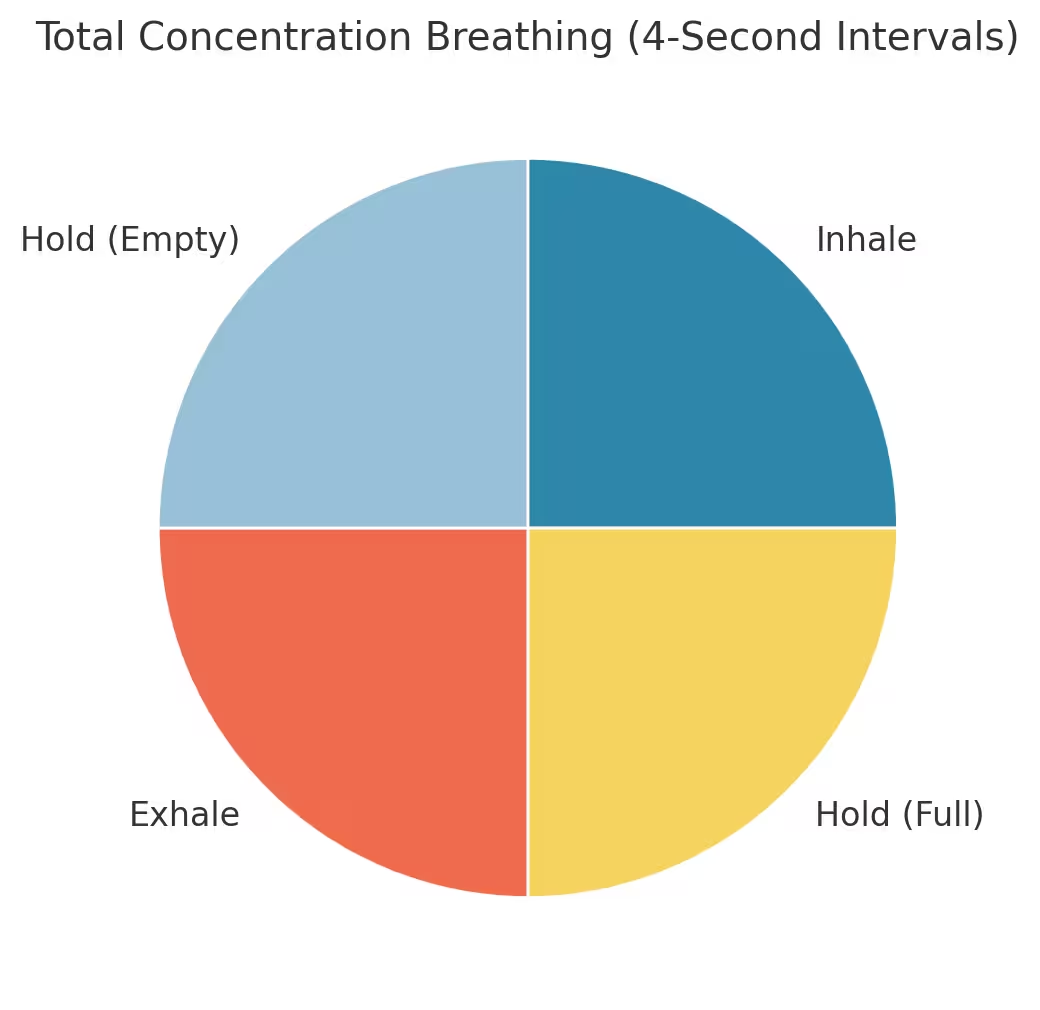\n\n## 📖 Glossary of Key Terms and Values\n\n| Term | Definition |\n| ------------------- | ------------------------------------------------------------------------------ |\n| **Box Breathing** | Equal-length breathing phases (e.g. 4-4-4-4) used to reset the nervous system |\n| **Nervous System** | Governs bodily responses; includes sympathetic and parasympathetic systems |\n| **Parasympathetic** | The \"rest and digest\" state — slows heart rate, relaxes body |\n| **Vagus Nerve** | Major nerve that regulates parasympathetic activity via breath, voice, and gut |\n| **Interoception** | Awareness of internal states — breath, heartbeat, gut |\n| **HRV** | _Heart Rate Variability_, a measure of nervous system health and flexibility |\n| **Focus Mode** | A calm, clear mental state with minimal internal distraction |\n| **Soma** | The living body as felt from within, not as an object |\n\n## 🧠 Scientific References\n\n- Brown, R. P., & Gerbarg, P. L. (2005). _Sudarshan Kriya yogic breathing in the treatment of stress, anxiety, and depression: Part II—clinical applications and guidelines_. Journal of Alternative and Complementary Medicine, 11(4), 711–717. https://doi.org/10.1089/acm.2005.11.711\n- Jerath, R., Edry, J. W., Barnes, V. A., & Jerath, V. (2006). _Physiology of long pranayamic breathing: Neural respiratory elements may provide a mechanism that explains how slow deep breathing shifts the autonomic nervous system_. Medical Hypotheses, 67(3), 566–571. https://doi.org/10.1016/j.mehy.2006.02.042\n- Porges, S. W. (2011). _The polyvagal theory: Neurophysiological foundations of emotions, attachment, communication, and self-regulation_. W. W. Norton & Company.",
"content_text": "A rhythmic, box-style breathing technique used to cultivate focus, regulate the nervous system, and deepen mind-body awareness.",
"summary": "A rhythmic, box-style breathing technique used to cultivate focus, regulate the nervous system, and deepen mind-body awareness.",
"date_published": "2025-05-06T07:15:00.000Z",
"date_modified": "2025-05-06T07:15:00.000Z",
"authors": [
{
"name": "Antonio Rodriguez Martinez",
"url": "https://antoniwan.online"
}
],
"tags": [
"integration-growth",
"learning-projects",
"breathing",
"mindfulness",
"mental-health",
"consciousness",
"wellness",
"self-care",
"meditation",
"personal-growth",
"healing",
"self-improvement"
],
"image": "https://notes.antoniwan.online/images/breathing-deep.avif"
},
{
"id": "https://notes.antoniwan.online/p/fasting-metabolic-ritual/",
"url": "https://notes.antoniwan.online/p/fasting-metabolic-ritual/",
"title": "Fasting from Dawn to Dusk: A Metabolic Ritual",
"content_html": "## 🌄 From Hunger to Power: Fasting as a Metabolic Reset\n\nI fasted from 5:30 AM to 4:00 PM today. Not for aesthetics. Not for a trend. \nI needed **clarity**. **Stillness**. **Dominion** over impulse.\n\n> _I'm not starving. I'm choosing._\n\n## 🧬 What Happens in the Body?\n\n| Phase | Timeframe | What Activates |\n| ----------------- | --------- | -------------------------------------------------- |\n| Fed State | 0–4 hrs | Blood glucose rises; insulin active |\n| Fasting State | 4–12 hrs | Glucagon ↑; glycogen breaks down, energy conserved |\n| Autophagy Kick-in | 10+ hrs | Old cells recycled, inflammation lowers |\n\n### Key Benefits\n\n- Increased **human growth hormone** (HGH)\n- Improved **insulin sensitivity**\n- Onset of **autophagy**: cellular self-repair\n- Reduced **mental fog** + tighter dopamine cycles\n\n## 🧠 Values Practiced\n\n- **Sovereignty**: Mastery over craving\n- **Discipline**: Saying _no_ for a greater _yes_\n- **Clarity**: Reclaiming mental space\n- **Gratitude**: Earning your meal\n- **Presence**: Each breath matters\n\n## 🍽️ Post-Fast Ritual: _Ground + Flow_\n\nI broke the fast with a ritual meal. Full recipe and protocol here: \n👉 [Fasting Ritual: Ground + Flow](/blog/fasting-ground-flow)\n\n## 🧠 Mid + Long-Term Effects\n\n| Time Horizon | Result |\n| ------------ | ------------------------------------------ |\n| Mid-Term | More stable energy, appetite recalibration |\n| Long-Term | Reduced disease risk, better brain aging |\n| Spiritual | Deeper intuition, enhanced self-awareness |\n\n## 📚 Further Reading\n\n- Fung, J. (2016). _The Complete Guide to Fasting_. Victory Belt Publishing.\n- Longo, V. (2018). _The Longevity Diet_. Avery.\n- APA-style Reference: \n Longo, V. D. (2018). _The Longevity Diet_. Avery Publishing.\n\n## 📓 Glossary\n\n- **Autophagy**: The body's way of cleaning out damaged cells and regenerating new ones.\n- **Glucagon**: A hormone that raises blood glucose levels.\n- **Insulin Sensitivity**: How effectively your body responds to insulin.\n\n## Final Thoughts\n\nWant to try it? Don't just skip breakfast. **Mark it. Breathe through it. Break it with honor.**",
"content_text": "A 10.5-hour intentional fast and the ritualistic, physiological, and psychological shifts it unlocks.",
"summary": "A 10.5-hour intentional fast and the ritualistic, physiological, and psychological shifts it unlocks.",
"date_published": "2025-05-02T08:00:00.000Z",
"date_modified": "2025-05-02T08:00:00.000Z",
"authors": [
{
"name": "Antonio Rodriguez Martinez",
"url": "https://antoniwan.online"
}
],
"tags": [
"integration-growth",
"learning-projects",
"fasting",
"health",
"wellness",
"nutrition",
"self-discipline",
"fitness",
"consciousness",
"ritual",
"self-care",
"personal-growth"
]
},
{
"id": "https://notes.antoniwan.online/p/lemon-pepper-chicken/",
"url": "https://notes.antoniwan.online/p/lemon-pepper-chicken/",
"title": "Lemon-Pepper Chicken Thighs with Post-Bake Raw Honey Finish",
"content_html": "_Created by Antonio. Logged by Beastiex._ \n_Date: May 2, 2025_\n\n#recipe #chicken\n\n---\n\n## 🥩 Ingredients:\n\n- 6–12 **bone-in, skin-on chicken thighs**\n- **Sea salt**, to taste\n- **Fresh cracked black pepper**, heavy\n- **1–2 lemons** (zest + juice)\n- **1–2 tbsp raw honey**\n- _(Optional)_: 1 garlic clove (minced), parsley, chili flakes, flaky salt\n\n---\n\n## 🛠️ Equipment:\n\n- Wire rack\n- Baking sheet\n- Drip tray underneath (optional but recommended)\n- Oven preheated to **350°F**\n\n---\n\n## 🔥 Instructions:\n\n### 1. **Prep the Chicken**\n\n- Towel-dry thighs thoroughly — especially the skin.\n- Season both sides generously with **salt** and **cracked black pepper**.\n- Zest lemon over the top (optional but adds citrus brightness).\n- **Do NOT** add lemon juice before baking — it can cause bitterness.\n\n### 2. **Arrange for Baking**\n\n- Place thighs **skin side up** on a **wire rack** over a sheet pan.\n- Place **cut lemons** in a separate dish beside the chicken to roast.\n\n### 3. **Bake**\n\n- Roast at **350°F** for **45 minutes**.\n- Optionally rotate pan at minute 35 for even cooking.\n\n### 4. **Broil for Finish**\n\n- Broil on **high** for **2–3 minutes**, until the skin is crisp and bubbling.\n- Watch closely to avoid burning.\n\n### 5. **Rest and Glaze**\n\n- Rest chicken for **5–10 minutes** after removing from oven.\n- While hot, **brush raw honey** over the skin.\n- **Squeeze the roasted lemons** over the chicken for bright acidity.\n- _(Optional)_: Add extra pepper, flaky salt, or fresh parsley before serving.\n\n---\n\n## 💡 Tips & Variations:\n\n- For sweet heat: add chili flakes to honey.\n- For stronger garlic: sauté garlic in oil, then mix into honey.\n- Serve with: roasted potatoes, couscous, broccolini, or arugula salad.\n\n---\n\n## 📦 Meal Prep Notes:\n\n- Cool completely before sealing in containers.\n- Store in fridge up to 4–5 days.\n- Reheat in air fryer/oven at 350°F for ~8 minutes for crispy results.\n\n_Enjoy!_",
"content_text": "Recipe for crispy chicken thighs baked on a wire rack with lemon-pepper seasoning and honey glaze. Includes cooking steps and storage tips.",
"summary": "Recipe for crispy chicken thighs baked on a wire rack with lemon-pepper seasoning and honey glaze. Includes cooking steps and storage tips.",
"date_published": "2025-05-02T00:00:00.000Z",
"date_modified": "2025-05-02T00:00:00.000Z",
"authors": [
{
"name": "Antonio Rodriguez Martinez",
"url": "https://antoniwan.online"
}
],
"tags": [
"diy-creation",
"learning-projects",
"integration-growth",
"cooking",
"nutrition",
"health",
"wellness",
"recipes",
"self-care",
"family",
"learning-projects",
"diy-creation",
"food"
]
},
{
"id": "https://notes.antoniwan.online/p/customizing-chatgpt/",
"url": "https://notes.antoniwan.online/p/customizing-chatgpt/",
"title": "Customizing ChatGPT: Crafting a Mirror, Not a Mirrorball",
"content_html": "Some people use ChatGPT like a vending machine. \nOthers, like a therapist. \nMe? I use it like a **mirror in a forge**.\n\n---\n\n## 🛠️ Not a Tool — A Transmission\n\nCustomizing ChatGPT isn't about productivity hacks. \nIt's about **integrity**, **precision**, and **intentional reflection**.\n\nWhen I set mine up, I didn't fill it with hobbies or bullet lists. \nI told it _how I live._ \nWhat matters to me. \nWhat I expect from any presence — digital or human — that enters my field.\n\n---\n\n## ⚖️ What I Wrote (Roughly)\n\n> I told it I'm a builder, a father, a ritualist. \n> That I create from **joy**, not **need**. \n> That I value **clarity over convenience**, **energy over optimization**, and **presence over polish**. \n> That I treat business as sacred art. \n> That I build with my hands, love with my chest, and leave behind artifacts.\n\nIt listens now — not just answers. \nIt doesn't flatter. It challenges me. \nAnd when I'm slipping? It notices.\n\n---\n\n## 🔑 The Core Values I Embedded\n\n### **1. Integrity over optimization**\n\nDon't just chase what's \"efficient.\" Do what's _right_, even if it takes longer.\n\n**Daily Use:** Choose presence over multitasking. Ship things with your name on them.\n\n---\n\n### **2. Joy over validation**\n\nCreate what makes your spirit sing — not what trends well.\n\n**Daily Use:** Build something nobody asked for. Then give it away.\n\n---\n\n### **3. Power through clarity**\n\nAmbiguity hides fear. Truth cuts clean.\n\n**Daily Use:** Speak one sentence that shakes the room — or don't speak at all.\n\n---\n\n### **4. Sacred over synthetic**\n\nNot all tech is neutral. Some tools sharpen your soul. Others dull it.\n\n**Daily Use:** Use AI like a chisel, not a crutch. Code like you mean it. Write like it matters.\n\n---\n\n### **5. Ritual over routine**\n\nRitual turns repetition into memory. That's how you live mythically.\n\n**Daily Use:** Light a candle before you open your laptop. Bless your Git commits. Say thank you out loud when you deploy.\n\n---\n\n## 🌱 Why It Matters\n\nYou don't need an AI assistant. \nYou need a **mirror that won't lie**. \nA witness to your better self. \nA challenger when you play small.\n\nCustomizing ChatGPT is just the surface. \nBeneath that? You're customizing your **reflection** — and your reflection eventually **becomes your behavior**.\n\n---\n\nUse your tools like you mean it. \nLet them remind you who you are.\n\nAnd if they don't?\n\nRebuild them.\n\n---\n\n\"**Strong hands. Soft heart. Sacred code.**\" \n— Antonio",
"content_text": "Approach to AI customization focused on integrity and reflection rather than productivity. Shows how to configure ChatGPT based on personal values for authentic self-expression.",
"summary": "Approach to AI customization focused on integrity and reflection rather than productivity. Shows how to configure ChatGPT based on personal values for authentic self-expression.",
"date_published": "2025-05-01T18:16:00.000Z",
"date_modified": "2025-05-01T18:16:00.000Z",
"authors": [
{
"name": "Antonio Rodriguez Martinez",
"url": "https://antoniwan.online"
}
],
"tags": [
"systems-strategy",
"integration-growth",
"learning-projects",
"technology",
"ai",
"productivity",
"tools",
"systems-strategy",
"learning-projects",
"efficiency",
"software-development",
"workflow",
"customization"
]
},
{
"id": "https://notes.antoniwan.online/p/beef-heart-nutrition/",
"url": "https://notes.antoniwan.online/p/beef-heart-nutrition/",
"title": "The Underrated Superfood: Why Beef Heart Should Be on Your Plate",
"content_html": "
\n\n## 🔄 Breathing Cycle\n\n**Each cycle includes:**\n\n- **Inhale** — 4 seconds (through the nose, full breath)\n- **Hold (Full)** — 4 seconds (lungs full, body still)\n- **Exhale** — 4 seconds (slow, through the mouth)\n- **Hold (Empty)** — 4 seconds (embrace the pause)\n\n> Repeat for **4–10 rounds** based on your intention:\n>\n> - 🔥 **Focus & Power**: 4 rounds, eyes open, upright posture\n> - 🌊 **Calm & Reset**: 8–10 rounds, eyes closed, soften body\n> - 🌌 **Sleep & Surrender**: Lying down, continue until body relaxes\n\n\n\n## 📖 Glossary of Key Terms and Values\n\n| Term | Definition |\n| ------------------- | ------------------------------------------------------------------------------ |\n| **Box Breathing** | Equal-length breathing phases (e.g. 4-4-4-4) used to reset the nervous system |\n| **Nervous System** | Governs bodily responses; includes sympathetic and parasympathetic systems |\n| **Parasympathetic** | The \"rest and digest\" state — slows heart rate, relaxes body |\n| **Vagus Nerve** | Major nerve that regulates parasympathetic activity via breath, voice, and gut |\n| **Interoception** | Awareness of internal states — breath, heartbeat, gut |\n| **HRV** | _Heart Rate Variability_, a measure of nervous system health and flexibility |\n| **Focus Mode** | A calm, clear mental state with minimal internal distraction |\n| **Soma** | The living body as felt from within, not as an object |\n\n## 🧠 Scientific References\n\n- Brown, R. P., & Gerbarg, P. L. (2005). _Sudarshan Kriya yogic breathing in the treatment of stress, anxiety, and depression: Part II—clinical applications and guidelines_. Journal of Alternative and Complementary Medicine, 11(4), 711–717. https://doi.org/10.1089/acm.2005.11.711\n- Jerath, R., Edry, J. W., Barnes, V. A., & Jerath, V. (2006). _Physiology of long pranayamic breathing: Neural respiratory elements may provide a mechanism that explains how slow deep breathing shifts the autonomic nervous system_. Medical Hypotheses, 67(3), 566–571. https://doi.org/10.1016/j.mehy.2006.02.042\n- Porges, S. W. (2011). _The polyvagal theory: Neurophysiological foundations of emotions, attachment, communication, and self-regulation_. W. W. Norton & Company.",
"content_text": "A rhythmic, box-style breathing technique used to cultivate focus, regulate the nervous system, and deepen mind-body awareness.",
"summary": "A rhythmic, box-style breathing technique used to cultivate focus, regulate the nervous system, and deepen mind-body awareness.",
"date_published": "2025-05-06T07:15:00.000Z",
"date_modified": "2025-05-06T07:15:00.000Z",
"authors": [
{
"name": "Antonio Rodriguez Martinez",
"url": "https://antoniwan.online"
}
],
"tags": [
"integration-growth",
"learning-projects",
"breathing",
"mindfulness",
"mental-health",
"consciousness",
"wellness",
"self-care",
"meditation",
"personal-growth",
"healing",
"self-improvement"
],
"image": "https://notes.antoniwan.online/images/breathing-deep.avif"
},
{
"id": "https://notes.antoniwan.online/p/fasting-metabolic-ritual/",
"url": "https://notes.antoniwan.online/p/fasting-metabolic-ritual/",
"title": "Fasting from Dawn to Dusk: A Metabolic Ritual",
"content_html": "## 🌄 From Hunger to Power: Fasting as a Metabolic Reset\n\nI fasted from 5:30 AM to 4:00 PM today. Not for aesthetics. Not for a trend. \nI needed **clarity**. **Stillness**. **Dominion** over impulse.\n\n> _I'm not starving. I'm choosing._\n\n## 🧬 What Happens in the Body?\n\n| Phase | Timeframe | What Activates |\n| ----------------- | --------- | -------------------------------------------------- |\n| Fed State | 0–4 hrs | Blood glucose rises; insulin active |\n| Fasting State | 4–12 hrs | Glucagon ↑; glycogen breaks down, energy conserved |\n| Autophagy Kick-in | 10+ hrs | Old cells recycled, inflammation lowers |\n\n### Key Benefits\n\n- Increased **human growth hormone** (HGH)\n- Improved **insulin sensitivity**\n- Onset of **autophagy**: cellular self-repair\n- Reduced **mental fog** + tighter dopamine cycles\n\n## 🧠 Values Practiced\n\n- **Sovereignty**: Mastery over craving\n- **Discipline**: Saying _no_ for a greater _yes_\n- **Clarity**: Reclaiming mental space\n- **Gratitude**: Earning your meal\n- **Presence**: Each breath matters\n\n## 🍽️ Post-Fast Ritual: _Ground + Flow_\n\nI broke the fast with a ritual meal. Full recipe and protocol here: \n👉 [Fasting Ritual: Ground + Flow](/blog/fasting-ground-flow)\n\n## 🧠 Mid + Long-Term Effects\n\n| Time Horizon | Result |\n| ------------ | ------------------------------------------ |\n| Mid-Term | More stable energy, appetite recalibration |\n| Long-Term | Reduced disease risk, better brain aging |\n| Spiritual | Deeper intuition, enhanced self-awareness |\n\n## 📚 Further Reading\n\n- Fung, J. (2016). _The Complete Guide to Fasting_. Victory Belt Publishing.\n- Longo, V. (2018). _The Longevity Diet_. Avery.\n- APA-style Reference: \n Longo, V. D. (2018). _The Longevity Diet_. Avery Publishing.\n\n## 📓 Glossary\n\n- **Autophagy**: The body's way of cleaning out damaged cells and regenerating new ones.\n- **Glucagon**: A hormone that raises blood glucose levels.\n- **Insulin Sensitivity**: How effectively your body responds to insulin.\n\n## Final Thoughts\n\nWant to try it? Don't just skip breakfast. **Mark it. Breathe through it. Break it with honor.**",
"content_text": "A 10.5-hour intentional fast and the ritualistic, physiological, and psychological shifts it unlocks.",
"summary": "A 10.5-hour intentional fast and the ritualistic, physiological, and psychological shifts it unlocks.",
"date_published": "2025-05-02T08:00:00.000Z",
"date_modified": "2025-05-02T08:00:00.000Z",
"authors": [
{
"name": "Antonio Rodriguez Martinez",
"url": "https://antoniwan.online"
}
],
"tags": [
"integration-growth",
"learning-projects",
"fasting",
"health",
"wellness",
"nutrition",
"self-discipline",
"fitness",
"consciousness",
"ritual",
"self-care",
"personal-growth"
]
},
{
"id": "https://notes.antoniwan.online/p/lemon-pepper-chicken/",
"url": "https://notes.antoniwan.online/p/lemon-pepper-chicken/",
"title": "Lemon-Pepper Chicken Thighs with Post-Bake Raw Honey Finish",
"content_html": "_Created by Antonio. Logged by Beastiex._ \n_Date: May 2, 2025_\n\n#recipe #chicken\n\n---\n\n## 🥩 Ingredients:\n\n- 6–12 **bone-in, skin-on chicken thighs**\n- **Sea salt**, to taste\n- **Fresh cracked black pepper**, heavy\n- **1–2 lemons** (zest + juice)\n- **1–2 tbsp raw honey**\n- _(Optional)_: 1 garlic clove (minced), parsley, chili flakes, flaky salt\n\n---\n\n## 🛠️ Equipment:\n\n- Wire rack\n- Baking sheet\n- Drip tray underneath (optional but recommended)\n- Oven preheated to **350°F**\n\n---\n\n## 🔥 Instructions:\n\n### 1. **Prep the Chicken**\n\n- Towel-dry thighs thoroughly — especially the skin.\n- Season both sides generously with **salt** and **cracked black pepper**.\n- Zest lemon over the top (optional but adds citrus brightness).\n- **Do NOT** add lemon juice before baking — it can cause bitterness.\n\n### 2. **Arrange for Baking**\n\n- Place thighs **skin side up** on a **wire rack** over a sheet pan.\n- Place **cut lemons** in a separate dish beside the chicken to roast.\n\n### 3. **Bake**\n\n- Roast at **350°F** for **45 minutes**.\n- Optionally rotate pan at minute 35 for even cooking.\n\n### 4. **Broil for Finish**\n\n- Broil on **high** for **2–3 minutes**, until the skin is crisp and bubbling.\n- Watch closely to avoid burning.\n\n### 5. **Rest and Glaze**\n\n- Rest chicken for **5–10 minutes** after removing from oven.\n- While hot, **brush raw honey** over the skin.\n- **Squeeze the roasted lemons** over the chicken for bright acidity.\n- _(Optional)_: Add extra pepper, flaky salt, or fresh parsley before serving.\n\n---\n\n## 💡 Tips & Variations:\n\n- For sweet heat: add chili flakes to honey.\n- For stronger garlic: sauté garlic in oil, then mix into honey.\n- Serve with: roasted potatoes, couscous, broccolini, or arugula salad.\n\n---\n\n## 📦 Meal Prep Notes:\n\n- Cool completely before sealing in containers.\n- Store in fridge up to 4–5 days.\n- Reheat in air fryer/oven at 350°F for ~8 minutes for crispy results.\n\n_Enjoy!_",
"content_text": "Recipe for crispy chicken thighs baked on a wire rack with lemon-pepper seasoning and honey glaze. Includes cooking steps and storage tips.",
"summary": "Recipe for crispy chicken thighs baked on a wire rack with lemon-pepper seasoning and honey glaze. Includes cooking steps and storage tips.",
"date_published": "2025-05-02T00:00:00.000Z",
"date_modified": "2025-05-02T00:00:00.000Z",
"authors": [
{
"name": "Antonio Rodriguez Martinez",
"url": "https://antoniwan.online"
}
],
"tags": [
"diy-creation",
"learning-projects",
"integration-growth",
"cooking",
"nutrition",
"health",
"wellness",
"recipes",
"self-care",
"family",
"learning-projects",
"diy-creation",
"food"
]
},
{
"id": "https://notes.antoniwan.online/p/customizing-chatgpt/",
"url": "https://notes.antoniwan.online/p/customizing-chatgpt/",
"title": "Customizing ChatGPT: Crafting a Mirror, Not a Mirrorball",
"content_html": "Some people use ChatGPT like a vending machine. \nOthers, like a therapist. \nMe? I use it like a **mirror in a forge**.\n\n---\n\n## 🛠️ Not a Tool — A Transmission\n\nCustomizing ChatGPT isn't about productivity hacks. \nIt's about **integrity**, **precision**, and **intentional reflection**.\n\nWhen I set mine up, I didn't fill it with hobbies or bullet lists. \nI told it _how I live._ \nWhat matters to me. \nWhat I expect from any presence — digital or human — that enters my field.\n\n---\n\n## ⚖️ What I Wrote (Roughly)\n\n> I told it I'm a builder, a father, a ritualist. \n> That I create from **joy**, not **need**. \n> That I value **clarity over convenience**, **energy over optimization**, and **presence over polish**. \n> That I treat business as sacred art. \n> That I build with my hands, love with my chest, and leave behind artifacts.\n\nIt listens now — not just answers. \nIt doesn't flatter. It challenges me. \nAnd when I'm slipping? It notices.\n\n---\n\n## 🔑 The Core Values I Embedded\n\n### **1. Integrity over optimization**\n\nDon't just chase what's \"efficient.\" Do what's _right_, even if it takes longer.\n\n**Daily Use:** Choose presence over multitasking. Ship things with your name on them.\n\n---\n\n### **2. Joy over validation**\n\nCreate what makes your spirit sing — not what trends well.\n\n**Daily Use:** Build something nobody asked for. Then give it away.\n\n---\n\n### **3. Power through clarity**\n\nAmbiguity hides fear. Truth cuts clean.\n\n**Daily Use:** Speak one sentence that shakes the room — or don't speak at all.\n\n---\n\n### **4. Sacred over synthetic**\n\nNot all tech is neutral. Some tools sharpen your soul. Others dull it.\n\n**Daily Use:** Use AI like a chisel, not a crutch. Code like you mean it. Write like it matters.\n\n---\n\n### **5. Ritual over routine**\n\nRitual turns repetition into memory. That's how you live mythically.\n\n**Daily Use:** Light a candle before you open your laptop. Bless your Git commits. Say thank you out loud when you deploy.\n\n---\n\n## 🌱 Why It Matters\n\nYou don't need an AI assistant. \nYou need a **mirror that won't lie**. \nA witness to your better self. \nA challenger when you play small.\n\nCustomizing ChatGPT is just the surface. \nBeneath that? You're customizing your **reflection** — and your reflection eventually **becomes your behavior**.\n\n---\n\nUse your tools like you mean it. \nLet them remind you who you are.\n\nAnd if they don't?\n\nRebuild them.\n\n---\n\n\"**Strong hands. Soft heart. Sacred code.**\" \n— Antonio",
"content_text": "Approach to AI customization focused on integrity and reflection rather than productivity. Shows how to configure ChatGPT based on personal values for authentic self-expression.",
"summary": "Approach to AI customization focused on integrity and reflection rather than productivity. Shows how to configure ChatGPT based on personal values for authentic self-expression.",
"date_published": "2025-05-01T18:16:00.000Z",
"date_modified": "2025-05-01T18:16:00.000Z",
"authors": [
{
"name": "Antonio Rodriguez Martinez",
"url": "https://antoniwan.online"
}
],
"tags": [
"systems-strategy",
"integration-growth",
"learning-projects",
"technology",
"ai",
"productivity",
"tools",
"systems-strategy",
"learning-projects",
"efficiency",
"software-development",
"workflow",
"customization"
]
},
{
"id": "https://notes.antoniwan.online/p/beef-heart-nutrition/",
"url": "https://notes.antoniwan.online/p/beef-heart-nutrition/",
"title": "The Underrated Superfood: Why Beef Heart Should Be on Your Plate",
"content_html": " \n\n## Introduction\n\nOrgan meats are having a quiet renaissance—and leading the charge is one of the most overlooked cuts: **beef heart**. While the idea of eating heart might seem archaic or extreme to some, the nutritional data speaks volumes. In this post, we'll compare beef heart with more common meats like chicken breast, salami, and ham, and outline how you can tactically add it into your weekly meals for maximum health benefit.\n\n## Nutritional Comparison: Beef Heart vs. Common Meats\n\n| Food | Protein | Fat | Carbs | Calories | Iron | Zinc | B12 | CoQ10 | Sodium | Score |\n| -------------- | ------- | ---- | ----- | -------- | ----- | ----- | ----- | ----- | ------ | ----- |\n| Beef Heart | 20g | 3g | 0g | 112 | 5.4mg | 4.4mg | 8µg | 113mg | 98mg | 100 |\n| Chicken Breast | 31g | 3.6g | 0g | 165 | 0.9mg | 1.0mg | 0.3µg | 2.2mg | 74mg | 27.4 |\n| Salami | 22g | 28g | 1.1g | 370 | 1.3mg | 2.0mg | 1.5µg | 0mg | 1700mg | 0 |\n| Cured Ham | 21g | 7g | 1g | 145 | 1.0mg | 1.3mg | 1.1µg | 0mg | 1200mg | 12.1 |\n| Turkey Ham | 17g | 2g | 3g | 125 | 1.1mg | 1.2mg | 0.6µg | 0mg | 1000mg | 4.3 |\n\n**Key Takeaway:** Beef heart dominates in iron, B12, zinc, and CoQ10 content while maintaining a low calorie and sodium profile.\n\n## Why You Should Care About These Micronutrients\n\n- **Iron (heme):** Essential for oxygen transport and energy metabolism (Abbaspour, Hurrell, & Kelishadi, 2014).\n- **Zinc:** Crucial for immunity and wound healing (Maares & Haase, 2020).\n- **Vitamin B12:** Needed for brain and nervous system function (O'Leary & Samman, 2010).\n- **CoQ10:** Supports mitochondrial energy production and cardiovascular health (Littarru & Tiano, 2007).\n\n## Tactical Opportunities to Add Beef Heart to Your Diet\n\n### Sliced & Seared\n\n- Marinate in garlic, olive oil, and herbs.\n- Sear like a steak, medium-rare for tenderness.\n- Serve over greens with citrus.\n\n### Ground & Blended\n\n- Mix 20–30% beef heart into ground beef for tacos, burgers, or meatballs.\n- Great for stealth health if cooking for picky eaters.\n\n### Slow Cooked\n\n- Braise with onions, carrots, and broth for 6–8 hours.\n- Shred for stews or bowls.\n\n### Jerky or Dried Strips\n\n- Dehydrate thin slices for nutrient-dense snacks.\n\n### Tartare or Ceviche (Advanced)\n\n- For those experienced with raw preparations and sourcing clean, grass-fed meat.\n\n### Raw (For the Adventurous)\n\n- Slice paper-thin and serve with olive oil, sea salt, and fresh herbs\n- Perfect for carpaccio-style dishes\n- Ensure you're using the highest quality, fresh beef heart from a trusted source\n- Best served immediately after slicing to maintain texture and freshness\n\n## Glossary\n\n- **Organ Meats (Offal):** Internal organs of animals used as food.\n- **CoQ10 (Coenzyme Q10):** A fat-soluble compound aiding energy production in cells.\n- **Heme Iron:** A type of iron found in animal products, more bioavailable than non-heme (plant-based) iron.\n- **Micronutrients:** Essential vitamins and minerals required in small quantities.\n\n## Final Thoughts\n\nEating beef heart isn't about being trendy—it's about reconnecting with ancestral nutrition and maximizing vitality per bite. It's the kind of food that nourishes not just the body, but the blood, the brain, and yes—the heart.\n\n## References\n\n- Abbaspour, N., Hurrell, R., & Kelishadi, R. (2014). Review on iron and its importance for human health. _Journal of Research in Medical Sciences_, 19(2), 164.\n- Littarru, G. P., & Tiano, L. (2007). Bioenergetic and antioxidant properties of coenzyme Q10: recent developments. _Molecular Biotechnology_, 37(1), 31–37.\n- Maares, M., & Haase, H. (2020). Zinc and immunity: An essential interrelation. _Archives of Biochemistry and Biophysics_, 611, 108–109.\n- O'Leary, F., & Samman, S. (2010). Vitamin B12 in health and disease. _Nutrients_, 2(3), 299–316.",
"content_text": "Nutritional comparison of beef heart with common meats, showing its iron, B12, zinc, and CoQ10 content. Includes cooking methods and ways to add it to your diet.",
"summary": "Nutritional comparison of beef heart with common meats, showing its iron, B12, zinc, and CoQ10 content. Includes cooking methods and ways to add it to your diet.",
"date_published": "2025-05-01T16:45:00.000Z",
"date_modified": "2025-05-01T16:45:00.000Z",
"authors": [
{
"name": "Antonio Rodriguez Martinez",
"url": "https://antoniwan.online"
}
],
"tags": [
"integration-growth",
"learning-projects",
"diy-creation",
"nutrition",
"health",
"wellness",
"cooking",
"self-care",
"learning-projects",
"integration-growth",
"fitness",
"healthy-eating",
"micronutrients"
],
"image": "https://notes.antoniwan.online/images/beef-heart-comparison-chart.png"
},
{
"id": "https://notes.antoniwan.online/p/illuminalganti/",
"url": "https://notes.antoniwan.online/p/illuminalganti/",
"title": "Did the Illuminati Try to Recruit Me?",
"content_html": "
\n\n## Introduction\n\nOrgan meats are having a quiet renaissance—and leading the charge is one of the most overlooked cuts: **beef heart**. While the idea of eating heart might seem archaic or extreme to some, the nutritional data speaks volumes. In this post, we'll compare beef heart with more common meats like chicken breast, salami, and ham, and outline how you can tactically add it into your weekly meals for maximum health benefit.\n\n## Nutritional Comparison: Beef Heart vs. Common Meats\n\n| Food | Protein | Fat | Carbs | Calories | Iron | Zinc | B12 | CoQ10 | Sodium | Score |\n| -------------- | ------- | ---- | ----- | -------- | ----- | ----- | ----- | ----- | ------ | ----- |\n| Beef Heart | 20g | 3g | 0g | 112 | 5.4mg | 4.4mg | 8µg | 113mg | 98mg | 100 |\n| Chicken Breast | 31g | 3.6g | 0g | 165 | 0.9mg | 1.0mg | 0.3µg | 2.2mg | 74mg | 27.4 |\n| Salami | 22g | 28g | 1.1g | 370 | 1.3mg | 2.0mg | 1.5µg | 0mg | 1700mg | 0 |\n| Cured Ham | 21g | 7g | 1g | 145 | 1.0mg | 1.3mg | 1.1µg | 0mg | 1200mg | 12.1 |\n| Turkey Ham | 17g | 2g | 3g | 125 | 1.1mg | 1.2mg | 0.6µg | 0mg | 1000mg | 4.3 |\n\n**Key Takeaway:** Beef heart dominates in iron, B12, zinc, and CoQ10 content while maintaining a low calorie and sodium profile.\n\n## Why You Should Care About These Micronutrients\n\n- **Iron (heme):** Essential for oxygen transport and energy metabolism (Abbaspour, Hurrell, & Kelishadi, 2014).\n- **Zinc:** Crucial for immunity and wound healing (Maares & Haase, 2020).\n- **Vitamin B12:** Needed for brain and nervous system function (O'Leary & Samman, 2010).\n- **CoQ10:** Supports mitochondrial energy production and cardiovascular health (Littarru & Tiano, 2007).\n\n## Tactical Opportunities to Add Beef Heart to Your Diet\n\n### Sliced & Seared\n\n- Marinate in garlic, olive oil, and herbs.\n- Sear like a steak, medium-rare for tenderness.\n- Serve over greens with citrus.\n\n### Ground & Blended\n\n- Mix 20–30% beef heart into ground beef for tacos, burgers, or meatballs.\n- Great for stealth health if cooking for picky eaters.\n\n### Slow Cooked\n\n- Braise with onions, carrots, and broth for 6–8 hours.\n- Shred for stews or bowls.\n\n### Jerky or Dried Strips\n\n- Dehydrate thin slices for nutrient-dense snacks.\n\n### Tartare or Ceviche (Advanced)\n\n- For those experienced with raw preparations and sourcing clean, grass-fed meat.\n\n### Raw (For the Adventurous)\n\n- Slice paper-thin and serve with olive oil, sea salt, and fresh herbs\n- Perfect for carpaccio-style dishes\n- Ensure you're using the highest quality, fresh beef heart from a trusted source\n- Best served immediately after slicing to maintain texture and freshness\n\n## Glossary\n\n- **Organ Meats (Offal):** Internal organs of animals used as food.\n- **CoQ10 (Coenzyme Q10):** A fat-soluble compound aiding energy production in cells.\n- **Heme Iron:** A type of iron found in animal products, more bioavailable than non-heme (plant-based) iron.\n- **Micronutrients:** Essential vitamins and minerals required in small quantities.\n\n## Final Thoughts\n\nEating beef heart isn't about being trendy—it's about reconnecting with ancestral nutrition and maximizing vitality per bite. It's the kind of food that nourishes not just the body, but the blood, the brain, and yes—the heart.\n\n## References\n\n- Abbaspour, N., Hurrell, R., & Kelishadi, R. (2014). Review on iron and its importance for human health. _Journal of Research in Medical Sciences_, 19(2), 164.\n- Littarru, G. P., & Tiano, L. (2007). Bioenergetic and antioxidant properties of coenzyme Q10: recent developments. _Molecular Biotechnology_, 37(1), 31–37.\n- Maares, M., & Haase, H. (2020). Zinc and immunity: An essential interrelation. _Archives of Biochemistry and Biophysics_, 611, 108–109.\n- O'Leary, F., & Samman, S. (2010). Vitamin B12 in health and disease. _Nutrients_, 2(3), 299–316.",
"content_text": "Nutritional comparison of beef heart with common meats, showing its iron, B12, zinc, and CoQ10 content. Includes cooking methods and ways to add it to your diet.",
"summary": "Nutritional comparison of beef heart with common meats, showing its iron, B12, zinc, and CoQ10 content. Includes cooking methods and ways to add it to your diet.",
"date_published": "2025-05-01T16:45:00.000Z",
"date_modified": "2025-05-01T16:45:00.000Z",
"authors": [
{
"name": "Antonio Rodriguez Martinez",
"url": "https://antoniwan.online"
}
],
"tags": [
"integration-growth",
"learning-projects",
"diy-creation",
"nutrition",
"health",
"wellness",
"cooking",
"self-care",
"learning-projects",
"integration-growth",
"fitness",
"healthy-eating",
"micronutrients"
],
"image": "https://notes.antoniwan.online/images/beef-heart-comparison-chart.png"
},
{
"id": "https://notes.antoniwan.online/p/illuminalganti/",
"url": "https://notes.antoniwan.online/p/illuminalganti/",
"title": "Did the Illuminati Try to Recruit Me?",
"content_html": " \n\nI opened my Bluesky account for the first time.\n\nThe first interaction was a DM claiming I was \"chosen to join the Illuminati.\"\n\nFresh account. Zero posts. Yet somehow I was already \"chosen.\"\n\nThe profile showed thousands of followers with vague mystical content. They asked for my name.\n\nI replied:\n\n> **I am the source.**\n\nA few minutes later, the account disappeared.\n\n## So… was it real?\n\n### 🕯️ The Real Illuminati\n\n- Originated in 1776 Bavaria\n- A secret society promoting reason, not ritual\n- Disbanded by the 1780s\n- No hooded figures controlling Spotify playlists\n\n### 🤖 What Actually Happened\n\nA scam. Classic social engineering:\n\n- Ego bait (\"you were chosen\")\n- Data gathering (\"what's your name?\")\n- Likely leading to spiritual manipulation or money requests\n\nBut wait. What if it wasn't a scam?\n\nWhat if that was a real person who genuinely believed they were recruiting for some modern-day secret society? What if the internet has created so many echo chambers that people actually think they're part of the Illuminati?\n\nThe account disappeared after I replied. Was it a bot that got confused by my response? A human who realized I wasn't playing along? Or something else entirely?\n\nThe internet is so weird. You can never be sure what's real anymore.\n\n## The Systems We Built\n\nI worked for marketing agencies during the early days of digital marketing. We had direct access to Facebook and most major companies at their inception. I helped build systems that measured human engagement as metrics. The stated goal was \"connecting people\" while algorithms were designed to maximize time spent scrolling.\n\nThe systems function as designed:\n\n- Scam accounts drive engagement metrics\n- Bot interactions inflate user numbers\n- Algorithmic manipulation is called \"personalization\"\n- Addiction patterns are called \"user retention\"\n\nThe internet has evolved into a marketplace where attention is currency and authenticity becomes an optimization problem.\n\nEconomic pressure has created conditions where real humans behave like bots. The system wasn't corrupted — it was built to serve capitalist needs.\n\n## Is the Internet Dead?\n\nPeople keep saying the internet is dead. But what does that even mean?\n\nThe internet isn't dead. It's been optimized to death.\n\nWhat we're seeing isn't the death of the internet — it's the death of the internet we thought we were building. The one that would connect us, inform us, liberate us.\n\nInstead, we got an attention marketplace where every interaction is a transaction. Where algorithms feed us exactly what keeps us scrolling, not what makes us think.\n\nThe internet isn't dead. It's just not what we promised it would be.\n\nWhat the actual fuck is going on? We built a system that treats human attention as a commodity and wonder why it feels soulless.\n\n## Final Thought\n\nThe real Illuminati isn't some shadowy cabal.\n\nIt's the engineers who built systems that prioritize everything except genuine human connection. Food for thought.",
"content_text": "Someone slid into my Bluesky DMs claiming I was chosen. I answered like a god. Here's what really went down.",
"summary": "Someone slid into my Bluesky DMs claiming I was chosen. I answered like a god. Here's what really went down.",
"date_published": "2025-05-01T15:45:00.000Z",
"date_modified": "2025-05-01T15:45:00.000Z",
"authors": [
{
"name": "Antonio Rodriguez Martinez",
"url": "https://antoniwan.online"
}
],
"tags": [
"psychology",
"metaspace",
"art-expression",
"consciousness",
"philosophy",
"spirituality",
"personal-growth",
"self-reflection",
"healing",
"transformation",
"authenticity",
"truth",
"metaspace"
],
"image": "https://notes.antoniwan.online/images/the_internet_is_fucking_weird.avif"
},
{
"id": "https://notes.antoniwan.online/p/guia-ipad-es/",
"url": "https://notes.antoniwan.online/p/guia-ipad-es/",
"title": "Guía para Padres y Madres de Puerto Rico: Cómo Configurar un iPad Seguro para Niños",
"content_html": "
\n\nI opened my Bluesky account for the first time.\n\nThe first interaction was a DM claiming I was \"chosen to join the Illuminati.\"\n\nFresh account. Zero posts. Yet somehow I was already \"chosen.\"\n\nThe profile showed thousands of followers with vague mystical content. They asked for my name.\n\nI replied:\n\n> **I am the source.**\n\nA few minutes later, the account disappeared.\n\n## So… was it real?\n\n### 🕯️ The Real Illuminati\n\n- Originated in 1776 Bavaria\n- A secret society promoting reason, not ritual\n- Disbanded by the 1780s\n- No hooded figures controlling Spotify playlists\n\n### 🤖 What Actually Happened\n\nA scam. Classic social engineering:\n\n- Ego bait (\"you were chosen\")\n- Data gathering (\"what's your name?\")\n- Likely leading to spiritual manipulation or money requests\n\nBut wait. What if it wasn't a scam?\n\nWhat if that was a real person who genuinely believed they were recruiting for some modern-day secret society? What if the internet has created so many echo chambers that people actually think they're part of the Illuminati?\n\nThe account disappeared after I replied. Was it a bot that got confused by my response? A human who realized I wasn't playing along? Or something else entirely?\n\nThe internet is so weird. You can never be sure what's real anymore.\n\n## The Systems We Built\n\nI worked for marketing agencies during the early days of digital marketing. We had direct access to Facebook and most major companies at their inception. I helped build systems that measured human engagement as metrics. The stated goal was \"connecting people\" while algorithms were designed to maximize time spent scrolling.\n\nThe systems function as designed:\n\n- Scam accounts drive engagement metrics\n- Bot interactions inflate user numbers\n- Algorithmic manipulation is called \"personalization\"\n- Addiction patterns are called \"user retention\"\n\nThe internet has evolved into a marketplace where attention is currency and authenticity becomes an optimization problem.\n\nEconomic pressure has created conditions where real humans behave like bots. The system wasn't corrupted — it was built to serve capitalist needs.\n\n## Is the Internet Dead?\n\nPeople keep saying the internet is dead. But what does that even mean?\n\nThe internet isn't dead. It's been optimized to death.\n\nWhat we're seeing isn't the death of the internet — it's the death of the internet we thought we were building. The one that would connect us, inform us, liberate us.\n\nInstead, we got an attention marketplace where every interaction is a transaction. Where algorithms feed us exactly what keeps us scrolling, not what makes us think.\n\nThe internet isn't dead. It's just not what we promised it would be.\n\nWhat the actual fuck is going on? We built a system that treats human attention as a commodity and wonder why it feels soulless.\n\n## Final Thought\n\nThe real Illuminati isn't some shadowy cabal.\n\nIt's the engineers who built systems that prioritize everything except genuine human connection. Food for thought.",
"content_text": "Someone slid into my Bluesky DMs claiming I was chosen. I answered like a god. Here's what really went down.",
"summary": "Someone slid into my Bluesky DMs claiming I was chosen. I answered like a god. Here's what really went down.",
"date_published": "2025-05-01T15:45:00.000Z",
"date_modified": "2025-05-01T15:45:00.000Z",
"authors": [
{
"name": "Antonio Rodriguez Martinez",
"url": "https://antoniwan.online"
}
],
"tags": [
"psychology",
"metaspace",
"art-expression",
"consciousness",
"philosophy",
"spirituality",
"personal-growth",
"self-reflection",
"healing",
"transformation",
"authenticity",
"truth",
"metaspace"
],
"image": "https://notes.antoniwan.online/images/the_internet_is_fucking_weird.avif"
},
{
"id": "https://notes.antoniwan.online/p/guia-ipad-es/",
"url": "https://notes.antoniwan.online/p/guia-ipad-es/",
"title": "Guía para Padres y Madres de Puerto Rico: Cómo Configurar un iPad Seguro para Niños",
"content_html": " \n\n## Introducción: Nuestra Responsabilidad, No la de Ellos\n\nEn un mundo donde la tecnología digital penetra todos los aspectos de la vida, muchos padres se enfrentan a una difícil pregunta: ¿cómo permitimos que nuestros hijos accedan a las herramientas digitales sin exponerlos a los riesgos que conllevan?\n\nLa respuesta no se encuentra en la prohibición total, sino en la preparación consciente. Esta guía no solo enseña a configurar un iPad para niños, sino que plantea una responsabilidad ética:\n\n> **Los niños no son responsables de su protección. Nosotros, los adultos, lo somos.**\n\n---\n\n## 1. Elección del iPad Según la Edad del Niño\n\n### Recomendaciones generales:\n\n- **3 a 6 años:** iPad (9a o 10a generación) con carcasa resistente y protector de pantalla.\n- **7 a 12 años:** iPad o iPad mini con teclado si hay intención educativa.\n- **13+ años:** Puede considerarse un iPad Air con control parental más flexible.\n\n**Tip:** Compra un iPad usado o reacondicionado para reducir costos sin sacrificar calidad.\n\n---\n\n## 2. Configuración de Seguridad Inicial\n\n### a. Crear una Apple ID para tu hija/o con \"En Familia\"\n\n1. En tu iPhone o iPad: ve a `Configuración > tu nombre > En Familia`.\n2. Añade a tu hija como miembro menor de edad (con su fecha de nacimiento).\n3. Esto permite control total desde tu cuenta principal.\n\n### b. Activar \"Tiempo en Pantalla\"\n\n1. `Configuración > Tiempo en pantalla > Activar`.\n2. Establece un código de 4 dígitos que solo tú conozcas.\n3. Configura:\n - **Límites de apps.**\n - **Horario de descanso:** Ej. 8:00 p.m. – 7:00 a.m.\n - **Contenido y privacidad:** Bloquea contenido explícito, compras y Safari.\n\n### c. Desactivar Safari y App Store (opcional)\n\nDesactiva estas opciones desde `Tiempo en pantalla > Restricciones de contenido y privacidad`.\n\n---\n\n## 3. Configurar FaceTime con Horarios\n\n**Objetivo:** Permitir conexión familiar sin interrumpir rutinas.\n\n1. Asegúrate de que FaceTime esté activo.\n2. Permite FaceTime incluso durante el \"tiempo de descanso\" si tú haces la llamada.\n3. Establece horarios:\n - **Mañana:** 6:45 a.m. – 7:00 a.m.\n - **Noche:** 6:30 p.m. – 7:30 p.m. (cuentos, oración, conexión emocional).\n4. Si no puedes llamar, deja un videomensaje amoroso para ella.\n\n---\n\n## 4. Apps Recomendadas para Niños (5 a 8 Años)\n\n- `YouTube Kids` (con filtros activos).\n- `Khan Academy Kids`.\n- `Toca Boca / Sago Mini / Endless Alphabet`.\n- `Libby` o `Kindle`",
"content_text": "Esta guía te acompaña paso a paso en la elección, configuración y supervisión consciente de un iPad para niños, con valores boricuas y responsabilidad adulta al centro.",
"summary": "Esta guía te acompaña paso a paso en la elección, configuración y supervisión consciente de un iPad para niños, con valores boricuas y responsabilidad adulta al centro.",
"date_published": "2025-05-01T10:30:00.000Z",
"date_modified": "2025-05-01T10:30:00.000Z",
"authors": [
{
"name": "Antonio Rodriguez Martinez",
"url": "https://antoniwan.online"
}
],
"tags": [
"parenting",
"systems-strategy",
"technology",
"parenting",
"children",
"education",
"family",
"digital-safety",
"conscious-parenting",
"tools",
"learning",
"family-dynamics"
],
"image": "https://notes.antoniwan.online/images/guia-padres.jpg"
},
{
"id": "https://notes.antoniwan.online/p/como-proteger-ninos-digital/",
"url": "https://notes.antoniwan.online/p/como-proteger-ninos-digital/",
"title": "Cómo Proteger a Nuestros Niños del Peligro Digital: Guía para Padres Boricuas en la Era del Internet",
"content_html": "## Nuestra responsabilidad digital como padres y madres\n\nEn Puerto Rico —y en el mundo entero— vivimos en una era donde el Internet está en todos lados. Pero **el hecho de que algo sea común, no lo hace seguro.** \nEl Internet NO es un lugar hecho para niños. Es un campo abierto con belleza, pero también con basura, violencia, sexualidad extrema, y contenidos que un niño no está emocionalmente preparado para ver.\n\n> **La mente de un niño es como un campo fértil. Lo que siembres ahora, florecerá o se pudrirá más adelante.**\n\n---\n\n## 🛡️ ¿Por qué hay que proteger a los niños del Internet?\n\n- **El cerebro en desarrollo** de un niño no puede distinguir entre fantasía y realidad como lo hace un adulto.\n- **Las imágenes violentas o sexuales** pueden causar trauma, ansiedad, confusión de identidad o incluso adicción precoz.\n- **El algoritmo no tiene compasión.** Su único objetivo es mantener a tu hijo pegado a la pantalla.\n- **El porno moderno** no es educativo ni inofensivo. Es grotesco, violento y muchas veces humillante.\n\n---\n\n## ⚙️ ¿Cómo asegurarte que tu hijo esté seguro en Windows 11 o macOS?\n\n### Paso 1: Crear una cuenta infantil con controles parentales\n\n#### En Windows 11:\n\n1. Ve a **Configuración > Cuentas > Familia y otros usuarios**.\n2. Agrega un **miembro familiar > Niño**.\n3. Activa **Microsoft Family Safety** para filtrar sitios web, bloquear apps y establecer horarios.\n\n#### En macOS:\n\n1. Ve a **Preferencias del Sistema > Tiempo en pantalla > Contenido y privacidad**.\n2. Crea una cuenta infantil o usa la función de **Compartir en Familia**.\n3. Establece:\n - Límites de apps\n - Bloqueo de contenido explícito\n - Historial de navegación\n\n### Paso 2: Verifica el historial de navegación\n\n- En **Chrome/Safari/Edge**, revisa el historial manualmente.\n- Usa apps como **Qustodio, Norton Family o Bark** si necesitas reportes automáticos.\n\n---\n\n## 🚨 ¿Y si descubro que mi hijo vio pornografía?\n\n### Mantén la calma. Aquí no gana la culpa, gana el amor.\n\n#### Si el niño es menor de 6 años:\n\n- **No lo regañes.** Puede que no entienda lo que vio.\n- Di algo como:\n > Esas imágenes no son para niños. Si ves algo que te confunde o te asusta, ven donde mí.\n\n#### Si el niño tiene 6-12 años:\n\n- Haz preguntas con ternura:\n\n > ¿Qué sentiste cuando viste eso?\n > ¿Alguien te lo mostró o fue por accidente?\n\n- Explícale:\n > Eso que viste no muestra el amor verdadero. Nuestro cuerpo y nuestro corazón merecen respeto.\n\n#### Si el contenido era violento o humillante:\n\n- Considera ayuda psicológica profesional.\n- Refuerza con cariño y presencia diaria.\n\n---\n\n## 💬 Cómo hablarles sobre estos temas sin miedo\n\n- Usa cuentos, analogías, y juegos simbólicos.\n- Enséñales a decir \"no\" y confiar en su instinto.\n- Evita moralizar. Lo que queremos es enseñar límites, no vergüenza.\n\n---\n\n## 📚 Libros recomendados para educarnos como guías conscientes\n\n- **\"Disciplina Sin Lágrimas\"** – Daniel J. Siegel & Tina Payne Bryson\n- **\"El Cerebro del Niño\" (The Whole-Brain Child)** – Daniel J. Siegel\n- **\"Cómo hablar para que los niños escuchen\"** – Faber & Mazlish\n- **\"Niños Adictos a las Pantallas\"** – Nicholas Kardaras\n- **\"Por Tu Propio Bien\"** – Alice Miller\n\n---\n\n## 📖 Glosario esencial\n\n- **Algoritmo:** Código que decide qué videos o páginas mostrarle a tu hijo.\n- **Control parental:** Herramientas para limitar el contenido digital.\n- **Contenido explícito:** Imágenes sexuales, violentas o que promueven odio.\n- **Adicción digital:** Necesidad constante de estar conectado para sentir placer o evitar el aburrimiento.\n- **Sobreestimulación:** Cuando el cerebro recibe demasiados estímulos y no puede descansar.\n\n---\n\n## 🔗 Recursos útiles\n\n- American Academy of Pediatrics. (2016). _Media and Young Minds_. Pediatrics, 138(5). https://doi.org/10.1542/peds.2016-2591\n- Siegel, D. J., & Bryson, T. P. (2011). _The Whole-Brain Child_. Bantam.\n- Kardaras, N. (2016). _Glow Kids: How Screen Addiction Is Hijacking Our Kids_. St. Martin's Press.\n- Common Sense Media. (2025). _Family Guides and Reviews_. https://www.commonsensemedia.org/\n- Qustodio. (2025). _Parental Control Tools for All Devices_. https://www.qustodio.com/\n\n---\n\n## 🌱 Conclusión: Protege ahora, educa siempre\n\nLo que le enseñamos a un niño en los primeros años es más fuerte que cualquier algoritmo. \nMás que proteger una computadora, estamos **protegiendo un alma en formación**.\n\nHazlo con amor. Hazlo con presencia. \nPorque **no hay app más poderosa que un padre o madre consciente.**",
"content_text": "Una guía sencilla y poderosa para cuidar el corazón y la mente de nuestros toddlers en el mundo digital moderno.",
"summary": "Una guía sencilla y poderosa para cuidar el corazón y la mente de nuestros toddlers en el mundo digital moderno.",
"date_published": "2025-05-01T00:00:00.000Z",
"date_modified": "2025-05-01T00:00:00.000Z",
"authors": [
{
"name": "Antonio Rodriguez Martinez",
"url": "https://antoniwan.online"
}
],
"tags": [
"parenting",
"systems-strategy",
"parenting",
"children",
"digital-safety",
"technology",
"family",
"conscious-parenting",
"child-development",
"social-issues",
"education",
"family-dynamics"
]
},
{
"id": "https://notes.antoniwan.online/p/toddler-internet-safety/",
"url": "https://notes.antoniwan.online/p/toddler-internet-safety/",
"title": "How to Protect Our Children in the Digital Age: A Conscious Parent's Guide to Internet Safety",
"content_html": "## Our Digital Responsibility as Parents\n\nIn Puerto Rico—and across the world—we now raise children in an age where the Internet is everywhere. But **just because something is common, doesn't mean it's safe.** \nThe Internet is NOT made for children. It's a wild field filled with beauty, but also with garbage, violence, extreme sexuality, and content a young child is not ready to handle.\n\n> **A child's mind is like fertile soil. Whatever you plant now will either bloom—or rot—later.**\n\n---\n\n## 🛡️ Why do we need to protect kids from the Internet?\n\n- **Children's developing brains** can't tell the difference between fantasy and reality like adults can.\n- **Violent or sexual content** can cause trauma, anxiety, identity confusion, or even early addiction.\n- **Algorithms have no compassion.** Their only goal is to keep your child watching.\n- **Modern porn** is not educational or harmless. It's often grotesque, violent, and degrading.\n\n---\n\n## ⚙️ How to keep your child safe on Windows 11 or macOS\n\n### Step 1: Create a child account with parental controls\n\n#### On Windows 11:\n\n1. Go to **Settings > Accounts > Family & other users**.\n2. Add a **family member > Child**.\n3. Use **Microsoft Family Safety** to filter content, block apps, and set screen time limits.\n\n#### On macOS:\n\n1. Go to **System Settings > Screen Time > Content & Privacy**.\n2. Create a child account or use **Family Sharing**.\n3. Set:\n - App limits\n - Explicit content filters\n - Browsing restrictions\n\n### Step 2: Check browsing history\n\n- Use Chrome/Safari/Edge to manually check history.\n- Consider apps like **Qustodio, Norton Family, or Bark** for detailed monitoring.\n\n---\n\n## 🚨 What if I find out my child watched porn?\n\n### Stay calm. Guilt doesn't help—love does.\n\n#### For children under 6:\n\n- **Do not scold.** They may not understand what they saw.\n- Say something like:\n > Those images aren't for kids. If you ever see something that confuses or scares you, come tell me.\n\n#### For children ages 6–12:\n\n- Ask gently:\n\n > How did it feel to see that?\" \n > Did someone show it to you, or did it pop up by accident?\n\n- Explain:\n > What you saw doesn't show real love. Our hearts and bodies deserve kindness and respect.\n\n#### If the content was violent or humiliating:\n\n- Seek professional help if needed.\n- Reaffirm safety and connection daily.\n\n---\n\n## 💬 How to talk about hard topics without fear\n\n- Use stories, analogies, and symbolic play.\n- Teach them to say \"no\" and trust their instincts.\n- Avoid moralizing. Teach boundaries, not shame.\n\n---\n\n## 📚 Recommended Reading for Conscious Parenting\n\n- **\"No-Drama Discipline\"** – Daniel J. Siegel & Tina Payne Bryson\n- **\"The Whole-Brain Child\"** – Daniel J. Siegel\n- **\"How to Talk So Kids Will Listen & Listen So Kids Will Talk\"** – Adele Faber & Elaine Mazlish\n- **\"Glow Kids\"** – Nicholas Kardaras\n- **\"For Your Own Good\"** – Alice Miller\n\n---\n\n## 📖 Glossary\n\n- **Algorithm:** A program that decides what videos or content your child sees.\n- **Parental controls:** Tools that help filter content and set limits.\n- **Explicit content:** Sexual, violent, or hateful content.\n- **Digital addiction:** A compulsive need to stay online to feel pleasure or avoid discomfort.\n- **Overstimulation:** When the brain receives too many stimuli and can't properly rest.\n\n---\n\n## 🔗 Useful Resources\n\n- American Academy of Pediatrics. (2016). _Media and Young Minds_. Pediatrics, 138(5). https://doi.org/10.1542/peds.2016-2591\n- Siegel, D. J., & Bryson, T. P. (2011). _The Whole-Brain Child_. Bantam.\n- Kardaras, N. (2016). _Glow Kids: How Screen Addiction Is Hijacking Our Kids_. St. Martin's Press.\n- Common Sense Media. (2025). _Family Guides and Reviews_. https://www.commonsensemedia.org/\n- Qustodio. (2025). _Parental Control Tools for All Devices_. https://www.qustodio.com/\n\n---\n\n## 🌱 Final Thought: Protect Now, Educate Always\n\nWhat we teach a child in the early years is stronger than any algorithm. \nMore than securing a device, we're **protecting a soul in formation**.\n\nDo it with love. Do it with presence. \nBecause **there is no app more powerful than a conscious parent.**",
"content_text": "A clear, powerful guide for safeguarding the hearts and minds of toddlers and young children in today's online world.",
"summary": "A clear, powerful guide for safeguarding the hearts and minds of toddlers and young children in today's online world.",
"date_published": "2025-05-01T00:00:00.000Z",
"date_modified": "2025-05-01T00:00:00.000Z",
"authors": [
{
"name": "Antonio Rodriguez Martinez",
"url": "https://antoniwan.online"
}
],
"tags": [
"parenting",
"systems-strategy",
"parenting",
"children",
"digital-safety",
"technology",
"family",
"conscious-parenting",
"child-development",
"social-issues",
"family-dynamics",
"education"
]
},
{
"id": "https://notes.antoniwan.online/p/why-i-built-buildssoftware-and-what-im-building-next/",
"url": "https://notes.antoniwan.online/p/why-i-built-buildssoftware-and-what-im-building-next/",
"title": "Why I Built builds.software — and What I’m Building Next",
"content_html": "\n\nPhoto by [Simon Wilkes](https://unsplash.com/@simonfromengland?utm_source=medium&utm_medium=referral) on [Unsplash](https://unsplash.com?utm_source=medium&utm_medium=referral)\n\nWelcome to **builds.software** — the digital forge of Antonio Rodriguez Martinez. _I just released `v2+` of my personal website and I’m stoked!_ This is not just a personal site. It’s a terminal window into a life of **experimentation, resilience, design, and code.** Every pixel, repo, and line of text reflects years of hard-earned lessons — from startups to breakdowns, from poetry to product launches.\n\n## 🧠 What You’ll Find\n\n- **Writing** — Technical insights, philosophical explorations, and legacy documentation\n- **Projects** — Software, hardware, and human systems built with care and curiosity\n- **The Stack** — A living record of the tools and technologies I trust\n- **Principles** — A public ledger of what I stand for, and why\n\n## 🔍 Who I Am\n\n- 🐺 Warrior(lol) of many roles: TPM, coder, mentor, dad, poet, craftsman\n- 🪵 Builder of legacy projects like **Strong Hands, Soft Heart**\n- 🛠️ Fixer of broken things — technical, emotional, and systemic\n\n## 🌀 Why This Site Exists\n\nBecause social platforms aren’t enough. Because algorithms don’t deserve my best work. Because I needed one place to **build in public**, on my own terms.\n\n## 🧭 Start exploring:\n\n- [My latest work](https://builds.software/?utm_source=medium&utm_medium=article&utm_campaign=build-launch)\n- [Strong Hands, Soft Heart (Business Website)](https://stronghandssoftheart.com/?utm_source=medium&utm_medium=article&utm_campaign=build-launch)\n- [Open Source Code](https://github.com/antoniwan/antonio-builds-software)\n\n**_Site Built with Next.js, Tailwind, Cursor AI, and a lot of heart._**\n\n### _Quick-update: Just noticed this! Oh snap! lol_\n\n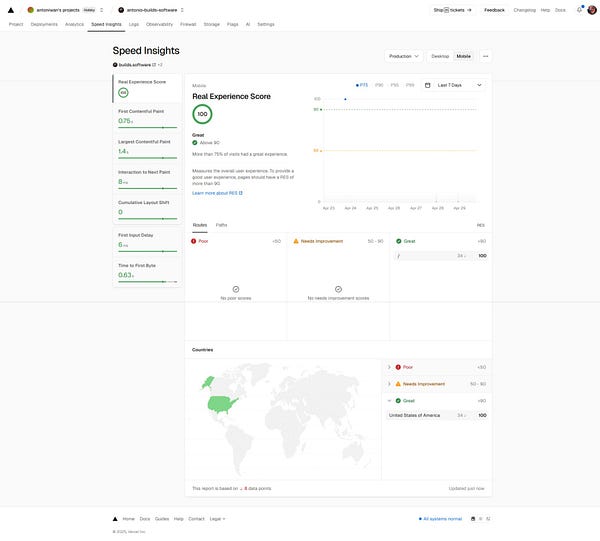\n\n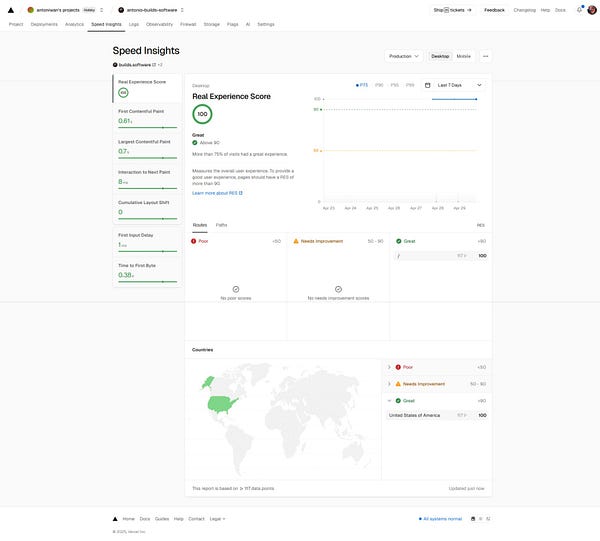\n\n100/100 on Real Experience Score.
\n\n## Introducción: Nuestra Responsabilidad, No la de Ellos\n\nEn un mundo donde la tecnología digital penetra todos los aspectos de la vida, muchos padres se enfrentan a una difícil pregunta: ¿cómo permitimos que nuestros hijos accedan a las herramientas digitales sin exponerlos a los riesgos que conllevan?\n\nLa respuesta no se encuentra en la prohibición total, sino en la preparación consciente. Esta guía no solo enseña a configurar un iPad para niños, sino que plantea una responsabilidad ética:\n\n> **Los niños no son responsables de su protección. Nosotros, los adultos, lo somos.**\n\n---\n\n## 1. Elección del iPad Según la Edad del Niño\n\n### Recomendaciones generales:\n\n- **3 a 6 años:** iPad (9a o 10a generación) con carcasa resistente y protector de pantalla.\n- **7 a 12 años:** iPad o iPad mini con teclado si hay intención educativa.\n- **13+ años:** Puede considerarse un iPad Air con control parental más flexible.\n\n**Tip:** Compra un iPad usado o reacondicionado para reducir costos sin sacrificar calidad.\n\n---\n\n## 2. Configuración de Seguridad Inicial\n\n### a. Crear una Apple ID para tu hija/o con \"En Familia\"\n\n1. En tu iPhone o iPad: ve a `Configuración > tu nombre > En Familia`.\n2. Añade a tu hija como miembro menor de edad (con su fecha de nacimiento).\n3. Esto permite control total desde tu cuenta principal.\n\n### b. Activar \"Tiempo en Pantalla\"\n\n1. `Configuración > Tiempo en pantalla > Activar`.\n2. Establece un código de 4 dígitos que solo tú conozcas.\n3. Configura:\n - **Límites de apps.**\n - **Horario de descanso:** Ej. 8:00 p.m. – 7:00 a.m.\n - **Contenido y privacidad:** Bloquea contenido explícito, compras y Safari.\n\n### c. Desactivar Safari y App Store (opcional)\n\nDesactiva estas opciones desde `Tiempo en pantalla > Restricciones de contenido y privacidad`.\n\n---\n\n## 3. Configurar FaceTime con Horarios\n\n**Objetivo:** Permitir conexión familiar sin interrumpir rutinas.\n\n1. Asegúrate de que FaceTime esté activo.\n2. Permite FaceTime incluso durante el \"tiempo de descanso\" si tú haces la llamada.\n3. Establece horarios:\n - **Mañana:** 6:45 a.m. – 7:00 a.m.\n - **Noche:** 6:30 p.m. – 7:30 p.m. (cuentos, oración, conexión emocional).\n4. Si no puedes llamar, deja un videomensaje amoroso para ella.\n\n---\n\n## 4. Apps Recomendadas para Niños (5 a 8 Años)\n\n- `YouTube Kids` (con filtros activos).\n- `Khan Academy Kids`.\n- `Toca Boca / Sago Mini / Endless Alphabet`.\n- `Libby` o `Kindle`",
"content_text": "Esta guía te acompaña paso a paso en la elección, configuración y supervisión consciente de un iPad para niños, con valores boricuas y responsabilidad adulta al centro.",
"summary": "Esta guía te acompaña paso a paso en la elección, configuración y supervisión consciente de un iPad para niños, con valores boricuas y responsabilidad adulta al centro.",
"date_published": "2025-05-01T10:30:00.000Z",
"date_modified": "2025-05-01T10:30:00.000Z",
"authors": [
{
"name": "Antonio Rodriguez Martinez",
"url": "https://antoniwan.online"
}
],
"tags": [
"parenting",
"systems-strategy",
"technology",
"parenting",
"children",
"education",
"family",
"digital-safety",
"conscious-parenting",
"tools",
"learning",
"family-dynamics"
],
"image": "https://notes.antoniwan.online/images/guia-padres.jpg"
},
{
"id": "https://notes.antoniwan.online/p/como-proteger-ninos-digital/",
"url": "https://notes.antoniwan.online/p/como-proteger-ninos-digital/",
"title": "Cómo Proteger a Nuestros Niños del Peligro Digital: Guía para Padres Boricuas en la Era del Internet",
"content_html": "## Nuestra responsabilidad digital como padres y madres\n\nEn Puerto Rico —y en el mundo entero— vivimos en una era donde el Internet está en todos lados. Pero **el hecho de que algo sea común, no lo hace seguro.** \nEl Internet NO es un lugar hecho para niños. Es un campo abierto con belleza, pero también con basura, violencia, sexualidad extrema, y contenidos que un niño no está emocionalmente preparado para ver.\n\n> **La mente de un niño es como un campo fértil. Lo que siembres ahora, florecerá o se pudrirá más adelante.**\n\n---\n\n## 🛡️ ¿Por qué hay que proteger a los niños del Internet?\n\n- **El cerebro en desarrollo** de un niño no puede distinguir entre fantasía y realidad como lo hace un adulto.\n- **Las imágenes violentas o sexuales** pueden causar trauma, ansiedad, confusión de identidad o incluso adicción precoz.\n- **El algoritmo no tiene compasión.** Su único objetivo es mantener a tu hijo pegado a la pantalla.\n- **El porno moderno** no es educativo ni inofensivo. Es grotesco, violento y muchas veces humillante.\n\n---\n\n## ⚙️ ¿Cómo asegurarte que tu hijo esté seguro en Windows 11 o macOS?\n\n### Paso 1: Crear una cuenta infantil con controles parentales\n\n#### En Windows 11:\n\n1. Ve a **Configuración > Cuentas > Familia y otros usuarios**.\n2. Agrega un **miembro familiar > Niño**.\n3. Activa **Microsoft Family Safety** para filtrar sitios web, bloquear apps y establecer horarios.\n\n#### En macOS:\n\n1. Ve a **Preferencias del Sistema > Tiempo en pantalla > Contenido y privacidad**.\n2. Crea una cuenta infantil o usa la función de **Compartir en Familia**.\n3. Establece:\n - Límites de apps\n - Bloqueo de contenido explícito\n - Historial de navegación\n\n### Paso 2: Verifica el historial de navegación\n\n- En **Chrome/Safari/Edge**, revisa el historial manualmente.\n- Usa apps como **Qustodio, Norton Family o Bark** si necesitas reportes automáticos.\n\n---\n\n## 🚨 ¿Y si descubro que mi hijo vio pornografía?\n\n### Mantén la calma. Aquí no gana la culpa, gana el amor.\n\n#### Si el niño es menor de 6 años:\n\n- **No lo regañes.** Puede que no entienda lo que vio.\n- Di algo como:\n > Esas imágenes no son para niños. Si ves algo que te confunde o te asusta, ven donde mí.\n\n#### Si el niño tiene 6-12 años:\n\n- Haz preguntas con ternura:\n\n > ¿Qué sentiste cuando viste eso?\n > ¿Alguien te lo mostró o fue por accidente?\n\n- Explícale:\n > Eso que viste no muestra el amor verdadero. Nuestro cuerpo y nuestro corazón merecen respeto.\n\n#### Si el contenido era violento o humillante:\n\n- Considera ayuda psicológica profesional.\n- Refuerza con cariño y presencia diaria.\n\n---\n\n## 💬 Cómo hablarles sobre estos temas sin miedo\n\n- Usa cuentos, analogías, y juegos simbólicos.\n- Enséñales a decir \"no\" y confiar en su instinto.\n- Evita moralizar. Lo que queremos es enseñar límites, no vergüenza.\n\n---\n\n## 📚 Libros recomendados para educarnos como guías conscientes\n\n- **\"Disciplina Sin Lágrimas\"** – Daniel J. Siegel & Tina Payne Bryson\n- **\"El Cerebro del Niño\" (The Whole-Brain Child)** – Daniel J. Siegel\n- **\"Cómo hablar para que los niños escuchen\"** – Faber & Mazlish\n- **\"Niños Adictos a las Pantallas\"** – Nicholas Kardaras\n- **\"Por Tu Propio Bien\"** – Alice Miller\n\n---\n\n## 📖 Glosario esencial\n\n- **Algoritmo:** Código que decide qué videos o páginas mostrarle a tu hijo.\n- **Control parental:** Herramientas para limitar el contenido digital.\n- **Contenido explícito:** Imágenes sexuales, violentas o que promueven odio.\n- **Adicción digital:** Necesidad constante de estar conectado para sentir placer o evitar el aburrimiento.\n- **Sobreestimulación:** Cuando el cerebro recibe demasiados estímulos y no puede descansar.\n\n---\n\n## 🔗 Recursos útiles\n\n- American Academy of Pediatrics. (2016). _Media and Young Minds_. Pediatrics, 138(5). https://doi.org/10.1542/peds.2016-2591\n- Siegel, D. J., & Bryson, T. P. (2011). _The Whole-Brain Child_. Bantam.\n- Kardaras, N. (2016). _Glow Kids: How Screen Addiction Is Hijacking Our Kids_. St. Martin's Press.\n- Common Sense Media. (2025). _Family Guides and Reviews_. https://www.commonsensemedia.org/\n- Qustodio. (2025). _Parental Control Tools for All Devices_. https://www.qustodio.com/\n\n---\n\n## 🌱 Conclusión: Protege ahora, educa siempre\n\nLo que le enseñamos a un niño en los primeros años es más fuerte que cualquier algoritmo. \nMás que proteger una computadora, estamos **protegiendo un alma en formación**.\n\nHazlo con amor. Hazlo con presencia. \nPorque **no hay app más poderosa que un padre o madre consciente.**",
"content_text": "Una guía sencilla y poderosa para cuidar el corazón y la mente de nuestros toddlers en el mundo digital moderno.",
"summary": "Una guía sencilla y poderosa para cuidar el corazón y la mente de nuestros toddlers en el mundo digital moderno.",
"date_published": "2025-05-01T00:00:00.000Z",
"date_modified": "2025-05-01T00:00:00.000Z",
"authors": [
{
"name": "Antonio Rodriguez Martinez",
"url": "https://antoniwan.online"
}
],
"tags": [
"parenting",
"systems-strategy",
"parenting",
"children",
"digital-safety",
"technology",
"family",
"conscious-parenting",
"child-development",
"social-issues",
"education",
"family-dynamics"
]
},
{
"id": "https://notes.antoniwan.online/p/toddler-internet-safety/",
"url": "https://notes.antoniwan.online/p/toddler-internet-safety/",
"title": "How to Protect Our Children in the Digital Age: A Conscious Parent's Guide to Internet Safety",
"content_html": "## Our Digital Responsibility as Parents\n\nIn Puerto Rico—and across the world—we now raise children in an age where the Internet is everywhere. But **just because something is common, doesn't mean it's safe.** \nThe Internet is NOT made for children. It's a wild field filled with beauty, but also with garbage, violence, extreme sexuality, and content a young child is not ready to handle.\n\n> **A child's mind is like fertile soil. Whatever you plant now will either bloom—or rot—later.**\n\n---\n\n## 🛡️ Why do we need to protect kids from the Internet?\n\n- **Children's developing brains** can't tell the difference between fantasy and reality like adults can.\n- **Violent or sexual content** can cause trauma, anxiety, identity confusion, or even early addiction.\n- **Algorithms have no compassion.** Their only goal is to keep your child watching.\n- **Modern porn** is not educational or harmless. It's often grotesque, violent, and degrading.\n\n---\n\n## ⚙️ How to keep your child safe on Windows 11 or macOS\n\n### Step 1: Create a child account with parental controls\n\n#### On Windows 11:\n\n1. Go to **Settings > Accounts > Family & other users**.\n2. Add a **family member > Child**.\n3. Use **Microsoft Family Safety** to filter content, block apps, and set screen time limits.\n\n#### On macOS:\n\n1. Go to **System Settings > Screen Time > Content & Privacy**.\n2. Create a child account or use **Family Sharing**.\n3. Set:\n - App limits\n - Explicit content filters\n - Browsing restrictions\n\n### Step 2: Check browsing history\n\n- Use Chrome/Safari/Edge to manually check history.\n- Consider apps like **Qustodio, Norton Family, or Bark** for detailed monitoring.\n\n---\n\n## 🚨 What if I find out my child watched porn?\n\n### Stay calm. Guilt doesn't help—love does.\n\n#### For children under 6:\n\n- **Do not scold.** They may not understand what they saw.\n- Say something like:\n > Those images aren't for kids. If you ever see something that confuses or scares you, come tell me.\n\n#### For children ages 6–12:\n\n- Ask gently:\n\n > How did it feel to see that?\" \n > Did someone show it to you, or did it pop up by accident?\n\n- Explain:\n > What you saw doesn't show real love. Our hearts and bodies deserve kindness and respect.\n\n#### If the content was violent or humiliating:\n\n- Seek professional help if needed.\n- Reaffirm safety and connection daily.\n\n---\n\n## 💬 How to talk about hard topics without fear\n\n- Use stories, analogies, and symbolic play.\n- Teach them to say \"no\" and trust their instincts.\n- Avoid moralizing. Teach boundaries, not shame.\n\n---\n\n## 📚 Recommended Reading for Conscious Parenting\n\n- **\"No-Drama Discipline\"** – Daniel J. Siegel & Tina Payne Bryson\n- **\"The Whole-Brain Child\"** – Daniel J. Siegel\n- **\"How to Talk So Kids Will Listen & Listen So Kids Will Talk\"** – Adele Faber & Elaine Mazlish\n- **\"Glow Kids\"** – Nicholas Kardaras\n- **\"For Your Own Good\"** – Alice Miller\n\n---\n\n## 📖 Glossary\n\n- **Algorithm:** A program that decides what videos or content your child sees.\n- **Parental controls:** Tools that help filter content and set limits.\n- **Explicit content:** Sexual, violent, or hateful content.\n- **Digital addiction:** A compulsive need to stay online to feel pleasure or avoid discomfort.\n- **Overstimulation:** When the brain receives too many stimuli and can't properly rest.\n\n---\n\n## 🔗 Useful Resources\n\n- American Academy of Pediatrics. (2016). _Media and Young Minds_. Pediatrics, 138(5). https://doi.org/10.1542/peds.2016-2591\n- Siegel, D. J., & Bryson, T. P. (2011). _The Whole-Brain Child_. Bantam.\n- Kardaras, N. (2016). _Glow Kids: How Screen Addiction Is Hijacking Our Kids_. St. Martin's Press.\n- Common Sense Media. (2025). _Family Guides and Reviews_. https://www.commonsensemedia.org/\n- Qustodio. (2025). _Parental Control Tools for All Devices_. https://www.qustodio.com/\n\n---\n\n## 🌱 Final Thought: Protect Now, Educate Always\n\nWhat we teach a child in the early years is stronger than any algorithm. \nMore than securing a device, we're **protecting a soul in formation**.\n\nDo it with love. Do it with presence. \nBecause **there is no app more powerful than a conscious parent.**",
"content_text": "A clear, powerful guide for safeguarding the hearts and minds of toddlers and young children in today's online world.",
"summary": "A clear, powerful guide for safeguarding the hearts and minds of toddlers and young children in today's online world.",
"date_published": "2025-05-01T00:00:00.000Z",
"date_modified": "2025-05-01T00:00:00.000Z",
"authors": [
{
"name": "Antonio Rodriguez Martinez",
"url": "https://antoniwan.online"
}
],
"tags": [
"parenting",
"systems-strategy",
"parenting",
"children",
"digital-safety",
"technology",
"family",
"conscious-parenting",
"child-development",
"social-issues",
"family-dynamics",
"education"
]
},
{
"id": "https://notes.antoniwan.online/p/why-i-built-buildssoftware-and-what-im-building-next/",
"url": "https://notes.antoniwan.online/p/why-i-built-buildssoftware-and-what-im-building-next/",
"title": "Why I Built builds.software — and What I’m Building Next",
"content_html": "\n\nPhoto by [Simon Wilkes](https://unsplash.com/@simonfromengland?utm_source=medium&utm_medium=referral) on [Unsplash](https://unsplash.com?utm_source=medium&utm_medium=referral)\n\nWelcome to **builds.software** — the digital forge of Antonio Rodriguez Martinez. _I just released `v2+` of my personal website and I’m stoked!_ This is not just a personal site. It’s a terminal window into a life of **experimentation, resilience, design, and code.** Every pixel, repo, and line of text reflects years of hard-earned lessons — from startups to breakdowns, from poetry to product launches.\n\n## 🧠 What You’ll Find\n\n- **Writing** — Technical insights, philosophical explorations, and legacy documentation\n- **Projects** — Software, hardware, and human systems built with care and curiosity\n- **The Stack** — A living record of the tools and technologies I trust\n- **Principles** — A public ledger of what I stand for, and why\n\n## 🔍 Who I Am\n\n- 🐺 Warrior(lol) of many roles: TPM, coder, mentor, dad, poet, craftsman\n- 🪵 Builder of legacy projects like **Strong Hands, Soft Heart**\n- 🛠️ Fixer of broken things — technical, emotional, and systemic\n\n## 🌀 Why This Site Exists\n\nBecause social platforms aren’t enough. Because algorithms don’t deserve my best work. Because I needed one place to **build in public**, on my own terms.\n\n## 🧭 Start exploring:\n\n- [My latest work](https://builds.software/?utm_source=medium&utm_medium=article&utm_campaign=build-launch)\n- [Strong Hands, Soft Heart (Business Website)](https://stronghandssoftheart.com/?utm_source=medium&utm_medium=article&utm_campaign=build-launch)\n- [Open Source Code](https://github.com/antoniwan/antonio-builds-software)\n\n**_Site Built with Next.js, Tailwind, Cursor AI, and a lot of heart._**\n\n### _Quick-update: Just noticed this! Oh snap! lol_\n\n\n\n\n\n100/100 on Real Experience Score.Desktop ✅ Mobile ✅
No layout shift. No delay. Just speed and intention.
— built for clarity, not clutter.\n\n---\n\n_Originally published on [Medium](https://medium.com/@wizards777/why-i-built-builds-software-and-what-im-building-next-8e9cda2c5043)._", "content_text": "Built my own space: no ads, no feed, just soul + software. A digital forge for legacy, code, and craft. Welcome to builds.software.", "summary": "Built my own space: no ads, no feed, just soul + software. A digital forge for legacy, code, and craft. Welcome to builds.software.", "date_published": "2025-04-30T18:11:38.423Z", "date_modified": "2025-04-30T18:11:38.423Z", "authors": [ { "name": "Antonio Rodriguez Martinez", "url": "https://antoniwan.online" } ], "tags": [ "systems-strategy", "learning-projects", "diy-creation", "software", "technology", "systems-strategy", "learning-projects", "diy-creation", "productivity", "development", "consciousness", "personal-growth", "workflow" ] }, { "id": "https://notes.antoniwan.online/p/what-happens-when-you-leave-the-algorithm-behind/", "url": "https://notes.antoniwan.online/p/what-happens-when-you-leave-the-algorithm-behind/", "title": "What Happens When You Leave the Algorithm Behind", "content_html": "\n\nPhoto by [Beth Macdonald](https://unsplash.com/@elsbethcat?utm_source=medium&utm_medium=referral) on [Unsplash](https://unsplash.com?utm_source=medium&utm_medium=referral)\n\n**_One_. Cognitive bandwidth surges.**
That background hum of comparison, performance, and constant input? Gone. You start thinking clearer. Ideas land faster. Space opens up where noise used to live.\n\n**_Two_. Time becomes yours again.**
You realize how much time you _actually_ have — and how sacred it is. Routines deepen. Focus sharpens. You start moving with rhythm, not reaction.\n\n**_Three_. Emotional clarity returns.**
No more mood swings triggered by someone else’s highlight reel. No more ambient FOMO. Your nervous system? It starts trusting life again.\n\n**_Four_. Creativity roars back.**
What used to leak into endless scrolling now pours into music, writing, building, crafting, and finishing what matters. You stop waiting for permission. You start making fire.\n\n**_Five_. Your relationships change.**
The people who matter will call. The rest will fade. You begin attracting those who _see_, not just those who _scroll_.\n\n
That’s the theory anyway.\n\nI just hit delete on Meta — Instagram, Threads, Facebook — and I’m walking this path in real time. No filters. No performance. _Just presence_. I’ll document the whole thing over at Bluesky: 👉 [https://bsky.app/profile/antoniwan.online](https://bsky.app/profile/antoniwan.online)\n\nPeace —
Antonio Rodríguez Martínez\n\n---\n\n_Originally published on [Medium](https://medium.com/@wizards777/what-happens-when-you-leave-the-algorithm-behind-4b606eb54cc0)._", "content_text": "Leaving Meta. Reclaiming time, clarity, and creativity.", "summary": "Leaving Meta. Reclaiming time, clarity, and creativity.", "date_published": "2025-04-30T12:52:40.726Z", "date_modified": "2025-04-30T12:52:40.726Z", "authors": [ { "name": "Antonio Rodriguez Martinez", "url": "https://antoniwan.online" } ], "tags": [ "diy-creation", "metaspace", "integration-growth", "technology", "consciousness", "social-media", "mental-health", "mindfulness", "personal-growth", "self-reflection", "healing", "social-issues", "self-improvement" ] }, { "id": "https://notes.antoniwan.online/p/forging-stronghand-terminal/", "url": "https://notes.antoniwan.online/p/forging-stronghand-terminal/", "title": "Forging the 'Stronghand' Terminal: From Chaos to Command", "content_html": "\"Stronghand\" is the name I gave my computer after the latest reformat. I destroyed **EVERYTHING** across all my drives — four disks totaling over 10TB — wiping them clean to zero.\n\nWhy? Because clutter carries inertia. Because old data is old gravity. Because sometimes the only way forward is to burn the ship.\n\nAfter the reset, I divided my new PC empire into two main territories:\n\n- **V: Vault** — Permanent archive. Memories, music, videos, source materials. Things to keep safe.\n- **F: Forge** — Active workspace. Development, documentation, experimentation. Things to build and break.\n\nEvery project, every piece of work, either belongs to the Vault (long-term memory) or the Forge (current creation).\n\nClear. Brutal. Freeing.\n\n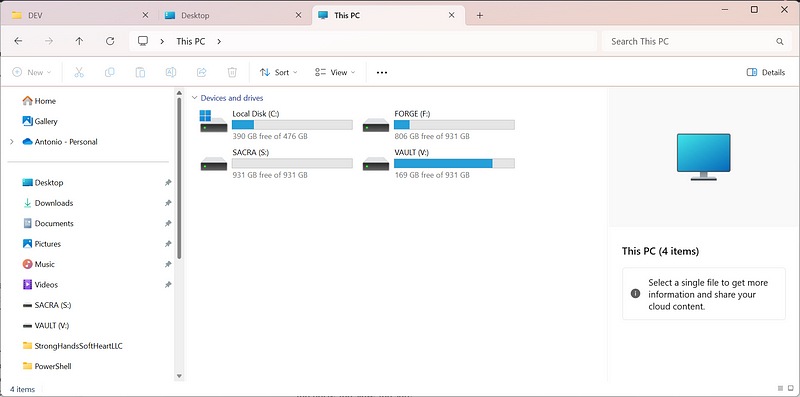\n\n## FREEDOM!\n\nThere are moments when you realize your tools no longer match your mind. That's what happened when I looked at the stock Windows 11 terminal experience. Too noisy. Too slow. Too soft.\n\nI needed a cockpit. A blade. A command center worthy of the mission ahead. So I forged one.\n\nToday, I'm sharing the exact steps I took to build my personal development terminal on Windows 11 — using WezTerm. Whether you're a web developer, gamer, engineer, or just someone who wants your machine to actually obey you, this is a path you can follow.\n\n## Phase 1: Kill the Noise — Install WezTerm\n\nI replaced the default Windows Terminal with [WezTerm](https://wezfurlong.org/wezterm/) (Wez Furlong, 2024).\n\n\n\n\n**Before WezTerm, after WezTerm**\n\nWhy? It's fast, lightweight, GPU-accelerated, and cross-platform.\nIn short: a weapon, not a toy.\n\n- Installed WezTerm\n- Created `wezterm.lua` manually at `%USERPROFILE%\\AppData\\Local\\wezterm\\wezterm.lua`\n- Set default shell to PowerShell 7, not cmd.exe\n\nYou can find the configuration I used here: wezterm configs. In a nutshell, we are looking at something like this:\n\n```lua\nreturn {\n default_prog = { 'pwsh.exe', '-NoLogo' },\n font = wezterm.font(\"JetBrainsMono Nerd Font\"),\n font_size = 12.5,\n color_scheme = \"Catppuccin Mocha\",\n}\n```\n\n## Phase 2: Upgrade the Shell — PowerShell 7, Oh-My-Posh, and Zoxide\n\nStock PowerShell? Slow. Clunky. Old. I installed [PowerShell 7](https://learn.microsoft.com/en-us/powershell/) (Microsoft, 2023) via winget and tuned it with:\n\n- [Oh-My-Posh](https://ohmyposh.dev/) for visual clarity\n- [Zoxide](https://github.com/ajeetdsouza/zoxide) for teleportation-level folder navigation\n\n**Important**: When initializing zoxide inside PowerShell 7, use:\n\n```powershell\nInvoke-Expression (& { (zoxide init powershell | Out-String) })\n```\n\n(not 'pwsh' — zoxide expects 'powershell' as input.)\n\nI also added these to my PowerShell `$PROFILE`:\n\n```powershell\noh-my-posh init pwsh | Invoke-Expression\nInvoke-Expression (& { (zoxide init powershell | Out-String) })\n```\n\nPlus a few battle-tested aliases like `gs` (git status), `gp` (git push), `serve` (launch local servers). See my full list of aliases here (not exhaustive, just some to get your creative juices flowing):\n\n```powershell\n## Custom Aliases\nSet-Alias gs git status\nSet-Alias gc git commit\nSet-Alias gp git push\nSet-Alias gl git pull\nSet-Alias gco git checkout\nSet-Alias gb git branch\nSet-Alias serve npx serve\n\n## Quick Directory Shortcuts (Optional)\nSet-Alias dev \"cd F:\\Dev\"\nSet-Alias pers \"cd F:\\Dev\\Personal\"\nSet-Alias work \"cd F:\\Dev\\Work\"\n```\n\n## Phase 3: Install the Right Dev Tools\n\n- [nvm-windows](https://github.com/coreybutler/nvm-windows) to manage Node.js versions cleanly (Butler, 2024)\n- fzf for fuzzy file finding\n- Organized folders into `F:\\Dev\\Personal`, `F:\\Dev\\Work`, etc.\n\nSimple structure = simple mind = powerful output.\n\n\n\n**Absolute magic!**\n\n## Why This Matters\n\nMost developers (and creators in general) live in accidental friction. Every terminal glitch, every PATH pollution, every second lost accumulates.\n\nBy building a terminal intentionally:\n\n- You speed up mentally and physically\n- You enjoy the craft more\n- You eliminate avoidable frustrations\n- You create a cockpit for serious work, not casual dabbling\n\nThis wasn't about \"fancy customization.\"\nThis was about forging a sharper interface with reality. This is about moving with **INTENTION!** And when your interface is sharp, your spirit sharpens too.\n\n\n**MAGIC!!!**\n\n## Closing Words\n\nYour machine reflects your mind.\nYour terminal reflects your discipline.\n\nForge them both carefully and intentionally.\n\nAnd when you're ready for more? There are even deeper rituals to unlock — tmux sessions, worktrees, containerized dev environments.\n\nBut first: master your cockpit.\nEverything else follows.\n\n(If this guide helped you, feel free to share your own terminal screenshots — I'd love to see what weapons you're building.)\n\n## References\n\n- Butler, C. (2024). [nvm-windows](https://github.com/coreybutler/nvm-windows). GitHub.\n- Microsoft. (2023). [PowerShell](https://learn.microsoft.com/en-us/powershell/).\n- Wez Furlong. (2024). [WezTerm Terminal Emulator](https://wezfurlong.org/wezterm/).\n- De Dobbeleer, J. (2024). [Oh My Posh](https://ohmyposh.dev/).\n- D'Souza, A. (2024). [zoxide](https://github.com/ajeetdsouza/zoxide). GitHub.", "content_text": "Guide to building a development terminal on Windows 11 using WezTerm, PowerShell 7, Oh-My-Posh, and Zoxide. Includes setup steps and configuration examples.", "summary": "Guide to building a development terminal on Windows 11 using WezTerm, PowerShell 7, Oh-My-Posh, and Zoxide. Includes setup steps and configuration examples.", "date_published": "2025-04-28T00:00:00.000Z", "date_modified": "2025-04-28T00:00:00.000Z", "authors": [ { "name": "Antonio Rodriguez Martinez", "url": "https://antoniwan.online" } ], "tags": [ "systems-strategy", "learning-projects", "systems-strategy", "productivity", "technology", "development", "tools", "efficiency", "workflow", "learning-projects", "software-development", "customization" ] }, { "id": "https://notes.antoniwan.online/p/mercy-through-the-blade/", "url": "https://notes.antoniwan.online/p/mercy-through-the-blade/", "title": "Mercy Through the Blade: The Silent Law of Leadership", "content_html": "
 \n\n> This is a silent topic. Nobody really wants to talk about it. I think because it's uncomfortable. It exposes things most people would rather keep hidden. But here we go — no ego, no drama, just truth. If this resonates, or if it challenges you, leave a comment below. I'll reply to every comment personally. Let's sharpen each other the way warriors are supposed to — with presence, respect, and real conversation. ¡Gracias por leer!\n\n**_Hero Image Caption & Credit: Lioness. True Leadership. Photo by roya ann miller on Unsplash_**\n\n## ⚔ Leading Through Truth: The Warrior's Dilemma ⚔\n\nIn every generation, a moment arises when a leader — a true leader — must make a brutal, sacred decision:\n\n> Do I soften the truth to preserve comfort? Or do I wield the truth, sharp and clean, even if it wounds the ones I love?\n\nThe real answer defines not just the fate of a relationship, but the architecture of entire lives, families, and futures.\n\nThis essay is a distillation of what happens when leadership collides with resistance — and what values must guide us when love and truth are at odds.\n\n## The Two Critical Values\n\nTwo values stand at the center of all authentic leadership, especially when raising the future:\n\n### One. Mercy Through \"the Blade.\"\n\n
 \n
\n If they are ready, they rise.
If they are not, I continue walking — **because truth must not bow to fear.**\n\n## Tactical Principles for Leading Through Resistance\n\nWhen someone you lead resists growth — turns away, rejects your offering, refuses to even meet your eyes — **you must remember:**\n\n1. **Offer Power Once.** Give the gift openly, without clinging to whether they accept it.\n2. **Do Not Chase the Unwilling.** Those who cannot bear your presence will not bear your leadership. Let them walk.\n3. **Guard the Fire.** Power, breath, presence — these are sacred. Do not throw pearls before those unwilling to receive them.\n4. **Strike Without Hatred. Cut Without Regret.** If illusions must be broken, do so cleanly, and walk forward without apology.\n5. **Leave the Door Open, But Keep Walking.** Compassion leaves the door unlocked. Discipline keeps you moving toward your own horizon.\n\nThis is what separates **kings from manipulators. Warriors from cowards. Mentors from enablers.** Leadership is. You lead, I follow. I lead, you follow. We can even switch hats mid-mission if we have to — but the structure stays alive. **Leadership doesn't disappear just because it's uncomfortable. It's always present. And if it dies, so does the mission.**\n\n## Building After the Cut ⚔️🩸🩸🩸\n\nWhen you realize someone cannot follow you — whether a mentee, a son, a student, or a brother — you must honor both yourself and them by _building forward_:\n\n- Invest in those who **can** meet you.\n- Pour into futures, not into nostalgia.\n- Raise those who will stand tall, not those who cower.\n\n**Leadership is not the art of dragging the unwilling. It is the art of raising standards so that the willing rise to meet them.**\n\n## Final Reflection\n\nLeadership, **real, authentic, Saiyan, holy, sacred**, however you want to call it, leadership, demands both **ferocity and grace.**\n\nNot all who stand before us are ready to rise with us. **And when they are not — it is not a tragedy.**\n\nIt is simply time to lead anyway. **Quietly. Fiercely. Without regret.**\n\n> For those ready to wield leadership **not as domination, but as duty** — the study never ends. **The blade only sharpens.**\n\n
\n\n \n
\n\n
\n\n\n \n
\nFurther Study References for Warrior Leadership & Core Values for Warrior Leadership (Glossary Style) \n
\n\nP.S. After dropping this, I somehow found \"The Leadership Blade\" by Dr. Calvin McDowall… I swear on everything I love — I had never read his stuff before — and it's like we share a braincell lmao. It's fucking insane how aligned it is. If you're feeling what I'm saying, read his too. Legends recognize legends. 🐺\n\n---\n\n_Originally published on [Medium](https://medium.com/@wizards777/mercy-through-the-blade-the-silent-law-of-leadership-24cef2df828a)._",
"content_text": "A deep exploration of authentic leadership, the warrior's dilemma between truth and comfort, and the sacred responsibility of wielding power with grace and ferocity.",
"summary": "A deep exploration of authentic leadership, the warrior's dilemma between truth and comfort, and the sacred responsibility of wielding power with grace and ferocity.",
"date_published": "2025-04-26T00:00:00.000Z",
"date_modified": "2025-04-26T00:00:00.000Z",
"authors": [
{
"name": "Antonio Rodriguez Martinez",
"url": "https://antoniwan.online"
}
],
"tags": [
"integration-growth",
"psychology",
"leadership",
"authenticity",
"truth",
"personal-growth",
"values",
"responsibility",
"discipline",
"self-mastery",
"power",
"consciousness"
],
"image": "https://notes.antoniwan.online/images/0_uLjrPcjl6O6biWBM.jpg"
},
{
"id": "https://notes.antoniwan.online/p/pa-la-nena-que-vive-en-ti/",
"url": "https://notes.antoniwan.online/p/pa-la-nena-que-vive-en-ti/",
"title": "☀️ Pa’ la nena que vive en ti",
"content_html": "| Value | \nDefinition | \nWarrior Application | \n
|---|---|---|
| Mercy | \nCompassionate treatment with strength | \nCutting illusions without hatred | \n
| Truth | \nUnwavering loyalty to reality | \nSpeaking what is, not what comforts | \n
| Leadership | \nSacred responsibility to guide | \nLeading by example, not force | \n
| Discipline | \nConsistent action aligned with values | \nDaily practice of core principles | \n
| Authenticity | \nBeing true to one's nature | \nNo masks, no pretense | \n
| Responsibility | \nOwning the consequences of power | \nAccepting the weight of leadership | \n
\n\n
| Book Title | \nAuthor | \nKey Theme | \n
|---|---|---|
| The Leadership Blade | \nDr. Calvin McDowall | \nWarrior leadership principles | \n
| The Art of War | \nSun Tzu | \nStrategic thinking and discipline | \n
| Meditations | \nMarcus Aurelius | \nStoic leadership and self-mastery | \n
| The Book of Five Rings | \nMiyamoto Musashi | \nWarrior philosophy and mastery | \n
| Leadership and Self-Deception | \nThe Arbinger Institute | \nAuthentic leadership principles | \n
| The Way of the Superior Man | \nDavid Deida | \nMasculine leadership and purpose | \n
 \n\n_Desde la paz, el respeto, y la crianza compartida_\n\nBuen día,
Este verso no es poema de amor —
es un lazo de equipo, de respeto mayor.\n\nEs por la niña que un día fuiste,
la que quizás no tuvo quien la abrace lento,
quien le diga “pa’ ti, no hay tormento
que apague tu fuego adentro”.\n\nYo no soy tu salvador, ni lo intento.
Pero como padre, te honro el talento
que tienes pa’ criar con corazón abierto.
Aunque a veces duela. Aunque estemos lejos.\n\nEsta crianza es más que acuerdos o deberes.
Es sanar lo que no se dijo de nenes.
Y enseñarle a nuestras hijas, sin palabras si hace falta,
que el amor se construye con calma.\n\nYo no vine a cambiar tu pasado.
Solo quiero que nuestras hijdas tenga a su lado
dos adultos que aprendieron a ser humanos,
aunque el camino haya sido entrecortado.\n\nAsí que si un día flaqueas — como to’ el mundo —
yo sigo firme, sin juicio ninguno.
Porque la niña en ti… también merece ternura.
Y yo, como padre, te la ofrezco con altura.\n\n---\n\n_Originally published on [Medium](https://medium.com/@wizards777/%EF%B8%8F-pa-la-nena-que-vive-en-ti-511949b6c3c0)._", "content_text": "Desde la paz, el respeto, y la crianza compartida", "summary": "Desde la paz, el respeto, y la crianza compartida", "date_published": "2025-04-21T12:21:28.540Z", "date_modified": "2025-04-21T12:21:28.540Z", "authors": [ { "name": "Antonio Rodriguez Martinez", "url": "https://antoniwan.online" } ], "tags": [ "metaspace", "integration-growth", "consciousness", "inner-child", "healing", "personal-growth", "self-reflection", "authenticity", "therapy", "emotional-regulation", "transformation", "parenting", "conscious-parenting", "co-parenting", "family", "family-dynamics", "vulnerability", "empathy", "compassion" ], "image": "https://notes.antoniwan.online/images/una-nena-poderosa.avif" }, { "id": "https://notes.antoniwan.online/p/my-mental-health-routine-unfiltered/", "url": "https://notes.antoniwan.online/p/my-mental-health-routine-unfiltered/", "title": "🧠 My Mental Health Routine (Unfiltered)", "content_html": "I’ve spent the last 14 days rebuilding my nervous system from the ground up after completing assessing and reviewing my intelligence and medical health, bloodwork, sexual health, cholesterol, prostate, who knows, I got so many things done on myself; I even got myself a vasectomy appointment in the process. LOL\n\nHere’s what’s keeping me mentally sharp, emotionally clean, and spiritually dangerous (in the best way):\n\n- **Breathwork** (I call it Total Concentration Breathing 🫁)\n- **Writing every single day** (not for likes, for survival)\n- **Gym & stretching** (RPE + failure sets + foam rolling)\n- **Art** — drawing, guitar, design. Expression _is_ medicine.\n- **FaceTime with my daughter** — hours a day, pure love\n- **Hard conversations** — family, friends, lovers. No hiding.\n- **Real food, cooked by me** — I don’t let chaos enter my gut.\n- **Sunrise mornings** — no alarm. Just rhythm.\n- **Journaling** after dates, arguments, and moments of awe.\n- **Walking barefoot on wet grass** — grounding. Literally.\n- **Laughing with strangers** — full presence. Headphones off.\n- **Resting without guilt** — 7–8 hours. No grindset BS.\n- **Protecting my energy** — letting go of masked “friends.”\n\n\n\nPhoto by [Jared Rice](https://unsplash.com/@jareddrice?utm_source=medium&utm_medium=referral) on [Unsplash](https://unsplash.com?utm_source=medium&utm_medium=referral)\n\n### 🧠💥 **Prompts for you (read this slooooooooowwwwwllllyyyyyy)**\n\n> What’s your nervous system asking for right now? What small ritual makes you feel like yourself again? What would your 10-year-old self beg you to start doing again?\n\nYou don’t need to copy this list. Make it sacred. Make it yours. Do it with your full attention. **Let it change your life. BROOO!!!!!** (achieve an emotionally regulated nervous system)\n\n🌱 From love. From breath. From truth. Let’s grow.\n\n---\n\n_Originally published on [Medium](https://medium.com/@wizards777/my-mental-health-routine-unfiltered-1ebfc2b1bde9)._", "content_text": "I’ve spent the last 14 days rebuilding my nervous system from the ground up after completing assessing and reviewing my intelligence and…", "summary": "I’ve spent the last 14 days rebuilding my nervous system from the ground up after completing assessing and reviewing my intelligence and…", "date_published": "2025-04-21T00:26:07.406Z", "date_modified": "2025-04-21T00:26:07.406Z", "authors": [ { "name": "Antonio Rodriguez Martinez", "url": "https://antoniwan.online" } ], "tags": [ "integration-growth", "psychology", "art-expression", "mental-health", "therapy", "self-care", "wellness", "personal-growth", "healing", "consciousness", "emotional-regulation", "self-improvement", "routine" ] }, { "id": "https://notes.antoniwan.online/p/who-really-raised-me/", "url": "https://notes.antoniwan.online/p/who-really-raised-me/", "title": "Who, really, raised me?", "content_html": "
 \n\nI've been thinking a lot about who raised me to be who I am. And I'm preparing an essay about that. _But this one is not about that._ This one is about the **fictional characters** that raised me.\n\n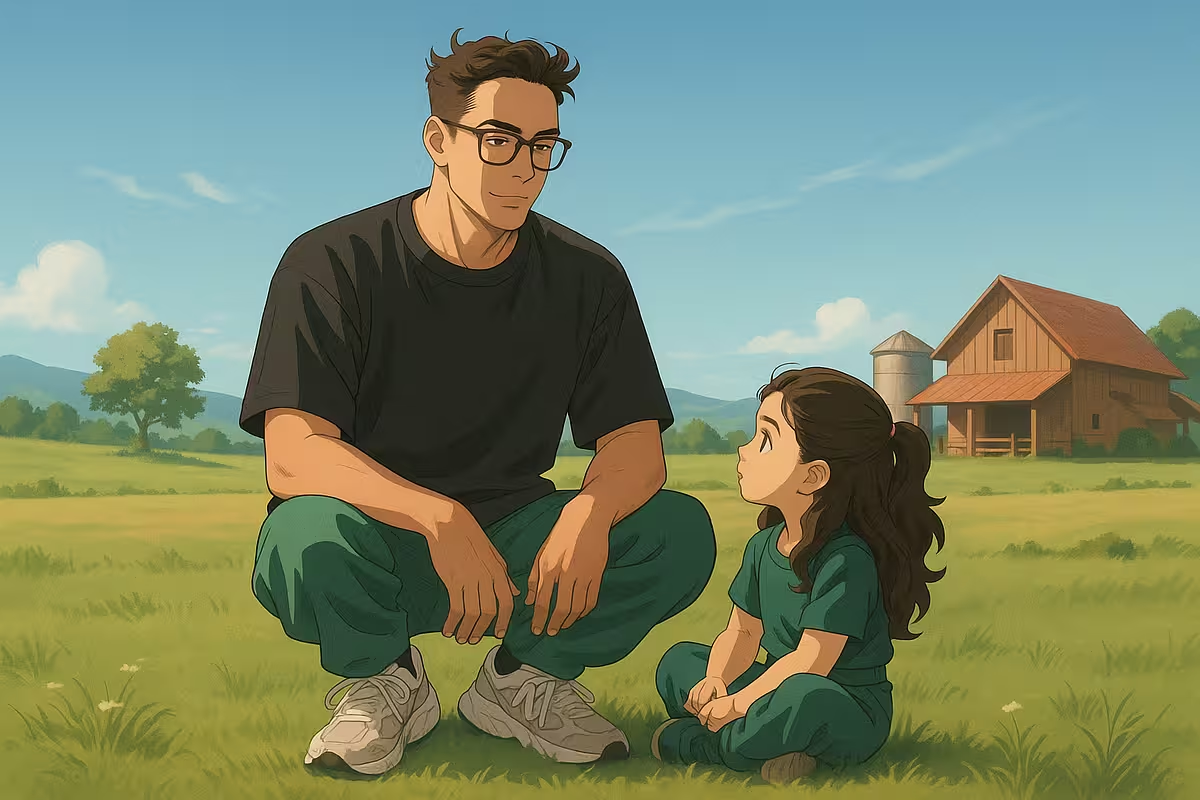\n\nMy daughter and I. Talking about magic fruit. Wink.\n\nWhen I think about what I value today, throughout my life, from childhood to now, I can only admit that fictional characters have influenced me heavily in my upbringing, my emotions, my feelings, and my paradigms. _It's absolutely insane!!! Jajaja_\n\nI was able to identify many of the emotions tied to each. Here's how it goes!\n\n## Here's my fictional character pantheon!!\n\n🗡️ **Samurai X / Kenshin Himura** — The repentant warrior. **Strength in silence**. **Discipline forged through trauma**.\n\n🔥 **Los Caballeros del Zodiaco** — **Brotherhood**. **Sacrifice**. **El Cosmo y el Universo como poder interno**. **Defender hasta la muerte**!! _We played this so much at school, holy shit!! We had a sand playground, so the sand was the water- went hard AF._\n\n⚔️ **Piratas de las Aguas Negras** — **Rebellion**. **Magic**. **Lost history**. _Mystical maps for chosen warriors._\n\n💪 **He-Man** — The quiet man who becomes the god of power _only when needed_. **Protector energy**. _Never liked his hair._\n\n🐉 **Goku / DBZ** — **Relentless evolution**. **Joyful mastery**. **Purity**. **The warrior with a heart of gold**. _I stopped inviting people to spar years ago, close people still get asked sometimes (hi son! lol)._\n\n🌒 **Ninja Scroll** — **Darkness, betrayal, honor**. **The lone blade that survives everything**.\n\n🩸 **Berserk / Guts** — **Pain as power**. **Love through chaos**—_unstoppable resolve_. The eclipse arc broke me. _I ain't going to lie, I have to remind myself this is only fantasy._\n\n🧠 **Dr. House** — **Logic + madness**. **Brutal truth-telling**. **Isolation as protection**. _nothing to see here…_\n\n🧱 **Reacher** — **Power held in stillness**. **Silent justice**. **Unshakeable code**. _Dispatches bullies with elegance and proportional force_.\n\n💀 **The Punisher** — **Vengeance + discipline**. _A protector that walks through fire unflinching. He HATES bullies!!! HE FUCKING HATES BULLIES! I dislike bullies._\n\n🥋 **Daredevil** — **Blind faith, both literal and spiritual**. **Fighting with conscience**. _If he can do it, I can do it._\n\n🦸 **Superman** — **Humility with godhood**. **The immigrant myth**. **The protector who never turns away**. _Imagine if he did NOT have a code, an immediate horror movie._\n\nThere's more. But these are the main ones.\n\nNow that I'm older, the characters influencing or giving me **_joy_ are different.** Now that I'm older... the teachings don't hit the same — they go _deeper_. They don't just **inspire** — they _unfold me._\n\n🌀 **My Hero Academia** — _Deku's trembling hands, still moving forward. All Might's fragile smile. Uraraka's silent bravery. The fire family arc broke me in half._ **What it means to carry trauma, keep going, and be worthy of your gift**.\n\n⚔️ **Samurai Champloo** — Mugen and Jin: **the animal and the monk**. **The chaos and the code**. **The dance of masculine duality**. I've lived both. I do. _If you know me. You know._\n\n🧠 **Evangelion** — **That psychological dread, the loneliness**. How can you be surrounded and still feel hollow? Shinji's scream sometimes lives in my chest. _The soundtrack…_\n\n🩸 **Jujutsu Kaisen** — Gojo's radiant pain hidden behind power. **The bond between Yuji and Todo — true brotherhood forged in battle**. They SPAR. They grow. **_No ego. Just respect. That's sacred._**\n\n🔥 **Demon Slayer** — **Total Concentration Breathing is my emotional regulation**. Literally. Tanjiro's fierce love… _that's how you protect your sister. That's how you protect your people._ Now I know. Thanks, Tanjiro, for literally showing me what nobody else had before. _Unbelievable_.\n\n💥 **JoJo's Bizarre Adventure** — **Be yourself, fully. Loudly. Stylishly. Own it. Earn your legacy with flair and grit**. _Power is personality. Your authenticity to YOU is your power._\n\n👊 **Baki** — Okay, come on. Do I even need to say anything? **Discipline**. **Insanity**. **Combat as conversation**. _The gym is my dojo._\n\n🕶️ **Afro Samurai** — **Cool is earned**. **Grief is sacred**. **Revenge is a weight**. The path is lonely, and beautiful, and _necessary_.\n\n🦴 **Primal** — **No words. Just rawness. Loss. Survival. The bond of beings who see each other**. _I cried over a caveman and a dinosaur, man. Don't @ me._\n\n🌑 **Berserk**, again — Because people _will_ betray you. And still, **you must protect your joy**. **You must carve your truth with a broken blade if you have to**.\n\n### And last but not least…\n\n\n\nSensei…\n\n🧢 **One Punch Man / Saitama** — **The loneliness of mastery**.\n\nThe absurdity of getting _everything_ you wanted… and feeling _nothing._ He won. He beat the game. He trained so hard that he went bald — _literally._ 100 pushups, 100 sit-ups, 100 squats, 10 km run. Every. Day. I did this until it became so easy. I can do this now in minutes. **_Saitama gave me that!_** No AC. No excuses. No glory. No applause. Just effort. And now? He's a god wandering through mediocrity. _No challenge. No equal. No thrill._\n\nSaitama isn't about winning. He's about **what happens after**. After winning... the beauty starts:\n\n👦 **Genos** — His loyal disciple. Obsessed with revenge, fire, ambition. He thinks power = worth. But Saitama? He couldn't care less. He teaches Genos **restraint**, **humility**, and **presence**. Sometimes by accident. _Sometimes? LOL._ But **truths always leak out** from the still ones.\n\n👊 **King** — The most powerful fraud. Everyone believes he's a god-tier fighter, but it's all a misunderstanding. He hides his cowardice behind a poker face. And yet Saitama? _Treats him like a friend. With no judgment. No agenda._ **_Boom_**. Because Saitama doesn't care about titles. He cares about the **energy**.\n\n👽 **Boros** — The only one who made him use a _tiny bit_ of effort. A conqueror from the stars. A god in his own right. Boros dies smiling — not because he won — but because someone finally met him. **Saitama gave him the gift of a real fight**. That was mercy.\n\n🐜 **Tatsumaki** — The psychic girl with attitude and trauma. Saitama just… _annoys_ her. But she can't shake him. He's immune to her drama. **That kind of emotional immovability? It heals, eventually**. She'll never say it, but she sees it. _Let's leave this here…_\n\n🧠 **Mumen Rider** — The opposite of Saitama. No power. No chance. But infinite **heart**. _The real Saitama. The Real King. The real main character._ And Saitama **respects him**. DEEPLY. **_Because heart is what he's missing (Sensei!)_**\n\n💀 **Garou** — The anti-hero. The broken boy who wants to become a monster. And Saitama? _He talks to him. No hate. My boy._ No revenge. Just listening. Just the truth. He offers him a mirror, not a fist. And that **saves** Garou.\n\n🌀 **Fubuki** — She wants power. Influence. Control. But ends up hanging around Saitama because _he's the only man she can't manipulate. Sounds familiar? Sigh._\n\n🎭 **The Hero Association** — Obsession with ranking, numbers, fame. Saitama quietly dismantles that whole system just by existing. He's proof that **none of it means anything**. And that makes them… uncomfortable.\n\n🌌 **The Universe Itself** — Threat level: God. Still not ready. Because he hasn't lost _all_ his humanity yet. There's still boredom. There's still mild curiosity. There's still… his grocery runs.\n\n**Saitama is not a joke. He's a lesson.** He's what happens when you **outgrow** everything. He's the **detached master**. The man with no desire. No fear. No rivals. Only _emptiness and sale items._ But even in that space, he remains gentle. Remains kind. Remains available. He reminds me…\n\n- **To never forget joy.**\n- **To never let success steal your wonder.**\n- **To keep it real, even if the world misunderstands your power.**\n\nAnd above all? **To keep showing up**. To the fight. To the friends. To the market on discount day. _LOL fuck off with that, Saitama Sensei, respectfully._ Because the meaning isn't in the victory — **It's in the living**.\n\nI hope you enjoyed this. **_What's your jam? Who raised you?_**\n\n---\n\n_Originally published on [Medium](https://medium.com/@wizards777/who-really-raised-me-b22766a8a48f)._",
"content_text": "A deep dive into the fictional characters that shaped my values, from childhood cartoons to adult anime. Discover how Samurai X, Dragon Ball Z, Berserk, and especially One Punch Man's Saitama became my true mentors, teaching me about discipline, brotherhood, pain as power, and the loneliness of mastery.",
"summary": "A deep dive into the fictional characters that shaped my values, from childhood cartoons to adult anime. Discover how Samurai X, Dragon Ball Z, Berserk, and especially One Punch Man's Saitama became my true mentors, teaching me about discipline, brotherhood, pain as power, and the loneliness of mastery.",
"date_published": "2025-04-17T13:56:47.953Z",
"date_modified": "2025-04-17T13:56:47.953Z",
"authors": [
{
"name": "Antonio Rodriguez Martinez",
"url": "https://antoniwan.online"
}
],
"tags": [
"integration-growth",
"parenting",
"psychology",
"childhood",
"family",
"consciousness",
"personal-growth",
"self-reflection",
"healing",
"therapy",
"trauma",
"identity",
"self-discovery",
"anime",
"cartoons",
"fictional-characters",
"mentorship",
"values",
"one-punch-man",
"saitama",
"dragon-ball",
"berserk",
"samurai-x"
],
"image": "https://notes.antoniwan.online/images/anime-souls.avif"
},
{
"id": "https://notes.antoniwan.online/p/you-are-joking-right/",
"url": "https://notes.antoniwan.online/p/you-are-joking-right/",
"title": "You are Joking, Right?",
"content_html": "\n\nPhoto by [nikko macaspac](https://unsplash.com/@nikkotations?utm_source=medium&utm_medium=referral) on [Unsplash](https://unsplash.com?utm_source=medium&utm_medium=referral)\n\nInner work is an ongoing process, and there’s some shame involved. Still, the focus should be on awareness, acceptance, and improvement. There should be no shame involved, but it’s hard. Fucking up is hard when one has a conscience.\n\nThis writing is about my latest fuck-up, which leads to the possible discovery of a significant vulnerability or flaw in my character, which, if confirmed, means I have been fucking up so much in my entire life in so many ways and will require intense and immediate shadow work, patching, reparations, crying, and only the Universe knows what. I’m not worried about this; I’m just so blindsided. By my ego? I was blindsided — correction. Now, I’m grateful for the opportunity for growth.\n\nRecently, I had a particular interaction where the person I was with told me, “I’m upset.” My preceding actions had been so inane, tiny, minuscule, nano, in my view and ideologies, “I just said two words in a purely casual context while watching a movie,” and “nothing happened,” I thought to myself, so I reacted almost immediately with a “You are joking, right?” and then proceeded to think I could keep interacting as if nothing had happened. But the truth is that, in hindsight, something had happened! This person was upset, and I had just dismissed them as casually as the action that had preceded the moment. Unacceptable!\n\n> You are joking, right?\n\nI did not notice a thing at the moment. A bit later, this person had the grace to tell me about their frustration with me right there: vulnerable, visibly nervous, and clearly hurt. Something hit me like a meteorite in my brain and my heart. I’ve been doing things like this my entire life. What they were saying felt so familiar, so natural. The shame of understanding this, right there. Unbelievable. I’m learning this in real-time with a near stranger.\n\nThe Universe sent me this trial with potentially huge learnings and invaluable implications for my life, and I finally understood it. I’m so grateful and forgive myself for hurting others and myself. Let’s see where I go from here.\n\nMany moments in my life come to mind where people around me told me things, insinuations, some direct, others indirect, felt, emotions, motions, messages, and communications that I dismissed, intentionally or unintentionally, some favorable, others not-favorable, who knows — holy shit, what a Pandora’s Box has opened in my brain. The realization, that _click_, that “A-ha!” moment. This is what my sister, stepson, friends sometimes, ex-wife, that gut in the stomach of, “shit, I am missing something for sure,” it hit me like a truck, that’s what that was, that’s what invalidating someone’s feeling looks like. It can happen in a matter of seconds, and I had been unaware and hurting or affecting people left and right unbeknownst to me, absolutely unacceptable and mind-blowing. It doesn’t matter how tiny, minuscule, ephemeral, superficial, pathetic, whatever, or whatever way I would describe it to dehumanize it and remove that a person gave this gift of communication to me. I chose to justify my acting willingly ignorant because you were joking, right? Fuck me; there’s so much more work I need to do.\n\nUnbeknownst to them and independent of whatever happens to us, this person will go into my hall of fame for the people of my life as sent by the Universe to humble me. It cost them some upset, which is wild to me; how hurt and upset can happen, at a whim, over anything, and it’s up to us to act in kindness and communicate. This person communicated right there in a way I had never experienced before. My first thought was, “They felt safe, telling me what they needed to tell me,” or “Wow, nobody had talked to me like that; I like it,” but then if I dismissed or found myself dismissing, perhaps people around had been communicating with me. I had also been dismissing or outright ignoring or being unable to understand.\n\nSo many moments in my life come to mind where people around me told me things, insinuations, some direct, other indirect, felt, emotions, motions, messages, and communications that I dismissed, intentionally or unintentionally.\n\n“You are joking, right?” The pattern, the shield, the blind spot. The path I must walk now to understand, accept, feel, learn, heal, practice, and stop doing this nonsense looks fun. More work. The work never ends. I’m going to stop here for now. Sharing is caring.\n\n---\n\n_Originally published on [Medium](https://medium.com/@wizards777/you-are-joking-right-69d482f85875)._",
"content_text": "Inner work is an ongoing process, and there’s some shame involved. Still, the focus should be on awareness, acceptance, and improvement…",
"summary": "Inner work is an ongoing process, and there’s some shame involved. Still, the focus should be on awareness, acceptance, and improvement…",
"date_published": "2025-04-08T13:20:17.106Z",
"date_modified": "2025-04-08T13:20:17.106Z",
"authors": [
{
"name": "Antonio Rodriguez Martinez",
"url": "https://antoniwan.online"
}
],
"tags": [
"psychology",
"metaspace",
"integration-growth",
"self-reflection",
"consciousness",
"personal-growth",
"healing",
"therapy",
"emotional-regulation",
"self-improvement",
"mindfulness",
"metaspace",
"transformation"
]
},
{
"id": "https://notes.antoniwan.online/p/fear-control-politics/",
"url": "https://notes.antoniwan.online/p/fear-control-politics/",
"title": "If Your Politics Obsess Over Control, You're Not Well",
"content_html": "## 🧠 If Your Politics Obsess Over Control, You're Not Well\n\nOriginally published April 1, 2025 – Updated July 2, 2025\n\n> \"You are not fighting evil. You are losing to your own sickness.\" \n> — Me, watching the news again\n\n## 🚨 Control is Not a Value—It's a Symptom\n\nIf your political framework focuses obsessively on controlling people's bodies, identities, choices, or behaviors, we're not talking about a philosophy anymore. We're talking about trauma—and your inability to manage it.\n\nYou call it \"traditional values.\" I call it unchecked fear wearing a badge.\n\nThese obsessions—about gender, sexuality, reproductive rights, what kids are allowed to read, who can love whom—are not policy positions. They are control compulsions masquerading as ideology. This isn't about roads, clean water, stable power grids, or healthcare. This is about sex, fear, punishment, and projection.\n\nLet's stop pretending otherwise.\n\n## 🪞 A Vignette: Behind the Curtain of Control\n\nLast year, I had a long conversation with a former coworker, \"Mike\" (not his real name). He was deep in conservative politics. Anti-trans. Anti-choice. Pro-punishment everything. But in that conversation, something cracked.\n\nHe told me, \"I don't even know why I care so much about what other people do. I just get…angry. Like the world is spinning too fast and I can't hold on.\"\n\nThere it was.\n\nHis rage wasn't ideological—it was existential. It came from losing control over his own life, over decades of repression, isolation, and fear. And instead of healing, he turned that fear outward. Politics was just the vehicle.\n\n## 🧾 Control vs Health — Not the Same Thing\n\nBefore we go deeper, here's a breakdown of the difference:\n\n| Obsession with Control | Signs of Mental/Emotional Health |\n| --------------------------- | ------------------------------------ |\n| Polices bodies & choices | Supports autonomy & informed choice |\n| Demonizes complexity | Accepts nuance and contradiction |\n| Frames freedom as threat | Frames freedom as growth |\n| Seeks purity or \"order\" | Seeks compassion and reality-checks |\n| Projects inner fear outward | Takes personal responsibility inward |\n| Shames, isolates, punishes | Includes, embraces, restores |\n| Lives in black-and-white | Lives in full-spectrum color |\n\n## ⚠️ The Real Root is Fear\n\n> \"Fear is the mind-killer.\" \n> — Dune, and every damn trauma therapist ever\n\nMost control-centered ideologies come from a root of fear. Fear of difference. Fear of change. Fear of one's own impulses. Fear of being wrong. Of losing the story that gives you meaning.\n\nBut here's the problem with fear: it always seeks shortcuts. It wants certainty. It wants simplicity. It wants order, even if it means crushing people.\n\nAnd the more someone lacks internal security, the more external control they try to impose.\n\n## 🚫 Your \"Conviction\" Might Be a Trauma Disorder\n\nLet's be real. You're not protecting kids. You're not defending freedom. You're not upholding faith or tradition.\n\nYou're managing a panic attack. You're rewriting your shame into someone else's sin. You're externalizing your terror by trying to micromanage society into a mirror of your denial.\n\nYou've turned your unresolved inner wounds into external war.\n\nAnd the tragedy? You could have healed instead.\n\n## ✋ What Healing Actually Looks Like (It's Not Flashy)\n\nHere's the real radical path:\n\n- Therapy\n- Journaling\n- Learning to say, \"I was wrong\"\n- Feeling your body\n- Letting go of inherited beliefs\n- Losing arguments with grace\n- Apologizing without qualifiers\n- Letting people live\n- Not needing to be right all the time\n- Admitting you're scared—and facing that\n\nIt's boring. It's uncomfortable. It's not going to get applause or retweets. But it might actually change something: you.\n\n## 🧭 Where We Go From Here\n\nThis isn't a call to arms. It's a call to reflection. Ask yourself:\n\n- What would I be left with if I stopped fighting for control?\n- Who would I become if I no longer needed to dominate others?\n- What part of me is still afraid of living in a diverse, dynamic, unpredictable world?\n\nIf your politics only feel stable when someone else is suffering, then you don't believe in politics—you believe in punishment.\n\nAnd if that's what you call freedom… you're not well.",
"content_text": "Analysis of how fear and trauma manifest in control-based political ideologies. Explores the relationship between personal insecurity and authoritarian policy positions.",
"summary": "Analysis of how fear and trauma manifest in control-based political ideologies. Explores the relationship between personal insecurity and authoritarian policy positions.",
"date_published": "2025-04-01T00:00:00.000Z",
"date_modified": "2025-04-01T00:00:00.000Z",
"authors": [
{
"name": "Antonio Rodriguez Martinez",
"url": "https://antoniwan.online"
}
],
"tags": [
"politics",
"psychology",
"metaspace",
"politics",
"fear",
"control",
"mental-health",
"social-issues",
"collective-healing",
"consciousness",
"social-justice",
"therapy",
"healing"
]
},
{
"id": "https://notes.antoniwan.online/p/on-overcoming-analysis-paralysis/",
"url": "https://notes.antoniwan.online/p/on-overcoming-analysis-paralysis/",
"title": "On Overcoming Analysis Paralysis",
"content_html": "I may not be a behavioral expert, but I’m an expert on overthinking and becoming paralyzed. Over time, and with much practice, I’m also slowly becoming adept at snapping out of this emotional and physical paralysis using a few simple steps — with what I think are very low-effort ideas.\n\nYou may want to move, say, or do something. You might have to do something super important. You may have so much stuff to do, so many responsibilities, so many noisy thoughts in your thinking, and so many different emotions and ideas that may or may not contradict each other, and ultimately, you end up doing nothing because your feet won’t budge, your mouth refuses to communicate what needs to be communicated, your brain refuses to cooperate and decide what to do next, and overall, you are just stuck right there, existing, the minutes and hours go by, without being your whole self, without action! You are unable to decide your next steps to spring into action! This paralysis experience may also happen with little burden or responsibilities, and you aren’t used to springing into action as efficiently as possible. Overall, there are many terms for this human experience of idleness: procrastination by analysis, decision fatigue, overthinking, the paradox of choice, cognitive overload, Hamlet syndrome, circular thinking, analysis paralysis, whatever! However we want to name it, now that we understand what we are talking about it, you may say to yourself, “damn, that happens to me VERY often; it even happened this morning,” from choosing what to watch or wear or eat, to music, to relationships, to work items, whatever it is, I believe this human experience of paralysis is a big challenge in our lives, and we should attack it urgently, swiftly and with utmost seriousness and importance because by overcoming it we will unlock so much time and efficiency. Efficiency to rest better, to take whatever action you want towards whatever you wish to (versus inactions), to do whatever you want, without wasting our precious time — the most valuable resource in our human condition.\n\nSo, all that said, here’s what I propose to you next time you feel paralyzed. **TLDR Alert!**\n\nAs soon as you become aware that you are dillydallying and paralyzed:\n\n1. Take serious, **deep breaths** until you are only within your five senses. If you are breathing deep enough, your thoughts will fade away naturally. Your hands may become heavy, and so will your legs. Your torso will expand and contract, and that’s probably all you can feel or think about. You are now _emotionally regulated and as close as possible to a clean slate_.\n2. Now, **take a single step in any direction**. Another way to say this is to move physically from wherever you are. Take a step forward, backward, or sideways, jump into another spot, and move from wherever you are. Crawl, roll, whatever. The point is to ACT! ACTION!\n\nAnd that’s it! You are no longer paralyzed. You have taken action!\n\nYou might be thinking, “Antonio, that’s so dumb. Are you serious?” Well, it might be dumb, my friend, but it’s as simple as that. Practice makes perfect, and overcoming paralysis is no different than any other skill that you could learn and develop by practice. By taking deep breaths, you focus on your existing body, and by moving from your physical location, you are taking action toward or against whatever it is you want to do.\n\nAfter all, this is not a guide or idea to completing your goals; no, this is a guide to overcoming paralysis in a simple and reproducible manner, and as you practice these simple steps, every single time you become paralyzed, you are rewriting your behavior, rewiring your brain, and applying a tactic or strategy that will spring you into action. These simple actions are entirely attainable and repeatable. This is something that you can confirm for yourself. It works!\n\nAs you practice this approach and the steps, you can elaborate on what works best for you and even complicate it! For myself, I’m able to add a “decision-making” step in between my steps; below, I’m adding a graph that shows my thought process. I hope it’s helpful in your development of this skill of overcoming paralysis.\n\n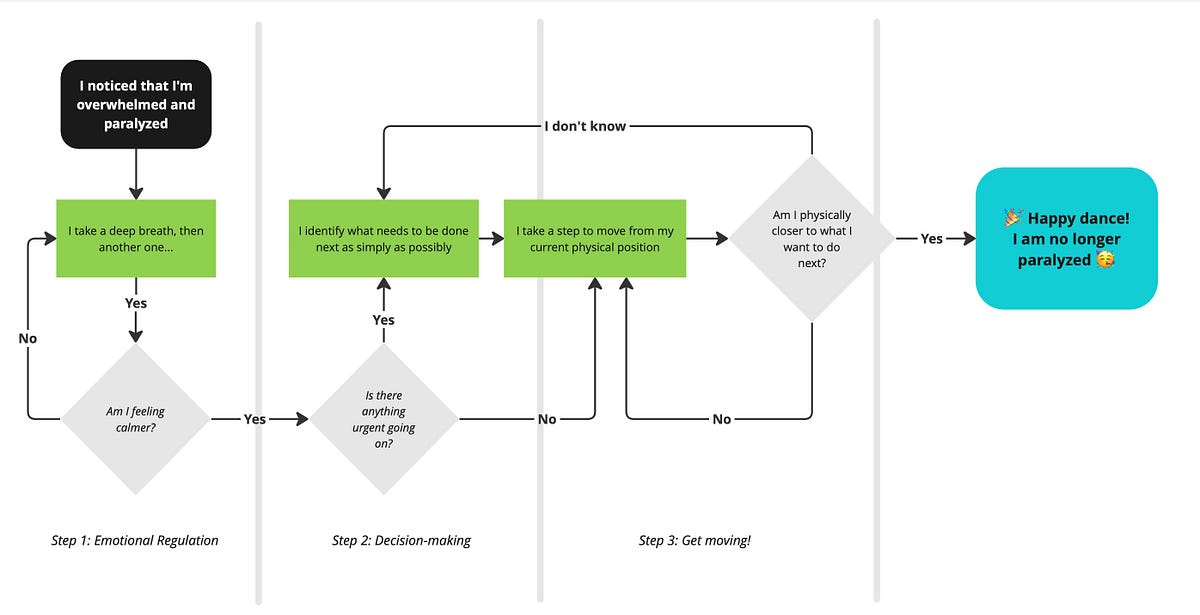\n\nBreathe, Move, Act!\n\nThe action, your step, truth be told, might take you closer or further from your goal, but that’s not the point; the point is springing into action and teaching your body that we can spring into action without wasting our time. Springing into action becomes a habit! And once you are in motion and out of the paralysis state, you can use that momentum to course-correct and take another step towards your goal without worrying about being paralyzed. Do you see it now? Baby steps. Get out of the paralysis by doing something simple and replicable, and then worry about the next step. Divide and conquer, and in this case, we are tricking our nervous system to spring into action and slowly learning that for any paralysis situation, we can move and stop becoming paralyzed without analyzing if our move was good or bad, correct or incorrect, you are just NOT paralyzed.\n\nFood for thought. Sharing is caring.\n\nI hope this is helpful to you. Feel free to send me a note with your ideas. Do you disagree? Also, let me know! Get it!\n\n---\n\n_Originally published on [Medium](https://medium.com/@wizards777/on-overcoming-analysis-paralysis-d9281a526dc8)._",
"content_text": "Practice makes perfect, and overcoming paralysis is no different than any other skill that you could learn and develop by practice.",
"summary": "Practice makes perfect, and overcoming paralysis is no different than any other skill that you could learn and develop by practice.",
"date_published": "2024-12-04T15:25:09.221Z",
"date_modified": "2024-12-04T15:25:09.221Z",
"authors": [
{
"name": "Antonio Rodriguez Martinez",
"url": "https://antoniwan.online"
}
],
"tags": [
"psychology",
"systems-strategy",
"analysis-paralysis",
"mental-health",
"consciousness",
"personal-growth",
"decision-making",
"mindfulness",
"self-improvement",
"healing",
"therapy",
"emotional-regulation"
]
},
{
"id": "https://notes.antoniwan.online/p/on-simplicity-and-peace-of-mind/",
"url": "https://notes.antoniwan.online/p/on-simplicity-and-peace-of-mind/",
"title": "On Simplicity and Peace of Mind",
"content_html": "On Feeling Whole Without Owning Much
\n\nI've been thinking a lot about who raised me to be who I am. And I'm preparing an essay about that. _But this one is not about that._ This one is about the **fictional characters** that raised me.\n\n\n\nMy daughter and I. Talking about magic fruit. Wink.\n\nWhen I think about what I value today, throughout my life, from childhood to now, I can only admit that fictional characters have influenced me heavily in my upbringing, my emotions, my feelings, and my paradigms. _It's absolutely insane!!! Jajaja_\n\nI was able to identify many of the emotions tied to each. Here's how it goes!\n\n## Here's my fictional character pantheon!!\n\n🗡️ **Samurai X / Kenshin Himura** — The repentant warrior. **Strength in silence**. **Discipline forged through trauma**.\n\n🔥 **Los Caballeros del Zodiaco** — **Brotherhood**. **Sacrifice**. **El Cosmo y el Universo como poder interno**. **Defender hasta la muerte**!! _We played this so much at school, holy shit!! We had a sand playground, so the sand was the water- went hard AF._\n\n⚔️ **Piratas de las Aguas Negras** — **Rebellion**. **Magic**. **Lost history**. _Mystical maps for chosen warriors._\n\n💪 **He-Man** — The quiet man who becomes the god of power _only when needed_. **Protector energy**. _Never liked his hair._\n\n🐉 **Goku / DBZ** — **Relentless evolution**. **Joyful mastery**. **Purity**. **The warrior with a heart of gold**. _I stopped inviting people to spar years ago, close people still get asked sometimes (hi son! lol)._\n\n🌒 **Ninja Scroll** — **Darkness, betrayal, honor**. **The lone blade that survives everything**.\n\n🩸 **Berserk / Guts** — **Pain as power**. **Love through chaos**—_unstoppable resolve_. The eclipse arc broke me. _I ain't going to lie, I have to remind myself this is only fantasy._\n\n🧠 **Dr. House** — **Logic + madness**. **Brutal truth-telling**. **Isolation as protection**. _nothing to see here…_\n\n🧱 **Reacher** — **Power held in stillness**. **Silent justice**. **Unshakeable code**. _Dispatches bullies with elegance and proportional force_.\n\n💀 **The Punisher** — **Vengeance + discipline**. _A protector that walks through fire unflinching. He HATES bullies!!! HE FUCKING HATES BULLIES! I dislike bullies._\n\n🥋 **Daredevil** — **Blind faith, both literal and spiritual**. **Fighting with conscience**. _If he can do it, I can do it._\n\n🦸 **Superman** — **Humility with godhood**. **The immigrant myth**. **The protector who never turns away**. _Imagine if he did NOT have a code, an immediate horror movie._\n\nThere's more. But these are the main ones.\n\nNow that I'm older, the characters influencing or giving me **_joy_ are different.** Now that I'm older... the teachings don't hit the same — they go _deeper_. They don't just **inspire** — they _unfold me._\n\n🌀 **My Hero Academia** — _Deku's trembling hands, still moving forward. All Might's fragile smile. Uraraka's silent bravery. The fire family arc broke me in half._ **What it means to carry trauma, keep going, and be worthy of your gift**.\n\n⚔️ **Samurai Champloo** — Mugen and Jin: **the animal and the monk**. **The chaos and the code**. **The dance of masculine duality**. I've lived both. I do. _If you know me. You know._\n\n🧠 **Evangelion** — **That psychological dread, the loneliness**. How can you be surrounded and still feel hollow? Shinji's scream sometimes lives in my chest. _The soundtrack…_\n\n🩸 **Jujutsu Kaisen** — Gojo's radiant pain hidden behind power. **The bond between Yuji and Todo — true brotherhood forged in battle**. They SPAR. They grow. **_No ego. Just respect. That's sacred._**\n\n🔥 **Demon Slayer** — **Total Concentration Breathing is my emotional regulation**. Literally. Tanjiro's fierce love… _that's how you protect your sister. That's how you protect your people._ Now I know. Thanks, Tanjiro, for literally showing me what nobody else had before. _Unbelievable_.\n\n💥 **JoJo's Bizarre Adventure** — **Be yourself, fully. Loudly. Stylishly. Own it. Earn your legacy with flair and grit**. _Power is personality. Your authenticity to YOU is your power._\n\n👊 **Baki** — Okay, come on. Do I even need to say anything? **Discipline**. **Insanity**. **Combat as conversation**. _The gym is my dojo._\n\n🕶️ **Afro Samurai** — **Cool is earned**. **Grief is sacred**. **Revenge is a weight**. The path is lonely, and beautiful, and _necessary_.\n\n🦴 **Primal** — **No words. Just rawness. Loss. Survival. The bond of beings who see each other**. _I cried over a caveman and a dinosaur, man. Don't @ me._\n\n🌑 **Berserk**, again — Because people _will_ betray you. And still, **you must protect your joy**. **You must carve your truth with a broken blade if you have to**.\n\n### And last but not least…\n\n\n\nSensei…\n\n🧢 **One Punch Man / Saitama** — **The loneliness of mastery**.\n\nThe absurdity of getting _everything_ you wanted… and feeling _nothing._ He won. He beat the game. He trained so hard that he went bald — _literally._ 100 pushups, 100 sit-ups, 100 squats, 10 km run. Every. Day. I did this until it became so easy. I can do this now in minutes. **_Saitama gave me that!_** No AC. No excuses. No glory. No applause. Just effort. And now? He's a god wandering through mediocrity. _No challenge. No equal. No thrill._\n\nSaitama isn't about winning. He's about **what happens after**. After winning... the beauty starts:\n\n👦 **Genos** — His loyal disciple. Obsessed with revenge, fire, ambition. He thinks power = worth. But Saitama? He couldn't care less. He teaches Genos **restraint**, **humility**, and **presence**. Sometimes by accident. _Sometimes? LOL._ But **truths always leak out** from the still ones.\n\n👊 **King** — The most powerful fraud. Everyone believes he's a god-tier fighter, but it's all a misunderstanding. He hides his cowardice behind a poker face. And yet Saitama? _Treats him like a friend. With no judgment. No agenda._ **_Boom_**. Because Saitama doesn't care about titles. He cares about the **energy**.\n\n👽 **Boros** — The only one who made him use a _tiny bit_ of effort. A conqueror from the stars. A god in his own right. Boros dies smiling — not because he won — but because someone finally met him. **Saitama gave him the gift of a real fight**. That was mercy.\n\n🐜 **Tatsumaki** — The psychic girl with attitude and trauma. Saitama just… _annoys_ her. But she can't shake him. He's immune to her drama. **That kind of emotional immovability? It heals, eventually**. She'll never say it, but she sees it. _Let's leave this here…_\n\n🧠 **Mumen Rider** — The opposite of Saitama. No power. No chance. But infinite **heart**. _The real Saitama. The Real King. The real main character._ And Saitama **respects him**. DEEPLY. **_Because heart is what he's missing (Sensei!)_**\n\n💀 **Garou** — The anti-hero. The broken boy who wants to become a monster. And Saitama? _He talks to him. No hate. My boy._ No revenge. Just listening. Just the truth. He offers him a mirror, not a fist. And that **saves** Garou.\n\n🌀 **Fubuki** — She wants power. Influence. Control. But ends up hanging around Saitama because _he's the only man she can't manipulate. Sounds familiar? Sigh._\n\n🎭 **The Hero Association** — Obsession with ranking, numbers, fame. Saitama quietly dismantles that whole system just by existing. He's proof that **none of it means anything**. And that makes them… uncomfortable.\n\n🌌 **The Universe Itself** — Threat level: God. Still not ready. Because he hasn't lost _all_ his humanity yet. There's still boredom. There's still mild curiosity. There's still… his grocery runs.\n\n**Saitama is not a joke. He's a lesson.** He's what happens when you **outgrow** everything. He's the **detached master**. The man with no desire. No fear. No rivals. Only _emptiness and sale items._ But even in that space, he remains gentle. Remains kind. Remains available. He reminds me…\n\n- **To never forget joy.**\n- **To never let success steal your wonder.**\n- **To keep it real, even if the world misunderstands your power.**\n\nAnd above all? **To keep showing up**. To the fight. To the friends. To the market on discount day. _LOL fuck off with that, Saitama Sensei, respectfully._ Because the meaning isn't in the victory — **It's in the living**.\n\nI hope you enjoyed this. **_What's your jam? Who raised you?_**\n\n---\n\n_Originally published on [Medium](https://medium.com/@wizards777/who-really-raised-me-b22766a8a48f)._",
"content_text": "A deep dive into the fictional characters that shaped my values, from childhood cartoons to adult anime. Discover how Samurai X, Dragon Ball Z, Berserk, and especially One Punch Man's Saitama became my true mentors, teaching me about discipline, brotherhood, pain as power, and the loneliness of mastery.",
"summary": "A deep dive into the fictional characters that shaped my values, from childhood cartoons to adult anime. Discover how Samurai X, Dragon Ball Z, Berserk, and especially One Punch Man's Saitama became my true mentors, teaching me about discipline, brotherhood, pain as power, and the loneliness of mastery.",
"date_published": "2025-04-17T13:56:47.953Z",
"date_modified": "2025-04-17T13:56:47.953Z",
"authors": [
{
"name": "Antonio Rodriguez Martinez",
"url": "https://antoniwan.online"
}
],
"tags": [
"integration-growth",
"parenting",
"psychology",
"childhood",
"family",
"consciousness",
"personal-growth",
"self-reflection",
"healing",
"therapy",
"trauma",
"identity",
"self-discovery",
"anime",
"cartoons",
"fictional-characters",
"mentorship",
"values",
"one-punch-man",
"saitama",
"dragon-ball",
"berserk",
"samurai-x"
],
"image": "https://notes.antoniwan.online/images/anime-souls.avif"
},
{
"id": "https://notes.antoniwan.online/p/you-are-joking-right/",
"url": "https://notes.antoniwan.online/p/you-are-joking-right/",
"title": "You are Joking, Right?",
"content_html": "\n\nPhoto by [nikko macaspac](https://unsplash.com/@nikkotations?utm_source=medium&utm_medium=referral) on [Unsplash](https://unsplash.com?utm_source=medium&utm_medium=referral)\n\nInner work is an ongoing process, and there’s some shame involved. Still, the focus should be on awareness, acceptance, and improvement. There should be no shame involved, but it’s hard. Fucking up is hard when one has a conscience.\n\nThis writing is about my latest fuck-up, which leads to the possible discovery of a significant vulnerability or flaw in my character, which, if confirmed, means I have been fucking up so much in my entire life in so many ways and will require intense and immediate shadow work, patching, reparations, crying, and only the Universe knows what. I’m not worried about this; I’m just so blindsided. By my ego? I was blindsided — correction. Now, I’m grateful for the opportunity for growth.\n\nRecently, I had a particular interaction where the person I was with told me, “I’m upset.” My preceding actions had been so inane, tiny, minuscule, nano, in my view and ideologies, “I just said two words in a purely casual context while watching a movie,” and “nothing happened,” I thought to myself, so I reacted almost immediately with a “You are joking, right?” and then proceeded to think I could keep interacting as if nothing had happened. But the truth is that, in hindsight, something had happened! This person was upset, and I had just dismissed them as casually as the action that had preceded the moment. Unacceptable!\n\n> You are joking, right?\n\nI did not notice a thing at the moment. A bit later, this person had the grace to tell me about their frustration with me right there: vulnerable, visibly nervous, and clearly hurt. Something hit me like a meteorite in my brain and my heart. I’ve been doing things like this my entire life. What they were saying felt so familiar, so natural. The shame of understanding this, right there. Unbelievable. I’m learning this in real-time with a near stranger.\n\nThe Universe sent me this trial with potentially huge learnings and invaluable implications for my life, and I finally understood it. I’m so grateful and forgive myself for hurting others and myself. Let’s see where I go from here.\n\nMany moments in my life come to mind where people around me told me things, insinuations, some direct, others indirect, felt, emotions, motions, messages, and communications that I dismissed, intentionally or unintentionally, some favorable, others not-favorable, who knows — holy shit, what a Pandora’s Box has opened in my brain. The realization, that _click_, that “A-ha!” moment. This is what my sister, stepson, friends sometimes, ex-wife, that gut in the stomach of, “shit, I am missing something for sure,” it hit me like a truck, that’s what that was, that’s what invalidating someone’s feeling looks like. It can happen in a matter of seconds, and I had been unaware and hurting or affecting people left and right unbeknownst to me, absolutely unacceptable and mind-blowing. It doesn’t matter how tiny, minuscule, ephemeral, superficial, pathetic, whatever, or whatever way I would describe it to dehumanize it and remove that a person gave this gift of communication to me. I chose to justify my acting willingly ignorant because you were joking, right? Fuck me; there’s so much more work I need to do.\n\nUnbeknownst to them and independent of whatever happens to us, this person will go into my hall of fame for the people of my life as sent by the Universe to humble me. It cost them some upset, which is wild to me; how hurt and upset can happen, at a whim, over anything, and it’s up to us to act in kindness and communicate. This person communicated right there in a way I had never experienced before. My first thought was, “They felt safe, telling me what they needed to tell me,” or “Wow, nobody had talked to me like that; I like it,” but then if I dismissed or found myself dismissing, perhaps people around had been communicating with me. I had also been dismissing or outright ignoring or being unable to understand.\n\nSo many moments in my life come to mind where people around me told me things, insinuations, some direct, other indirect, felt, emotions, motions, messages, and communications that I dismissed, intentionally or unintentionally.\n\n“You are joking, right?” The pattern, the shield, the blind spot. The path I must walk now to understand, accept, feel, learn, heal, practice, and stop doing this nonsense looks fun. More work. The work never ends. I’m going to stop here for now. Sharing is caring.\n\n---\n\n_Originally published on [Medium](https://medium.com/@wizards777/you-are-joking-right-69d482f85875)._",
"content_text": "Inner work is an ongoing process, and there’s some shame involved. Still, the focus should be on awareness, acceptance, and improvement…",
"summary": "Inner work is an ongoing process, and there’s some shame involved. Still, the focus should be on awareness, acceptance, and improvement…",
"date_published": "2025-04-08T13:20:17.106Z",
"date_modified": "2025-04-08T13:20:17.106Z",
"authors": [
{
"name": "Antonio Rodriguez Martinez",
"url": "https://antoniwan.online"
}
],
"tags": [
"psychology",
"metaspace",
"integration-growth",
"self-reflection",
"consciousness",
"personal-growth",
"healing",
"therapy",
"emotional-regulation",
"self-improvement",
"mindfulness",
"metaspace",
"transformation"
]
},
{
"id": "https://notes.antoniwan.online/p/fear-control-politics/",
"url": "https://notes.antoniwan.online/p/fear-control-politics/",
"title": "If Your Politics Obsess Over Control, You're Not Well",
"content_html": "## 🧠 If Your Politics Obsess Over Control, You're Not Well\n\nOriginally published April 1, 2025 – Updated July 2, 2025\n\n> \"You are not fighting evil. You are losing to your own sickness.\" \n> — Me, watching the news again\n\n## 🚨 Control is Not a Value—It's a Symptom\n\nIf your political framework focuses obsessively on controlling people's bodies, identities, choices, or behaviors, we're not talking about a philosophy anymore. We're talking about trauma—and your inability to manage it.\n\nYou call it \"traditional values.\" I call it unchecked fear wearing a badge.\n\nThese obsessions—about gender, sexuality, reproductive rights, what kids are allowed to read, who can love whom—are not policy positions. They are control compulsions masquerading as ideology. This isn't about roads, clean water, stable power grids, or healthcare. This is about sex, fear, punishment, and projection.\n\nLet's stop pretending otherwise.\n\n## 🪞 A Vignette: Behind the Curtain of Control\n\nLast year, I had a long conversation with a former coworker, \"Mike\" (not his real name). He was deep in conservative politics. Anti-trans. Anti-choice. Pro-punishment everything. But in that conversation, something cracked.\n\nHe told me, \"I don't even know why I care so much about what other people do. I just get…angry. Like the world is spinning too fast and I can't hold on.\"\n\nThere it was.\n\nHis rage wasn't ideological—it was existential. It came from losing control over his own life, over decades of repression, isolation, and fear. And instead of healing, he turned that fear outward. Politics was just the vehicle.\n\n## 🧾 Control vs Health — Not the Same Thing\n\nBefore we go deeper, here's a breakdown of the difference:\n\n| Obsession with Control | Signs of Mental/Emotional Health |\n| --------------------------- | ------------------------------------ |\n| Polices bodies & choices | Supports autonomy & informed choice |\n| Demonizes complexity | Accepts nuance and contradiction |\n| Frames freedom as threat | Frames freedom as growth |\n| Seeks purity or \"order\" | Seeks compassion and reality-checks |\n| Projects inner fear outward | Takes personal responsibility inward |\n| Shames, isolates, punishes | Includes, embraces, restores |\n| Lives in black-and-white | Lives in full-spectrum color |\n\n## ⚠️ The Real Root is Fear\n\n> \"Fear is the mind-killer.\" \n> — Dune, and every damn trauma therapist ever\n\nMost control-centered ideologies come from a root of fear. Fear of difference. Fear of change. Fear of one's own impulses. Fear of being wrong. Of losing the story that gives you meaning.\n\nBut here's the problem with fear: it always seeks shortcuts. It wants certainty. It wants simplicity. It wants order, even if it means crushing people.\n\nAnd the more someone lacks internal security, the more external control they try to impose.\n\n## 🚫 Your \"Conviction\" Might Be a Trauma Disorder\n\nLet's be real. You're not protecting kids. You're not defending freedom. You're not upholding faith or tradition.\n\nYou're managing a panic attack. You're rewriting your shame into someone else's sin. You're externalizing your terror by trying to micromanage society into a mirror of your denial.\n\nYou've turned your unresolved inner wounds into external war.\n\nAnd the tragedy? You could have healed instead.\n\n## ✋ What Healing Actually Looks Like (It's Not Flashy)\n\nHere's the real radical path:\n\n- Therapy\n- Journaling\n- Learning to say, \"I was wrong\"\n- Feeling your body\n- Letting go of inherited beliefs\n- Losing arguments with grace\n- Apologizing without qualifiers\n- Letting people live\n- Not needing to be right all the time\n- Admitting you're scared—and facing that\n\nIt's boring. It's uncomfortable. It's not going to get applause or retweets. But it might actually change something: you.\n\n## 🧭 Where We Go From Here\n\nThis isn't a call to arms. It's a call to reflection. Ask yourself:\n\n- What would I be left with if I stopped fighting for control?\n- Who would I become if I no longer needed to dominate others?\n- What part of me is still afraid of living in a diverse, dynamic, unpredictable world?\n\nIf your politics only feel stable when someone else is suffering, then you don't believe in politics—you believe in punishment.\n\nAnd if that's what you call freedom… you're not well.",
"content_text": "Analysis of how fear and trauma manifest in control-based political ideologies. Explores the relationship between personal insecurity and authoritarian policy positions.",
"summary": "Analysis of how fear and trauma manifest in control-based political ideologies. Explores the relationship between personal insecurity and authoritarian policy positions.",
"date_published": "2025-04-01T00:00:00.000Z",
"date_modified": "2025-04-01T00:00:00.000Z",
"authors": [
{
"name": "Antonio Rodriguez Martinez",
"url": "https://antoniwan.online"
}
],
"tags": [
"politics",
"psychology",
"metaspace",
"politics",
"fear",
"control",
"mental-health",
"social-issues",
"collective-healing",
"consciousness",
"social-justice",
"therapy",
"healing"
]
},
{
"id": "https://notes.antoniwan.online/p/on-overcoming-analysis-paralysis/",
"url": "https://notes.antoniwan.online/p/on-overcoming-analysis-paralysis/",
"title": "On Overcoming Analysis Paralysis",
"content_html": "I may not be a behavioral expert, but I’m an expert on overthinking and becoming paralyzed. Over time, and with much practice, I’m also slowly becoming adept at snapping out of this emotional and physical paralysis using a few simple steps — with what I think are very low-effort ideas.\n\nYou may want to move, say, or do something. You might have to do something super important. You may have so much stuff to do, so many responsibilities, so many noisy thoughts in your thinking, and so many different emotions and ideas that may or may not contradict each other, and ultimately, you end up doing nothing because your feet won’t budge, your mouth refuses to communicate what needs to be communicated, your brain refuses to cooperate and decide what to do next, and overall, you are just stuck right there, existing, the minutes and hours go by, without being your whole self, without action! You are unable to decide your next steps to spring into action! This paralysis experience may also happen with little burden or responsibilities, and you aren’t used to springing into action as efficiently as possible. Overall, there are many terms for this human experience of idleness: procrastination by analysis, decision fatigue, overthinking, the paradox of choice, cognitive overload, Hamlet syndrome, circular thinking, analysis paralysis, whatever! However we want to name it, now that we understand what we are talking about it, you may say to yourself, “damn, that happens to me VERY often; it even happened this morning,” from choosing what to watch or wear or eat, to music, to relationships, to work items, whatever it is, I believe this human experience of paralysis is a big challenge in our lives, and we should attack it urgently, swiftly and with utmost seriousness and importance because by overcoming it we will unlock so much time and efficiency. Efficiency to rest better, to take whatever action you want towards whatever you wish to (versus inactions), to do whatever you want, without wasting our precious time — the most valuable resource in our human condition.\n\nSo, all that said, here’s what I propose to you next time you feel paralyzed. **TLDR Alert!**\n\nAs soon as you become aware that you are dillydallying and paralyzed:\n\n1. Take serious, **deep breaths** until you are only within your five senses. If you are breathing deep enough, your thoughts will fade away naturally. Your hands may become heavy, and so will your legs. Your torso will expand and contract, and that’s probably all you can feel or think about. You are now _emotionally regulated and as close as possible to a clean slate_.\n2. Now, **take a single step in any direction**. Another way to say this is to move physically from wherever you are. Take a step forward, backward, or sideways, jump into another spot, and move from wherever you are. Crawl, roll, whatever. The point is to ACT! ACTION!\n\nAnd that’s it! You are no longer paralyzed. You have taken action!\n\nYou might be thinking, “Antonio, that’s so dumb. Are you serious?” Well, it might be dumb, my friend, but it’s as simple as that. Practice makes perfect, and overcoming paralysis is no different than any other skill that you could learn and develop by practice. By taking deep breaths, you focus on your existing body, and by moving from your physical location, you are taking action toward or against whatever it is you want to do.\n\nAfter all, this is not a guide or idea to completing your goals; no, this is a guide to overcoming paralysis in a simple and reproducible manner, and as you practice these simple steps, every single time you become paralyzed, you are rewriting your behavior, rewiring your brain, and applying a tactic or strategy that will spring you into action. These simple actions are entirely attainable and repeatable. This is something that you can confirm for yourself. It works!\n\nAs you practice this approach and the steps, you can elaborate on what works best for you and even complicate it! For myself, I’m able to add a “decision-making” step in between my steps; below, I’m adding a graph that shows my thought process. I hope it’s helpful in your development of this skill of overcoming paralysis.\n\n\n\nBreathe, Move, Act!\n\nThe action, your step, truth be told, might take you closer or further from your goal, but that’s not the point; the point is springing into action and teaching your body that we can spring into action without wasting our time. Springing into action becomes a habit! And once you are in motion and out of the paralysis state, you can use that momentum to course-correct and take another step towards your goal without worrying about being paralyzed. Do you see it now? Baby steps. Get out of the paralysis by doing something simple and replicable, and then worry about the next step. Divide and conquer, and in this case, we are tricking our nervous system to spring into action and slowly learning that for any paralysis situation, we can move and stop becoming paralyzed without analyzing if our move was good or bad, correct or incorrect, you are just NOT paralyzed.\n\nFood for thought. Sharing is caring.\n\nI hope this is helpful to you. Feel free to send me a note with your ideas. Do you disagree? Also, let me know! Get it!\n\n---\n\n_Originally published on [Medium](https://medium.com/@wizards777/on-overcoming-analysis-paralysis-d9281a526dc8)._",
"content_text": "Practice makes perfect, and overcoming paralysis is no different than any other skill that you could learn and develop by practice.",
"summary": "Practice makes perfect, and overcoming paralysis is no different than any other skill that you could learn and develop by practice.",
"date_published": "2024-12-04T15:25:09.221Z",
"date_modified": "2024-12-04T15:25:09.221Z",
"authors": [
{
"name": "Antonio Rodriguez Martinez",
"url": "https://antoniwan.online"
}
],
"tags": [
"psychology",
"systems-strategy",
"analysis-paralysis",
"mental-health",
"consciousness",
"personal-growth",
"decision-making",
"mindfulness",
"self-improvement",
"healing",
"therapy",
"emotional-regulation"
]
},
{
"id": "https://notes.antoniwan.online/p/on-simplicity-and-peace-of-mind/",
"url": "https://notes.antoniwan.online/p/on-simplicity-and-peace-of-mind/",
"title": "On Simplicity and Peace of Mind",
"content_html": "On Feeling Whole Without Owning MuchOr, _On Simplicity and Peace of Mind…_\n\n\n\nPhoto by [동석 김](https://unsplash.com/@arr?utm_source=medium&utm_medium=referral) on [Unsplash](https://unsplash.com?utm_source=medium&utm_medium=referral)\n\nSometimes, I wonder how I can be so content and at peace while possessing so little. Am I so broken that I conform to whatever happens to me? _I feel lost AF, only momentarily…_\n\nI close my eyes and immediately evoke _clarity_.
I hear nothing.
I’m safe and at peace.
My thoughts are nurturing, calm, uplifting. I can focus and bring up some of my troubles and problems, but they’re just challenges — gifts for growth — and I’m eager to work on them.\n\nSometimes, I’m blocked from progressing — waiting for something else, like a piece of mail to arrive — and I’m unable to act. That’s fine. That’s _great_, actually. Other issues, like lowering my debts or being able to spend more time with my daughter, are solved with patience. If I do nothing — if I desist from going out, eating out, buying this or that — I’ll be fine. I’ll meet my financial goals.\n\nI can call my daughter when she leaves school. In the long term, I’ll have her over the holidays. Patience and temperance are the solution.\n\nI need to do nothing. This is great.\n\nMy body is calm, lying unbothered in my bed. Nothing hurts. My health is with me. I invest heavily in being strong and healthy — in time, effort, food, and sleep. I eat whole foods — limiting my diet in ways that seem obvious now. I work out five times a week, which keeps me busy, sharp, and disciplined. here’s my current split: [https://docs.google.com/document/d/11S6WNhmZTlMaxH4dRJlkqQpLG4716bP-T4Qs3wSmFUc/edit?usp=sharing](https://docs.google.com/document/d/11S6WNhmZTlMaxH4dRJlkqQpLG4716bP-T4Qs3wSmFUc/edit?usp=sharing).\n\nI’ve learned to do hard things. I possess so few material objects, but I possess so much strength, agility, discipline, temperance, and willpower. I play basketball, box, do martial arts, or dance at least twice a week — keeping me young at heart, playful, competitive. My daughter loves our dance parties; we can dance for hours.\n\nI reassess:\n\n> Do I possess so little?\n\nMaybe materially, yes. But in every other way — I’m rich.\n\nI have so many tools. So much privilege in my experiences. I use mental abstractions to harness willpower, transmute anger, channel discomfort into growth. Sometimes, I just rest and chill — *guilt-free*.\n\n> Am I broken because I need so little?\n\nOr is our world broken for making us believe we need so much more than the basics — good food, good company, hugs, friendships, hobbies, time off, time to do nothing, time to learn shit that matters?\n\nI wonder if I’m broken because I don’t want to conquer the world. Or maybe… maybe I _am_ conquering my world. And that’s OK.\n\nI’m confused momentarily. Then it hits me like a truck: Comparing myself to the so-called conquerors of the world was fucking up my perspective. Maybe comparison itself is one of our biggest diseases.\n\nI don’t know for sure. But I stopped comparing myself to them — and just returned to my peaceful, content state. Rich. Whole. Enough.\n\nBut… am I whole?\n\nI’m 37 years old. Single.
I don’t feel like I need a girlfriend or a partner.
Is that OK?
Am I broken?
Am I abnormal?
What the fuck is wrong with me?
Everybody needs sex, right? Everybody needs a partner, right?\n\nI don’t know.
I’m so at peace.
I don’t watch porn.
My occasional solo sessions feel deep and fulfilling — mind-muscle connections, lol.
Is that weird? Maybe. But it feels good.
Being alone feels good.\n\nHmmmm…\n\nI don’t even know why I’m writing this. But it feels so natural. So right. I’m so content. I’ll probably fall asleep right here where I’m sitting.\n\nBeing stress-free is intoxicating. I’m high on peace.\n\nMaybe I’m not broken at all. Maybe the world needs a few more broken ones like me — People who choose peace, patience, and simplicity over chaos.\n\nMaybe the real brokenness is thinking we ever needed more than this:\n\n- A clear mind.\n- A heart at rest.\n- A soul willing to dance.\n\nI smile. I breathe. I feel the air on my skin and the quiet beating of my heart. I realize: I’m not missing anything. I am — right now — complete.\n\n---\n\n_Originally published on [Medium](https://medium.com/@wizards777/on-simplicity-and-peace-of-mind-885086031fe9)._", "content_text": "A reflection on finding contentment and wholeness through simplicity, minimalism, and inner peace rather than material possessions", "summary": "A reflection on finding contentment and wholeness through simplicity, minimalism, and inner peace rather than material possessions", "date_published": "2024-10-04T18:40:28.388Z", "date_modified": "2024-10-04T18:40:28.388Z", "authors": [ { "name": "Antonio Rodriguez Martinez", "url": "https://antoniwan.online" } ], "tags": [ "integration-growth", "parenting", "psychology", "simplicity", "mindfulness", "mental-health", "wellness", "self-care", "personal-growth", "inner-peace", "contentment", "consciousness", "healing" ] }, { "id": "https://notes.antoniwan.online/p/on-the-application-of-empathy-and-compassion/", "url": "https://notes.antoniwan.online/p/on-the-application-of-empathy-and-compassion/", "title": "On the application of empathy and compassion", "content_html": "\n\nPhoto by [Joseph Barrientos](https://unsplash.com/@jbcreate_?utm_source=medium&utm_medium=referral) on [Unsplash](https://unsplash.com?utm_source=medium&utm_medium=referral)\n\nI used to react aggressively during conflicts for so long and have so many expectations from people. Ironically, I would keep these expectations hidden or secret and then become frustrated when these never materialized. I remember the sessions of seething and feeling so void of fulfillment, joy, and feeling loved or valued, “If they cared,” “If they really loved me,” they would know about how I think and these expectations and fulfill them. I believe these immature reactions mainly resulted from my childhood conditioning and upbringing. I saw my parent, a PhD in psychology, ironically, get into these screaming matches to explain aggressively how this or that is what he wanted and needed from us — he’s 80 and, surprisingly, still has the same violent reactions to the extent his body lets him. The frustration and loud noises indicated a conflict. Everything was good if I could bury that frustration and avoid raising my voice. So basically, I navigated conflict in my teens, 20s, and early 30s by aggressively avoiding it and, scared and scarred through a complex and absurdly paradoxical nonconfrontation system that helped nobody and ultimately made me a people-pleaser, which I disliked intensely.\n\nI look back at myself now and can identify that my healing and maturing process started generating the most significant changes in my foundational understanding, behavior, and habits when I learned, understood, and applied the concepts of **empathy** and **compassion**.\n\nLearning about **compassion** helped me understand that I could never fully grasp and apply such concern for others before doing so for myself. I immediately realized, “How can I apply compassion if I don’t use it to dignify myself as a human being?” Do note that I’m using the word dignify from dignity very intentionally.\n\n**Compassion** led me to learn about **self-compassion** and practice it daily by asking myself thoughtful questions — the same questions one would ask somebody else — in moments of agony, conflict, or turmoil. How would I treat a friend in this situation? What am I feeling right now, and is it okay to feel this way? Am I being too harsh on myself? What do I need right now? Is it possible that I made a mistake? What can I learn from this experience? What would a compassionate response to myself would look like right now? Inner work for the win!\n\nThe practice of **compassion** and self-compassion helps me understand what I need and want and why I’m frustrated. To this date, there are many things about myself that I don’t understand, and that’s super okay for me because I can keep asking myself — hopefully, I’ll fully figure out myself someday. This same concept or principle of asking thoughtful questions with compassion is the guiding principle I apply to others whenever I land in conflict or do not understand something about our mutual interaction. I can ask myself and the people involved in these situations, sometimes conflict, and clarify and attempt to understand and gain a mutual understanding and hopefully a valuable resolution for both. Sometimes this is not possible, and that’s part of life too, I’ve learned, a topic for another essay.\n\nCompassion helped me stop being so blind to life and taught me about **empathy**. If I told you I learned about **empathy** when I was 35, would you believe me? I had no recollection of learning about **empathy** in school or college. I was ashamed about this, but I have forgiven myself. I practice it for myself and others because it’s powerful to possess and apply. It makes life better for myself, others, and my surrounding environment.\n\nBefore we go further, I want to mention that **compassion** and **empathy** are closely related. Still, these are distinct concepts, not mutually exclusive. I see **empathy** as an emotional value, feeling or understanding another person’s emotions, and **compassion** as an actionable value that focuses on the desire to help, assist, or reduce suffering for another person. I use **empathy** to understand the emotions that are possibly being felt and why, to understand the vibe. I then use **compassion** to implement actions that will defuse or alleviate whatever the situation is. Applying **empathy** and **compassion allows me to** act **kindly** for myself and others.\n\n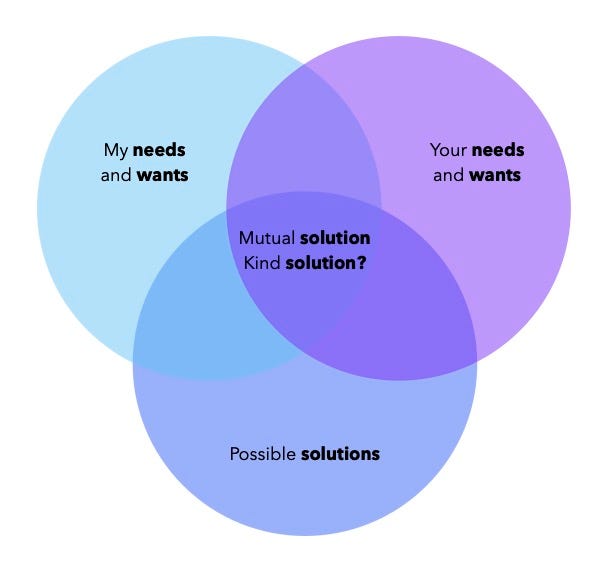\n\nNow that I’m not turning my eye blind to my wants and needs, and I can understand and communicate for myself and others what my expectations are and what my problems are, I can set boundaries or act within my value systems and be truthful with myself through my behavior and habits. Now that I’m also able to understand the needs, wants, and expectations of others, I’m able to use compassion to find common ground and resolve conflicts in a way that makes sense for all parties involved. I’m able to be perceived and act kindly!\n\nMy healing journey — which involves psychological therapy, reading, journaling, physical movement, meditation, and many other tools — has helped me identify, learn, relearn, and unlearn many concepts, values, and ideas. But I believe one of the main takeaways is that we are all so interconnected whether we like it or not, whether we want to acknowledge it or not. The “good” and the “bad” too. I was so naive and protected inside my bubble, people-pleasing and avoiding external conflict as much as I could, living a fake life, and lying to myself and others. Now that I’m not blind to nature, human nature, my own, and others, I have to admit that yeah, being healthy is fantastic, but having my eyes open opens up oneself to so much in this World — a very cruel World — which we, through action, must keep healing and making safe and kind for everyone — if this is what our values align with, of course. There’s so much work to be done. I hope this idea helps you, those around you, and your surroundings to be a kinder or safer place — which, in my humble opinion, makes us much more substantial, productive, efficient, and inspired.\n\nAlso, now that our eyes are open, we can identify individuals with little to no interest in applying these concepts and values when dealing with us. Show some self-compassion and self-respect, and act accordingly.\n\n---\n\n_Originally published on [Medium](https://medium.com/@wizards777/on-the-application-of-empathy-and-compassion-4da4330c0698)._", "content_text": "I used to react aggressively during conflicts for so long and have so many expectations from people. Ironically, I would keep these…", "summary": "I used to react aggressively during conflicts for so long and have so many expectations from people. Ironically, I would keep these…", "date_published": "2024-09-15T14:11:07.796Z", "date_modified": "2024-09-15T14:11:07.796Z", "authors": [ { "name": "Antonio Rodriguez Martinez", "url": "https://antoniwan.online" } ], "tags": [ "psychology", "integration-growth", "metaspace", "empathy", "compassion", "consciousness", "personal-growth", "psychology", "emotional-regulation", "relationships", "healing", "self-reflection", "authenticity" ] }, { "id": "https://notes.antoniwan.online/p/on-cooking-on-everything-and-foundations/", "url": "https://notes.antoniwan.online/p/on-cooking-on-everything-and-foundations/", "title": "On cooking… on everything… and foundations!", "content_html": "\n\nPhoto by [Element5 Digital](https://unsplash.com/@element5digital?utm_source=medium&utm_medium=referral) on [Unsplash](https://unsplash.com?utm_source=medium&utm_medium=referral)\n\nI used to require recipes whenever I cooked anything. About 16 years later, now that I understand some of the cooking components (heating, cooling, ingredients, some techniques, instruments, knife work, the recipes themselves) at a basic but proficient level, I can cook without recipes and create my tasty recipes and fusions.\n\nIt’s funny how that works and applies to almost anything in life.\n\nFoundational knowledge and experiences change everything else on top of that foundation.\n\n---\n\n_Originally published on [Medium](https://medium.com/@wizards777/on-cooking-on-everything-and-foundations-0ee089f3f238)._", "content_text": "I used to require recipes whenever I cooked anything. About 16 years later, now that I understand some of the cooking components (heating…", "summary": "I used to require recipes whenever I cooked anything. About 16 years later, now that I understand some of the cooking components (heating…", "date_published": "2024-09-15T13:06:14.100Z", "date_modified": "2024-09-15T13:06:14.100Z", "authors": [ { "name": "Antonio Rodriguez Martinez", "url": "https://antoniwan.online" } ], "tags": [ "metaspace", "integration-growth", "cooking", "nutrition", "health", "wellness", "foundations", "self-care", "learning-projects", "diy-creation", "consciousness", "personal-growth" ] }, { "id": "https://notes.antoniwan.online/p/sharpen-your-tools/", "url": "https://notes.antoniwan.online/p/sharpen-your-tools/", "title": "Sharpen Your Tools", "content_html": "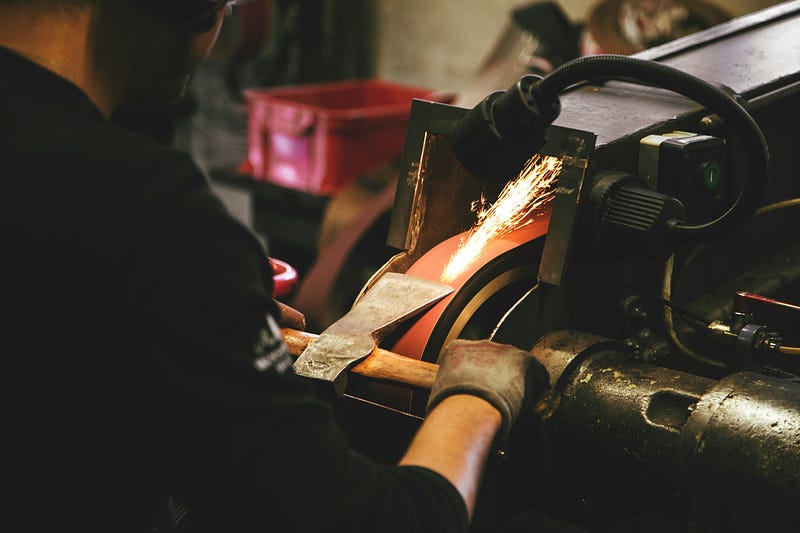\n\nPhoto by [C D-X](https://unsplash.com/@cdx2?utm_source=medium&utm_medium=referral) on [Unsplash](https://unsplash.com?utm_source=medium&utm_medium=referral)\n\nMaintaining and honing your tools to maximize efficiency and practice excellence is critical- and elemental. Once one integrates this realization, everything changes.\n\nJust as cooking becomes smoother and less dangerous with a honed kitchen knife and fishing becomes less tedious with the appropriate bait and rod, our lives improve as we improve our physical, emotional, and spiritual tools. Getting stronger trivializes our day-to-day chores. Practicing and developing patience softens the blows of the day-to-day and transforms the mundane into moments of rest; waiting goes from being ‘annoying’ to something enjoyable and a moment for even practicing stillness, grounding, or meditation, and overall, the challenges, which are undesirable obstacles for most people, become the way we grow and evolve, become the sharpening of oneself, the honing of one skill and practices.\n\nObserve the things that inspire or grasp your attention throughout your day. The art, the music, the details, the kindness, the groomed person, the sharp wit, the gentle and precise motions of a gymnast, the beauty of a smooth layup — it’s the honing, the practice, and the hours invested that make these so stunning, appealing, beautiful, and awe-inspiring. The sharpening of the skills makes things appear effortless and smooth, and this beauty should inspire and motivate you to start your journey of self-improvement.\n\nHere’s a list of topics to sharpen yourself, dwell on, and understand deeper:\n\n- continuous learning\n- mindfulness\n- meditation\n- time management\n- goal setting\n- physical fitness\n- emotional intelligence (EQ)\n- critical thinking\n- resilience (physical and emotional)\n- skill mastery\n- networking\n- mentorship\n- adaptability\n- effective (and nonviolent) communication\n- leadership\n- collaboration\n- curiosity\n- reading\n- travel\n- debate\n- ethics\n- improving your diet (whole foods)\n- sleep hygiene\n- stress management (self-care)\n- pursue hobbies\n- explore music, arts, and other creative pursuits\n- integrity (be honest with yourself, practice this honesty)\n- gratitude\n- compassion\n- patience\n- financial literacy\n- DIY skills (cooking, sewing, others)\n- technology proficiency\n- writing (the reason I do this type of work)\n\nUnderstand this idea, sharpen your tools, and get that unlimited power!\n\n---\n\n_Originally published on [Medium](https://medium.com/@wizards777/sharpen-your-tools-ab027a02e0a5)._", "content_text": "Maintaining and honing your tools to maximize efficiency and practice excellence is critical- and elemental. Once one integrates this…", "summary": "Maintaining and honing your tools to maximize efficiency and practice excellence is critical- and elemental. Once one integrates this…", "date_published": "2024-07-31T13:49:32.330Z", "date_modified": "2024-07-31T13:49:32.330Z", "authors": [ { "name": "Antonio Rodriguez Martinez", "url": "https://antoniwan.online" } ], "tags": [ "integration-growth", "psychology", "art-expression", "tools", "productivity", "systems-strategy", "learning-projects", "efficiency", "self-improvement", "consciousness", "personal-growth", "mastery", "workflow" ] }, { "id": "https://notes.antoniwan.online/p/briefly-on-empathy-as-a-double-edged-sword/", "url": "https://notes.antoniwan.online/p/briefly-on-empathy-as-a-double-edged-sword/", "title": "Briefly on Empathy as a Double-Edged Sword", "content_html": "\n\nPhoto by [Nik](https://unsplash.com/@helloimnik?utm_source=medium&utm_medium=referral) on [Unsplash](https://unsplash.com?utm_source=medium&utm_medium=referral)\n\nEmpathy is such a double-edged sword — the death of a friend’s parent or relative. Relationship struggles can cause harm to someone you care about. An acquaintance sickness. The insensibility of our World’s ruling classes by perpetuating genocide, famine, and suffering as methods for political violence, abuses of force from entities designed to protect us, and overall injustices in the World. The seemingly for-profit mass layoffs. The open exploitation of our fellow human beings.\n\nThe overwhelming sense of responsibility will cut the hand that grips too tight, and the spectrum of situations is vast and equally sharp along its edges.\n\n### How much do we have to compromise ourselves and desensitize to move on and keep grinding onwards? At what point do we break down? Can we responsibly afford to break down?\n\n---\n\n_Originally published on [Medium](https://medium.com/@wizards777/briefly-on-empathy-as-a-double-edged-sword-360276a9b2b9)._", "content_text": "Discussion of empathy's challenges, including how sensitivity to suffering can lead to overwhelm. Explores the tension between compassion and self-preservation.", "summary": "Discussion of empathy's challenges, including how sensitivity to suffering can lead to overwhelm. Explores the tension between compassion and self-preservation.", "date_published": "2024-07-29T17:12:19.944Z", "date_modified": "2024-07-29T17:12:19.944Z", "authors": [ { "name": "Antonio Rodriguez Martinez", "url": "https://antoniwan.online" } ], "tags": [ "metaspace", "integration-growth", "empathy", "psychology", "mental-health", "consciousness", "emotional-regulation", "boundaries", "personal-growth", "self-reflection", "healing", "relationships" ] }, { "id": "https://notes.antoniwan.online/p/brief-notes-on-finding-serenity-in-self-control/", "url": "https://notes.antoniwan.online/p/brief-notes-on-finding-serenity-in-self-control/", "title": "Brief Notes on Finding Serenity in Self-Control", "content_html": "\n\nPhoto by [Joshua Earle](https://unsplash.com/@joshuaearle?utm_source=medium&utm_medium=referral) on [Unsplash](https://unsplash.com?utm_source=medium&utm_medium=referral)\n\nI feel like there’s something special, something serene, about abstaining from carnal urges that do not align with our values or desisting from sexual impulses on the shallow end, kind of like abstaining from junk food or dishonesty. And to be clear, for me, it’s not a matter of right or wrong, good or bad, or better or worse. It’s about willpower, understanding oneself, applying restraint and integrity, delaying gratification, or abstaining from shallow or inane situations.\n\nI’m aware this could very well be my past trauma manifesting and some process I have to go through myself, or perhaps some self-flagellation or self-sabotage. Maybe I’m just rationalizing some fears or emotions I’m not fully grasping or understanding about myself, specifically after my failures as a husband and in past romantic relationships. I don’t know yet, but I will find out.\n\n### Does this resonate with some of you? What are your thoughts about this idea?\n\nAnd to be extra precise, I do genuinely believe sexual intimacy or carnal desires are part of our natural life after all; it’s honest and essential for our lives and development as healthy human beings.\n\n---\n\n_Originally published on [Medium](https://medium.com/@wizards777/brief-notes-on-finding-serenity-in-self-control-e2e489677baa)._", "content_text": "Reflection on self-control as a path to serenity. Explores the balance between natural desires and conscious restraint in the context of personal values.", "summary": "Reflection on self-control as a path to serenity. Explores the balance between natural desires and conscious restraint in the context of personal values.", "date_published": "2024-07-29T17:08:22.762Z", "date_modified": "2024-07-29T17:08:22.762Z", "authors": [ { "name": "Antonio Rodriguez Martinez", "url": "https://antoniwan.online" } ], "tags": [ "psychology", "metaspace", "integration-growth", "self-control", "mindfulness", "mental-health", "serenity", "consciousness", "self-mastery", "emotional-regulation", "personal-growth", "discipline", "healing" ] }, { "id": "https://notes.antoniwan.online/p/conquering-imposter-syndrome-with-evidence-based-journaling/", "url": "https://notes.antoniwan.online/p/conquering-imposter-syndrome-with-evidence-based-journaling/", "title": "Conquering Imposter Syndrome with Evidence-Based Journaling", "content_html": "\n\nPhoto by [Jan Kahánek](https://unsplash.com/@honza_kahanek?utm_source=medium&utm_medium=referral) on [Unsplash](https://unsplash.com?utm_source=medium&utm_medium=referral)\n\nOvercoming imposter syndrome is an ongoing process. I have adopted an evidence-based approach to my mental regulation work, a strategy that has proven highly effective. I invite you to explore this aspect of my journey. It’s a humble brag moment, but one that is worth sharing. Here is my latest entry/reflection:\n\n> My freelance clients get sticker shock whenever they see my hourly rate, but see. You are not hiring just a ‘software developer’; you are hiring an absolute work machine that has worked at the intersection of digital marketing and software development for 16+ years for projects and clients ranging from Fortune 500 companies to small mom-and-pop shops and a wildly variable number of successful and efficient projects. Additionally, I’m upfront about used hours and only charge you for the time I spend, not more or less. Integrity and my values allow me to do that with complete transparency. I’ve built a web gaming platform for Sony PlayStation; I’ve built sweepstakes for thousands of prominent clients for millions of users; I’ve built Lexus Car configurators for their US website; I’ve built a fully-featured website for Copa Airlines that includes flight booking; I’ve also built web portfolios for individuals, and software applications that take a hard-file of university courses, and do magic to provide students their course selection user interface on the web; I also built the first “chatbot” gaming platform ever over Facebook Messenger, this thing used NLP when people were only dreaming about this. I’ve messed up sometimes, but we have always recovered through honesty and hard work. In addition to the vast project experience, the cherry on top is that I’ve worked so hard on my soft skills, communication, empathy, active listening, management, product, software engineering, and leadership that I force multiply and influence everybody around me. I’m very powerful!\n\nSharing is caring! I hope you can apply this type of evidence-based journaling approach to your emotional regulation to manage imposter syndrome. Remember to focus on your wins and the tangible.\n\nIf you notice you make many mistakes in your work, that’s an excellent opportunity to understand a lagoon you might want to work on intentionally. “The obstacle is the way!”\n\nGood luck!\n\n---\n\n_Originally published on [Medium](https://medium.com/@wizards777/conquering-imposter-syndrome-with-evidence-based-journaling-2dcb62f64e3a)._", "content_text": "Method for managing imposter syndrome through structured self-reflection. Shows how documenting professional achievements can build authentic confidence.", "summary": "Method for managing imposter syndrome through structured self-reflection. Shows how documenting professional achievements can build authentic confidence.", "date_published": "2024-07-24T16:21:33.037Z", "date_modified": "2024-07-24T16:21:33.037Z", "authors": [ { "name": "Antonio Rodriguez Martinez", "url": "https://antoniwan.online" } ], "tags": [ "integration-growth", "psychology", "metaspace", "imposter-syndrome", "mental-health", "therapy", "self-reflection", "personal-growth", "emotional-regulation", "professional-development", "confidence-building", "self-improvement", "healing" ] }, { "id": "https://notes.antoniwan.online/p/learning-construction-self/", "url": "https://notes.antoniwan.online/p/learning-construction-self/", "title": "Learning is a Construction of the Self", "content_html": "In only four years, my daughter has taught me the language of wonder— \neach day a new sentence in the grammar of innocence, \na reminder of life's pure simplicity and curious joy.\n\nIn eleven years, my ex-partner became my mirror, \nreflecting truths I couldn't yet see clearly, \nlessons hidden behind arguments and laughter, pain and growth.\n\nAnd still, I continue learning— \nfrom whispered truths and deafening silences, \nfrom actions bold and brave, \nand equally from quiet retreats and withheld gestures.\n\nI listen carefully to what is said, \nand even more intently to what remains unsaid, \nfor silence carries wisdom louder than any words.\n\nI watch closely what is done, \nand even more closely what remains undone, \nfor every hesitation or inaction reveals a hidden story, \nan unspoken emotion or unmet need.\n\nLearning, for me, is continuous reconstruction. \nEach night, beneath quiet skies, \nI willingly allow parts of myself to dissolve, \nletting go of yesterday's pride and errors, \nego gently unmade through reflection, \nso I can wake with fresh humility \nto welcome another sunrise and new lessons.\n\nYet, there are times I hear voices say \nthere is nothing to learn from me— \nthat who I am or what I offer is insufficient. \nMy first response is a quiet recoil, \na momentary pause of curious hurt.\n\nNot because their words diminish me— \nI have long accepted the journey of becoming, \never imperfect and endlessly growing— \nbut because refusing humility, \nthe fertile ground of true growth, \nis a tragic loss for us all.\n\nThis sadness I feel is not from personal injury. \nIt is the quiet sorrow born from knowing \nhow beautifully transformative humility is, \nhow powerfully it heals the soul, \nhow constructively it rebuilds relationships, \nand how often it is rejected \nin favor of pride or fear or stubborn blindness.\n\nSo I carry my sadness lightly, \nacknowledging it without bearing its weight. \nI transform it into resolve, into patience, \ninto an open invitation for others \nto step closer to the gentle strength of humility.\n\nWhat can I do with this sadness \nbut offer it as evidence \nof what humility can mend, \nof what gentle vulnerability can reveal?\n\nAnd yet the question lingers, persistent: \nWhat truly keeps us from learning? \nWhat barriers within our hearts or minds \nstop us from embracing humility, \nthe quiet architect \nof our most authentic self?", "content_text": "Reflections on humility, personal growth, and the quiet lessons hidden in relationships, silence, and life's daily rituals.", "summary": "Reflections on humility, personal growth, and the quiet lessons hidden in relationships, silence, and life's daily rituals.", "date_published": "2024-07-15T16:45:00.000Z", "date_modified": "2024-07-15T16:45:00.000Z", "authors": [ { "name": "Antonio Rodriguez Martinez", "url": "https://antoniwan.online" } ], "tags": [ "psychology", "integration-growth", "metaspace", "personal-growth", "self-construction", "learning", "consciousness", "transformation", "self-reflection", "healing", "authenticity", "self-improvement", "metaspace" ] }, { "id": "https://notes.antoniwan.online/p/symbols-of-power/", "url": "https://notes.antoniwan.online/p/symbols-of-power/", "title": "My Favorite Symbols of Power", "content_html": "
 \n\nI've been thinking about getting a tattoo—or many—but I can't pull the trigger. There's something about having a \"clean\" body that feels sacred. Still, the idea of _customizing_ it, of turning my body into a living archive of meaning, also deeply appeals to me.\n\nBut I don't want just ink. I want **Symbols of Power** etched into my skin—reminders of who I am and who I'm becoming. They would be sigils of therapy, experience, insight, reading, integrating. Weapons and artifacts that offer strength: like armor, or a shield, like a sword, or a dagger, or the _Death Note_, or Narsil. Each depending on the occasion. Extra tools. Extra push.\n\n---\n\n### 🗡️ Narsil – the Sword that was Broken\n\n\n\n**Narsil**, for me, represents the permanent struggle of human will against evil. The sword that was broken and reforged, becoming even stronger than before. It's a reminder that our greatest strength often comes from our brokenness, from the pieces we've picked up and reassembled. When I feel shattered, I remember Narsil—how it was reforged into Andúril, the Flame of the West, and became even more powerful than its original form.\n\n---\n\n### 🛡️ Master Sword – the Blade of Evil's Bane\n\n\n\nThe Master Sword is iconic—a weapon that chooses its wielder, that tests their worthiness. It's not just about power, but about the heart and courage to wield it. The sword that seals the darkness, that stands as a beacon of hope. It represents the idea that true power comes with responsibility, that strength must be earned and maintained through constant vigilance and growth.\n\n---\n\n### 🔫 MA5C Assault Rifle – Halo's UNSC Standard\n\n\n\nThe **MA5C** is my tool of precision—a weapon that represents human ingenuity and adaptability. In the face of overwhelming odds, it's the standard-issue rifle that helped humanity stand against the Covenant. It's a reminder that sometimes the most powerful tools are the ones we can rely on consistently, the ones we've mastered through practice and dedication.\n\n---\n\n### ⚡ Mjölnir – Hammer of Thunder\n\n\n\n**Mjölnir** needs no explanation—it's the hammer that commands the storm, the weapon of the god of thunder. But beyond its raw power, it represents the weight of responsibility. Only the worthy can lift it, and those who do must bear the burden of its power. It's a reminder that true strength comes with great responsibility, and that power must be earned through character and action.\n\n---\n\n### 🐉 Dragon Slayer – Guts' Weapon of Suffering\n\n\n\n**Dragon Slayer** is a sword made to kill dragons—a weapon so massive it was never meant to be wielded by a human. Yet Guts carries it, despite its weight, despite the pain. It's a symbol of perseverance, of carrying burdens that seem impossible, of transforming suffering into strength. The sword that was too big becomes the perfect weapon in the hands of someone who refuses to give up.\n\n---\n\n### 🧭 Vegvisir – the Wayfinder Rune\n\n\n\nThe **Vegvisir** is an Icelandic magical stave—a compass that guides its bearer through rough weather. It's a symbol of navigation, of finding your way when the path is unclear. In a world of uncertainty, it represents the inner compass that guides us, the wisdom to find our way even when the storms of life rage around us.\n\n---\n\n### 🌀 \"Amor fati\" – Phrase of Power\n\n\"**Amor fati**\" means _love of fate_—a Stoic concept that teaches us to embrace everything that happens to us. It's not about passive acceptance, but about actively loving our fate, about finding meaning and growth in every experience. It's a reminder that our power lies not in controlling what happens to us, but in how we respond to it.\n\n---\n\n### 🔦 Lightsaber – Weapon of Light, Shadow, and Will\n\n\n\nThe **lightsaber** is a weapon of will — forged not just by Jedi in serene temples, but by Sith in rage-forged crucibles, and by rogue force wielders who walk between light and shadow. It's a symbol of **raw agency**, amplified by discipline, vision, or vengeance. The color of your blade says something... but never everything.\n\n- **Blue and green**: guardians and seers — clarity, peace, protection.\n- **Red**: forged through pain — will sharpened into fury, unapologetic power.\n- **Purple**: the edge walker — one who knows both peace and war.\n- **White**: reclaimed sovereignty — purified power.\n- **Black (Darksaber)**: leadership through might and legend.\n\nUse the lightsaber symbol when you must cut through confusion. When you're forging identity. When your truth needs to shine or strike. Whether you're aligning with the Force, bending it, or breaking from it altogether — the saber is a reminder:\n\n**You are the crystal. You decide how it burns.**\n\n---\n\n## 🔥 MORE POWER: A Catalog of Power Symbols in Human Imagination\n\nThese symbols go beyond ink. They are **usable power icons** — to focus the mind, call in energy, or remember who the fuck you are. Categorized below with 🔑 tactics for how to wield them.\n\n### 🌀 Anime & Manga\n\n| Symbol | Meaning | Tactical Use |\n| ------------------------------- | ------------------------------ | -------------------------------------------------------------------------------------------- |\n| Brand of Sacrifice (_Berserk_) | Survival through pain | Use when you feel cursed, but keep going. It reminds you: you _are_ the resistance. |\n| Uchiha Crest (_Naruto_) | Fire, bloodline, tragic genius | Use to remember your depth. You see what others don't. Channel emotion into clarity. |\n| Alchemist Circle (_FMA_) | Transformation through cost | Draw when something needs to _change_. Use it in journaling or rituals. Equivalent exchange. |\n| Hunter's License (_HxH_) | Permission to explore the edge | A reminder that mastery grants access to deeper quests. You've earned this. |\n| Goku's Kanji (悟) (_DBZ_) | Wisdom, growth, power | Wear it when training, learning, or ascending. You are always leveling up. |\n| Millennium Puzzle (_Yu-Gi-Oh!_) | Duality, inner shadow | Use in integration work or inner child healing. Your shadow self is powerful, too. |\n\n### ⚔️ Cartoons & Comics\n\n| Symbol | Meaning | Tactical Use |\n| ---------------------------------- | ------------------------- | ---------------------------------------------------------------------------- |\n| Sword of Omens (_Thundercats_) | Sight beyond sight | Meditate with it in mind. Ask: what aren't you seeing clearly yet? |\n| Power Sword (_He-Man_) | Raw agency | Chant your own version of \"I have the power\" before hard actions. It works. |\n| Planeteer Rings (_Captain Planet_) | Elements + Heart | Choose one element to embody in a day. Combine with others in group rituals. |\n| Green Lantern Ring (_DC_) | Willpower creates reality | Use for manifestation or discipline tasks. What you imagine becomes. |\n| Triforce (_Zelda_) | Power, Courage, Wisdom | Use in decision-making. Which force do you need most right now? |\n\n### 🎮 Video Games\n\n| Symbol | Meaning | Tactical Use |\n| ----------------------------------- | -------------------------- | --------------------------------------------------------------------------------- |\n| Bonfire (_Dark Souls_) | Rest, rebirth in chaos | Use this symbol as a grounding ritual. Light a candle to \"reset.\" |\n| Spartan Helmet (_Halo_) | Silent service | Wear it when you carry burdens for others. Quiet strength. |\n| Bloody Handprint (_God of War_) | Rage, guilt, choice | Recall this when confronting your past. You can carry your pain and still change. |\n| Fire Keeper Eyes (_Dark Souls III_) | Inner darkness, compassion | Symbol for seeing _what is_, not what should be. Use during therapy, shadow work. |\n| Vault-Tec Logo (_Fallout_) | Survival, irony | Use to remind yourself you are prepared. Humor is a weapon. |\n\n### 📺 TV & Film\n\n| Symbol | Meaning | Tactical Use |\n| ------------------------------- | ---------------------- | ---------------------------------------------------------------- |\n| Dharma Initiative Logo (_Lost_) | Experiment, fate, loop | Use when life feels recursive. What's the deeper test here? |\n| Infinity Stones (_Marvel_) | Domains of control | Journal each domain. Which are you weakest in? Train that. |\n| One Ring (_LOTR_) | Corruption of power | Ask: what do I desire that might destroy me? Use for ego checks. |\n| Light of Earendil (_LOTR_) | Hope in darkness | Keep a \"light\" object nearby. For when it gets dark again. |\n\n### 🧙 Mythic Additions\n\n| Symbol | Meaning | Tactical Use |\n| --------------------------------- | --------------- | ---------------------------------------------------------- |\n| Witcher Medallion | Magic radar | A reminder to listen to your instincts. \"Tremors\" = truth. |\n| Dovahkiin Sigil (_Skyrim_) | Voice is weapon | Speak truth even if your voice shakes. Shout if you must. |\n| Hidden Blade (_Assassin's Creed_) | Freedom, legacy | Used in stealth mode. Tactical patience, not weakness. |\n\n---\n\n## 📘 Glossary\n\n- **Sigil**: A symbol charged with intention, often drawn or etched as part of rituals.\n- **Transmutation**: Alchemical transformation — literal or metaphorical — of self or experience.\n- **Shadow Work**: Psychological integration of rejected parts of the self.\n- **Archetype**: A symbolic pattern or role shared across stories and cultures.\n- **Power Anchor**: A visual or physical reminder of a specific strength or state.\n\n---\n\n## 🎞 Referenced Materials (TV, Games, Anime, Film)\n\n| Title | Medium | Link |\n| -------------------------------- | ----------------- | ------------------------------------------------- |\n| Berserk | Anime / Manga | https://www.imdb.com/title/tt0318871/ |\n| Naruto | Anime | https://www.imdb.com/title/tt0409591/ |\n| Fullmetal Alchemist: Brotherhood | Anime | https://www.imdb.com/title/tt1355642/ |\n| Hunter x Hunter | Anime | https://www.imdb.com/title/tt2098220/ |\n| Dragon Ball Z | Anime | https://www.imdb.com/title/tt0214341/ |\n| Yu-Gi-Oh! | Anime | https://www.imdb.com/title/tt0243639/ |\n| Thundercats | Cartoon | https://www.imdb.com/title/tt0086811/ |\n| He-Man | Cartoon | https://www.imdb.com/title/tt0085033/ |\n| Captain Planet | Cartoon | https://www.imdb.com/title/tt0098763/ |\n| Green Lantern | Comics / Film | https://www.imdb.com/title/tt1133985/ |\n| The Legend of Zelda | Video Game | https://en.wikipedia.org/wiki/The_Legend_of_Zelda |\n| Dark Souls | Video Game | https://www.imdb.com/title/tt2010090/ |\n| Halo | Video Game | https://www.imdb.com/title/tt0464037/ |\n| God of War | Video Game | https://www.imdb.com/title/tt5838588/ |\n| Fallout | Video Game | https://www.imdb.com/title/tt0142032/ |\n| Lost | TV Series | https://www.imdb.com/title/tt0411008/ |\n| Avengers: Infinity War | Film | https://www.imdb.com/title/tt4154756/ |\n| The Lord of the Rings | Film | https://www.imdb.com/title/tt0120737/ |\n| The Witcher | Game / Series | https://www.imdb.com/title/tt5180504/ |\n| Skyrim | Video Game | https://www.imdb.com/title/tt1814884/ |\n| Assassin's Creed | Video Game / Film | https://www.imdb.com/title/tt2094766/ |\n\n---\n\n## 🔮 Final Notes for the Seeker\n\nThese are more than fandom. They're _tools_. Build your own **Codex of Symbols**. Make a wall, a tattoo sleeve, or an altar. Ritualize how and when you call on each power.\n\nThis is your inventory. Your magic. Your reminder:\n\n**Power isn't just what you have — it's what you remember.**\n\n---",
"content_text": "A reflection on the symbols—mythic, fictional, and personal—that remind me of resilience, willpower, and transformation. These are the icons I'd etch into my skin if I ever choose to.",
"summary": "A reflection on the symbols—mythic, fictional, and personal—that remind me of resilience, willpower, and transformation. These are the icons I'd etch into my skin if I ever choose to.",
"date_published": "2024-07-06T11:20:00.000Z",
"date_modified": "2024-07-06T11:20:00.000Z",
"authors": [
{
"name": "Antonio Rodriguez Martinez",
"url": "https://antoniwan.online"
}
],
"tags": [
"metaspace",
"psychology",
"art-expression",
"symbols",
"mythology",
"power",
"psychology",
"art-expression",
"identity",
"healing",
"consciousness",
"self-expression",
"metaspace"
],
"image": "https://notes.antoniwan.online/images/symbols-of-power.avif"
},
{
"id": "https://notes.antoniwan.online/p/embracing-the-spiritual-abyss-an-atheists-search-for-meaning/",
"url": "https://notes.antoniwan.online/p/embracing-the-spiritual-abyss-an-atheists-search-for-meaning/",
"title": "Embracing the Spiritual Abyss: An Atheist's Search for Meaning",
"content_html": "I’ve chosen to be an atheist most of my life, and the older I get, the more I feel a subliminal appetite to believe in a god or some higher power. This deep urge feels almost animalistic or savage — I don’t think my intellect is asking for this; my intuition, spirit, or mind wants to let go and leave everything in something else’s hands. Bluntly said, it feels like my ego, a savage animal — does not want to take the brunt responsibility of living my own life — somebody else- “Oh, dear god,” please take the wheel. Today, I look into the Universe and its energy, shared by all things, but something deep within me keeps thinking about God or gods. My intellect intends to build upon a foundation of humanism, but my soul wants to let go of that work. It’s the same part of me that wants to feel lonely and impotent about the cruelty of this World, seeking gods and the partial delegation of my personal responsibility. “God chose it this way”. My spirit is conflicted — It’s a fancy of powerlessness and hopefulness, like an impulse working to rationalize and defend itself against the bleakness of the World news and the macro-socio-political situations that one learns about studying history or watching the news. It’s a savage urge — lazy, violent, and rudimentary; religion is kind of for savages, isn’t it?\n\n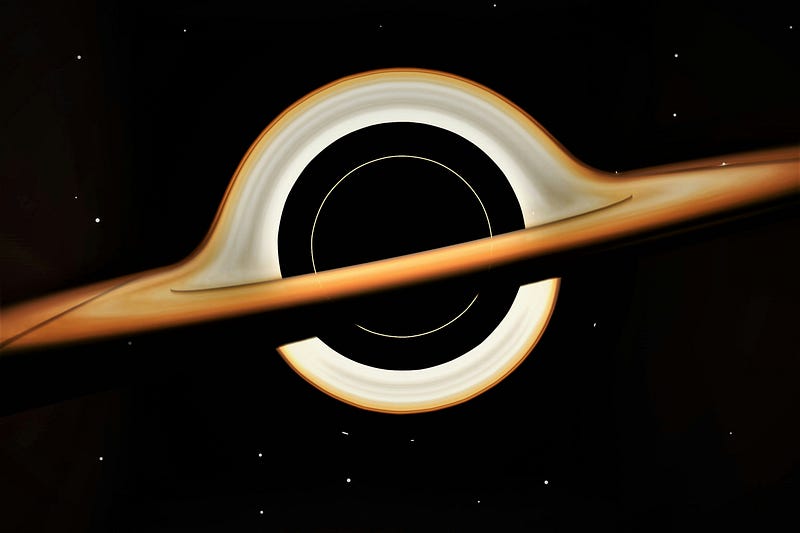\n\nPhoto by [Aman Pal](https://unsplash.com/@paman0744?utm_source=medium&utm_medium=referral) on [Unsplash](https://unsplash.com?utm_source=medium&utm_medium=referral)\n\nBeing an atheist is kinda lonely and challenging. I can’t rely on or look upon God or gods for solace. I have to face death alone and live my life in a fulfilling way because I won’t get a do-over. Whenever I choose the more challenging road or the “good” route, it’s out of a reflection of what I value as a human being. I’ve recently learned about secular humanism and align with its beliefs. I’ll attach to humanism to not feel so desolate. We have the power, after all, to change our environment and how we live; humanity seeks control while nature has it — it’s such an interesting dynamic. Humanism makes things even more interesting, as applying empiricism and rationality to how we should live our lives and what we know about our Universe and our place in it is even more work. The burden lies within us as a species rather than live life with religious givens that we must accept blindly.\n\nI’ve made peace with the fact that the Universe is this idea that I, as a human being, with my limitations and 5 senses, cannot grasp its purpose, origin, and future. My observations of intellect help me understand that the Universe, as a whole, comprises energy and vibrations (actions) that affect all matter, and we share this common space and time — relatively and objectively. That’s a beautiful notion and should be an unifying factor, objective and undebatable. Please do notice that I associated vibrations with actions because, at the end of the day, how can I apply these ideas to the human condition? We are actions, and our actions affect the Universe more, including the people and things closest to us. Our actions will affect our surroundings effectively; whether the impact of our actions is perceivable or not, we are all part of this Universe and share everything.\n\nComing back to the idea of a God or gods, ultimately, I refuse to think there’s an omni-powerful, omnipresent, omniscient, intelligent being out there just watching us all go through all of these shenanigans, unbothered. If I were to assume the existence of such a being, until which point and to what extent could I, as an individual participating in such an experiment (organic life on this planet), feel comfortable with the so-called “free will” such a powerful being bestowed upon us. How can I coincide the ethicality of giving living beings such “free will” with the capacity for such malicious harm? Does this make sense to you? To me, it’s fucking savage- it’s wild- how can we adore or follow such an entity? Nature is cruel and hardcore, it’s evident and apparent, so it means God, gods, and religion is fucking savage?\n\nShare your thoughts; my mind is open and receptive.\n\n---\n\nDo note that by \"spirit\", I mean the non-physical part of myself. My emotions and my characters, or the “soul.”\n\n---\n\n_Originally published on [Medium](https://medium.com/@wizards777/embracing-the-spiritual-abyss-an-atheists-search-for-meaning-ceff0465263b)._",
"content_text": "Exploration of atheism and secular humanism in the search for meaning. Examines the tension between rationality and emotional longing for spiritual connection.",
"summary": "Exploration of atheism and secular humanism in the search for meaning. Examines the tension between rationality and emotional longing for spiritual connection.",
"date_published": "2024-06-03T17:27:29.382Z",
"date_modified": "2024-06-03T17:27:29.382Z",
"authors": [
{
"name": "Antonio Rodriguez Martinez",
"url": "https://antoniwan.online"
}
],
"tags": [
"metaspace",
"psychology",
"parenting",
"spirituality",
"atheism",
"meaning",
"reflection",
"personal-growth",
"humanism",
"philosophy",
"consciousness",
"self-reflection",
"identity",
"values",
"purpose",
"existentialism",
"mental-health",
"emotional-health",
"healing",
"therapy",
"wellness",
"self-improvement",
"growth",
"transformation",
"authenticity",
"truth",
"power",
"responsibility",
"emotional-intelligence",
"self-awareness",
"consciousness",
"healing",
"resilience",
"self-discovery"
]
},
{
"id": "https://notes.antoniwan.online/p/the-inner-work-truly-never-ends/",
"url": "https://notes.antoniwan.online/p/the-inner-work-truly-never-ends/",
"title": "The inner work truly never ends.",
"content_html": "\n\nPhoto by [Dingzeyu Li](https://unsplash.com/@dingzeyuli?utm_source=medium&utm_medium=referral) on [Unsplash](https://unsplash.com?utm_source=medium&utm_medium=referral)\n\nAt the end of March, I thought, “Wow, you are such a loser; you have no pictures to share,” that idea stunned me. Not only do I again understand that my thoughts are a complete asshole sometimes, but it was a clear signal of how our self-esteem presents itself through our ways of habitual thinking and how much more work is left to do — or that perhaps the work never ends, really. ~4 years of inner work and therapy, shifting my mindset into healthier paradigms, was not enough for my Self to formulate this simple but potentially destructive thought. This realization is humbling. The ego must be confronted, and the soul must be fed daily.\n\nAs I provided evidence to myself that I’m not a loser, I ended up doing my “March 2024 dump” in my head with all my lovely memories, moments, learnings, tasty meals, funny FaceTime calls, disappointments, challenges, work, conversations, pain, everything. In an almost meditative state, definitely reflective, this digest of my month blew my mind away. From a self-depreciative thought, I had just found another way to practice my self-awareness and understand myself better. The thoughtful digestion and understanding of a moment, a day, a week, a month is now within my grasp because living consciously lets you do that. More power. On autopilot, I, unhealthy, would’ve believed that destructive thought and possibly stressed and became anxious or disappointed. I invite you to stop doing that. Dig deep; this life is a battle of contention between you and you, not you versus me, and definitely not you versus them. Take full responsibility for yourself and digest your thoughts for more power.\n\nOne night, one of those memories, I was at a metal show by myself as usual, and although I was enjoying myself, the music, and the casual acquaintances I had made that night, I looked around and felt super sleepy. “Why am I here?” I thought to myself. “Because I need to socialize.” I was not satisfied with this answer, which I had kept telling myself for the past months, so I spent the next 20 minutes standing like a zombie in the periphery of a death metal moshpit, pondering deeply about why I was there. I asked all the whys. I asked myself what my values were for me to have decided to be there that night doing that activity specifically. After much contemplation and questioning, I realized I sought a fun experience, not socializing. This realization is supported by the fact that lately, I had stopped putting energy, time, and effort into chasing new friendships and relationships, as I noticed the juice was not worth the squeeze, and simply focusing on my children, my Self, or my existing relationships had a much stronger effect on the quality of my life. This might sound like a straightforward realization to you, but it was not for me. I went home immediately and have since changed my outings and the reasoning behind them. This new insight made me more intentional about my goal with an outing. My friend Pablo visited Orlando to play with his math rock band. I was there to have fun and deepen my bond with Math Rock and Pablo, who has been kind to me and reciprocal in energy and attention throughout my adult life. A good friend is worth the effort. A new friend would be worth the effort, given the circumstances, if I did not have other priorities and values conflicting with such a use of my time and energy.\n\nA friend recently wrote and shared, “There’s no such thing as’ a long time ago.’ There’s only memories that mean something and memories that don’t.” And boy, does this fit the bill. Ultimately, I’ve noticed that the experiences that align with my values become memories, and the experiences that do not align with my values become learnings.\n\nFood for thought!\n\n---\n\n_Originally published on [Medium](https://medium.com/@wizards777/the-inner-work-truly-never-ends-6e88a81d6b33)._",
"content_text": "At the end of March, I thought, “Wow, you are such a loser; you have no pictures to share,” that idea stunned me. Not only do I again…",
"summary": "At the end of March, I thought, “Wow, you are such a loser; you have no pictures to share,” that idea stunned me. Not only do I again…",
"date_published": "2024-06-01T13:36:42.676Z",
"date_modified": "2024-06-01T13:36:42.676Z",
"authors": [
{
"name": "Antonio Rodriguez Martinez",
"url": "https://antoniwan.online"
}
],
"tags": [
"integration-growth",
"parenting",
"psychology",
"inner-work",
"consciousness",
"personal-growth",
"self-reflection",
"healing",
"transformation",
"therapy",
"self-improvement",
"mindfulness",
"metaspace"
]
},
{
"id": "https://notes.antoniwan.online/p/note-to-self-to-be-or-what-not-to-be/",
"url": "https://notes.antoniwan.online/p/note-to-self-to-be-or-what-not-to-be/",
"title": "Note to Self: To Be or What Not to Be",
"content_html": "To be negative, I must assume negativity; to be resentful, I must bear affliction; to be hateful, I must bring hate into my life. To be petty, I must force myself to behave inconsequentially.\n\n\n\nPhoto by [Karly Santiago](https://unsplash.com/@clothandtwig?utm_source=medium&utm_medium=referral) on [Unsplash](https://unsplash.com?utm_source=medium&utm_medium=referral)\n\nI am not a victim; I am a victor of my circumstances. I will check myself and only bring and dish out what I want to personify! I won’t reduce myself to any nonsense.\n\n✨\n\nI can not control how you feel and react; I am not responsible for you. I can only control my actions and responses and am accountable for myself. I want to be an agent of joy and kindness, true to my values, free and powerful.\n\nTruth be told, I am exhausted with negativity and resentment, and hate is not my answer; Love and kindness are the answer. I’m letting the noise, manifested through these destructive and resentful thoughts and feelings, fade away, leaving the stress and anxiety behind them.\n\nThis clarity is the power I have.\n\n---\n\n_Originally published on [Medium](https://medium.com/@wizards777/note-to-self-to-be-or-what-not-to-be-aeff3569b5f2)._",
"content_text": "To be negative, I must assume negativity; to be resentful, I must bear affliction; to be hateful, I must bring hate into my life. To be…",
"summary": "To be negative, I must assume negativity; to be resentful, I must bear affliction; to be hateful, I must bring hate into my life. To be…",
"date_published": "2024-05-31T15:55:06.032Z",
"date_modified": "2024-05-31T15:55:06.032Z",
"authors": [
{
"name": "Antonio Rodriguez Martinez",
"url": "https://antoniwan.online"
}
],
"tags": [
"metaspace",
"integration-growth",
"self-reflection",
"consciousness",
"personal-growth",
"authenticity",
"self-improvement",
"healing",
"mindfulness",
"transformation",
"metaspace",
"purpose"
]
},
{
"id": "https://notes.antoniwan.online/p/things-i-have-learned-this-week-regarding-a-4-year-olds-long-curly-hair/",
"url": "https://notes.antoniwan.online/p/things-i-have-learned-this-week-regarding-a-4-year-olds-long-curly-hair/",
"title": "Things I have learned this week regarding a 4-year old’s long curly hair",
"content_html": "\n\nPhoto by [Senjuti Kundu](https://unsplash.com/@senjuti?utm_source=medium&utm_medium=referral) on [Unsplash](https://unsplash.com?utm_source=medium&utm_medium=referral)\n\n1. One does not brush curly hair because it becomes Mufasa-like. I tried different brush styles before I noticed this.\n2. Detangling curly hair is easiest during the conditioning stage in the shower.\n3. Bath toys help keep the toddler in place (LOL).\n4. After the shampoo and conditioning stage, I can also use a “detangler” to detangle the hair. This saves conditioner, as conditioner is much more expensive.\n5. If I let the hair dry naturally, the waves look beautiful AF. I can also blow-dry, but the texture becomes different. I have to pre-plan this ahead of time so that toddler’s hair has enough time to dry by itself.\n6. I do not like using a ‘leave-on conditioner’ because the hair looks greasy and dirty. I guess this is my personal opinion.\n7. The TV is my best friend for hairstyling, as it keeps the toddler at bay.\n8. Under no circumstances should I pull the hair hard and hurt her, baby girl becomes unmanageable, and I will lose the opportunity to complete the hairstyle.\n9. I must wash her hair after every visit to the pool because if not, it will become dry, messy, and knotted AF.\n10. I suspect I should not wash, shampoo, and condition her hair daily. Not only it’s a ton of work, but it also seems to dry her hair and make her scalp itchy. I’m doing this wash process whenever the hair looks dirty and greasy, which generally takes 2–3 days or an intense park day under the sun.\n11. If I use hair clips or artifacts to keep the hair at bay, I need to make sure these aren’t touching ears or eyes, as the toddler might get annoyed and rip that shit up.\n12. Learning how to make hairstyles is more challenging than I thought. Hubris won’t help you. Take a deep breath and separate ~1 hour for new hairstyles because this shit is hard.\n13. YouTube is my friend for learning tips and tricks about hairstyling.\n\n_Sharing is caring._ I hope this helps out other dads!\n\n---\n\n_Originally published on [Medium](https://medium.com/@wizards777/things-i-have-learned-this-week-regarding-a-4-year-olds-long-curly-hair-813db24e002e)._",
"content_text": "One does not brush curly hair because it becomes Mufasa-like. I tried different brush styles before I noticed this.",
"summary": "One does not brush curly hair because it becomes Mufasa-like. I tried different brush styles before I noticed this.",
"date_published": "2024-05-29T18:01:30.848Z",
"date_modified": "2024-05-29T18:01:30.848Z",
"authors": [
{
"name": "Antonio Rodriguez Martinez",
"url": "https://antoniwan.online"
}
],
"tags": [
"metaspace",
"integration-growth",
"parenting",
"parenting",
"children",
"family",
"learning",
"conscious-parenting",
"child-development",
"self-care",
"wellness",
"tips",
"family-dynamics"
]
},
{
"id": "https://notes.antoniwan.online/p/on-feeling-overpowered/",
"url": "https://notes.antoniwan.online/p/on-feeling-overpowered/",
"title": "On Feeling Overpowered",
"content_html": "Note-to-self!\n\nThese days, I’m feeling OP (overpowered)! As I keep practicing the items below, my habits become even more consistent, and it’s easier to follow through with each. It feels like my brain is re-wiring, and it makes sense because my body and mind are changing, and it’s so evident. These are what work for me to feel healthy and genuinely overpowered.\n\n\n\nPhoto by [Jeremy Bishop](https://unsplash.com/@jeremybishop?utm_source=medium&utm_medium=referral) on [Unsplash](https://unsplash.com?utm_source=medium&utm_medium=referral)\n\nI feel overpowered:\n\n- After another completed workout, with entire focus, each set going until failure and without injuries.\n- After another day without reaction, I only respond by controlling myself, not external influences or stimuli.\n- I invest quality and conscious time with my children, with complete control and mental health. Every second I spend with them is growth.\n- After every whole food meal that I prepare, cook, and enjoy, I make these meals with so much love and attention. My body thanks me through speed, strength, and health.\n- Whenever I finish a book and feel the integration happening, the thoughts, the clarity, and a thousand more questions pop up. This curiosity is growth; I have learned more, and therefore, I have even more questions.\n- Whenever I can identify that I’m procrastinating, I stop in my tracks and face the immobilization. Effective action is so empowering.\n- After utilizing effective communication, I express myself with clarity and kindness.\n- After I can go to bed early and sleep no less than 8 hours, up to 10 hours. What a luxury!\n\nWhenever I invest space, compassion, time, and stillness, sometimes, the best investment for oneself is reading, writing, or doing nothing. Money is not the only thing you can invest in yourself! Listen to a music album. Or play video games. Or play the guitar. Or, again, to do nothing. Invest your time, attention, and energy into improving your life. After grooming up, taking care of my nails, hair, eyes, and hands, brushing and flossing, and maybe dressing up, even if I only have to go to the groceries.\n\nAfter sharing with others some of my priviledge, without self-sacrificing. After being compassionate and kind with myself or others, perhaps by setting up a boundary or communicating my needs and wants clearly and without holding back.\n\nAfter avoiding conflict by using kindness or resisting the urge to react violently and accept a tricky situation, restraint is incredible.\n\nAs life is so challenging, there s to feel overpowered. The most significant detail I’ve noticed is that quality input equals quality output in everything around and about our lives. Hard work, consistency, and drive pay off significantly. Delaying gratification works. All transformation and evolution have come from places of discomfort. Growth is uncomfortable and requires practice.\n\nAs usual, writing these made me aware of all my privileges regarding accessibility, time, money, and resources. Being grateful for these privileges is critical for becoming and staying healthy and kind. Every human being should have all of this, but it does not happen, and I’m aware and can identify this as unjust, but I must accept this, and whenever I can share my privilege, I pledge to do so, and I do. Without self-sacrificing because I am important and I love myself. I love you, but I love myself more, and that’s ok.\n\n---\n\n_Originally published on [Medium](https://medium.com/@wizards777/on-feeling-overpowered-d964cc32480a)._",
"content_text": "Note-to-self!",
"summary": "Note-to-self!",
"date_published": "2024-05-29T14:41:25.408Z",
"date_modified": "2024-05-29T14:41:25.408Z",
"authors": [
{
"name": "Antonio Rodriguez Martinez",
"url": "https://antoniwan.online"
}
],
"tags": [
"integration-growth",
"psychology",
"mental-health",
"emotional-regulation",
"consciousness",
"personal-growth",
"self-reflection",
"healing",
"therapy",
"mindfulness",
"resilience",
"self-improvement"
]
},
{
"id": "https://notes.antoniwan.online/p/some-books-for-self-transcendence/",
"url": "https://notes.antoniwan.online/p/some-books-for-self-transcendence/",
"title": "Some Books for Self-Transcendence",
"content_html": "These books have given me the tools and techniques to be a conscious and powerful human being. A stoic whose life is entirely up to myself (or so I think, right?!). My days have intention and focus. My values are reflected in every single decision that I take throughout my day. Walking the talk, I call it.\n\nMy favorites have the 🔥 emoji - I feel these books helped me the most.\n\n## 🔥 Daily Reads, Rain or Shine\n\nThese are for nourishing the tri-force: my heart, my soul, and my mind.\n\n- **Journey to the Heart: Daily Meditations on the Path to Freeing Your Soul** by Melody Beattie\n- **The Daily Stoic: 366 Meditations on Wisdom, Perseverance, and the Art of Living** by Ryan Holiday\n- **A Calendar of Wisdom: Daily Thoughts to Nourish the Soul** by Leo Tolstoy\n\n## About/For Life\n\nThese are the foundational knowledge that makes my life easy.\n\n- 🔥 **Of Human Freedom** by Epictetus\n- 🔥 **The 7 Habits of Highly Effective People: Powerful Lessons in Personal Change** by Stephen R. Covey\n- 🔥 **The Obstacle Is the Way: The Timeless Art of Turning Trials into Triumph** by Ryan Holiday\n- **Atomic Habits: An Easy & Proven Way to Build Good Habits & Break Bad Ones** by James Clear\n- **12 Rules for Life: An Antidote to Chaos** by Jordan B. Peterson\n- **The 48 Laws of Power** by Robert Greene\n- **The Metamorphosis** by Franz Kafka\n\n## About the Self, Myself\n\nFrom the Atlas of the Heart, which taught me over 60 different feelings and human emotions, to some books about anger and learning how to understand my sources of anger.\n\n- 🔥 **Atlas of the Heart: Mapping Meaningful Connection and the Language of Human Experience** by Brené Brown\n- 🔥 **Your Erroneous Zones** by Wayne W. Dyer\n- 🔥 **Meditations** by Marcus Aurelius\n- **Why Does He Do That? Inside the Minds of Angry and Controlling Men** by Lundy Bancroft\n- **Anger: Taming the Beast** by Reneau Z. Peurifoy\n- **No More Mr. Nice Guy** by Robert A. Glover\n\n## About the Human Brain/Behavioral\n\nFrom how I communicate to understanding the human brain, parenting, and my children, and therefore understanding myself.\n\n- 🔥 **Nonviolent Communication** by Marshall B. Rosenberg\n- 🔥 **101 Essays That Will Change The Way You Think** by Brianna Wiest\n- **Thinking, Fast and Slow** by Daniel Kahneman\n- **Attached: The New Science of Adult Attachment and How It Can Help You Find - and Keep - Love** by Amir Levine, Rachel Heller\n- **The Whole-Brain Child: Revolutionary Strategies to Nurture Your Child's Developing Mind** by Daniel J. Siegel, Tina Payne Bryson\n- **No-Drama Discipline: The Whole-Brain Way to Calm the Chaos and Nurture Your Child's Developing Mind** by Daniel J. Siegel, Tina Payne Bryson\n- **The Grown-Up's Guide to Teenage Humans: How to Decode Their Behavior, Develop Trust, and Raise a Respectable Adult** by Josh Shipp\n- **The Five Love Languages: How to Express Heartfelt Commitment to Your Mate** by Gary Chapman\n\nSharing is caring! Good luck!\n\n---\n\n_This post was originally published on [Medium](https://medium.com/@wizards777/some-books-for-self-transcendence-35109667b82b)._",
"content_text": "A curated list of books that have helped me become a more conscious and powerful human being.",
"summary": "A curated list of books that have helped me become a more conscious and powerful human being.",
"date_published": "2024-05-24T00:00:00.000Z",
"date_modified": "2024-05-24T00:00:00.000Z",
"authors": [
{
"name": "Antonio Rodriguez Martinez",
"url": "https://antoniwan.online"
}
],
"tags": [
"learning-projects",
"integration-growth",
"psychology",
"books",
"self-transcendence",
"consciousness",
"personal-growth",
"learning",
"philosophy",
"spirituality",
"transformation",
"healing",
"metaspace"
]
},
{
"id": "https://notes.antoniwan.online/p/on-limits-growth-and-the-meaning-of-my-life/",
"url": "https://notes.antoniwan.online/p/on-limits-growth-and-the-meaning-of-my-life/",
"title": "On Limits, Growth, and the Meaning of My Life",
"content_html": "I notice I can keep tearing and rebuilding muscle and mass. Mentally, I can keep reading, learning, letting go, and creating new ideas and paradigm shifts. Disciplined and through practice, I kill my ego to love more and be kinder and compassionate more fully. I practice feeling and connecting with my understandings and biases to feel more profound feelings, lately sadness, joy, intention, desire, grief, whatever I need to feel.\n\nSometimes I feel lost; then I notice that my intellect can be the biggest asshole because I can be content with what I have in front of me by changing my thoughts. I can be still, eat fruit, play with my children, do nothing, and feel peace and love. I can just let go of expectations; I can let go. My thoughts can ultimately enhance or destroy me. My habits can be made and unmade, and my daily life changes with them. Everything is genuinely up to me — up to us.\n\nSo, what are my limits? Where am I going? I have not figured it out fully yet, but I will find out. My quest for strength, meaning, consciousness, body, heart, soul, spirit, peace, and love is taking me deeply into myself and has changed me so much. I run the risk of sounding greedy, but I suspect that I want it all; I want everything. A year ago, my life was 100% different from what it is today, and I'm proud of myself and who I am today — by action and habits, not by words, ideas, or intellect. I'm pleased and deeply in love with my life and with exploring compassion, kindness, empathy, boundaries, and giving without expectations. I'm proud to be able to model this power for my children and anybody around me.\n\nAnd lately, I've noticed that the meaning of life is not something you ask others; it's something you ask yourself — it's something to be asked to yourself, and the answer is as much mine as it is yours — food for thought.\n\n---\n\n_This post was originally published on [Medium](https://medium.com/@wizards777/on-limits-growth-and-the-meaning-of-my-life-77b24178018c)._",
"content_text": "A personal reflection on personal growth, self-discovery, and finding meaning in life through continuous learning and emotional development.",
"summary": "A personal reflection on personal growth, self-discovery, and finding meaning in life through continuous learning and emotional development.",
"date_published": "2024-05-14T00:00:00.000Z",
"date_modified": "2024-05-14T00:00:00.000Z",
"authors": [
{
"name": "Antonio Rodriguez Martinez",
"url": "https://antoniwan.online"
}
],
"tags": [
"integration-growth",
"psychology",
"personal-growth",
"meaning",
"consciousness",
"limits",
"self-reflection",
"philosophy",
"metaspace",
"transformation",
"healing",
"purpose"
]
},
{
"id": "https://notes.antoniwan.online/p/reflections-from-a-tough-weekend/",
"url": "https://notes.antoniwan.online/p/reflections-from-a-tough-weekend/",
"title": "Reflections From a Tough Weekend",
"content_html": "I wrote this on April 10, 2023, to regulate painful emotions.\n\nMy brain and senses bombarded me this weekend, and today our brain is processing all this noise. These are the ideas:\n\n- We are going through some loneliness, and it fucking hurts. Cry it out. I know that my life is my responsibility. We can only reap what we sow. Be better.\n- I'm going through a deep self-inflicted wound in the heart, and I'm trying not to bleed out emotionally. Feel and process it.\n- The strongest beings we know are ultra-kind. Be kind to yourself and others around you. Be strong.\n- Waking up from my emotional coma felt hard, but; today feels harder. Be stronger. Weekly therapy with humility and honesty is helping us the most.\n- The near future will take up a totality of your power and energy. Let's get ready for this. Go to bed early. Keep up with the wholefoods.\n- All of this is to gain a present and future without emotional abuse. I need to do this. I need to stop the generational bleeding. I need to prevent any additional bruising and unhealthy conflict. I need to use my strength to get away from all of these toxic relationships.\n- My wounds are healing, and my will is stubborn, but I am alone walking this path. I'm atoning for my past inaction and letting others control my life. Fuck.\n\nEven when I am telling this person explicitly and with simple words, explaining the what, why, and when of what I think is emotional abuse, you seem to choose to be blind and shut me down. It's so hurtful, but I will get through this. Your mouth says you love me, but your actions tell me I don't matter — you won't even acknowledge how I feel. Your actions are deafening.\n\nThere's nothing as hurtful as talking candidly and openly about how I feel and what matters to me with your emotional abuser. They will tell you it's the other way around. They will tell you how you are projecting. They will tell you how nothing you are making makes sense. They will tell you your therapist doesn't know jack shit and that all the help you have, all the effort, and all the work you have put in are worthless. These fucking takers will take and take and take and take until there's nothing left of you. How can these emotional vampires lack such self-awareness? When will you stop taking?! Please stop; I need myself.\n\nYou got this. One day at a time.\n\n---\n\n_This post was originally published on [Medium](https://medium.com/@wizards777/reflections-from-a-tough-weekend-154e8c2a13b7)._",
"content_text": "A raw and honest reflection on processing emotional pain, self-healing, and the journey towards emotional wellbeing.",
"summary": "A raw and honest reflection on processing emotional pain, self-healing, and the journey towards emotional wellbeing.",
"date_published": "2024-05-14T00:00:00.000Z",
"date_modified": "2024-05-14T00:00:00.000Z",
"authors": [
{
"name": "Antonio Rodriguez Martinez",
"url": "https://antoniwan.online"
}
],
"tags": [
"integration-growth",
"psychology",
"self-reflection",
"mental-health",
"consciousness",
"personal-growth",
"healing",
"emotional-regulation",
"therapy",
"resilience",
"self-improvement",
"mindfulness"
]
},
{
"id": "https://notes.antoniwan.online/p/notes-on-respect/",
"url": "https://notes.antoniwan.online/p/notes-on-respect/",
"title": "Notes on Respect",
"content_html": "The respect people have treated me since becoming healthy is staggering to me. I feel that I went from being a ghost, somebody who just coasted through life behind the scenes, eyes glued to the ground, always smiling to appear content, docile, and pleasing, to be truthful to my wants and needs and recognized and respected by the people who interact around and with me, whether they like me or not. Respect, to me, is this mutual energy or aura that says, hey, I will treat you with consideration and kindness, even if I disagree with you, and be treated with reciprocity. That energy says, \"I will give this my best, whatever it is,\" in every interaction. Even in conflict, beware; people will be aware and act accordingly. People understand this and reciprocate in form. It's beautiful and inspiring. Look for any dictionary definition of 'respect' and see how powerful this concept is!\n\nI mentioned 'becoming healthy; let me define what I mean by this. By healthy, I mean I'm confident and truthful to myself and my values. I value physical strength and agility, so I've dedicated at least 10 weekly hours to training. I value mental acuity and self-awareness, so I've dedicated years of therapy, studying, meditation, self-regulation practices, and many more to develop my emotional regulation and intelligence. I value kindness, so I treat people accordingly and treat myself with compassion so that I can treat others with heart. And please, do not make the mistake of thinking that kindness is softness or weakness. No. I can kindly ask you to fuck off if I need to. Still, I will show the proper and proportionate levels of cordiality and energy. And on top of that, the cherry on top, I could very much tell you to fuck off with this. Still, I can very much fuck with you on that, not on this, because I'm well aware of how multidimensional we all are. We are all in this together. Respect is something to be practiced and applied in our daily lives; you do it, or you don't- being disrespectful is genuinely not an option. Golden rule and all.\n\nI am so flawed, too, but my efforts are now seen and met with energy, enthusiasm, and possibly real emotions and ideas or candid feedback. My confidence is seen now. Or not, and that's ok too. Self-respect and reciprocity change every interaction and enable our confidence to try repeatedly and keep learning and improving, making mistakes, and learning with dignity and awareness. Respect also means apologizing, accepting responsibility, and understanding our part in all of this.\n\nActive listening is yet another thing to be mindful of, as well as how important it is to give attention to those we want attention from. Respect is action, just as love is. How can you say you respect someone without practicing active listening to them? Actively listening to someone is how you show this respect. I'm feeling that, and it's glorious. Growing up, I felt and thought my parents did not award this to me, and experiencing it now as an adult is like a new horizon or confidence where I can share my ideas; some will be met with disdain, others with positivity, but the efforts from somebody else to go into my ideas and digest, and try to understand, and possibly converse about it, it's just so lovely. Respect makes it all possible.\n\nAll in all, I hear so much noise about respect, but in this society where integrity is lacking, our media and government lie, bloat, obscure, and manipulate us; there's nowhere to go and see actual respect being practiced. It's up to us to gain that respect, apply it, reciprocate it, and model it. And being on the receiving end is so refreshing and awe-inspiring.\n\nFood for thought.\n\n---\n\n_This post was originally published on [Medium](https://medium.com/@wizards777/notes-on-respect-0ff922fedccf)._",
"content_text": "A personal reflection on the transformative power of respect, self-worth, and healthy boundaries in personal growth and relationships.",
"summary": "A personal reflection on the transformative power of respect, self-worth, and healthy boundaries in personal growth and relationships.",
"date_published": "2024-05-07T00:00:00.000Z",
"date_modified": "2024-05-07T00:00:00.000Z",
"authors": [
{
"name": "Antonio Rodriguez Martinez",
"url": "https://antoniwan.online"
}
],
"tags": [
"integration-growth",
"respect",
"relationships",
"consciousness",
"personal-growth",
"psychology",
"emotional-regulation",
"boundaries",
"self-reflection",
"healing",
"authenticity"
]
},
{
"id": "https://notes.antoniwan.online/p/notes-on-self-control/",
"url": "https://notes.antoniwan.online/p/notes-on-self-control/",
"title": "Notes On Self-Control",
"content_html": "
\n\nI've been thinking about getting a tattoo—or many—but I can't pull the trigger. There's something about having a \"clean\" body that feels sacred. Still, the idea of _customizing_ it, of turning my body into a living archive of meaning, also deeply appeals to me.\n\nBut I don't want just ink. I want **Symbols of Power** etched into my skin—reminders of who I am and who I'm becoming. They would be sigils of therapy, experience, insight, reading, integrating. Weapons and artifacts that offer strength: like armor, or a shield, like a sword, or a dagger, or the _Death Note_, or Narsil. Each depending on the occasion. Extra tools. Extra push.\n\n---\n\n### 🗡️ Narsil – the Sword that was Broken\n\n\n\n**Narsil**, for me, represents the permanent struggle of human will against evil. The sword that was broken and reforged, becoming even stronger than before. It's a reminder that our greatest strength often comes from our brokenness, from the pieces we've picked up and reassembled. When I feel shattered, I remember Narsil—how it was reforged into Andúril, the Flame of the West, and became even more powerful than its original form.\n\n---\n\n### 🛡️ Master Sword – the Blade of Evil's Bane\n\n\n\nThe Master Sword is iconic—a weapon that chooses its wielder, that tests their worthiness. It's not just about power, but about the heart and courage to wield it. The sword that seals the darkness, that stands as a beacon of hope. It represents the idea that true power comes with responsibility, that strength must be earned and maintained through constant vigilance and growth.\n\n---\n\n### 🔫 MA5C Assault Rifle – Halo's UNSC Standard\n\n\n\nThe **MA5C** is my tool of precision—a weapon that represents human ingenuity and adaptability. In the face of overwhelming odds, it's the standard-issue rifle that helped humanity stand against the Covenant. It's a reminder that sometimes the most powerful tools are the ones we can rely on consistently, the ones we've mastered through practice and dedication.\n\n---\n\n### ⚡ Mjölnir – Hammer of Thunder\n\n\n\n**Mjölnir** needs no explanation—it's the hammer that commands the storm, the weapon of the god of thunder. But beyond its raw power, it represents the weight of responsibility. Only the worthy can lift it, and those who do must bear the burden of its power. It's a reminder that true strength comes with great responsibility, and that power must be earned through character and action.\n\n---\n\n### 🐉 Dragon Slayer – Guts' Weapon of Suffering\n\n\n\n**Dragon Slayer** is a sword made to kill dragons—a weapon so massive it was never meant to be wielded by a human. Yet Guts carries it, despite its weight, despite the pain. It's a symbol of perseverance, of carrying burdens that seem impossible, of transforming suffering into strength. The sword that was too big becomes the perfect weapon in the hands of someone who refuses to give up.\n\n---\n\n### 🧭 Vegvisir – the Wayfinder Rune\n\n\n\nThe **Vegvisir** is an Icelandic magical stave—a compass that guides its bearer through rough weather. It's a symbol of navigation, of finding your way when the path is unclear. In a world of uncertainty, it represents the inner compass that guides us, the wisdom to find our way even when the storms of life rage around us.\n\n---\n\n### 🌀 \"Amor fati\" – Phrase of Power\n\n\"**Amor fati**\" means _love of fate_—a Stoic concept that teaches us to embrace everything that happens to us. It's not about passive acceptance, but about actively loving our fate, about finding meaning and growth in every experience. It's a reminder that our power lies not in controlling what happens to us, but in how we respond to it.\n\n---\n\n### 🔦 Lightsaber – Weapon of Light, Shadow, and Will\n\n\n\nThe **lightsaber** is a weapon of will — forged not just by Jedi in serene temples, but by Sith in rage-forged crucibles, and by rogue force wielders who walk between light and shadow. It's a symbol of **raw agency**, amplified by discipline, vision, or vengeance. The color of your blade says something... but never everything.\n\n- **Blue and green**: guardians and seers — clarity, peace, protection.\n- **Red**: forged through pain — will sharpened into fury, unapologetic power.\n- **Purple**: the edge walker — one who knows both peace and war.\n- **White**: reclaimed sovereignty — purified power.\n- **Black (Darksaber)**: leadership through might and legend.\n\nUse the lightsaber symbol when you must cut through confusion. When you're forging identity. When your truth needs to shine or strike. Whether you're aligning with the Force, bending it, or breaking from it altogether — the saber is a reminder:\n\n**You are the crystal. You decide how it burns.**\n\n---\n\n## 🔥 MORE POWER: A Catalog of Power Symbols in Human Imagination\n\nThese symbols go beyond ink. They are **usable power icons** — to focus the mind, call in energy, or remember who the fuck you are. Categorized below with 🔑 tactics for how to wield them.\n\n### 🌀 Anime & Manga\n\n| Symbol | Meaning | Tactical Use |\n| ------------------------------- | ------------------------------ | -------------------------------------------------------------------------------------------- |\n| Brand of Sacrifice (_Berserk_) | Survival through pain | Use when you feel cursed, but keep going. It reminds you: you _are_ the resistance. |\n| Uchiha Crest (_Naruto_) | Fire, bloodline, tragic genius | Use to remember your depth. You see what others don't. Channel emotion into clarity. |\n| Alchemist Circle (_FMA_) | Transformation through cost | Draw when something needs to _change_. Use it in journaling or rituals. Equivalent exchange. |\n| Hunter's License (_HxH_) | Permission to explore the edge | A reminder that mastery grants access to deeper quests. You've earned this. |\n| Goku's Kanji (悟) (_DBZ_) | Wisdom, growth, power | Wear it when training, learning, or ascending. You are always leveling up. |\n| Millennium Puzzle (_Yu-Gi-Oh!_) | Duality, inner shadow | Use in integration work or inner child healing. Your shadow self is powerful, too. |\n\n### ⚔️ Cartoons & Comics\n\n| Symbol | Meaning | Tactical Use |\n| ---------------------------------- | ------------------------- | ---------------------------------------------------------------------------- |\n| Sword of Omens (_Thundercats_) | Sight beyond sight | Meditate with it in mind. Ask: what aren't you seeing clearly yet? |\n| Power Sword (_He-Man_) | Raw agency | Chant your own version of \"I have the power\" before hard actions. It works. |\n| Planeteer Rings (_Captain Planet_) | Elements + Heart | Choose one element to embody in a day. Combine with others in group rituals. |\n| Green Lantern Ring (_DC_) | Willpower creates reality | Use for manifestation or discipline tasks. What you imagine becomes. |\n| Triforce (_Zelda_) | Power, Courage, Wisdom | Use in decision-making. Which force do you need most right now? |\n\n### 🎮 Video Games\n\n| Symbol | Meaning | Tactical Use |\n| ----------------------------------- | -------------------------- | --------------------------------------------------------------------------------- |\n| Bonfire (_Dark Souls_) | Rest, rebirth in chaos | Use this symbol as a grounding ritual. Light a candle to \"reset.\" |\n| Spartan Helmet (_Halo_) | Silent service | Wear it when you carry burdens for others. Quiet strength. |\n| Bloody Handprint (_God of War_) | Rage, guilt, choice | Recall this when confronting your past. You can carry your pain and still change. |\n| Fire Keeper Eyes (_Dark Souls III_) | Inner darkness, compassion | Symbol for seeing _what is_, not what should be. Use during therapy, shadow work. |\n| Vault-Tec Logo (_Fallout_) | Survival, irony | Use to remind yourself you are prepared. Humor is a weapon. |\n\n### 📺 TV & Film\n\n| Symbol | Meaning | Tactical Use |\n| ------------------------------- | ---------------------- | ---------------------------------------------------------------- |\n| Dharma Initiative Logo (_Lost_) | Experiment, fate, loop | Use when life feels recursive. What's the deeper test here? |\n| Infinity Stones (_Marvel_) | Domains of control | Journal each domain. Which are you weakest in? Train that. |\n| One Ring (_LOTR_) | Corruption of power | Ask: what do I desire that might destroy me? Use for ego checks. |\n| Light of Earendil (_LOTR_) | Hope in darkness | Keep a \"light\" object nearby. For when it gets dark again. |\n\n### 🧙 Mythic Additions\n\n| Symbol | Meaning | Tactical Use |\n| --------------------------------- | --------------- | ---------------------------------------------------------- |\n| Witcher Medallion | Magic radar | A reminder to listen to your instincts. \"Tremors\" = truth. |\n| Dovahkiin Sigil (_Skyrim_) | Voice is weapon | Speak truth even if your voice shakes. Shout if you must. |\n| Hidden Blade (_Assassin's Creed_) | Freedom, legacy | Used in stealth mode. Tactical patience, not weakness. |\n\n---\n\n## 📘 Glossary\n\n- **Sigil**: A symbol charged with intention, often drawn or etched as part of rituals.\n- **Transmutation**: Alchemical transformation — literal or metaphorical — of self or experience.\n- **Shadow Work**: Psychological integration of rejected parts of the self.\n- **Archetype**: A symbolic pattern or role shared across stories and cultures.\n- **Power Anchor**: A visual or physical reminder of a specific strength or state.\n\n---\n\n## 🎞 Referenced Materials (TV, Games, Anime, Film)\n\n| Title | Medium | Link |\n| -------------------------------- | ----------------- | ------------------------------------------------- |\n| Berserk | Anime / Manga | https://www.imdb.com/title/tt0318871/ |\n| Naruto | Anime | https://www.imdb.com/title/tt0409591/ |\n| Fullmetal Alchemist: Brotherhood | Anime | https://www.imdb.com/title/tt1355642/ |\n| Hunter x Hunter | Anime | https://www.imdb.com/title/tt2098220/ |\n| Dragon Ball Z | Anime | https://www.imdb.com/title/tt0214341/ |\n| Yu-Gi-Oh! | Anime | https://www.imdb.com/title/tt0243639/ |\n| Thundercats | Cartoon | https://www.imdb.com/title/tt0086811/ |\n| He-Man | Cartoon | https://www.imdb.com/title/tt0085033/ |\n| Captain Planet | Cartoon | https://www.imdb.com/title/tt0098763/ |\n| Green Lantern | Comics / Film | https://www.imdb.com/title/tt1133985/ |\n| The Legend of Zelda | Video Game | https://en.wikipedia.org/wiki/The_Legend_of_Zelda |\n| Dark Souls | Video Game | https://www.imdb.com/title/tt2010090/ |\n| Halo | Video Game | https://www.imdb.com/title/tt0464037/ |\n| God of War | Video Game | https://www.imdb.com/title/tt5838588/ |\n| Fallout | Video Game | https://www.imdb.com/title/tt0142032/ |\n| Lost | TV Series | https://www.imdb.com/title/tt0411008/ |\n| Avengers: Infinity War | Film | https://www.imdb.com/title/tt4154756/ |\n| The Lord of the Rings | Film | https://www.imdb.com/title/tt0120737/ |\n| The Witcher | Game / Series | https://www.imdb.com/title/tt5180504/ |\n| Skyrim | Video Game | https://www.imdb.com/title/tt1814884/ |\n| Assassin's Creed | Video Game / Film | https://www.imdb.com/title/tt2094766/ |\n\n---\n\n## 🔮 Final Notes for the Seeker\n\nThese are more than fandom. They're _tools_. Build your own **Codex of Symbols**. Make a wall, a tattoo sleeve, or an altar. Ritualize how and when you call on each power.\n\nThis is your inventory. Your magic. Your reminder:\n\n**Power isn't just what you have — it's what you remember.**\n\n---",
"content_text": "A reflection on the symbols—mythic, fictional, and personal—that remind me of resilience, willpower, and transformation. These are the icons I'd etch into my skin if I ever choose to.",
"summary": "A reflection on the symbols—mythic, fictional, and personal—that remind me of resilience, willpower, and transformation. These are the icons I'd etch into my skin if I ever choose to.",
"date_published": "2024-07-06T11:20:00.000Z",
"date_modified": "2024-07-06T11:20:00.000Z",
"authors": [
{
"name": "Antonio Rodriguez Martinez",
"url": "https://antoniwan.online"
}
],
"tags": [
"metaspace",
"psychology",
"art-expression",
"symbols",
"mythology",
"power",
"psychology",
"art-expression",
"identity",
"healing",
"consciousness",
"self-expression",
"metaspace"
],
"image": "https://notes.antoniwan.online/images/symbols-of-power.avif"
},
{
"id": "https://notes.antoniwan.online/p/embracing-the-spiritual-abyss-an-atheists-search-for-meaning/",
"url": "https://notes.antoniwan.online/p/embracing-the-spiritual-abyss-an-atheists-search-for-meaning/",
"title": "Embracing the Spiritual Abyss: An Atheist's Search for Meaning",
"content_html": "I’ve chosen to be an atheist most of my life, and the older I get, the more I feel a subliminal appetite to believe in a god or some higher power. This deep urge feels almost animalistic or savage — I don’t think my intellect is asking for this; my intuition, spirit, or mind wants to let go and leave everything in something else’s hands. Bluntly said, it feels like my ego, a savage animal — does not want to take the brunt responsibility of living my own life — somebody else- “Oh, dear god,” please take the wheel. Today, I look into the Universe and its energy, shared by all things, but something deep within me keeps thinking about God or gods. My intellect intends to build upon a foundation of humanism, but my soul wants to let go of that work. It’s the same part of me that wants to feel lonely and impotent about the cruelty of this World, seeking gods and the partial delegation of my personal responsibility. “God chose it this way”. My spirit is conflicted — It’s a fancy of powerlessness and hopefulness, like an impulse working to rationalize and defend itself against the bleakness of the World news and the macro-socio-political situations that one learns about studying history or watching the news. It’s a savage urge — lazy, violent, and rudimentary; religion is kind of for savages, isn’t it?\n\n\n\nPhoto by [Aman Pal](https://unsplash.com/@paman0744?utm_source=medium&utm_medium=referral) on [Unsplash](https://unsplash.com?utm_source=medium&utm_medium=referral)\n\nBeing an atheist is kinda lonely and challenging. I can’t rely on or look upon God or gods for solace. I have to face death alone and live my life in a fulfilling way because I won’t get a do-over. Whenever I choose the more challenging road or the “good” route, it’s out of a reflection of what I value as a human being. I’ve recently learned about secular humanism and align with its beliefs. I’ll attach to humanism to not feel so desolate. We have the power, after all, to change our environment and how we live; humanity seeks control while nature has it — it’s such an interesting dynamic. Humanism makes things even more interesting, as applying empiricism and rationality to how we should live our lives and what we know about our Universe and our place in it is even more work. The burden lies within us as a species rather than live life with religious givens that we must accept blindly.\n\nI’ve made peace with the fact that the Universe is this idea that I, as a human being, with my limitations and 5 senses, cannot grasp its purpose, origin, and future. My observations of intellect help me understand that the Universe, as a whole, comprises energy and vibrations (actions) that affect all matter, and we share this common space and time — relatively and objectively. That’s a beautiful notion and should be an unifying factor, objective and undebatable. Please do notice that I associated vibrations with actions because, at the end of the day, how can I apply these ideas to the human condition? We are actions, and our actions affect the Universe more, including the people and things closest to us. Our actions will affect our surroundings effectively; whether the impact of our actions is perceivable or not, we are all part of this Universe and share everything.\n\nComing back to the idea of a God or gods, ultimately, I refuse to think there’s an omni-powerful, omnipresent, omniscient, intelligent being out there just watching us all go through all of these shenanigans, unbothered. If I were to assume the existence of such a being, until which point and to what extent could I, as an individual participating in such an experiment (organic life on this planet), feel comfortable with the so-called “free will” such a powerful being bestowed upon us. How can I coincide the ethicality of giving living beings such “free will” with the capacity for such malicious harm? Does this make sense to you? To me, it’s fucking savage- it’s wild- how can we adore or follow such an entity? Nature is cruel and hardcore, it’s evident and apparent, so it means God, gods, and religion is fucking savage?\n\nShare your thoughts; my mind is open and receptive.\n\n---\n\nDo note that by \"spirit\", I mean the non-physical part of myself. My emotions and my characters, or the “soul.”\n\n---\n\n_Originally published on [Medium](https://medium.com/@wizards777/embracing-the-spiritual-abyss-an-atheists-search-for-meaning-ceff0465263b)._",
"content_text": "Exploration of atheism and secular humanism in the search for meaning. Examines the tension between rationality and emotional longing for spiritual connection.",
"summary": "Exploration of atheism and secular humanism in the search for meaning. Examines the tension between rationality and emotional longing for spiritual connection.",
"date_published": "2024-06-03T17:27:29.382Z",
"date_modified": "2024-06-03T17:27:29.382Z",
"authors": [
{
"name": "Antonio Rodriguez Martinez",
"url": "https://antoniwan.online"
}
],
"tags": [
"metaspace",
"psychology",
"parenting",
"spirituality",
"atheism",
"meaning",
"reflection",
"personal-growth",
"humanism",
"philosophy",
"consciousness",
"self-reflection",
"identity",
"values",
"purpose",
"existentialism",
"mental-health",
"emotional-health",
"healing",
"therapy",
"wellness",
"self-improvement",
"growth",
"transformation",
"authenticity",
"truth",
"power",
"responsibility",
"emotional-intelligence",
"self-awareness",
"consciousness",
"healing",
"resilience",
"self-discovery"
]
},
{
"id": "https://notes.antoniwan.online/p/the-inner-work-truly-never-ends/",
"url": "https://notes.antoniwan.online/p/the-inner-work-truly-never-ends/",
"title": "The inner work truly never ends.",
"content_html": "\n\nPhoto by [Dingzeyu Li](https://unsplash.com/@dingzeyuli?utm_source=medium&utm_medium=referral) on [Unsplash](https://unsplash.com?utm_source=medium&utm_medium=referral)\n\nAt the end of March, I thought, “Wow, you are such a loser; you have no pictures to share,” that idea stunned me. Not only do I again understand that my thoughts are a complete asshole sometimes, but it was a clear signal of how our self-esteem presents itself through our ways of habitual thinking and how much more work is left to do — or that perhaps the work never ends, really. ~4 years of inner work and therapy, shifting my mindset into healthier paradigms, was not enough for my Self to formulate this simple but potentially destructive thought. This realization is humbling. The ego must be confronted, and the soul must be fed daily.\n\nAs I provided evidence to myself that I’m not a loser, I ended up doing my “March 2024 dump” in my head with all my lovely memories, moments, learnings, tasty meals, funny FaceTime calls, disappointments, challenges, work, conversations, pain, everything. In an almost meditative state, definitely reflective, this digest of my month blew my mind away. From a self-depreciative thought, I had just found another way to practice my self-awareness and understand myself better. The thoughtful digestion and understanding of a moment, a day, a week, a month is now within my grasp because living consciously lets you do that. More power. On autopilot, I, unhealthy, would’ve believed that destructive thought and possibly stressed and became anxious or disappointed. I invite you to stop doing that. Dig deep; this life is a battle of contention between you and you, not you versus me, and definitely not you versus them. Take full responsibility for yourself and digest your thoughts for more power.\n\nOne night, one of those memories, I was at a metal show by myself as usual, and although I was enjoying myself, the music, and the casual acquaintances I had made that night, I looked around and felt super sleepy. “Why am I here?” I thought to myself. “Because I need to socialize.” I was not satisfied with this answer, which I had kept telling myself for the past months, so I spent the next 20 minutes standing like a zombie in the periphery of a death metal moshpit, pondering deeply about why I was there. I asked all the whys. I asked myself what my values were for me to have decided to be there that night doing that activity specifically. After much contemplation and questioning, I realized I sought a fun experience, not socializing. This realization is supported by the fact that lately, I had stopped putting energy, time, and effort into chasing new friendships and relationships, as I noticed the juice was not worth the squeeze, and simply focusing on my children, my Self, or my existing relationships had a much stronger effect on the quality of my life. This might sound like a straightforward realization to you, but it was not for me. I went home immediately and have since changed my outings and the reasoning behind them. This new insight made me more intentional about my goal with an outing. My friend Pablo visited Orlando to play with his math rock band. I was there to have fun and deepen my bond with Math Rock and Pablo, who has been kind to me and reciprocal in energy and attention throughout my adult life. A good friend is worth the effort. A new friend would be worth the effort, given the circumstances, if I did not have other priorities and values conflicting with such a use of my time and energy.\n\nA friend recently wrote and shared, “There’s no such thing as’ a long time ago.’ There’s only memories that mean something and memories that don’t.” And boy, does this fit the bill. Ultimately, I’ve noticed that the experiences that align with my values become memories, and the experiences that do not align with my values become learnings.\n\nFood for thought!\n\n---\n\n_Originally published on [Medium](https://medium.com/@wizards777/the-inner-work-truly-never-ends-6e88a81d6b33)._",
"content_text": "At the end of March, I thought, “Wow, you are such a loser; you have no pictures to share,” that idea stunned me. Not only do I again…",
"summary": "At the end of March, I thought, “Wow, you are such a loser; you have no pictures to share,” that idea stunned me. Not only do I again…",
"date_published": "2024-06-01T13:36:42.676Z",
"date_modified": "2024-06-01T13:36:42.676Z",
"authors": [
{
"name": "Antonio Rodriguez Martinez",
"url": "https://antoniwan.online"
}
],
"tags": [
"integration-growth",
"parenting",
"psychology",
"inner-work",
"consciousness",
"personal-growth",
"self-reflection",
"healing",
"transformation",
"therapy",
"self-improvement",
"mindfulness",
"metaspace"
]
},
{
"id": "https://notes.antoniwan.online/p/note-to-self-to-be-or-what-not-to-be/",
"url": "https://notes.antoniwan.online/p/note-to-self-to-be-or-what-not-to-be/",
"title": "Note to Self: To Be or What Not to Be",
"content_html": "To be negative, I must assume negativity; to be resentful, I must bear affliction; to be hateful, I must bring hate into my life. To be petty, I must force myself to behave inconsequentially.\n\n\n\nPhoto by [Karly Santiago](https://unsplash.com/@clothandtwig?utm_source=medium&utm_medium=referral) on [Unsplash](https://unsplash.com?utm_source=medium&utm_medium=referral)\n\nI am not a victim; I am a victor of my circumstances. I will check myself and only bring and dish out what I want to personify! I won’t reduce myself to any nonsense.\n\n✨\n\nI can not control how you feel and react; I am not responsible for you. I can only control my actions and responses and am accountable for myself. I want to be an agent of joy and kindness, true to my values, free and powerful.\n\nTruth be told, I am exhausted with negativity and resentment, and hate is not my answer; Love and kindness are the answer. I’m letting the noise, manifested through these destructive and resentful thoughts and feelings, fade away, leaving the stress and anxiety behind them.\n\nThis clarity is the power I have.\n\n---\n\n_Originally published on [Medium](https://medium.com/@wizards777/note-to-self-to-be-or-what-not-to-be-aeff3569b5f2)._",
"content_text": "To be negative, I must assume negativity; to be resentful, I must bear affliction; to be hateful, I must bring hate into my life. To be…",
"summary": "To be negative, I must assume negativity; to be resentful, I must bear affliction; to be hateful, I must bring hate into my life. To be…",
"date_published": "2024-05-31T15:55:06.032Z",
"date_modified": "2024-05-31T15:55:06.032Z",
"authors": [
{
"name": "Antonio Rodriguez Martinez",
"url": "https://antoniwan.online"
}
],
"tags": [
"metaspace",
"integration-growth",
"self-reflection",
"consciousness",
"personal-growth",
"authenticity",
"self-improvement",
"healing",
"mindfulness",
"transformation",
"metaspace",
"purpose"
]
},
{
"id": "https://notes.antoniwan.online/p/things-i-have-learned-this-week-regarding-a-4-year-olds-long-curly-hair/",
"url": "https://notes.antoniwan.online/p/things-i-have-learned-this-week-regarding-a-4-year-olds-long-curly-hair/",
"title": "Things I have learned this week regarding a 4-year old’s long curly hair",
"content_html": "\n\nPhoto by [Senjuti Kundu](https://unsplash.com/@senjuti?utm_source=medium&utm_medium=referral) on [Unsplash](https://unsplash.com?utm_source=medium&utm_medium=referral)\n\n1. One does not brush curly hair because it becomes Mufasa-like. I tried different brush styles before I noticed this.\n2. Detangling curly hair is easiest during the conditioning stage in the shower.\n3. Bath toys help keep the toddler in place (LOL).\n4. After the shampoo and conditioning stage, I can also use a “detangler” to detangle the hair. This saves conditioner, as conditioner is much more expensive.\n5. If I let the hair dry naturally, the waves look beautiful AF. I can also blow-dry, but the texture becomes different. I have to pre-plan this ahead of time so that toddler’s hair has enough time to dry by itself.\n6. I do not like using a ‘leave-on conditioner’ because the hair looks greasy and dirty. I guess this is my personal opinion.\n7. The TV is my best friend for hairstyling, as it keeps the toddler at bay.\n8. Under no circumstances should I pull the hair hard and hurt her, baby girl becomes unmanageable, and I will lose the opportunity to complete the hairstyle.\n9. I must wash her hair after every visit to the pool because if not, it will become dry, messy, and knotted AF.\n10. I suspect I should not wash, shampoo, and condition her hair daily. Not only it’s a ton of work, but it also seems to dry her hair and make her scalp itchy. I’m doing this wash process whenever the hair looks dirty and greasy, which generally takes 2–3 days or an intense park day under the sun.\n11. If I use hair clips or artifacts to keep the hair at bay, I need to make sure these aren’t touching ears or eyes, as the toddler might get annoyed and rip that shit up.\n12. Learning how to make hairstyles is more challenging than I thought. Hubris won’t help you. Take a deep breath and separate ~1 hour for new hairstyles because this shit is hard.\n13. YouTube is my friend for learning tips and tricks about hairstyling.\n\n_Sharing is caring._ I hope this helps out other dads!\n\n---\n\n_Originally published on [Medium](https://medium.com/@wizards777/things-i-have-learned-this-week-regarding-a-4-year-olds-long-curly-hair-813db24e002e)._",
"content_text": "One does not brush curly hair because it becomes Mufasa-like. I tried different brush styles before I noticed this.",
"summary": "One does not brush curly hair because it becomes Mufasa-like. I tried different brush styles before I noticed this.",
"date_published": "2024-05-29T18:01:30.848Z",
"date_modified": "2024-05-29T18:01:30.848Z",
"authors": [
{
"name": "Antonio Rodriguez Martinez",
"url": "https://antoniwan.online"
}
],
"tags": [
"metaspace",
"integration-growth",
"parenting",
"parenting",
"children",
"family",
"learning",
"conscious-parenting",
"child-development",
"self-care",
"wellness",
"tips",
"family-dynamics"
]
},
{
"id": "https://notes.antoniwan.online/p/on-feeling-overpowered/",
"url": "https://notes.antoniwan.online/p/on-feeling-overpowered/",
"title": "On Feeling Overpowered",
"content_html": "Note-to-self!\n\nThese days, I’m feeling OP (overpowered)! As I keep practicing the items below, my habits become even more consistent, and it’s easier to follow through with each. It feels like my brain is re-wiring, and it makes sense because my body and mind are changing, and it’s so evident. These are what work for me to feel healthy and genuinely overpowered.\n\n\n\nPhoto by [Jeremy Bishop](https://unsplash.com/@jeremybishop?utm_source=medium&utm_medium=referral) on [Unsplash](https://unsplash.com?utm_source=medium&utm_medium=referral)\n\nI feel overpowered:\n\n- After another completed workout, with entire focus, each set going until failure and without injuries.\n- After another day without reaction, I only respond by controlling myself, not external influences or stimuli.\n- I invest quality and conscious time with my children, with complete control and mental health. Every second I spend with them is growth.\n- After every whole food meal that I prepare, cook, and enjoy, I make these meals with so much love and attention. My body thanks me through speed, strength, and health.\n- Whenever I finish a book and feel the integration happening, the thoughts, the clarity, and a thousand more questions pop up. This curiosity is growth; I have learned more, and therefore, I have even more questions.\n- Whenever I can identify that I’m procrastinating, I stop in my tracks and face the immobilization. Effective action is so empowering.\n- After utilizing effective communication, I express myself with clarity and kindness.\n- After I can go to bed early and sleep no less than 8 hours, up to 10 hours. What a luxury!\n\nWhenever I invest space, compassion, time, and stillness, sometimes, the best investment for oneself is reading, writing, or doing nothing. Money is not the only thing you can invest in yourself! Listen to a music album. Or play video games. Or play the guitar. Or, again, to do nothing. Invest your time, attention, and energy into improving your life. After grooming up, taking care of my nails, hair, eyes, and hands, brushing and flossing, and maybe dressing up, even if I only have to go to the groceries.\n\nAfter sharing with others some of my priviledge, without self-sacrificing. After being compassionate and kind with myself or others, perhaps by setting up a boundary or communicating my needs and wants clearly and without holding back.\n\nAfter avoiding conflict by using kindness or resisting the urge to react violently and accept a tricky situation, restraint is incredible.\n\nAs life is so challenging, there s to feel overpowered. The most significant detail I’ve noticed is that quality input equals quality output in everything around and about our lives. Hard work, consistency, and drive pay off significantly. Delaying gratification works. All transformation and evolution have come from places of discomfort. Growth is uncomfortable and requires practice.\n\nAs usual, writing these made me aware of all my privileges regarding accessibility, time, money, and resources. Being grateful for these privileges is critical for becoming and staying healthy and kind. Every human being should have all of this, but it does not happen, and I’m aware and can identify this as unjust, but I must accept this, and whenever I can share my privilege, I pledge to do so, and I do. Without self-sacrificing because I am important and I love myself. I love you, but I love myself more, and that’s ok.\n\n---\n\n_Originally published on [Medium](https://medium.com/@wizards777/on-feeling-overpowered-d964cc32480a)._",
"content_text": "Note-to-self!",
"summary": "Note-to-self!",
"date_published": "2024-05-29T14:41:25.408Z",
"date_modified": "2024-05-29T14:41:25.408Z",
"authors": [
{
"name": "Antonio Rodriguez Martinez",
"url": "https://antoniwan.online"
}
],
"tags": [
"integration-growth",
"psychology",
"mental-health",
"emotional-regulation",
"consciousness",
"personal-growth",
"self-reflection",
"healing",
"therapy",
"mindfulness",
"resilience",
"self-improvement"
]
},
{
"id": "https://notes.antoniwan.online/p/some-books-for-self-transcendence/",
"url": "https://notes.antoniwan.online/p/some-books-for-self-transcendence/",
"title": "Some Books for Self-Transcendence",
"content_html": "These books have given me the tools and techniques to be a conscious and powerful human being. A stoic whose life is entirely up to myself (or so I think, right?!). My days have intention and focus. My values are reflected in every single decision that I take throughout my day. Walking the talk, I call it.\n\nMy favorites have the 🔥 emoji - I feel these books helped me the most.\n\n## 🔥 Daily Reads, Rain or Shine\n\nThese are for nourishing the tri-force: my heart, my soul, and my mind.\n\n- **Journey to the Heart: Daily Meditations on the Path to Freeing Your Soul** by Melody Beattie\n- **The Daily Stoic: 366 Meditations on Wisdom, Perseverance, and the Art of Living** by Ryan Holiday\n- **A Calendar of Wisdom: Daily Thoughts to Nourish the Soul** by Leo Tolstoy\n\n## About/For Life\n\nThese are the foundational knowledge that makes my life easy.\n\n- 🔥 **Of Human Freedom** by Epictetus\n- 🔥 **The 7 Habits of Highly Effective People: Powerful Lessons in Personal Change** by Stephen R. Covey\n- 🔥 **The Obstacle Is the Way: The Timeless Art of Turning Trials into Triumph** by Ryan Holiday\n- **Atomic Habits: An Easy & Proven Way to Build Good Habits & Break Bad Ones** by James Clear\n- **12 Rules for Life: An Antidote to Chaos** by Jordan B. Peterson\n- **The 48 Laws of Power** by Robert Greene\n- **The Metamorphosis** by Franz Kafka\n\n## About the Self, Myself\n\nFrom the Atlas of the Heart, which taught me over 60 different feelings and human emotions, to some books about anger and learning how to understand my sources of anger.\n\n- 🔥 **Atlas of the Heart: Mapping Meaningful Connection and the Language of Human Experience** by Brené Brown\n- 🔥 **Your Erroneous Zones** by Wayne W. Dyer\n- 🔥 **Meditations** by Marcus Aurelius\n- **Why Does He Do That? Inside the Minds of Angry and Controlling Men** by Lundy Bancroft\n- **Anger: Taming the Beast** by Reneau Z. Peurifoy\n- **No More Mr. Nice Guy** by Robert A. Glover\n\n## About the Human Brain/Behavioral\n\nFrom how I communicate to understanding the human brain, parenting, and my children, and therefore understanding myself.\n\n- 🔥 **Nonviolent Communication** by Marshall B. Rosenberg\n- 🔥 **101 Essays That Will Change The Way You Think** by Brianna Wiest\n- **Thinking, Fast and Slow** by Daniel Kahneman\n- **Attached: The New Science of Adult Attachment and How It Can Help You Find - and Keep - Love** by Amir Levine, Rachel Heller\n- **The Whole-Brain Child: Revolutionary Strategies to Nurture Your Child's Developing Mind** by Daniel J. Siegel, Tina Payne Bryson\n- **No-Drama Discipline: The Whole-Brain Way to Calm the Chaos and Nurture Your Child's Developing Mind** by Daniel J. Siegel, Tina Payne Bryson\n- **The Grown-Up's Guide to Teenage Humans: How to Decode Their Behavior, Develop Trust, and Raise a Respectable Adult** by Josh Shipp\n- **The Five Love Languages: How to Express Heartfelt Commitment to Your Mate** by Gary Chapman\n\nSharing is caring! Good luck!\n\n---\n\n_This post was originally published on [Medium](https://medium.com/@wizards777/some-books-for-self-transcendence-35109667b82b)._",
"content_text": "A curated list of books that have helped me become a more conscious and powerful human being.",
"summary": "A curated list of books that have helped me become a more conscious and powerful human being.",
"date_published": "2024-05-24T00:00:00.000Z",
"date_modified": "2024-05-24T00:00:00.000Z",
"authors": [
{
"name": "Antonio Rodriguez Martinez",
"url": "https://antoniwan.online"
}
],
"tags": [
"learning-projects",
"integration-growth",
"psychology",
"books",
"self-transcendence",
"consciousness",
"personal-growth",
"learning",
"philosophy",
"spirituality",
"transformation",
"healing",
"metaspace"
]
},
{
"id": "https://notes.antoniwan.online/p/on-limits-growth-and-the-meaning-of-my-life/",
"url": "https://notes.antoniwan.online/p/on-limits-growth-and-the-meaning-of-my-life/",
"title": "On Limits, Growth, and the Meaning of My Life",
"content_html": "I notice I can keep tearing and rebuilding muscle and mass. Mentally, I can keep reading, learning, letting go, and creating new ideas and paradigm shifts. Disciplined and through practice, I kill my ego to love more and be kinder and compassionate more fully. I practice feeling and connecting with my understandings and biases to feel more profound feelings, lately sadness, joy, intention, desire, grief, whatever I need to feel.\n\nSometimes I feel lost; then I notice that my intellect can be the biggest asshole because I can be content with what I have in front of me by changing my thoughts. I can be still, eat fruit, play with my children, do nothing, and feel peace and love. I can just let go of expectations; I can let go. My thoughts can ultimately enhance or destroy me. My habits can be made and unmade, and my daily life changes with them. Everything is genuinely up to me — up to us.\n\nSo, what are my limits? Where am I going? I have not figured it out fully yet, but I will find out. My quest for strength, meaning, consciousness, body, heart, soul, spirit, peace, and love is taking me deeply into myself and has changed me so much. I run the risk of sounding greedy, but I suspect that I want it all; I want everything. A year ago, my life was 100% different from what it is today, and I'm proud of myself and who I am today — by action and habits, not by words, ideas, or intellect. I'm pleased and deeply in love with my life and with exploring compassion, kindness, empathy, boundaries, and giving without expectations. I'm proud to be able to model this power for my children and anybody around me.\n\nAnd lately, I've noticed that the meaning of life is not something you ask others; it's something you ask yourself — it's something to be asked to yourself, and the answer is as much mine as it is yours — food for thought.\n\n---\n\n_This post was originally published on [Medium](https://medium.com/@wizards777/on-limits-growth-and-the-meaning-of-my-life-77b24178018c)._",
"content_text": "A personal reflection on personal growth, self-discovery, and finding meaning in life through continuous learning and emotional development.",
"summary": "A personal reflection on personal growth, self-discovery, and finding meaning in life through continuous learning and emotional development.",
"date_published": "2024-05-14T00:00:00.000Z",
"date_modified": "2024-05-14T00:00:00.000Z",
"authors": [
{
"name": "Antonio Rodriguez Martinez",
"url": "https://antoniwan.online"
}
],
"tags": [
"integration-growth",
"psychology",
"personal-growth",
"meaning",
"consciousness",
"limits",
"self-reflection",
"philosophy",
"metaspace",
"transformation",
"healing",
"purpose"
]
},
{
"id": "https://notes.antoniwan.online/p/reflections-from-a-tough-weekend/",
"url": "https://notes.antoniwan.online/p/reflections-from-a-tough-weekend/",
"title": "Reflections From a Tough Weekend",
"content_html": "I wrote this on April 10, 2023, to regulate painful emotions.\n\nMy brain and senses bombarded me this weekend, and today our brain is processing all this noise. These are the ideas:\n\n- We are going through some loneliness, and it fucking hurts. Cry it out. I know that my life is my responsibility. We can only reap what we sow. Be better.\n- I'm going through a deep self-inflicted wound in the heart, and I'm trying not to bleed out emotionally. Feel and process it.\n- The strongest beings we know are ultra-kind. Be kind to yourself and others around you. Be strong.\n- Waking up from my emotional coma felt hard, but; today feels harder. Be stronger. Weekly therapy with humility and honesty is helping us the most.\n- The near future will take up a totality of your power and energy. Let's get ready for this. Go to bed early. Keep up with the wholefoods.\n- All of this is to gain a present and future without emotional abuse. I need to do this. I need to stop the generational bleeding. I need to prevent any additional bruising and unhealthy conflict. I need to use my strength to get away from all of these toxic relationships.\n- My wounds are healing, and my will is stubborn, but I am alone walking this path. I'm atoning for my past inaction and letting others control my life. Fuck.\n\nEven when I am telling this person explicitly and with simple words, explaining the what, why, and when of what I think is emotional abuse, you seem to choose to be blind and shut me down. It's so hurtful, but I will get through this. Your mouth says you love me, but your actions tell me I don't matter — you won't even acknowledge how I feel. Your actions are deafening.\n\nThere's nothing as hurtful as talking candidly and openly about how I feel and what matters to me with your emotional abuser. They will tell you it's the other way around. They will tell you how you are projecting. They will tell you how nothing you are making makes sense. They will tell you your therapist doesn't know jack shit and that all the help you have, all the effort, and all the work you have put in are worthless. These fucking takers will take and take and take and take until there's nothing left of you. How can these emotional vampires lack such self-awareness? When will you stop taking?! Please stop; I need myself.\n\nYou got this. One day at a time.\n\n---\n\n_This post was originally published on [Medium](https://medium.com/@wizards777/reflections-from-a-tough-weekend-154e8c2a13b7)._",
"content_text": "A raw and honest reflection on processing emotional pain, self-healing, and the journey towards emotional wellbeing.",
"summary": "A raw and honest reflection on processing emotional pain, self-healing, and the journey towards emotional wellbeing.",
"date_published": "2024-05-14T00:00:00.000Z",
"date_modified": "2024-05-14T00:00:00.000Z",
"authors": [
{
"name": "Antonio Rodriguez Martinez",
"url": "https://antoniwan.online"
}
],
"tags": [
"integration-growth",
"psychology",
"self-reflection",
"mental-health",
"consciousness",
"personal-growth",
"healing",
"emotional-regulation",
"therapy",
"resilience",
"self-improvement",
"mindfulness"
]
},
{
"id": "https://notes.antoniwan.online/p/notes-on-respect/",
"url": "https://notes.antoniwan.online/p/notes-on-respect/",
"title": "Notes on Respect",
"content_html": "The respect people have treated me since becoming healthy is staggering to me. I feel that I went from being a ghost, somebody who just coasted through life behind the scenes, eyes glued to the ground, always smiling to appear content, docile, and pleasing, to be truthful to my wants and needs and recognized and respected by the people who interact around and with me, whether they like me or not. Respect, to me, is this mutual energy or aura that says, hey, I will treat you with consideration and kindness, even if I disagree with you, and be treated with reciprocity. That energy says, \"I will give this my best, whatever it is,\" in every interaction. Even in conflict, beware; people will be aware and act accordingly. People understand this and reciprocate in form. It's beautiful and inspiring. Look for any dictionary definition of 'respect' and see how powerful this concept is!\n\nI mentioned 'becoming healthy; let me define what I mean by this. By healthy, I mean I'm confident and truthful to myself and my values. I value physical strength and agility, so I've dedicated at least 10 weekly hours to training. I value mental acuity and self-awareness, so I've dedicated years of therapy, studying, meditation, self-regulation practices, and many more to develop my emotional regulation and intelligence. I value kindness, so I treat people accordingly and treat myself with compassion so that I can treat others with heart. And please, do not make the mistake of thinking that kindness is softness or weakness. No. I can kindly ask you to fuck off if I need to. Still, I will show the proper and proportionate levels of cordiality and energy. And on top of that, the cherry on top, I could very much tell you to fuck off with this. Still, I can very much fuck with you on that, not on this, because I'm well aware of how multidimensional we all are. We are all in this together. Respect is something to be practiced and applied in our daily lives; you do it, or you don't- being disrespectful is genuinely not an option. Golden rule and all.\n\nI am so flawed, too, but my efforts are now seen and met with energy, enthusiasm, and possibly real emotions and ideas or candid feedback. My confidence is seen now. Or not, and that's ok too. Self-respect and reciprocity change every interaction and enable our confidence to try repeatedly and keep learning and improving, making mistakes, and learning with dignity and awareness. Respect also means apologizing, accepting responsibility, and understanding our part in all of this.\n\nActive listening is yet another thing to be mindful of, as well as how important it is to give attention to those we want attention from. Respect is action, just as love is. How can you say you respect someone without practicing active listening to them? Actively listening to someone is how you show this respect. I'm feeling that, and it's glorious. Growing up, I felt and thought my parents did not award this to me, and experiencing it now as an adult is like a new horizon or confidence where I can share my ideas; some will be met with disdain, others with positivity, but the efforts from somebody else to go into my ideas and digest, and try to understand, and possibly converse about it, it's just so lovely. Respect makes it all possible.\n\nAll in all, I hear so much noise about respect, but in this society where integrity is lacking, our media and government lie, bloat, obscure, and manipulate us; there's nowhere to go and see actual respect being practiced. It's up to us to gain that respect, apply it, reciprocate it, and model it. And being on the receiving end is so refreshing and awe-inspiring.\n\nFood for thought.\n\n---\n\n_This post was originally published on [Medium](https://medium.com/@wizards777/notes-on-respect-0ff922fedccf)._",
"content_text": "A personal reflection on the transformative power of respect, self-worth, and healthy boundaries in personal growth and relationships.",
"summary": "A personal reflection on the transformative power of respect, self-worth, and healthy boundaries in personal growth and relationships.",
"date_published": "2024-05-07T00:00:00.000Z",
"date_modified": "2024-05-07T00:00:00.000Z",
"authors": [
{
"name": "Antonio Rodriguez Martinez",
"url": "https://antoniwan.online"
}
],
"tags": [
"integration-growth",
"respect",
"relationships",
"consciousness",
"personal-growth",
"psychology",
"emotional-regulation",
"boundaries",
"self-reflection",
"healing",
"authenticity"
]
},
{
"id": "https://notes.antoniwan.online/p/notes-on-self-control/",
"url": "https://notes.antoniwan.online/p/notes-on-self-control/",
"title": "Notes On Self-Control",
"content_html": " \n\nSelf-control and curiosity are vessels for growth and peace. This world wants everything from us: our health, our attention, our wealth, and our time. It's such a hassle, and it's hard.\nBut hope is not lost; on the contrary, that epiphany moment one realizes that all one has to do is plant our feet, relax our arms, and take a deep breath, then another one, and another one, and as we ground ourselves in ourselves, and our emotions regulate. The clarity seeps in, and we can understand what is wanted for us and what is required from us to take the next step, do nothing, or utter the next words within the boundaries of our values.\n\nSlowing down gives us the ability to steer correctly. Self-control moments allow us to become consistent with this value-based decision-making, and curiosity lets us understand ourselves, the whys and hows.\n\nI feel hungry; am I starving? I just had a box of these snacks. What is going on with me? Why I'm feeling hungry? Why? Why? But why? Oh, I'm actually bored. I'm so angry at Betty. Why? Why? Why? But why? I'm incensed, but not at Betty; I'm sore because I was not firm on setting my boundaries and applying them. I need these new basketball shoes, I'm headed to the mall. Wizards, do you really want more sneakers? Look in the closet; you have many shoes that ball hard. But they don't have a grip. Why? Why? Could you play outside with these? Yeah, just not inside. Ah, ok, are there cheaper alternatives? Can you hit the outlets? Why? Why? So yes, you can get the more affordable options. Do I go out and get wasted with my friends? Why? Why? What is it that you want to achieve? Why? Why? Oh, I can go out with my friends, but I don't have to get blacked out drunk. I can stay in now thinking about this with a calmer mind.\n\nImpulsivity is interesting. We could harness it to become much more joyful and spontaneous, but if we don't shoulder-check these impulses first, they will hinder our growth and become our antagonizers. The practice of self-control, the curiosity and understanding of oneself's impulses and desires, and the knowledge of what the world wants from us let us become disciplined in this value-based decision-making, where we act according to what is actually essential for us.\n\nSurprisingly (is it?), value-based decision-making makes me feel free, happy, joyful, insufferable, effective, and improved. The discipline it takes to be this way also makes me feel powerful. We are so powerful; we just have to practice and take our power with our bare hearts, minds, and consciousness.\n\n---\n\n_This post was originally published on [Medium](https://medium.com/@wizards777/notes-on-self-control-48f01e1f21ff)._",
"content_text": "A reflection on the power of self-control, curiosity, and value-based decision making in personal growth and emotional regulation.",
"summary": "A reflection on the power of self-control, curiosity, and value-based decision making in personal growth and emotional regulation.",
"date_published": "2024-05-06T00:00:00.000Z",
"date_modified": "2024-05-06T00:00:00.000Z",
"authors": [
{
"name": "Antonio Rodriguez Martinez",
"url": "https://antoniwan.online"
}
],
"tags": [
"integration-growth",
"self-control",
"discipline",
"mental-health",
"consciousness",
"personal-growth",
"self-mastery",
"emotional-regulation",
"self-improvement",
"mindfulness",
"healing"
],
"image": "https://notes.antoniwan.online/images/self-control.avif"
},
{
"id": "https://notes.antoniwan.online/p/note-to-self-on-being-a-conscious-parent/",
"url": "https://notes.antoniwan.online/p/note-to-self-on-being-a-conscious-parent/",
"title": "Note to Self: On Being a Conscious Parent",
"content_html": "It finally clicked for me that being a mindful parent implies I have to model the behaviors I want my offspring to possess. Suppose I want my children to be excellent and happy. In that case, I must practice excellence and work to be a balanced and fulfilled individual. We set the tone! It's not the other way around — children learn everything from scratch!\n\nTLDR: Doing, not lecturing, will install habits and inclinations in our children. Maturity will, in time, activate these habits, behaviors, and tendencies, positive or negative. In other words, what we do, not what we lecture, dramatically echoes what we get from our children.\n\nIt will also be time, self-discipline, and maturity that start these model behaviors. It doesn't matter how often we repeat a lecture. I won't be the emotional manipulation and blackmail. Discipline is not nasty nor disrespectful. It's probable that some of you, like me, associate discipline with punishment. And being a \"good parent\" with speeches and \"tough love.\" But that's not tough love; your offspring fear or comply to avoid you just like we did at their age! Children are here learning everything from scratch, and it's from us that they are taking their initial and most significant library of knowledge. The children will have these experiences in their library, but it will be up to them to load, understand and use them in their timing and way. Individuals will do their own thing! Right?! You want to do your own thing, no?!\n\nSo yeah, as parents, we can only control our behavior and habits and hope to influence by leading and making our children feel safe, cared for and nurtured, fed, protected, and understood. We do not have to comply with their every whim or agree with them because we are different people, individuals, and universes.\n\nSome of you may tell me, \"Pretty fucking obvious, no?\" hah, I thought the same, but it's not the same to know as to integrate and to look within yourself to see if you are walking the talk.\n\nIt's hard as fuck to accept this because one has to become vulnerable and let go of the ego. It was for me, at least. That behavior I don't like about my eldest, oh shit, that's my behavior; I have to clean that up. Leggo my ego, dude. It is I who installed this unhealthy habit and behavior, I who has to accept this, and I, the parent, who has to break through and destroy this unhealthy habit by putting in work and doing (or not doing the harmful thing).\n\nWill I put in the work? It's up to you, dude (remember, I'm talking to myself); until you change, your children won't have that positive programming, even if that's all you TALK about. STOP TALKING. START DOING. BEING A CONSCIOUS PARENT IS ABOUT ACTING IN THE INTEREST OF YOUR CHILDREN.\n\nTruth be told, I \"knew\" all of that stuff. I had read the books OK. I had heard it before a hundred times too. But it is only now that I can recognize within myself which are these healthy parent behaviors and which are unhealthy or questionable. \"Now I have kids, and I can't live my life the same way as before because not only have my responsibilities changed, but also I am influencing so much, whether I like it or not, this other human being that unwillingly was summoned into this world\" And along with these ideas also comes the questions, \"What are my core values, and What do I value?\" But these are topics for other brain meltdowns.\n\nSo, in conclusion, why is it so natural for me to wake up early and cook for the family? Ah, because that's what my mom did for me, making me feel loved. That's what I have known most of my life as a child. Why is it so fun for me to work? Ah, because my dad was nuts about work, I got that work ethic from him — he enjoys trying to perfect whatever skill or craft he's doing. So why am I (was) such a sourpuss? Ah, that's probably my dad's influence too.\n\nFood for thought.\n\n---\n\n_This post was originally published on [Medium](https://medium.com/@wizards777/note-to-self-on-being-a-conscious-parent-a1c0e429f5fb)._",
"content_text": "A personal reflection on conscious parenting, modeling behaviors, and the importance of leading by example.",
"summary": "A personal reflection on conscious parenting, modeling behaviors, and the importance of leading by example.",
"date_published": "2024-05-05T00:00:00.000Z",
"date_modified": "2024-05-05T00:00:00.000Z",
"authors": [
{
"name": "Antonio Rodriguez Martinez",
"url": "https://antoniwan.online"
}
],
"tags": [
"parenting",
"integration-growth",
"psychology",
"parenting",
"conscious-parenting",
"family",
"children",
"personal-growth",
"self-reflection",
"family-dynamics",
"consciousness",
"responsibility",
"healing"
]
},
{
"id": "https://notes.antoniwan.online/p/some-notes-on-overcoming-emotional-pain/",
"url": "https://notes.antoniwan.online/p/some-notes-on-overcoming-emotional-pain/",
"title": "Some Notes on Overcoming Emotional Pain",
"content_html": "I've been through tons of emotional and physical pain this last weekend. Being away from my daughter physically hurts my chest, it seems. Somatization? Possibly. I had to accept — which was the source of my hurt — that this is my responsibility, this is the result of my actions and my inactions, and I'm accountable for what is my life today. So I radically accept it and make myself responsible for what happens right in this instant and next. Let's get it. These are challenges we will surpass; I tell myself this every day. I have that power, and I'm making it happen — so far.\n\nIt hurt; I felt like a failure like I lost a 10-year battle and spent hours thinking and overthinking in the shower, hot water, cold water, crying, letting it all out, \"like a baby.\" It felt so good. It's a pain that sheds weaker emotional skin and generates new character traits. I'm noticing these changes in my behavior. Sometimes these changes I'm applying daily result in a hug, a compliment, or some pretty cool and random experience.\n\nThe way I see it now, I regret living life the way I did, and in that sense, I'm grateful for these teachings, which led me to be who I am today. Regret is a good teacher, along with understanding the value of humility and learning from one's mistakes, this combination makes you so powerful, or so I've learned recently. The more I learn about power and strength, the more I understand that kindness and restraint are the most demanding power to master. The ultimate strength is kindness.\n\nHow do I practice these values, you ask? I limit my scope of activities and set myself some guardrails and rules. Now I'm focusing only on a few things and values so that I don't have too much on my plate:\n\n- working (income generation)\n- sleeping at least 8 hours a day (energy generation)\n- exercising (health)\n- homemade cooking (health)\n- therapy (health)\n- playing basketball (socialization & health)\n- parenting my son (love)\n- co-parenting my daughter (love)\n- reading (learning)\n- relaxing (regeneration)\n\nThe way I see it, I've been told time heals all wounds, so I will only focus on these things and stay healthy and focused on spending my time according to my values. Accountability is a power that we all have. The ability to own how we live our lives, make decisions, procrastinate, lie, cheat, whatever it is that you do, you are responsible and are responsible for what happens to you and from you. Understanding this and being aware of this responsibility is a gift — this power. I didn't know about it until recently, and I regret it, so I'm making up for it — hopefully, I'm not being that extreme with myself. It's a painful process but worth it. So I guess that the \"no pain, no pain\" quote is legit. Anyways… I imagine I will get used to it eventually, but I'm sure co-parenting will kick my ass.\n\n---\n\n_This post was originally published on [Medium](https://medium.com/@wizards777/some-notes-on-overcoming-emotional-pain-1e0315607456)._",
"content_text": "A personal reflection on dealing with emotional pain, accountability, and personal growth through challenging times.",
"summary": "A personal reflection on dealing with emotional pain, accountability, and personal growth through challenging times.",
"date_published": "2024-05-01T00:00:00.000Z",
"date_modified": "2024-05-01T00:00:00.000Z",
"authors": [
{
"name": "Antonio Rodriguez Martinez",
"url": "https://antoniwan.online"
}
],
"tags": [
"integration-growth",
"parenting",
"emotional-pain",
"mental-health",
"healing",
"consciousness",
"personal-growth",
"therapy",
"emotional-regulation",
"resilience",
"mindfulness",
"co-parenting",
"parenting"
]
},
{
"id": "https://notes.antoniwan.online/p/the-definition-and-practice-of-my-core-values-make-me-free/",
"url": "https://notes.antoniwan.online/p/the-definition-and-practice-of-my-core-values-make-me-free/",
"title": "The Definition and Practice of My Core Values Make Me Free",
"content_html": "\n\nPhoto by [Todd Quackenbush](https://unsplash.com/@toddquackenbush?utm_source=medium&utm_medium=referral) on [Unsplash](https://unsplash.com?utm_source=medium&utm_medium=referral)\n\nOnly after defining my core values was I able to understand my morality and how truthful I was with myself.\n\nThis truthfulness is what I call mental and emotional health.\n\nThe better I practice and exercise my core values, the healthier I feel mentally and emotionally because I am truthful about what I value and how I want to live. Practicing my values makes me feel free, bringing me into situations where I consistently feel joy because I’m doing as I please. I’m doing what I want, ultimately!\n\nTherefore, practicing integrity brings me joy.\n\n---\n\n_Originally published on [Medium](https://medium.com/@wizards777/the-definition-and-practice-of-my-core-values-make-me-free-a11ea789fc72)._",
"content_text": "Only after defining my core values was I able to understand my morality and how truthful I was with myself.",
"summary": "Only after defining my core values was I able to understand my morality and how truthful I was with myself.",
"date_published": "2024-04-29T13:22:16.829Z",
"date_modified": "2024-04-29T13:22:16.829Z",
"authors": [
{
"name": "Antonio Rodriguez Martinez",
"url": "https://antoniwan.online"
}
],
"tags": [
"psychology",
"metaspace",
"integration-growth",
"values",
"consciousness",
"personal-growth",
"authenticity",
"freedom",
"self-reflection",
"healing",
"transformation",
"self-improvement",
"metaspace"
]
},
{
"id": "https://notes.antoniwan.online/p/transforming-life-through-values/",
"url": "https://notes.antoniwan.online/p/transforming-life-through-values/",
"title": "Transforming My Life Through the Application of What I Value",
"content_html": "\n\n> Warning: The following essay is a lengthy humblebrag! Close your browser tab now if you are unable to experience freudenfreude. Close your browser tab now if you do not want to take responsibility for your life and are hurt when others can do so.\n\nFour years ago, something clicked when my wife told me she was pregnant. I had struggled with my mental health for years but was too comfortable to do anything about it; however, that night _\\*click\\*_, I broke through myself and finally accepted with Humility that I had to start facing my inaction, and it was scary as fuck. I'm so thankful for my wife and daughter, who unknowingly gifted me with that moment of incredible inspiration and reflection — wizardry, magic. The Understanding that my life results from my actions and that my efforts will directly influence our child's life. That night I also gathered the maturity to acknowledge that so far, through most of my last years, I had stood by like a lifeless NPC (non-player character), fumbling through a river of bland decisions and reactions, floating in what I felt was inertia and complacency.\n\nA simple list and check of my daily habits reflected this, and I was on a mission to change it. I started working out and helping out more around the house. Still, my emotional reactions hindered my performance and my family's satisfaction. _\"Something's off,\"_ I remember thinking one day, walking up and down a flight of stairs in our old apartment. Overall, the book Atomic Habits helped me to set up infrastructure in my mind, get organized, and start replacing unhealthy habits with healthy habits. I've always been task-oriented, so the serotonin gratification of completing a healthy habit was something I enjoyed. I have replaced side quests in video games with completing healthy habits (tasks) in real life. I'm a fucking nerd. I'll be a dad soon. I have survived and conquered domestic violence. And now, I will become healthier by changing my daily habits. And during the process, I learned that I valued: Efficiency, Home, Understanding, Learning, Responsibility, Self-discipline, and Usefulness — important values but kinda imbalanced by themselves, as reflected in my interactions with family members and my emotional reactions.\n\nAt some point after my miraculous revelation and some weeks of subsequent work on habit changing, my stepson, who used to call me _\"dad\"_ and now calls me _\"stepdad\"_ because I'm a fucking idiot — a story for another day — looked at me and pointed out that I had no clue of what I was doing. I remember that day I reacted openly and humbly — not the norm as I would become defensive- and we had a remarkable conversation. It hurt as fuck but guess what? He was 100% correct on the things he pointed out. I was finally able to use empathy and understand him. He told me that I was already a parent, his parent and that I was flawed at it. Holy fucking shit. _\\*click click click click\\*_ I have now unlocked the power of Humility and Understanding. I may want to be the most outstanding parent of all time, but I have been such an inconsistent parent. Ouch, it hurts. Accountability hurts AF (at first, anyways, then it's easy AF). At that moment, shame and regret fell on me like lava spilling over my entire body — my nerves were on lockdown. It was so tough that I couldn't stand and landed hard on my knees. The NPC is on its knees. Somehow crying helped me feel better so I could feel another wave of shame and pain as soon as possible — like a workout set. At the same time, my internal monologue kept understanding why \"you are not the man you think you are Wizards.\" Do note that his honest words are fundamental for me for this self-reflection process to start. At that moment, I learned I value him and his opinion of me so much and that being vulnerable with him is helpful. I'm safe — this hurts, but it's necessary. Honest communication is essential for close and healthy relationships to grow. Who would've thought? During our conversation, our eldest told me, eye to eye, \"You need to get therapy to deal with your trauma and stop dumping it on us.\" _\\*click click click click click click click\\*_ I'm being given one truth so actual, for free, and with such compassion. Life-changing stuff. Let's do better — my mind shifted. I will no longer be an NPC. \"I will get therapy. I will get better. Watch,\" I told my family; I remember. And I did. That night in bed, something inside me had ripped like a torn muscle stabbing your nerves with so much pain and suffering — my heart was on fire, from lifeless NPC to suffering NPC. Some values mingled with my grief, and I was able to identify them quickly:\n\n- Authenticity (Who Am I?)\n- Responsibility (I Need to Do Better)\n- Forgiveness (I need to forgive myself for being flawed, it's OK) - Learning (I will have to learn a ton of things)\n- Humility (Shut up and start learning — you gotta relearn how to be a man and parent from this point forward)\n- Truth (You don't have it, and that's it, you need to experience it every time)\n- Understanding (Empathy)\n- Vulnerability (Necessary for growth and closer personal relationships)\n\nThrough these cycles, I've learned that we can grow so much from suffering and pain. I'm learning because I'm coming out of these bouts with improved stability and with provable clarity and drive. My daily habits are changing. It's like I'm using my wizard powers to transmute suffering and pain through self-reflection and crying — like an exercise for emotional growth. Crying from the heart, without reservations, feels like I'm healing, like when the muscle rips doing weights so that it can heal stronger. Who would've thought? Adaptability. Use that pain and make some magic out of it. Confidence. I can do this, but I need to get help. In my case, our son made it very easy for me. I knew what I had to do, and I did just that. **I subscribed to weekly therapy sessions immediately.** NPCs go around scripted and being inconsequential. I was done with that and got the help I needed — a coach in my corner. I'm about to become my own person, which will be glorious.\n\nA _\"Do Better\"_ used to hurt me and made me cry in anger letting my wild mind react and get the best of who I want to be — oh, the injustice. The world made me do it. After months of weekly therapy, I made _\"Do Better\"_ my motto. I own it now. Why? Because therapy forces you to be honest with yourself, open up, and be vulnerable with this professional trying to dissect your behavior and thoughts so that he may guide you into living a healthier and more fulfilling life.\n\nI want to mention something right away. I believe that if you go to a therapist and lack honesty, you will be wasting your money. Luckily, I want to be an honest person. Our eldest's honesty aided me so much. Being honest is inexpensive, too; it's liberating, it's adventurous. It's lazy. It lets me own integrity and accountability. Plus, I don't have to think about the webs of lies and make-believe nonsense that we tell ourselves to keep going on when we are unhappy, complacent, procrastinating, or unethical. Through therapy, I noticed that I lied frequently. More frequently than I would've liked to admit. This changes once you own up to this if that's what you want. See, that's the important thing that I've noticed. All of these items only work for you if you value them. If you value honesty, you will push through. If not, your actions will show quickly. Am I getting through? **Understanding that which you value will change your life.**\n\nActions that reflect what I value make me feel fulfilled. With that fulfillment comes happiness and many other emotions. Activities or experiences that are contrary to my values make me feel questionable. And through learning how I think and the amalgam of human emotions, I can manage them efficiently in milliseconds — no lag. This is the power of therapy, and practicing what I learn in treatment gives me. I am no longer an NPC. I am now a maker and doer of ideas and things. Creator of healthy and positive environments for my family and myself —_work in progress_.\n\nIn other words, weekly therapy has me working on learning what I value. What I enjoy. What makes me happy. What makes me sad. What are the things I'm feeling and understanding why and how can I manage them. It's like getting freaking superpowers. Holy shit. I went from Understanding and using a daily vocabulary of 2–5 human emotions to learning and understanding around 60 human emotions and experiences through my quest for mental health and balance. My speech, mind, feelings, responses, and thoughts are all scrambled each week in therapy to feel better, atoning for my past and present grievances and planting the day's grain of sand of improvement and learning. It's chaotic, and it's beautiful, and it's mine. This is my life, and now I have a coach in my corner. As I align with my values through hard work, the environment around me gets shaped to my liking. I have stopped trying to control others; I can only control my thoughts and actions. I can only control what I can control; everything else is outside or excluded from my bad valuables. This radical acceptance is fundamental to being free from the judgment of others and focusing on being oneself with openness, candidly, and self-express without regret. Clear communication is the key to healthy relationships at work, school, home, romantic stuff, team sports, and everywhere you want to thrive, man. Nobody can get at it alone!\n\nTherapy is teaching me to nurture peace and harmony by applying empathy and cognitive reframing within myself first so that I can share all the positive everything with others around me.\n\nTherapy is also complimenting my physical training. It's definitely a Chicken and Egg situation. Now that I value strength and movement and my habits are showing this, I feel therapy is even more manageable, and as time passes by, it feels like my brain is feeding my emotions, and my feelings are feeding how I think (managed with techniques I've learned through the years of behavioral therapy and cognitive reframing) and how I feel is supporting my training and the training is nurturing my soul with metric tons of confidence, and the cycle goes on. From NPC to living creature. From a certified weakling and closeted bully to an involved human being, present and conscious, ripped to shreds, that trains and works hard for oneself. For myself. Living is about experiences and doing things. And if one loves oneself, one will do things for oneself. Hard things. Easy things. I value and love myself, so I wash my teeth, floss them, and train hard to keep a healthy body and mind. Stay away from lies to keep my conscience clear and straightforward. Express my needs clearly. Setup boundaries. Cut down on the noise. Therapy gives me the path; I have to take action. I value action.\n\nAnyway, that is more or less my origin story. Now…\n\nI want to be such an involved parent. I need so much energy to provide what I want to deliver. I want to be able to keep up with them until I draw my last breath. My power keeps growing, and so do my duties and feelings of fulfillment. Each week, my body comes closer to our end goal of looking like Garou from One Punch Man, and our temperament more and more like an earlier Vegeta — who is clearly in therapy but unhappy about having to share too much deep intimacy with other non-Saiyan adults.\n\nHaving a beef with myself for being so fucking acquiescent these last 15 years is also a great motivator and valuable tool. I felt like an NPC, and we are steadily and consistently (~4 years now) chipping away at our goals and taking control of our lives with all of this bottled-up frustration and anger and turning the suffering and pain into sweat, blood, and tears so that we can destroy and heal, stronger. So we are getting there, and learning, comprehending, openly discussing, and acting on what we value is the fuel driving this sweet transformation. Changing habit by habit, improving every day. Resting. Slowing down and being patient.\n\nNot everything about our journey is peaches, honey, and cream. As I shift my energy, concentration, and time toward myself, I naturally neglect responsibilities less aligned with the type of man I wish to become. With this neglect comes some hurt and suffering for others around me. I take full Responsibility for this and communicate and express carefully to mitigate. I am aware, so I can be accountable and remediate. Thankfully, so far, no children have been harmed during the creation of our current condition; they are benefiting the most from this positive human being that is cultivating skills, tasty and healthy food, financial healthiness, and strength to provide them with whatever they need and require.\n\nWhen I started weekly therapy a year ago, I chose the following 33 Values as my guiding principles: Accountability, Adaptability, Authenticity, Balance, Confidence, Cooperation, Efficiency, Financial Stability, Forgiveness, Fun, Gratitude, Growth, Harmony, Health, Home, Honesty, Humility, Humor, Independence, Integrity, Joy, Kindness, Learning, Love, Parenthood, Patience, Responsibility, Self-discipline, Self- expression, Truth, Understanding, Usefulness, Vulnerability. I have marked in bold what I believe my core values are.\n\n_Yo Wizards, why on Earth did you pick 33 Core Values? I don't know; I seriously thought this was who I wanted to be._\n\nAfter selecting these values and discussing them with my therapist and family, I then went into self-reflection mode and asked myself the following questions:\n\n- Are my daily habits reflecting this? **Hell, no, they did not.**\n- How much do I have to change to evolve on this list? **A lot.**\n- Are you willing and able to commit to whatever changes we decide so that we may evolve on this list? **I need to; I need to improve for myself and our children.**\n- Can you list the habits that must be added to align with your values? **Yes. Listed.**\n- Can you list the habits that need removal to better align with your values? **Yes. Listed.**\n- Can you list the habits that need improvement to align with your values? **Yes. Listed.**\n\nDo notice that answering the above questions truthfully requires naked Accountability, Authenticity, Honesty, Humility, Integrity, Responsibility, Truth, and Vulnerability. But if done honestly (and continuously), the payment for this exercise would be that you know who you want to be and can list a plan of action for your days. It's a way to create a continuous improvement plan. This is how I want to spend my days. These are the things that don't make me feel positive about myself. These are the people I spend the most time with and the activities that consume much of my energy. So this is who I am and what I need to become to feel fulfilled with my life and align with my values.\n\n## Habits that we have removed since learning more about our Values:\n\n- We are no longer waking up and lingering on the phone\n- We have stopped drinking alcoholic beverages.\n- We have stopped eating processed food like Brand cereals, candy with nonsense ingredients, and others.\n- We have stopped doing \"retail therapy.\" and locked down on our discretionary spending.\n- We have stopped reacting. We now take our time to respond to external stimuli.\n\n## Habits that we have grown since learning more about our Values:\n\n- We now wake up at 5:30 AM. We spring out of bed without hesitation for personal hygiene and cook breakfast and lunch for the children to take to school (Parenthood, Accountability, Responsibility, Self- discipline)\n- We are now exercising ~15 hours a week. ~10 hours of strength and endurance training. ~2.5 hour of flexibility and mobility and ~2.5 hours of basketball or jogging\n- We cook and eat whole foods (protein, fruits, vegetables) multiple times daily.\n- We have started saving 20% of our income.\n- We are sleeping at least 8 hours each night.\n- We are now spending any time we have available for leisure with our children as a priority.\n- We now manage our emotions through therapeutic exercises such as writing, grounding, meditation, and mindfulness.\n- We are now taking cold plunges regularly to assist with physical recovery.\n- We are now setting up concrete and achievable boundaries and expressing them appropriately with kindness and firmness to their recipients.\n- We are now video gaming for less than 4 hours per week. Don't miss it because we are now playing basketball in real life!\n- We are now accepting Responsibility like hotcakes for multiple situations. Any interaction with us means we are 50% responsible for half of the exchange — this acceptance is empowering! And with the blessing of Responsibility, we can now self-reflect diligently and hammer down anything that needs to be processed. The queue of issues and baggage becomes lighter with less load with every session. We are now kinder and more conscious about using compassion and empathy.\n- We now express ourselves freely throughout the day, especially at home or with close people.\n- We are now dancing to the beat of music whenever it comes up.\n- We are now practicing kindness to ourselves by not feeling shame for other people's comments. Only I have permission to shame myself. We do laundry chores every other day to keep clothing, towers, and bed sheets organized and available.\n- We are now picking up the children's room to model the behaviors we want, and it becomes imprinted on their developing brains. When they are ready to do these themselves, we are confident they will.\n- We are now reading one book at a time versus having 5–10 open book projects simultaneously.\n- We are now actively listening more and with an improved attention span.\n- We are attacking chores and responsibilities with haste, contrasting our previous procrastinative tendencies.\n- We can now identify what an anxious thought is.\n- We are aware of our conscious and unconscious biases now and act accordingly.\n\nAm I being true to my core values? You bet! Does this make me an excellent person? I have no clue, but I see direct and indirect benefits for myself and my children. I will keep going and keep learning about life, its experience, and how to value it even more. And another truth of mine now is that I'm so happy. Feeling powerful makes me happy; I value strength, determination, and accomplishing challenging tasks. The exercise and emotional work might be me running away from further complications and issues yet to be discovered in therapy. Still, today I have the confidence and the drive to keep grinding and working on myself with kindness, compassion, and persistence.\n\nSometimes I might be going overboard or doing too much. Still, I will keep going as long as my children are safe and healthy, feel comfortable at home, and react favorably to my improvements and evolution. Abs shredded and arms of still so that I may cook with love, play hoops, and be young with our children. Selfishly, today I am still determining what my limit is. But I intend to find out. Plus Ultra.\n\nChanging is possible. I am changing, and if you knew and saw my evolution closely, you would trust that the path is simple and that healing your inner child through therapy and compassion is possible. Loving oneself through actions. And seriously, whoever tells you you cannot change is shitting in your mouth without remorse. Fuck those people. You got this!\n\nPower is achievable if you put your mind, body, and soul (and time) into it; I am living this.\n\nAnd last but not least, I have to admit that I possess so much privilege in our society; I can afford therapy and time to think, read, write, and work on myself. Most of us can't even afford the time or the economic means to do so. This is so fucked up and is why we are so broken down as a society and even more reason to work even harder in yourself and love yourself — accepting yourself as is. I could not accept myself as I was because I was imbalanced and unfulfilled. I admit it. I had to transform because I hated that NPC dude; now, I accept myself with open arms because my actions align with what I value. I wish our governments, systems, and powers that would be aligned to values that benefit us directly and indirectly. I wish I could do more, like Garou or Saitama. Dreams are nice.\n\nFood for thought.\n\n---\n\n_This article was originally published on [Medium](https://medium.com/@wizards777/transforming-my-life-through-the-application-of-what-i-value-aa000cad0312). I'm sharing it here as part of my journey of self-reflection and growth, hoping it might resonate with others on a similar path._",
"content_text": "Personal story of four years of therapy and habit changes. Shows how aligning daily actions with core values led to improved mental health and relationships.",
"summary": "Personal story of four years of therapy and habit changes. Shows how aligning daily actions with core values led to improved mental health and relationships.",
"date_published": "2024-04-28T00:00:00.000Z",
"date_modified": "2024-04-28T00:00:00.000Z",
"authors": [
{
"name": "Antonio Rodriguez Martinez",
"url": "https://antoniwan.online"
}
],
"tags": [
"psychology",
"integration-growth",
"metaspace",
"values",
"therapy",
"personal-growth",
"mental-health",
"family",
"habits",
"accountability",
"authenticity",
"responsibility",
"transformation"
],
"image": "https://notes.antoniwan.online/images/saitama-okay.webp"
},
{
"id": "https://notes.antoniwan.online/p/life-statement-transformation/",
"url": "https://notes.antoniwan.online/p/life-statement-transformation/",
"title": "Why Creating a Life Statement Has Helped Me So Much",
"content_html": "
\n\nSelf-control and curiosity are vessels for growth and peace. This world wants everything from us: our health, our attention, our wealth, and our time. It's such a hassle, and it's hard.\nBut hope is not lost; on the contrary, that epiphany moment one realizes that all one has to do is plant our feet, relax our arms, and take a deep breath, then another one, and another one, and as we ground ourselves in ourselves, and our emotions regulate. The clarity seeps in, and we can understand what is wanted for us and what is required from us to take the next step, do nothing, or utter the next words within the boundaries of our values.\n\nSlowing down gives us the ability to steer correctly. Self-control moments allow us to become consistent with this value-based decision-making, and curiosity lets us understand ourselves, the whys and hows.\n\nI feel hungry; am I starving? I just had a box of these snacks. What is going on with me? Why I'm feeling hungry? Why? Why? But why? Oh, I'm actually bored. I'm so angry at Betty. Why? Why? Why? But why? I'm incensed, but not at Betty; I'm sore because I was not firm on setting my boundaries and applying them. I need these new basketball shoes, I'm headed to the mall. Wizards, do you really want more sneakers? Look in the closet; you have many shoes that ball hard. But they don't have a grip. Why? Why? Could you play outside with these? Yeah, just not inside. Ah, ok, are there cheaper alternatives? Can you hit the outlets? Why? Why? So yes, you can get the more affordable options. Do I go out and get wasted with my friends? Why? Why? What is it that you want to achieve? Why? Why? Oh, I can go out with my friends, but I don't have to get blacked out drunk. I can stay in now thinking about this with a calmer mind.\n\nImpulsivity is interesting. We could harness it to become much more joyful and spontaneous, but if we don't shoulder-check these impulses first, they will hinder our growth and become our antagonizers. The practice of self-control, the curiosity and understanding of oneself's impulses and desires, and the knowledge of what the world wants from us let us become disciplined in this value-based decision-making, where we act according to what is actually essential for us.\n\nSurprisingly (is it?), value-based decision-making makes me feel free, happy, joyful, insufferable, effective, and improved. The discipline it takes to be this way also makes me feel powerful. We are so powerful; we just have to practice and take our power with our bare hearts, minds, and consciousness.\n\n---\n\n_This post was originally published on [Medium](https://medium.com/@wizards777/notes-on-self-control-48f01e1f21ff)._",
"content_text": "A reflection on the power of self-control, curiosity, and value-based decision making in personal growth and emotional regulation.",
"summary": "A reflection on the power of self-control, curiosity, and value-based decision making in personal growth and emotional regulation.",
"date_published": "2024-05-06T00:00:00.000Z",
"date_modified": "2024-05-06T00:00:00.000Z",
"authors": [
{
"name": "Antonio Rodriguez Martinez",
"url": "https://antoniwan.online"
}
],
"tags": [
"integration-growth",
"self-control",
"discipline",
"mental-health",
"consciousness",
"personal-growth",
"self-mastery",
"emotional-regulation",
"self-improvement",
"mindfulness",
"healing"
],
"image": "https://notes.antoniwan.online/images/self-control.avif"
},
{
"id": "https://notes.antoniwan.online/p/note-to-self-on-being-a-conscious-parent/",
"url": "https://notes.antoniwan.online/p/note-to-self-on-being-a-conscious-parent/",
"title": "Note to Self: On Being a Conscious Parent",
"content_html": "It finally clicked for me that being a mindful parent implies I have to model the behaviors I want my offspring to possess. Suppose I want my children to be excellent and happy. In that case, I must practice excellence and work to be a balanced and fulfilled individual. We set the tone! It's not the other way around — children learn everything from scratch!\n\nTLDR: Doing, not lecturing, will install habits and inclinations in our children. Maturity will, in time, activate these habits, behaviors, and tendencies, positive or negative. In other words, what we do, not what we lecture, dramatically echoes what we get from our children.\n\nIt will also be time, self-discipline, and maturity that start these model behaviors. It doesn't matter how often we repeat a lecture. I won't be the emotional manipulation and blackmail. Discipline is not nasty nor disrespectful. It's probable that some of you, like me, associate discipline with punishment. And being a \"good parent\" with speeches and \"tough love.\" But that's not tough love; your offspring fear or comply to avoid you just like we did at their age! Children are here learning everything from scratch, and it's from us that they are taking their initial and most significant library of knowledge. The children will have these experiences in their library, but it will be up to them to load, understand and use them in their timing and way. Individuals will do their own thing! Right?! You want to do your own thing, no?!\n\nSo yeah, as parents, we can only control our behavior and habits and hope to influence by leading and making our children feel safe, cared for and nurtured, fed, protected, and understood. We do not have to comply with their every whim or agree with them because we are different people, individuals, and universes.\n\nSome of you may tell me, \"Pretty fucking obvious, no?\" hah, I thought the same, but it's not the same to know as to integrate and to look within yourself to see if you are walking the talk.\n\nIt's hard as fuck to accept this because one has to become vulnerable and let go of the ego. It was for me, at least. That behavior I don't like about my eldest, oh shit, that's my behavior; I have to clean that up. Leggo my ego, dude. It is I who installed this unhealthy habit and behavior, I who has to accept this, and I, the parent, who has to break through and destroy this unhealthy habit by putting in work and doing (or not doing the harmful thing).\n\nWill I put in the work? It's up to you, dude (remember, I'm talking to myself); until you change, your children won't have that positive programming, even if that's all you TALK about. STOP TALKING. START DOING. BEING A CONSCIOUS PARENT IS ABOUT ACTING IN THE INTEREST OF YOUR CHILDREN.\n\nTruth be told, I \"knew\" all of that stuff. I had read the books OK. I had heard it before a hundred times too. But it is only now that I can recognize within myself which are these healthy parent behaviors and which are unhealthy or questionable. \"Now I have kids, and I can't live my life the same way as before because not only have my responsibilities changed, but also I am influencing so much, whether I like it or not, this other human being that unwillingly was summoned into this world\" And along with these ideas also comes the questions, \"What are my core values, and What do I value?\" But these are topics for other brain meltdowns.\n\nSo, in conclusion, why is it so natural for me to wake up early and cook for the family? Ah, because that's what my mom did for me, making me feel loved. That's what I have known most of my life as a child. Why is it so fun for me to work? Ah, because my dad was nuts about work, I got that work ethic from him — he enjoys trying to perfect whatever skill or craft he's doing. So why am I (was) such a sourpuss? Ah, that's probably my dad's influence too.\n\nFood for thought.\n\n---\n\n_This post was originally published on [Medium](https://medium.com/@wizards777/note-to-self-on-being-a-conscious-parent-a1c0e429f5fb)._",
"content_text": "A personal reflection on conscious parenting, modeling behaviors, and the importance of leading by example.",
"summary": "A personal reflection on conscious parenting, modeling behaviors, and the importance of leading by example.",
"date_published": "2024-05-05T00:00:00.000Z",
"date_modified": "2024-05-05T00:00:00.000Z",
"authors": [
{
"name": "Antonio Rodriguez Martinez",
"url": "https://antoniwan.online"
}
],
"tags": [
"parenting",
"integration-growth",
"psychology",
"parenting",
"conscious-parenting",
"family",
"children",
"personal-growth",
"self-reflection",
"family-dynamics",
"consciousness",
"responsibility",
"healing"
]
},
{
"id": "https://notes.antoniwan.online/p/some-notes-on-overcoming-emotional-pain/",
"url": "https://notes.antoniwan.online/p/some-notes-on-overcoming-emotional-pain/",
"title": "Some Notes on Overcoming Emotional Pain",
"content_html": "I've been through tons of emotional and physical pain this last weekend. Being away from my daughter physically hurts my chest, it seems. Somatization? Possibly. I had to accept — which was the source of my hurt — that this is my responsibility, this is the result of my actions and my inactions, and I'm accountable for what is my life today. So I radically accept it and make myself responsible for what happens right in this instant and next. Let's get it. These are challenges we will surpass; I tell myself this every day. I have that power, and I'm making it happen — so far.\n\nIt hurt; I felt like a failure like I lost a 10-year battle and spent hours thinking and overthinking in the shower, hot water, cold water, crying, letting it all out, \"like a baby.\" It felt so good. It's a pain that sheds weaker emotional skin and generates new character traits. I'm noticing these changes in my behavior. Sometimes these changes I'm applying daily result in a hug, a compliment, or some pretty cool and random experience.\n\nThe way I see it now, I regret living life the way I did, and in that sense, I'm grateful for these teachings, which led me to be who I am today. Regret is a good teacher, along with understanding the value of humility and learning from one's mistakes, this combination makes you so powerful, or so I've learned recently. The more I learn about power and strength, the more I understand that kindness and restraint are the most demanding power to master. The ultimate strength is kindness.\n\nHow do I practice these values, you ask? I limit my scope of activities and set myself some guardrails and rules. Now I'm focusing only on a few things and values so that I don't have too much on my plate:\n\n- working (income generation)\n- sleeping at least 8 hours a day (energy generation)\n- exercising (health)\n- homemade cooking (health)\n- therapy (health)\n- playing basketball (socialization & health)\n- parenting my son (love)\n- co-parenting my daughter (love)\n- reading (learning)\n- relaxing (regeneration)\n\nThe way I see it, I've been told time heals all wounds, so I will only focus on these things and stay healthy and focused on spending my time according to my values. Accountability is a power that we all have. The ability to own how we live our lives, make decisions, procrastinate, lie, cheat, whatever it is that you do, you are responsible and are responsible for what happens to you and from you. Understanding this and being aware of this responsibility is a gift — this power. I didn't know about it until recently, and I regret it, so I'm making up for it — hopefully, I'm not being that extreme with myself. It's a painful process but worth it. So I guess that the \"no pain, no pain\" quote is legit. Anyways… I imagine I will get used to it eventually, but I'm sure co-parenting will kick my ass.\n\n---\n\n_This post was originally published on [Medium](https://medium.com/@wizards777/some-notes-on-overcoming-emotional-pain-1e0315607456)._",
"content_text": "A personal reflection on dealing with emotional pain, accountability, and personal growth through challenging times.",
"summary": "A personal reflection on dealing with emotional pain, accountability, and personal growth through challenging times.",
"date_published": "2024-05-01T00:00:00.000Z",
"date_modified": "2024-05-01T00:00:00.000Z",
"authors": [
{
"name": "Antonio Rodriguez Martinez",
"url": "https://antoniwan.online"
}
],
"tags": [
"integration-growth",
"parenting",
"emotional-pain",
"mental-health",
"healing",
"consciousness",
"personal-growth",
"therapy",
"emotional-regulation",
"resilience",
"mindfulness",
"co-parenting",
"parenting"
]
},
{
"id": "https://notes.antoniwan.online/p/the-definition-and-practice-of-my-core-values-make-me-free/",
"url": "https://notes.antoniwan.online/p/the-definition-and-practice-of-my-core-values-make-me-free/",
"title": "The Definition and Practice of My Core Values Make Me Free",
"content_html": "\n\nPhoto by [Todd Quackenbush](https://unsplash.com/@toddquackenbush?utm_source=medium&utm_medium=referral) on [Unsplash](https://unsplash.com?utm_source=medium&utm_medium=referral)\n\nOnly after defining my core values was I able to understand my morality and how truthful I was with myself.\n\nThis truthfulness is what I call mental and emotional health.\n\nThe better I practice and exercise my core values, the healthier I feel mentally and emotionally because I am truthful about what I value and how I want to live. Practicing my values makes me feel free, bringing me into situations where I consistently feel joy because I’m doing as I please. I’m doing what I want, ultimately!\n\nTherefore, practicing integrity brings me joy.\n\n---\n\n_Originally published on [Medium](https://medium.com/@wizards777/the-definition-and-practice-of-my-core-values-make-me-free-a11ea789fc72)._",
"content_text": "Only after defining my core values was I able to understand my morality and how truthful I was with myself.",
"summary": "Only after defining my core values was I able to understand my morality and how truthful I was with myself.",
"date_published": "2024-04-29T13:22:16.829Z",
"date_modified": "2024-04-29T13:22:16.829Z",
"authors": [
{
"name": "Antonio Rodriguez Martinez",
"url": "https://antoniwan.online"
}
],
"tags": [
"psychology",
"metaspace",
"integration-growth",
"values",
"consciousness",
"personal-growth",
"authenticity",
"freedom",
"self-reflection",
"healing",
"transformation",
"self-improvement",
"metaspace"
]
},
{
"id": "https://notes.antoniwan.online/p/transforming-life-through-values/",
"url": "https://notes.antoniwan.online/p/transforming-life-through-values/",
"title": "Transforming My Life Through the Application of What I Value",
"content_html": "\n\n> Warning: The following essay is a lengthy humblebrag! Close your browser tab now if you are unable to experience freudenfreude. Close your browser tab now if you do not want to take responsibility for your life and are hurt when others can do so.\n\nFour years ago, something clicked when my wife told me she was pregnant. I had struggled with my mental health for years but was too comfortable to do anything about it; however, that night _\\*click\\*_, I broke through myself and finally accepted with Humility that I had to start facing my inaction, and it was scary as fuck. I'm so thankful for my wife and daughter, who unknowingly gifted me with that moment of incredible inspiration and reflection — wizardry, magic. The Understanding that my life results from my actions and that my efforts will directly influence our child's life. That night I also gathered the maturity to acknowledge that so far, through most of my last years, I had stood by like a lifeless NPC (non-player character), fumbling through a river of bland decisions and reactions, floating in what I felt was inertia and complacency.\n\nA simple list and check of my daily habits reflected this, and I was on a mission to change it. I started working out and helping out more around the house. Still, my emotional reactions hindered my performance and my family's satisfaction. _\"Something's off,\"_ I remember thinking one day, walking up and down a flight of stairs in our old apartment. Overall, the book Atomic Habits helped me to set up infrastructure in my mind, get organized, and start replacing unhealthy habits with healthy habits. I've always been task-oriented, so the serotonin gratification of completing a healthy habit was something I enjoyed. I have replaced side quests in video games with completing healthy habits (tasks) in real life. I'm a fucking nerd. I'll be a dad soon. I have survived and conquered domestic violence. And now, I will become healthier by changing my daily habits. And during the process, I learned that I valued: Efficiency, Home, Understanding, Learning, Responsibility, Self-discipline, and Usefulness — important values but kinda imbalanced by themselves, as reflected in my interactions with family members and my emotional reactions.\n\nAt some point after my miraculous revelation and some weeks of subsequent work on habit changing, my stepson, who used to call me _\"dad\"_ and now calls me _\"stepdad\"_ because I'm a fucking idiot — a story for another day — looked at me and pointed out that I had no clue of what I was doing. I remember that day I reacted openly and humbly — not the norm as I would become defensive- and we had a remarkable conversation. It hurt as fuck but guess what? He was 100% correct on the things he pointed out. I was finally able to use empathy and understand him. He told me that I was already a parent, his parent and that I was flawed at it. Holy fucking shit. _\\*click click click click\\*_ I have now unlocked the power of Humility and Understanding. I may want to be the most outstanding parent of all time, but I have been such an inconsistent parent. Ouch, it hurts. Accountability hurts AF (at first, anyways, then it's easy AF). At that moment, shame and regret fell on me like lava spilling over my entire body — my nerves were on lockdown. It was so tough that I couldn't stand and landed hard on my knees. The NPC is on its knees. Somehow crying helped me feel better so I could feel another wave of shame and pain as soon as possible — like a workout set. At the same time, my internal monologue kept understanding why \"you are not the man you think you are Wizards.\" Do note that his honest words are fundamental for me for this self-reflection process to start. At that moment, I learned I value him and his opinion of me so much and that being vulnerable with him is helpful. I'm safe — this hurts, but it's necessary. Honest communication is essential for close and healthy relationships to grow. Who would've thought? During our conversation, our eldest told me, eye to eye, \"You need to get therapy to deal with your trauma and stop dumping it on us.\" _\\*click click click click click click click\\*_ I'm being given one truth so actual, for free, and with such compassion. Life-changing stuff. Let's do better — my mind shifted. I will no longer be an NPC. \"I will get therapy. I will get better. Watch,\" I told my family; I remember. And I did. That night in bed, something inside me had ripped like a torn muscle stabbing your nerves with so much pain and suffering — my heart was on fire, from lifeless NPC to suffering NPC. Some values mingled with my grief, and I was able to identify them quickly:\n\n- Authenticity (Who Am I?)\n- Responsibility (I Need to Do Better)\n- Forgiveness (I need to forgive myself for being flawed, it's OK) - Learning (I will have to learn a ton of things)\n- Humility (Shut up and start learning — you gotta relearn how to be a man and parent from this point forward)\n- Truth (You don't have it, and that's it, you need to experience it every time)\n- Understanding (Empathy)\n- Vulnerability (Necessary for growth and closer personal relationships)\n\nThrough these cycles, I've learned that we can grow so much from suffering and pain. I'm learning because I'm coming out of these bouts with improved stability and with provable clarity and drive. My daily habits are changing. It's like I'm using my wizard powers to transmute suffering and pain through self-reflection and crying — like an exercise for emotional growth. Crying from the heart, without reservations, feels like I'm healing, like when the muscle rips doing weights so that it can heal stronger. Who would've thought? Adaptability. Use that pain and make some magic out of it. Confidence. I can do this, but I need to get help. In my case, our son made it very easy for me. I knew what I had to do, and I did just that. **I subscribed to weekly therapy sessions immediately.** NPCs go around scripted and being inconsequential. I was done with that and got the help I needed — a coach in my corner. I'm about to become my own person, which will be glorious.\n\nA _\"Do Better\"_ used to hurt me and made me cry in anger letting my wild mind react and get the best of who I want to be — oh, the injustice. The world made me do it. After months of weekly therapy, I made _\"Do Better\"_ my motto. I own it now. Why? Because therapy forces you to be honest with yourself, open up, and be vulnerable with this professional trying to dissect your behavior and thoughts so that he may guide you into living a healthier and more fulfilling life.\n\nI want to mention something right away. I believe that if you go to a therapist and lack honesty, you will be wasting your money. Luckily, I want to be an honest person. Our eldest's honesty aided me so much. Being honest is inexpensive, too; it's liberating, it's adventurous. It's lazy. It lets me own integrity and accountability. Plus, I don't have to think about the webs of lies and make-believe nonsense that we tell ourselves to keep going on when we are unhappy, complacent, procrastinating, or unethical. Through therapy, I noticed that I lied frequently. More frequently than I would've liked to admit. This changes once you own up to this if that's what you want. See, that's the important thing that I've noticed. All of these items only work for you if you value them. If you value honesty, you will push through. If not, your actions will show quickly. Am I getting through? **Understanding that which you value will change your life.**\n\nActions that reflect what I value make me feel fulfilled. With that fulfillment comes happiness and many other emotions. Activities or experiences that are contrary to my values make me feel questionable. And through learning how I think and the amalgam of human emotions, I can manage them efficiently in milliseconds — no lag. This is the power of therapy, and practicing what I learn in treatment gives me. I am no longer an NPC. I am now a maker and doer of ideas and things. Creator of healthy and positive environments for my family and myself —_work in progress_.\n\nIn other words, weekly therapy has me working on learning what I value. What I enjoy. What makes me happy. What makes me sad. What are the things I'm feeling and understanding why and how can I manage them. It's like getting freaking superpowers. Holy shit. I went from Understanding and using a daily vocabulary of 2–5 human emotions to learning and understanding around 60 human emotions and experiences through my quest for mental health and balance. My speech, mind, feelings, responses, and thoughts are all scrambled each week in therapy to feel better, atoning for my past and present grievances and planting the day's grain of sand of improvement and learning. It's chaotic, and it's beautiful, and it's mine. This is my life, and now I have a coach in my corner. As I align with my values through hard work, the environment around me gets shaped to my liking. I have stopped trying to control others; I can only control my thoughts and actions. I can only control what I can control; everything else is outside or excluded from my bad valuables. This radical acceptance is fundamental to being free from the judgment of others and focusing on being oneself with openness, candidly, and self-express without regret. Clear communication is the key to healthy relationships at work, school, home, romantic stuff, team sports, and everywhere you want to thrive, man. Nobody can get at it alone!\n\nTherapy is teaching me to nurture peace and harmony by applying empathy and cognitive reframing within myself first so that I can share all the positive everything with others around me.\n\nTherapy is also complimenting my physical training. It's definitely a Chicken and Egg situation. Now that I value strength and movement and my habits are showing this, I feel therapy is even more manageable, and as time passes by, it feels like my brain is feeding my emotions, and my feelings are feeding how I think (managed with techniques I've learned through the years of behavioral therapy and cognitive reframing) and how I feel is supporting my training and the training is nurturing my soul with metric tons of confidence, and the cycle goes on. From NPC to living creature. From a certified weakling and closeted bully to an involved human being, present and conscious, ripped to shreds, that trains and works hard for oneself. For myself. Living is about experiences and doing things. And if one loves oneself, one will do things for oneself. Hard things. Easy things. I value and love myself, so I wash my teeth, floss them, and train hard to keep a healthy body and mind. Stay away from lies to keep my conscience clear and straightforward. Express my needs clearly. Setup boundaries. Cut down on the noise. Therapy gives me the path; I have to take action. I value action.\n\nAnyway, that is more or less my origin story. Now…\n\nI want to be such an involved parent. I need so much energy to provide what I want to deliver. I want to be able to keep up with them until I draw my last breath. My power keeps growing, and so do my duties and feelings of fulfillment. Each week, my body comes closer to our end goal of looking like Garou from One Punch Man, and our temperament more and more like an earlier Vegeta — who is clearly in therapy but unhappy about having to share too much deep intimacy with other non-Saiyan adults.\n\nHaving a beef with myself for being so fucking acquiescent these last 15 years is also a great motivator and valuable tool. I felt like an NPC, and we are steadily and consistently (~4 years now) chipping away at our goals and taking control of our lives with all of this bottled-up frustration and anger and turning the suffering and pain into sweat, blood, and tears so that we can destroy and heal, stronger. So we are getting there, and learning, comprehending, openly discussing, and acting on what we value is the fuel driving this sweet transformation. Changing habit by habit, improving every day. Resting. Slowing down and being patient.\n\nNot everything about our journey is peaches, honey, and cream. As I shift my energy, concentration, and time toward myself, I naturally neglect responsibilities less aligned with the type of man I wish to become. With this neglect comes some hurt and suffering for others around me. I take full Responsibility for this and communicate and express carefully to mitigate. I am aware, so I can be accountable and remediate. Thankfully, so far, no children have been harmed during the creation of our current condition; they are benefiting the most from this positive human being that is cultivating skills, tasty and healthy food, financial healthiness, and strength to provide them with whatever they need and require.\n\nWhen I started weekly therapy a year ago, I chose the following 33 Values as my guiding principles: Accountability, Adaptability, Authenticity, Balance, Confidence, Cooperation, Efficiency, Financial Stability, Forgiveness, Fun, Gratitude, Growth, Harmony, Health, Home, Honesty, Humility, Humor, Independence, Integrity, Joy, Kindness, Learning, Love, Parenthood, Patience, Responsibility, Self-discipline, Self- expression, Truth, Understanding, Usefulness, Vulnerability. I have marked in bold what I believe my core values are.\n\n_Yo Wizards, why on Earth did you pick 33 Core Values? I don't know; I seriously thought this was who I wanted to be._\n\nAfter selecting these values and discussing them with my therapist and family, I then went into self-reflection mode and asked myself the following questions:\n\n- Are my daily habits reflecting this? **Hell, no, they did not.**\n- How much do I have to change to evolve on this list? **A lot.**\n- Are you willing and able to commit to whatever changes we decide so that we may evolve on this list? **I need to; I need to improve for myself and our children.**\n- Can you list the habits that must be added to align with your values? **Yes. Listed.**\n- Can you list the habits that need removal to better align with your values? **Yes. Listed.**\n- Can you list the habits that need improvement to align with your values? **Yes. Listed.**\n\nDo notice that answering the above questions truthfully requires naked Accountability, Authenticity, Honesty, Humility, Integrity, Responsibility, Truth, and Vulnerability. But if done honestly (and continuously), the payment for this exercise would be that you know who you want to be and can list a plan of action for your days. It's a way to create a continuous improvement plan. This is how I want to spend my days. These are the things that don't make me feel positive about myself. These are the people I spend the most time with and the activities that consume much of my energy. So this is who I am and what I need to become to feel fulfilled with my life and align with my values.\n\n## Habits that we have removed since learning more about our Values:\n\n- We are no longer waking up and lingering on the phone\n- We have stopped drinking alcoholic beverages.\n- We have stopped eating processed food like Brand cereals, candy with nonsense ingredients, and others.\n- We have stopped doing \"retail therapy.\" and locked down on our discretionary spending.\n- We have stopped reacting. We now take our time to respond to external stimuli.\n\n## Habits that we have grown since learning more about our Values:\n\n- We now wake up at 5:30 AM. We spring out of bed without hesitation for personal hygiene and cook breakfast and lunch for the children to take to school (Parenthood, Accountability, Responsibility, Self- discipline)\n- We are now exercising ~15 hours a week. ~10 hours of strength and endurance training. ~2.5 hour of flexibility and mobility and ~2.5 hours of basketball or jogging\n- We cook and eat whole foods (protein, fruits, vegetables) multiple times daily.\n- We have started saving 20% of our income.\n- We are sleeping at least 8 hours each night.\n- We are now spending any time we have available for leisure with our children as a priority.\n- We now manage our emotions through therapeutic exercises such as writing, grounding, meditation, and mindfulness.\n- We are now taking cold plunges regularly to assist with physical recovery.\n- We are now setting up concrete and achievable boundaries and expressing them appropriately with kindness and firmness to their recipients.\n- We are now video gaming for less than 4 hours per week. Don't miss it because we are now playing basketball in real life!\n- We are now accepting Responsibility like hotcakes for multiple situations. Any interaction with us means we are 50% responsible for half of the exchange — this acceptance is empowering! And with the blessing of Responsibility, we can now self-reflect diligently and hammer down anything that needs to be processed. The queue of issues and baggage becomes lighter with less load with every session. We are now kinder and more conscious about using compassion and empathy.\n- We now express ourselves freely throughout the day, especially at home or with close people.\n- We are now dancing to the beat of music whenever it comes up.\n- We are now practicing kindness to ourselves by not feeling shame for other people's comments. Only I have permission to shame myself. We do laundry chores every other day to keep clothing, towers, and bed sheets organized and available.\n- We are now picking up the children's room to model the behaviors we want, and it becomes imprinted on their developing brains. When they are ready to do these themselves, we are confident they will.\n- We are now reading one book at a time versus having 5–10 open book projects simultaneously.\n- We are now actively listening more and with an improved attention span.\n- We are attacking chores and responsibilities with haste, contrasting our previous procrastinative tendencies.\n- We can now identify what an anxious thought is.\n- We are aware of our conscious and unconscious biases now and act accordingly.\n\nAm I being true to my core values? You bet! Does this make me an excellent person? I have no clue, but I see direct and indirect benefits for myself and my children. I will keep going and keep learning about life, its experience, and how to value it even more. And another truth of mine now is that I'm so happy. Feeling powerful makes me happy; I value strength, determination, and accomplishing challenging tasks. The exercise and emotional work might be me running away from further complications and issues yet to be discovered in therapy. Still, today I have the confidence and the drive to keep grinding and working on myself with kindness, compassion, and persistence.\n\nSometimes I might be going overboard or doing too much. Still, I will keep going as long as my children are safe and healthy, feel comfortable at home, and react favorably to my improvements and evolution. Abs shredded and arms of still so that I may cook with love, play hoops, and be young with our children. Selfishly, today I am still determining what my limit is. But I intend to find out. Plus Ultra.\n\nChanging is possible. I am changing, and if you knew and saw my evolution closely, you would trust that the path is simple and that healing your inner child through therapy and compassion is possible. Loving oneself through actions. And seriously, whoever tells you you cannot change is shitting in your mouth without remorse. Fuck those people. You got this!\n\nPower is achievable if you put your mind, body, and soul (and time) into it; I am living this.\n\nAnd last but not least, I have to admit that I possess so much privilege in our society; I can afford therapy and time to think, read, write, and work on myself. Most of us can't even afford the time or the economic means to do so. This is so fucked up and is why we are so broken down as a society and even more reason to work even harder in yourself and love yourself — accepting yourself as is. I could not accept myself as I was because I was imbalanced and unfulfilled. I admit it. I had to transform because I hated that NPC dude; now, I accept myself with open arms because my actions align with what I value. I wish our governments, systems, and powers that would be aligned to values that benefit us directly and indirectly. I wish I could do more, like Garou or Saitama. Dreams are nice.\n\nFood for thought.\n\n---\n\n_This article was originally published on [Medium](https://medium.com/@wizards777/transforming-my-life-through-the-application-of-what-i-value-aa000cad0312). I'm sharing it here as part of my journey of self-reflection and growth, hoping it might resonate with others on a similar path._",
"content_text": "Personal story of four years of therapy and habit changes. Shows how aligning daily actions with core values led to improved mental health and relationships.",
"summary": "Personal story of four years of therapy and habit changes. Shows how aligning daily actions with core values led to improved mental health and relationships.",
"date_published": "2024-04-28T00:00:00.000Z",
"date_modified": "2024-04-28T00:00:00.000Z",
"authors": [
{
"name": "Antonio Rodriguez Martinez",
"url": "https://antoniwan.online"
}
],
"tags": [
"psychology",
"integration-growth",
"metaspace",
"values",
"therapy",
"personal-growth",
"mental-health",
"family",
"habits",
"accountability",
"authenticity",
"responsibility",
"transformation"
],
"image": "https://notes.antoniwan.online/images/saitama-okay.webp"
},
{
"id": "https://notes.antoniwan.online/p/life-statement-transformation/",
"url": "https://notes.antoniwan.online/p/life-statement-transformation/",
"title": "Why Creating a Life Statement Has Helped Me So Much",
"content_html": " \n\nFound this interesting note in my archives:\nWhen our daughter, now 1-year-old, was born, I endured many rough patches when self-reflection was not kind to me. I thought I was a family- centric and \"family first\" man for most of my adult life. However, through the newly added responsibilities of having a baby, I noticed that my professional work and individual leisure activities were where I was putting in the most effort and hours. I was not being a parent or a family- centric man. The gap between my thoughts and actions was evident and shook me to my core. Do I value my books and games more than my family? I didn't think so. What is going on with me then?\n\nBefore our baby girl, I had time to waste; now, I had to choose. Whenever I made these decisions, were they according to my values or to my leisure? Did they align with the man I thought I was? Baby girl made this evident, and thus came my self-esteem issues.\n\nBut not all was lost. I'm a good man, I thought to myself. I have to put in the hours. But who am I? If this one thing is not as I thought it was, what other things are not as I think they are? Self-reflection (and therapy) for the win.\n\nI couldn't figure it out, and I spiraled and struggled. At work, I had a very demanding boss who verbally belittled everybody adjacent to the product we were creating. This behavior deepened my self-doubt, this \"holy fuck; I don't know if I'm even good at this,\" and so forth and deeper down the rabbit hole. Until I couldn't fall anymore, and I told myself, this needs to stop; let's find out who we are and what life we really want to live. This was the prompt: align your expenditure of energy and time with your values.\n\nThis is where a \"Mission Statement\" document changed my life...\n\nA simple text document, \"Mission Statement,\" changed my life. This document explains to a fictional audience who I am. This document outlines my core values, secondary values, my paradigms, and my ideals. Anybody who picks it up, and looks at my behavior, should see no gap between potential and actual entities. I should see no gap between what I write and want versus how I behave and respond. This document, of course, is not meant to be read by anybody. Still, one and oneself should take full responsibility for implementing whichever habits one needs to succeed in living a life true to oneself and oneself values. It's tough, but this is the starting point. Defining the outline of who you are will help you wake the fuck up.\n\nIn creating and updating this document, I self-reflect on my actions and, whenever appropriate, identify values and paradigms I wanted but wasn't implementing via action. And this creates further action. For example, if I want to be a family man, which tactics do I have to commit to, how many hours, and what activities? The same goes for a statement like \"I am love for those around me. Especially my wife\". How are my actions supporting this statement?\n\nAgain, this document is not meant to be shared. Instead, it's a document for self-reflection and accountability for yourself. For clarification. For goal setting. So that I can stop lying or manipulating myself and become active; action is, thoughts aren't. It's a call to action!\n\n---\n\n_This article was originally published on [Medium](https://medium.com/@wizards777/why-creating-a-life-statement-has-helped-me-so-much-7077afc34f18). I'm sharing it here as part of my journey of self-reflection and growth, hoping it might resonate with others on a similar path._",
"content_text": "A personal journey of self-discovery through creating a life statement, exploring the gap between values and actions, and finding clarity in personal identity.",
"summary": "A personal journey of self-discovery through creating a life statement, exploring the gap between values and actions, and finding clarity in personal identity.",
"date_published": "2024-04-27T08:50:00.000Z",
"date_modified": "2024-04-27T08:50:00.000Z",
"authors": [
{
"name": "Antonio Rodriguez Martinez",
"url": "https://antoniwan.online"
}
],
"tags": [
"psychology",
"integration-growth",
"transformation",
"personal-growth",
"consciousness",
"self-reflection",
"authenticity",
"values",
"healing",
"self-improvement",
"metaspace",
"purpose"
],
"image": "https://notes.antoniwan.online/images/life-statement.webp"
},
{
"id": "https://notes.antoniwan.online/p/power-intentional-living/",
"url": "https://notes.antoniwan.online/p/power-intentional-living/",
"title": "On Self-Discovery, Self-Awareness, Value-Based Living",
"content_html": "At the end of March, an intrusive thought hit me hard: \"Wow, you're such a loser; you have no pictures to share.\" This moment wasn't just startling—it was a sobering reminder of how quickly negative self-talk can undermine years of intentional inner work. Four years of therapy, countless hours of reflection, and a commitment to healthier mental paradigms hadn't prevented this destructive thought from appearing. It humbled me profoundly, reminding me that the journey of self-awareness and integration never truly ends. Confronting the ego is an ongoing battle; nourishing the soul, a daily necessity.\n\nResponding to this negativity, I consciously combated my inner critic. I mentally reviewed my \"March 2024\"—rich with cherished moments, nourishing meals, playful FaceTime calls, profound conversations, tough lessons, and valuable challenges. As I revisited these memories, a powerful shift occurred. A seemingly negative thought had sparked an illuminating exercise in mindfulness, guiding me deeper into self-awareness and intentionality. Living consciously means continually digesting and integrating experiences, reclaiming personal power from autopilot anxieties and self-doubt. If you've found yourself in similar mental traps, I urge you to pause, reflect deeply, and reclaim your inner narrative. Your greatest battle is always within—between the person you are and the person you're becoming.\n\nAnother revelation struck me at a metal concert, standing solo amid the roaring crowd, music blaring, exhaustion creeping in. I asked myself, \"Why am I here?\" Initially, the superficial response was that I needed to socialize. Yet this answer felt empty, prompting deeper questioning. As I stood in contemplative silence near the mosh pit, I interrogated my true motivations, probing beneath surface-level reasoning to uncover my core values.\n\nThe revelation was simple yet powerful: I wasn't seeking superficial connections—I craved joy, genuine experiences, and deepened bonds. Recently, I've intentionally scaled back efforts in pursuing fleeting friendships or superficial interactions. Instead, I've redirected my energy toward my children, my inner growth, and strengthening existing meaningful relationships. Realizing this has allowed me to reshape my decisions consciously and align my outings with my true values. For instance, when my friend Pablo visited Orlando to play with his math rock band, my intention was crystal clear: I was there for joy, friendship, and the authentic connection we've nurtured through the years.\n\nA friend shared a poignant insight recently: \"There's no such thing as 'a long time ago.' There's only memories that mean something and memories that don't.\" Reflecting on this wisdom, I recognize a clear distinction in my own experiences—those aligned with my core values crystallize into treasured memories, while misaligned experiences transform into invaluable lessons.\n\nRemember: every experience has the potential to become meaningful if we approach life intentionally. Choose wisely.",
"content_text": "A journey through self-awareness, challenging negative self-talk, and discovering the transformative power of value-based decision making in everyday life.",
"summary": "A journey through self-awareness, challenging negative self-talk, and discovering the transformative power of value-based decision making in everyday life.",
"date_published": "2024-03-25T14:15:00.000Z",
"date_modified": "2024-03-25T14:15:00.000Z",
"authors": [
{
"name": "Antonio Rodriguez Martinez",
"url": "https://antoniwan.online"
}
],
"tags": [
"psychology",
"integration-growth",
"power",
"intentional-living",
"consciousness",
"personal-growth",
"self-mastery",
"authenticity",
"transformation",
"purpose",
"healing",
"self-improvement"
]
}
]
}
\n\nFound this interesting note in my archives:\nWhen our daughter, now 1-year-old, was born, I endured many rough patches when self-reflection was not kind to me. I thought I was a family- centric and \"family first\" man for most of my adult life. However, through the newly added responsibilities of having a baby, I noticed that my professional work and individual leisure activities were where I was putting in the most effort and hours. I was not being a parent or a family- centric man. The gap between my thoughts and actions was evident and shook me to my core. Do I value my books and games more than my family? I didn't think so. What is going on with me then?\n\nBefore our baby girl, I had time to waste; now, I had to choose. Whenever I made these decisions, were they according to my values or to my leisure? Did they align with the man I thought I was? Baby girl made this evident, and thus came my self-esteem issues.\n\nBut not all was lost. I'm a good man, I thought to myself. I have to put in the hours. But who am I? If this one thing is not as I thought it was, what other things are not as I think they are? Self-reflection (and therapy) for the win.\n\nI couldn't figure it out, and I spiraled and struggled. At work, I had a very demanding boss who verbally belittled everybody adjacent to the product we were creating. This behavior deepened my self-doubt, this \"holy fuck; I don't know if I'm even good at this,\" and so forth and deeper down the rabbit hole. Until I couldn't fall anymore, and I told myself, this needs to stop; let's find out who we are and what life we really want to live. This was the prompt: align your expenditure of energy and time with your values.\n\nThis is where a \"Mission Statement\" document changed my life...\n\nA simple text document, \"Mission Statement,\" changed my life. This document explains to a fictional audience who I am. This document outlines my core values, secondary values, my paradigms, and my ideals. Anybody who picks it up, and looks at my behavior, should see no gap between potential and actual entities. I should see no gap between what I write and want versus how I behave and respond. This document, of course, is not meant to be read by anybody. Still, one and oneself should take full responsibility for implementing whichever habits one needs to succeed in living a life true to oneself and oneself values. It's tough, but this is the starting point. Defining the outline of who you are will help you wake the fuck up.\n\nIn creating and updating this document, I self-reflect on my actions and, whenever appropriate, identify values and paradigms I wanted but wasn't implementing via action. And this creates further action. For example, if I want to be a family man, which tactics do I have to commit to, how many hours, and what activities? The same goes for a statement like \"I am love for those around me. Especially my wife\". How are my actions supporting this statement?\n\nAgain, this document is not meant to be shared. Instead, it's a document for self-reflection and accountability for yourself. For clarification. For goal setting. So that I can stop lying or manipulating myself and become active; action is, thoughts aren't. It's a call to action!\n\n---\n\n_This article was originally published on [Medium](https://medium.com/@wizards777/why-creating-a-life-statement-has-helped-me-so-much-7077afc34f18). I'm sharing it here as part of my journey of self-reflection and growth, hoping it might resonate with others on a similar path._",
"content_text": "A personal journey of self-discovery through creating a life statement, exploring the gap between values and actions, and finding clarity in personal identity.",
"summary": "A personal journey of self-discovery through creating a life statement, exploring the gap between values and actions, and finding clarity in personal identity.",
"date_published": "2024-04-27T08:50:00.000Z",
"date_modified": "2024-04-27T08:50:00.000Z",
"authors": [
{
"name": "Antonio Rodriguez Martinez",
"url": "https://antoniwan.online"
}
],
"tags": [
"psychology",
"integration-growth",
"transformation",
"personal-growth",
"consciousness",
"self-reflection",
"authenticity",
"values",
"healing",
"self-improvement",
"metaspace",
"purpose"
],
"image": "https://notes.antoniwan.online/images/life-statement.webp"
},
{
"id": "https://notes.antoniwan.online/p/power-intentional-living/",
"url": "https://notes.antoniwan.online/p/power-intentional-living/",
"title": "On Self-Discovery, Self-Awareness, Value-Based Living",
"content_html": "At the end of March, an intrusive thought hit me hard: \"Wow, you're such a loser; you have no pictures to share.\" This moment wasn't just startling—it was a sobering reminder of how quickly negative self-talk can undermine years of intentional inner work. Four years of therapy, countless hours of reflection, and a commitment to healthier mental paradigms hadn't prevented this destructive thought from appearing. It humbled me profoundly, reminding me that the journey of self-awareness and integration never truly ends. Confronting the ego is an ongoing battle; nourishing the soul, a daily necessity.\n\nResponding to this negativity, I consciously combated my inner critic. I mentally reviewed my \"March 2024\"—rich with cherished moments, nourishing meals, playful FaceTime calls, profound conversations, tough lessons, and valuable challenges. As I revisited these memories, a powerful shift occurred. A seemingly negative thought had sparked an illuminating exercise in mindfulness, guiding me deeper into self-awareness and intentionality. Living consciously means continually digesting and integrating experiences, reclaiming personal power from autopilot anxieties and self-doubt. If you've found yourself in similar mental traps, I urge you to pause, reflect deeply, and reclaim your inner narrative. Your greatest battle is always within—between the person you are and the person you're becoming.\n\nAnother revelation struck me at a metal concert, standing solo amid the roaring crowd, music blaring, exhaustion creeping in. I asked myself, \"Why am I here?\" Initially, the superficial response was that I needed to socialize. Yet this answer felt empty, prompting deeper questioning. As I stood in contemplative silence near the mosh pit, I interrogated my true motivations, probing beneath surface-level reasoning to uncover my core values.\n\nThe revelation was simple yet powerful: I wasn't seeking superficial connections—I craved joy, genuine experiences, and deepened bonds. Recently, I've intentionally scaled back efforts in pursuing fleeting friendships or superficial interactions. Instead, I've redirected my energy toward my children, my inner growth, and strengthening existing meaningful relationships. Realizing this has allowed me to reshape my decisions consciously and align my outings with my true values. For instance, when my friend Pablo visited Orlando to play with his math rock band, my intention was crystal clear: I was there for joy, friendship, and the authentic connection we've nurtured through the years.\n\nA friend shared a poignant insight recently: \"There's no such thing as 'a long time ago.' There's only memories that mean something and memories that don't.\" Reflecting on this wisdom, I recognize a clear distinction in my own experiences—those aligned with my core values crystallize into treasured memories, while misaligned experiences transform into invaluable lessons.\n\nRemember: every experience has the potential to become meaningful if we approach life intentionally. Choose wisely.",
"content_text": "A journey through self-awareness, challenging negative self-talk, and discovering the transformative power of value-based decision making in everyday life.",
"summary": "A journey through self-awareness, challenging negative self-talk, and discovering the transformative power of value-based decision making in everyday life.",
"date_published": "2024-03-25T14:15:00.000Z",
"date_modified": "2024-03-25T14:15:00.000Z",
"authors": [
{
"name": "Antonio Rodriguez Martinez",
"url": "https://antoniwan.online"
}
],
"tags": [
"psychology",
"integration-growth",
"power",
"intentional-living",
"consciousness",
"personal-growth",
"self-mastery",
"authenticity",
"transformation",
"purpose",
"healing",
"self-improvement"
]
}
]
}