# I'll Take That W
> The day after the 2026 midterms, a concession speech from a state rep in Jacksonville did more for my cynicism than winning Congress did.
- Author: Antonio Rodriguez Martinez
- Published: 2026-11-05
- Language: en
- Canonical: https://notes.antoniwan.online/p/ill-take-that-w
"I'm an organizer. Not a politician. And organizers don't quit on the mission because one option closes."
Angie Nixon said that on Tuesday night in Jacksonville, less than a minute into conceding Florida's Senate race, and it was the most hopeful thing I heard after the midterms. A state rep from Moncrief, a neighborhood on Jacksonville's Northside, conceding would have slipped right past me in the RSS firehose I mostly skim, so I only saw it because friends more politically involved than me dropped it in our Discord the next morning.
The same night, Democrats took both the House and the Senate nationally, and Florida stayed red from the governor down, so Tallahassee, where my kids' schools and my home insurance get decided, didn't change hands. Democrats broke the Republican supermajority in the state House, which matters, but Republicans still run both chambers. My cynicism shoved its way in first, the way it always does, faster than any real thought and dressed up as intelligence, half humility and half arrogance. It brought the old belief that the real decisions get made by donors and people I can't see from here before anyone casts a vote, in a mess so tangled that even the news contradicts itself, and half of what passes for news is one guy pointing a finger at another guy, or at a whole group of them, so you vote and someone wins and the suits rotate and that's about it. I wouldn't call it hopelessness, since I still vote and I still want to be proven wrong, but it's close. So it surprised me that what cracked my cynicism a little was Nixon's concession speech, from a woman who had just lost. I don't know her, and some of what I heard was probably my own hunger to hear it. The only thing that would lose me is finding out she's all talk, and between us, I'm hoping she isn't, because a queen of we the people would be pretty dope.
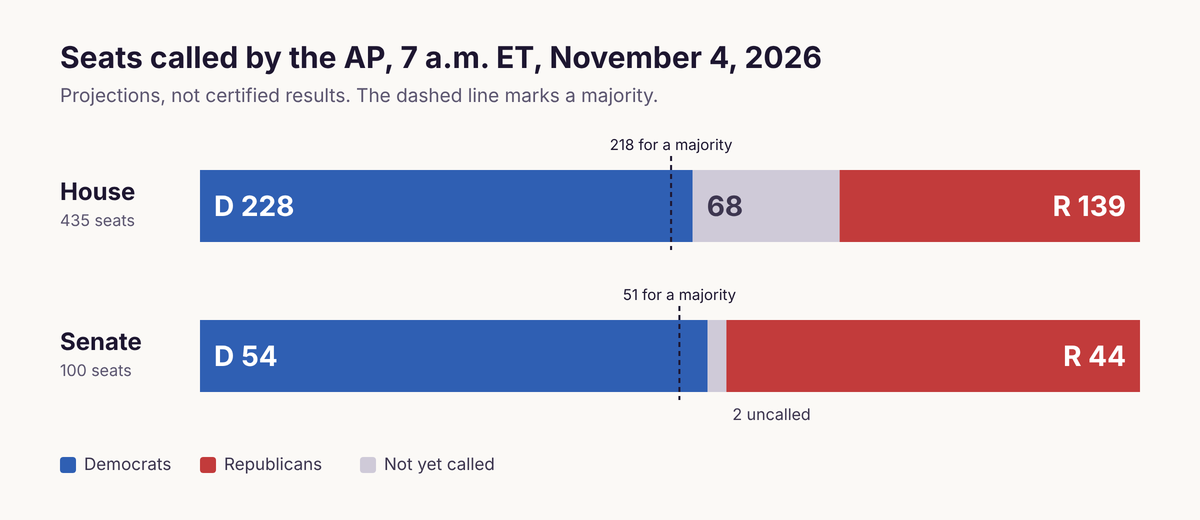
_Seats called by the AP as of 7 a.m. ET on November 4. Projections, not certified results._
I think Nixon's "organizer, not a politician" is a better map of American politics than the one I observe most people around me using, the one that sorts everybody into red and blue and then argues about which color is less rotten. The question underneath it is where a person's power comes from. Some people get it from organized people. Some get it from holding a seat, and from the donors and the seniority and the caucus that come with holding it. And some, a lot more than we like to admit in a country that says it has no aristocracy, get it from a surname, a family name that had the money and the recognition before they ever ran, which is really just the seat's power handed down, the Bushes and Kennedys and Cuomos, and if you're Puerto Rican like me you can probably name five island families without trying. Nixon holds an office too, so what separates her from a Politician, with a capital P for the type and not the job, is where her power comes from, and that matters most on the day you lose, because power that came from people is still sitting in those people the next morning, and power that came from the seat goes wherever the seat goes.
If you watched her speech you already felt it. The hundred thousand volunteers she thanked don't stop existing on Wednesday, the doors they knocked on stay knocked, and the people who did it for the first time still know how, and still know each other. And when a Politician loses, what's actually left? From where I sit it looks like mostly the Politician, a name and a donor list and a career that keeps going somewhere else, and I honestly wonder whether their power was ever kept in the people who voted for them, or whether it just leaves with the seat while the voters end up about where they started.
That's my best explanation for why "someone wins, nothing changes" still felt true to me on Tuesday, November 3, when Democrats won what NBC projects as their biggest House majority in nearly two decades and flipped Senate seats in places like North Carolina, South Carolina, Ohio and Texas, which on paper is about as much change as one election can deliver. A party winning Congress changes which Politicians sit in which seats, and it doesn't change what Politicians get rewarded for, which is keeping the seat, so the ones who won will read the result in whatever way keeps it. They'll call it a mandate, and I'd call it a _rebuke_, a lot of people saying no, out loud, to the cruelty and the strongman politics of the last two years, and a rebuke tells you what people walked away from without telling you where they want to go. Whoever organizes gets to answer that. If nobody does, the Politicians answer it, and they usually answer with themselves. To be fair to them, the record has real things in it, the bipartisan kind you can point at: the PACT Act in 2022, which finally covered veterans made sick by burn pits, the First Step Act in 2018, which shortened some federal prison sentences, the 988 crisis line you can call or text, the 2021 infrastructure law. When I look at how the PACT Act happened, though, it had organized people pushing for years, veterans and burn-pit families who kept showing up after every vote that failed, which is more or less my point.
And between us, what makes me angriest is that the deal itself, where we hand a few hundred people in Washington power over our lives and they answer to us and keep each other in check, was supposed to be sacred, or at least treated like a responsibility, with great power and great responsibility and all that, and somewhere along the way "we the people" turned into the egos of specific people serving specific interests. The founders never expected ego to stay out of it. James Madison, who did more than anyone to shape the Constitution, wrote it plainly in Federalist 51, one of the newspaper essays he and his allies published to sell it to the public, "Ambition must be made to counteract ambition," which, as far as I understand it, was the idea: set ego against ego so no single one wins. What I'm watching instead is the egos quitting the fight, lining up by party and by donor instead of by branch: a Congress shielding a president of its own party when it was supposed to check him, a majority taking a minority member's idea and the credit along with it. When the ambitions collude, the balance is gone, and the check left standing is the one outside the building, which is us, and we only count as a check when we're organized. What the actual fuck. And for what, money and power? That's about the oldest, most worn-out story we have, older than Madison, and to me it's almost insulting how unsophisticated it is, all that education and all those advisors and the plan is still just get more.
Hakeem Jeffries, another name I don't know personally, is the clearest example I have of the capital-P kind, and he'll most likely be Speaker in January. I've called him worse than anything I'd print, which proves nothing, so I'll describe him first. He's been in Congress since 2013 and has led House Democrats since 2023, and his power comes from managing a caucus and the money around it. In 2025, when his own party's nominee for mayor of his own city was a young organizer named Zohran Mamdani, Jeffries waited until the eve of early voting, four months after the primary, to endorse him. I read it as a man who treats organized energy on his own side as a risk to manage, and for regular people the risk looks pretty simple: people who organize themselves push for things leadership didn't pick, they make the donors nervous, and if they get good enough at it they show up in a primary and beat the safe candidate with the famous name, which is exactly what Mamdani did that June. That reading is about as close to Nixon's meaning of "Politician" as I can get. I don't know Mamdani either, any more than I know Nixon, so some of this is me sorting strangers into teams from a distance. My gut says Jeffries is a useless Politician, and that's my gut talking, so take it for what it's worth. Mamdani reads to me like one of mine, a politician with a lowercase p, someone who holds office, he's the mayor of New York now, but got there the way Nixon describes, with something like fifty thousand volunteers knocking doors for a state assemblyman from Queens.
Trump breaks my own test, honestly, because by it he isn't a Politician at all. He lost in 2020 and his power didn't go anywhere, it stayed in millions of people who stayed his. Look at that word, _his_, like he owns them, and... anyways, that's exactly what I just said organized power looks like. So the test tells you where power is kept, and it doesn't tell you whether that power is good, and people can clearly be organized around grievance and resentment and money and somebody to blame just as well as around decency. There's a whole shelf of books on how, and Robert Greene's 48 Laws of Power even has a law for building a cult-like following, at least lol. The difference I can actually see is _which way_ the power flows. Organizing the way Nixon or Mamdani means it makes the people more capable, so they'd keep going if either of them disappeared tomorrow and new leaders would come up out of the work. A following makes the leader more capable, and everything runs back up to one man and one name. Following is the polite word, and I'd personally call it a cult, or at least what the textbooks call a _cult of personality_, and the difference matters more than the insult does. People in a following like a leader and can drift away when he disappoints them. In a cult of personality the loyalty to the man outranks the facts, so his being right becomes part of what people believe, and every loss has to be explained as a lie, which is why that kind of movement usually needs a story about a stolen election when it loses. And that's also why evidence doesn't move it, more or less, because the evidence is arguing with the belief itself. Maybe the sharper test is what's left the morning after the leader is gone.
That stolen-election story found me on Wednesday too, and unlike the speech it found me all by itself, through the algorithm. Texas had flipped its Senate seat to James Talarico, a Democratic state rep and former schoolteacher, and a verified account on Threads, stinchfield1776, had a selfie video up from some ballroom with "The Texas model is dead! This is a disaster for not just the state but America! And where did the extra 2 million votes come from during early voting?" Tens of thousands of views, more than a thousand replies. The post never says the election was stolen, and that's how it works, it asks a question, and a question can't be fact-checked the way a claim can, so every reader supplies the accusation in their own head and the man who posted it was just asking. I don't know the Texas early-vote numbers, and from the post, neither does he. My guess is most of the people sharing it don't need it answered anyway. The question exists to give people who lost a place to put the loss that isn't themselves.
I think it works best on the guys who see themselves as alphas, the ones proud of never being fooled, because it flatters them twice. It tells them they're too sharp to swallow the official story, and it tells them they didn't lose, they were robbed. In that story being robbed can happen to a strong man, while losing fair, to more people who simply showed up, only happens to the weak, so the insinuation does a lot more to protect a self-image than to say anything about Texas. And a lot of these are the same people who spent a decade calling everybody else snowflakes, fragile, triggered, can't handle a loss, and now a grown man in a sport coat can't handle one state for one morning without reaching for a conspiracy. That's _projection_, more or less, the weakness you can't stand in yourself coming out as the insult you throw at everyone else, and the guy doing it is usually the last one to see it. And as a grown man, it's honestly embarrassing to watch, so many adults in my feed filming themselves saying the midterms were rigged, when that's exactly what some of us muttered after they won again, and they called us whiners and sore losers for it. Now it's their turn, and the videos are kind of hilarious, a lot of red faces and a lot of math nobody shows. Bruh. Really.
So Tuesday showed two ways to lose inside a few hours of each other. Nixon turned her loss into the next piece of work. "2028 is around the corner," she told the room, and she named the woman who beat her. The post turned a loss into a grievance that some people will carry into the next election and the one after, and I'd guess the grievance is a lot easier to build, since anybody can pick one up in thirty seconds on their phone and organizing takes evenings away from you. Still, she lost, and the people who kept their seats are the ones writing the laws in January, so I went and looked at what she's actually done with hers. It's mostly organizing, plus a sit-in at the governor's office that got her arrested in May and three bills she co-sponsored that became law this year, and I couldn't find a single law she wrote herself that passed, which in a Republican supermajority might be all the work there is to do, or might be the talk I said would lose me, and I don't know yet which.
I'm closer to the grievance than I'd like to admit. My cynicism is its own way of refusing a result, quieter and cheaper than his but the same family. I had a reply typed under that Texas post, something about crybabies, and I didn't send it, mostly because I knew what I'd be feeding. And I've said more than once, in writing, that I'm not a politician, I'm a learner and a dreamer, and I think I said it like it let me off the hook. Nixon said she's an organizer and not a politician like it put her on one.
If I'm honest about which of these feelings actually live in me, resignation is rare, I almost never fully give up on a thing, and disgust shows up when it should, at war and death and barbarism, at cruelty and bullying and abuse, which I think is a disgust worth keeping because it's pointed at something real. Cynicism is the daily one, a low hum about a world that seems less and less built around intelligence, kinda like living inside the movie Idiocracy with better phones. And when I ask what the cynicism is actually for, the answer is pretty basic: it protects me from hurt. If I expect nothing from the people we elect, they can't disappoint me again, and I never have to feel what I'd feel if I let myself hope and watched it go nowhere. Once I can see that, the cynic loses most of his power over me, because what looked like wisdom turns out to be a bandage, and alone with a feed, a bandage is about all you get.
What I can see from St. Cloud backs her version more than mine. Turnout in Osceola County was about 56 percent of registered voters, against about 40 in the last midterm, and our school tax passed 64 to 36 in a state that went red almost everywhere else. I don't know who knocked on those doors, but somebody did, and my guess, which is only a guess, is that somebody organized it.
**What I'm holding this Congress to**
So I'll hold the Congress that just won to the plainest bar I can come up with:
- No shutdown.
- Disaster money that arrives on time, because I live in Florida and hurricanes don't check anybody's registration.
- Oversight of the administration that produces documents and not just clips.
- A few bills that help people who aren't donors.
If they clear it I'll say so here, and if they don't I'll say that too, with dates. And the next time I vote, I'd like it to be for people like her who also deliver, organizers who are doers too, people whose power is kept in their neighbors and who would still be doing the work if nobody ever elected them.
I'll take that W. The speech is what I'm keeping, though, and the last thing she told that room was that they'd be "joyfully resisting." I have the resisting down. The joyful part, and the part where it costs me some evenings, is what I'm still working on.