If God Had Gentle Parented Us
What if God had knelt instead of exiling us? Genesis as a parenting story — and how that first answer still shapes how we punish and how we parent.
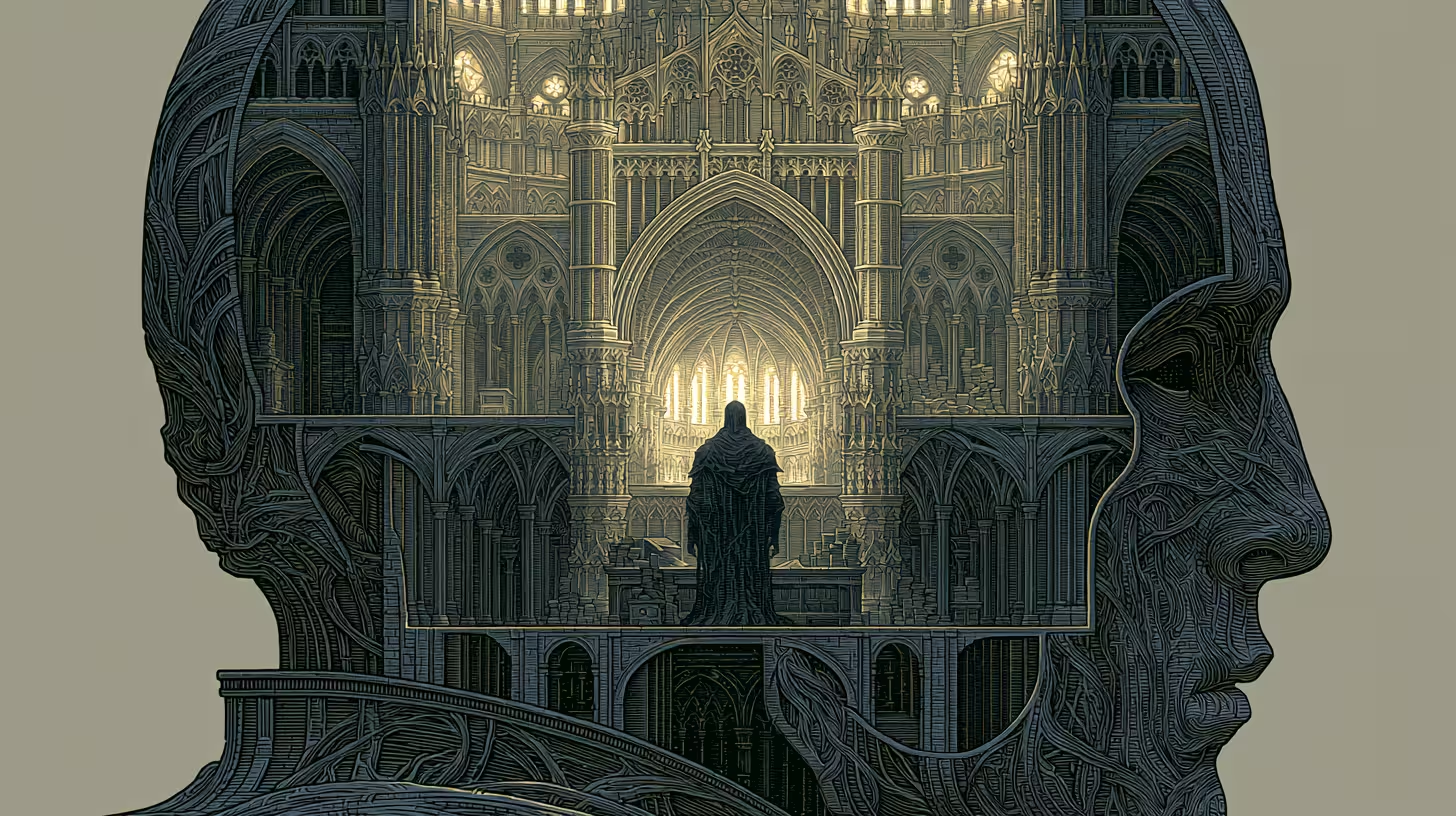
My daughter broke something last week. She snapped the thing in half by mistake and it doesn’t really matter what it was. What matters to me is that split second right after, when she looked up at me, or to any parent that might be around, to find out what kind of world she lives in.
That look is a whole thing. Poetic and philosophical, kinda ironic, something so simple, such a simple moment no? In that look, I think she wasn’t asking “what did I break?”, she was asking “what happens to people who break things?”, and whatever answer a parent gives in that split second becomes physics to a child. Not a rule, because rules can be argued with, but physics, the way gravity works, the way love works, the way mistakes work, the way this world works.
I always try to kneel down and say something like: “That didn’t work. Here’s why. Let’s try something different. I’m still here. Now please pick up the aftermath and take it to the trash.” Me and her mother are mostly gentle parents, and she’s six now, so she more or less knows what to expect from us, which is another way of saying that in our house, breaking things is safe.
Several days later I was driving down one of our big roads here in Florida, the kind lined with an assortment of churches, truck sellers, malls of all sizes, and gun places, in a loop, completely unrelated to this writing but it was there, and that’s when it hit me like a ton of bricks, an a-ha moment, what if God had gentle parented us?! What would be our lives, our world? Because, between us, and very seriously, that gentleness is not the answer our civilization was raised on and it shows. Our civilization got a very different answer, in its very first story, and we have been living inside that answer ever since. Literally and figuratively.
I’m an atheist, have been most of my life I think, but I’ve also participated in church most of my life. I was raised Catholic, went to Catholic school, and even as an adult, church is something I see as positive, the building, the ideas, the community services, the empowerment. Sometimes I’m there, sitting mid-song, thinking: do these people understand the power they’d be granted if they truly integrated these beliefs? Super similar to Super Saiyan Rosé. But some of the people have always turned me away, and their practices, upon observation, even more. The hypocrites, and who the hell am I to call anyone evil, so let me just describe them: the ones who, even when someone is explaining it to them directly, with the Bible right there as the reference, still find a way to make God about personal enrichment, about exploitation and extraction from and of others, about fear and fearing others, about war and the crusades. Most of you know exactly who I’m talking about.
Still, I take the Bible seriously as architecture, and you should too, whatever you believe, because whether or not you ever set foot in a church, you were raised inside a culture that was raised inside this book. You don’t stand next to it. You stand on it. You don’t have to believe in a building to live in it, is what I’m trying to tell you.
So let’s look at the foundational story. Two children in a garden, Adam and Eve, created immature, childlike, meant to grow, and given exactly one rule, which of course they break, because that is what children do with rules, as any parent in the known universe will attest.
And what does The Omniscient and Omnipowerful Father of All Time and All Things, aka God, do with his children upon the breaking of the rule?
Exile, infinite and non-negotiable, from divinity, from heaven, from paradise itself. Pain in childbirth, forever. Work turned into suffering, forever. Death, introduced as a feature. A curse that runs downhill through every generation that follows, children billed for a fruit they never tasted, and an angel with a flaming sword posted at the gate so nobody gets any ideas about coming home. What type of parenting is this? God-like, apparently. Christ-like, definitely not.
Now put my daughter’s look on their faces, that second after they tasted that damned fruit, when they looked up to find out what kind of world they lived in. Did they look into skies raining blood while all of it came down? That was the answer they got, and it became our physics and the architecture of our lives, like it or not.
Strip away the stained glass and read Genesis as what it actually is, a parenting story, the original parenting or origin story, the first documented response to a child’s mistake in the Western canon, and the response is: you fucked up, now suffer for eternity.
The hellfire and brimstone fear-mongering became the template, disobedience, then consequence, then suffering, and then, maybe, if you grovel correctly, redemption, an entire moral framework running not on understanding, not on growth, but on fear of retribution. And notice where this framework stores safety: heaven, the end goal, the you-made-it, achievable only by death. Life itself never gets to be safe; safety is what you get for dying correctly. Kinda hardcore isn’t it, this is our foundational parenting story. I wonder what type of world we’d have had if God had gentle parented us, really. I wonder how many of us ever actually arrive (in Heaven).
Now please run the scene again with the same garden, the same fruit, the same mortal mistake, but this time the father kneels down, eye-to-eye.
“You chose knowledge. That was a real choice, and it changes things. Here’s what it means. Here’s what it costs. Let me show you how to work with what you’ve gained. I’m still here.”
Not exile but teaching and presence. Not stripping away everything they had and everything they were, but guidance through the transition. Consequences, yes, real ones, because knowledge genuinely changes what a life requires of you, but consequence without cruelty, boundaries without banishment, a door that stays open, a warmth kinda similar to the things we learn to recognize as heavenly or divine.
I personally believe if you are an all-powerful, all-knowing, omnipresent being, a gentle version was always possible. Why not? It was sitting right there, and any parent who has ever knelt down instead of exploded has proven it can be done, in real time, under real frustration, by beings far less patient than a god is supposed to be.
We just never got that version. And I think it’s worth asking why. You can argue that Jesus Christ is that answer and that version, sure, hold that thought, we’re getting there.
When the foundational story of your civilization says “disobey and be destroyed,” everything built downstream inherits that logic, the same way every function inherits the bugs in the framework it’s built on.
In parenting, it becomes control through fear. Generations of children who behaved not because they understood anything, but because they were terrified of the belt, the yelling, the withdrawal of love. Ask them why the rule existed and they couldn’t tell you. They could only tell you what happened to kids who broke it.
In morality, it becomes punishment-avoidance wearing the costume of goodness really. The operating question stops being “what serves connection and life?” and becomes “what keeps me safe from retribution?” Those ideas or paradigms produce very different people and societies. And one produces character and the other produces compliance, and compliance evaporates the moment nobody’s watching. Which is kinda a problem in itself, you can go to church all you want but if church doesn’t get into you and your habits, well, compliance alone, when people are watching, when performing for witnesses, is really not taking you to heaven, sorry to tell you, and that’s the symptom of why the world is looking like it does today. In public we are this but in private we are that and that and that, God-like versus Christ-like, and I say this with a humble but stern heart, as an observation.
In and for our justice systems, that God-like foundation becomes the machinery we have now, systems designed to make people suffer for what they did rather than help them integrate what they learned. We call it corrections and correct almost no one, because the blueprint was never correction but labor or retribution. The blueprint was exile too, very God-like!
And in your own head, think about it, all that fear and judgment, it becomes the voice. You know the voice. The one that says you’re not good enough, that you have to earn your worthiness back, that you deserve to feel bad for a while after you fail, as if suffering were a fee you owe before you’re allowed to move on. That voice did not come from nowhere. That judgment, the judgment I feel when witnessed by a specific type of church-goer, that judgment is exactly that. That voice is punishment theology, internalized so young and so deep that it presents as your own personality. It is Eden’s landlord, still collecting rent. It’s the gatekeeper of the fruit, ready to rain blood on us all. That shit is embedded deep.
Ultimately, I believe that a god who teaches is a god you can question. You can sit with a teacher, disagree, ask why, learn alongside. Teaching creates peers, eventually. That’s the whole point of teaching and discipline.
Inversely, a god who punishes is a god you submit to. Fear is efficient for control and shame is powerful for manipulation and look at the world we have built. Gang, just take a quick look! All that eternal punishment is the single greatest compliance mechanism ever designed. An infinite penalty attached to finite behavior. Why we keep going with this design is really beyond my understanding, who benefits from these foundations? We can name these people and types of people directly and they aren’t Christ-like, more like God-like… These punishment models serve authority, the growth not of humanity but of capital and moneys and concentrations of power. These learning models serve development. Past and current history tells us explicitly which one got canonized by institutions whose entire existence depended on obedience.
Before you tell me that God did gentle parent us eventually, that this is the whole point of Jesus, I know, and that’s exactly what convicts them. The same book carries both parenting models: the father with the flaming sword, and the teacher who kneels, eats with the exiled, and says “neither do I condemn you.” The gentle version was on the shelf, canonized, named the son of God himself, and the institutions still built everything on the father’s penal code. And the hell they enforce it with barely exists in the book’s own foundation. The Hebrew Bible has no fiery torment, only Sheol, one gray underworld for saint and sinner alike; the furnace got sketched in the centuries between the testaments, and whatever Jesus meant by his Gehenna warnings, scholars still argue, the full infrastructure of eternal torment, the maps, the degrees, the forever, was built out by churchmen and poets centuries later. They had both models in one book and chose the sword. That was never scripture.
I don’t say all of this to sneer at believers. Most believers I know are gentler than their book. They read past the exile and find the love anyway, and that act of quiet editing might be the most human thing about faith. What I’m pointing at is the architecture itself, because the architecture escaped the church centuries ago. It’s in secular courtrooms and secular schools and secular households and secular heads. This stuff is embedded everywhere! You can leave the religion and keep the operating system. I did, for years. Most atheists I know still flog themselves like medieval monks. We didn’t lose the punishment god. We just moved him inside.
Every time I talk about this, someone hears “no consequences,” so let me kill that idea right now.
Gentle, or gentle parenting, is not permissive. The alternative to punishment is not “anything goes.” Anyone who has actually practiced this with a real child knows it is harder than punishing, not easier. Punishment is fast. Punishment feels like doing something. Teaching requires you to stay regulated, stay present, and stay in the room with a small person who is testing whether your love has a breaking point.
The distinction is this. Punishment says: you had it good, you fucked up, now you suffer until you’re worthy again. It treats suffering as the tuition of goodness, and it teaches exactly one lesson, which is fear of the punisher.
Learning says: you had one way of operating, you chose another, and now we work with what that choice requires. Struggle still exists, but it’s friction that produces capability, not sentence that produces shame. Boundaries still exist, but they exist the way a spotter exists at the squat rack, to create the conditions where you can safely find your limits, not to crush you for having them.
The root problem was never human nature. The root problem is a belief: that suffering is the primary path to learning, that people must be broken before they can be good. That belief was installed. It has been reinforced for a few thousand years. And it is entirely, completely constructed, which is the best news in this whole essay, because constructed things can be replaced.
Hell dissolves first. A learning-focused god has no use for eternal torture, because torture teaches nothing. Infinite punishment isn’t pedagogy but sadism wearing a judge’s robe. Look at Dante’s depiction of the Inferno, look what the human psyche and mind interpret and pass as hell and heaven. It’s very telling!
Original sin becomes original transition. Not a stain requiring blood, but a developmental shift requiring new skills. Every parent recognizes this instantly. Your kid gaining self-awareness isn’t a fall but a milestone. You don’t curse a child for growing up.
Shame loses its job. You do not need to feel worthless to learn. Shame actively blocks learning. Every good teacher knows this, every good coach knows this, and somehow the theology that shaped our civilization missed it, or didn’t miss it at all and simply had other priorities.
I can’t rewrite Genesis. But I’ve noticed the architecture only survives by being rebuilt daily, in small decisions, by people like me and you.
With my children, the reps are constant. Mistakes do not cost them connection. Ever (bullshit, it’s harder than it seems and I’m not perfect). Consequences are natural and named, boundaries are real and explained, and the message underneath every correction is the same five words: that didn’t work, I’m still here. I am not trying to break their will because their will is the engine they’ll drive out of my house someday (or drive them out of the house). I’m only trying to build their capacity to steer it, not to tell them where to go.
With myself, the work is quieter and harder. I catch the internal voice mid-sentence now, right when it starts drafting my sentence for some failure, and I ask myself one question: what did this reveal? Not “what do I owe.” What did this reveal, and what’s the learning? Some days I catch it. Some days the old landlord collects. But I know his name now, and knowing the name of the pattern is the first honest step out of it.
And in everything I build, tools, processes, teams, relationships, I’ve started checking one thing before anything else: does this architecture reward learning, or does it punish failure? Because whatever it does, the people inside it will become. Is this teaching me to be God-like or Christ-like?
That look my daughter gave me, the one asking what kind of world she lives in? Every person you love gives you that look sometimes, right after they drop something. Colleagues give it. Partners give it. The face in the mirror gives it, and you are literally somebody’s answer to that question. You are the physics someone else is learning.
The garden story told us the father’s love had a breaking point and we’ve been flinching ever since but it was only ever a story, written by men who needed obedience more than they needed us whole. There was always another version.
I’m no guru, just another asshole, another dad figuring it out.
Kneel down. Say the other thing.
I’m still here.
Reading Signals
14 min read
💬 Join the Conversation
Share your thoughts, ask questions, or simply let me know what resonated with you. I read and respond to every comment personally. Sign in with your favorite social account to participate.