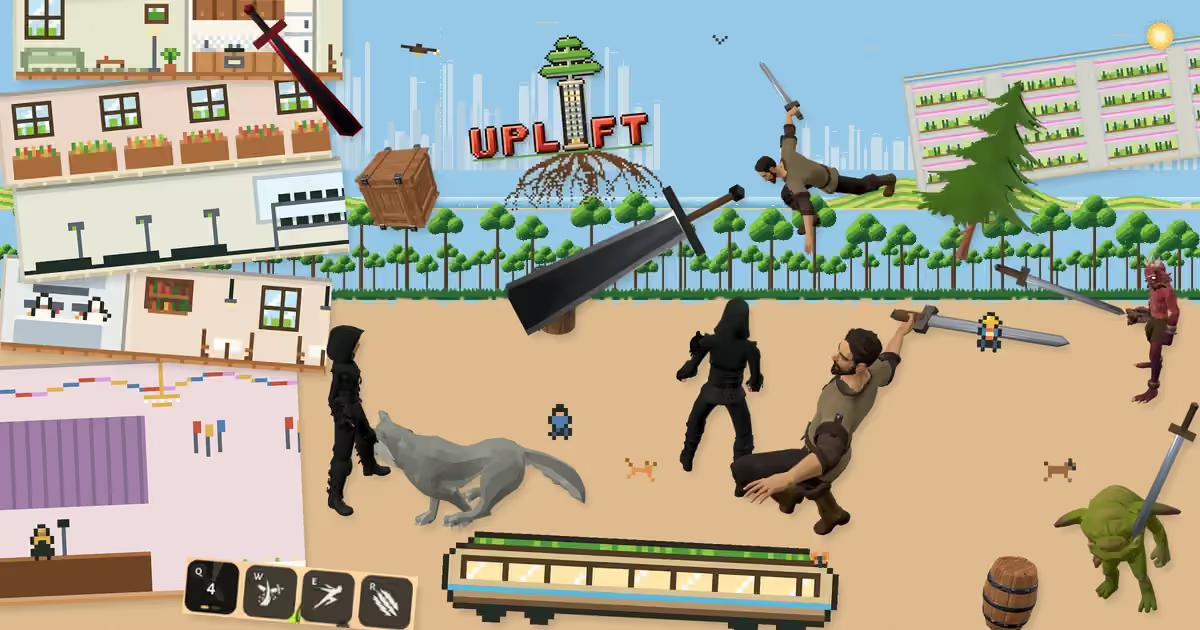
I have a day job and a family, and in the last ten days I put a tower game on the web and started building a sword game in a real game engine. I did not write a single line of the code for either one. Claude did.
A lot of people dislike AI in games right now, and some of that is earned: there is a flood of games on Steam that somebody published but nobody seems to have directed, games where nobody made a call. So this devlog is about the calls I make while the machine types.
The tokens are going to be bought and used anyway, so I’ll buy some and make kick-ass games with them, in the open. I say when AI is in the work, I make the calls, and I understand what it builds.
The two games
| Uplift | Lifesworn | |
|---|---|---|
| What it is | A tower-building game, my take on SimTower | A 3D action RPG about a swordsman for hire |
| Where it stands | Early and playable: a vertical slice, live and free | A playable combat slice: bodies since October 20, a title screen since October 22 |
| Decisions written down | 170+ | 200+ |
| Play it | uplifttowergame.com | Not yet. Support it on Patreon |
Uplift: live in three days
Uplift started on October 11 with one sentence, more or less exactly: “i’ve always loved SimTower, let’s build a worth web-based successor for it, let’s create the project plan, let’s define everything before building anything, help me out.”
Define everything before building anything. That was the whole method, and it still is. Before any code there were questions, a lot of them, and every answer I gave got written down with my words and the date. When the code and my words disagree, my words win, and the code gets fixed.
Three days after that first sentence, Uplift was live.
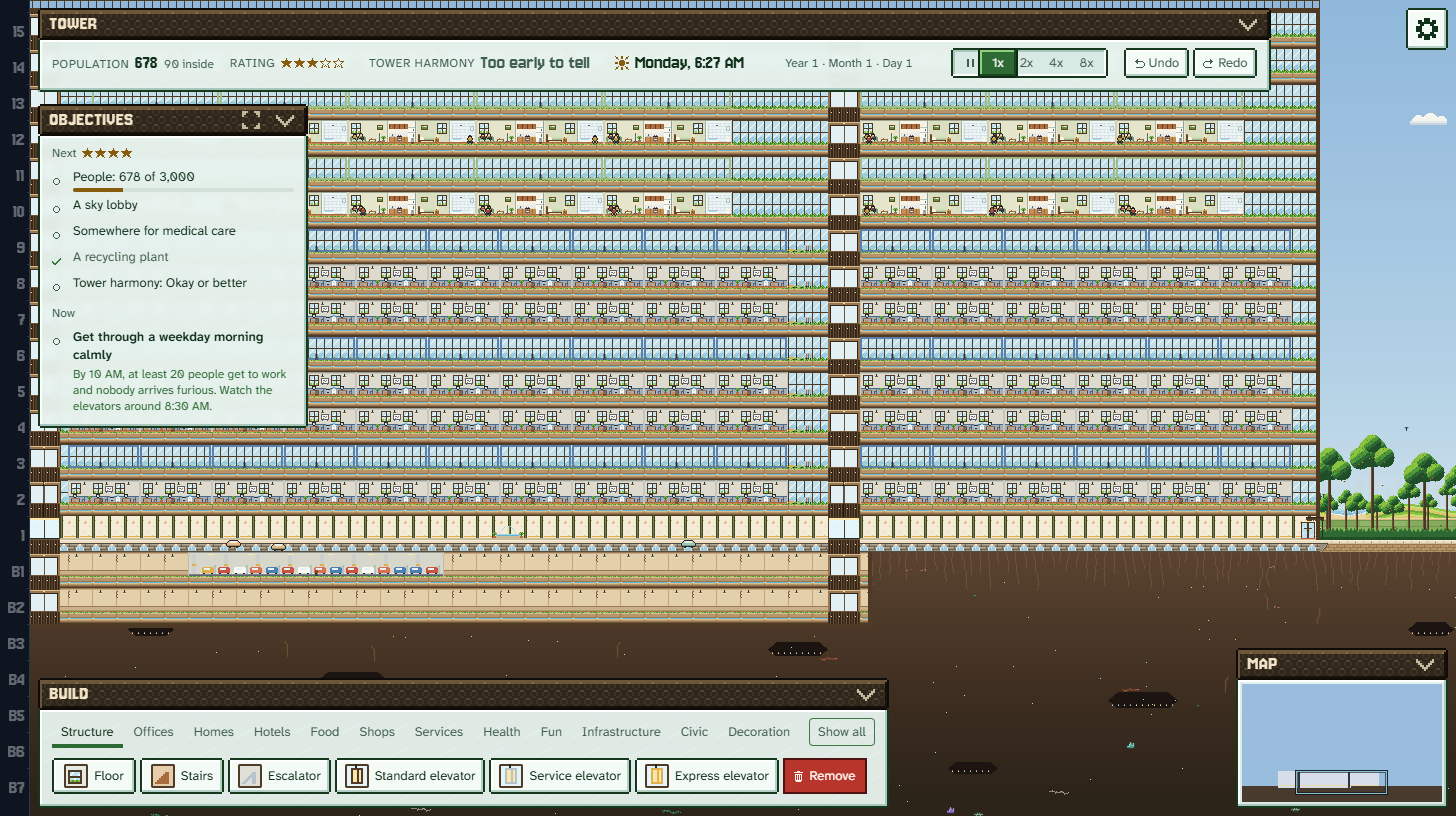
Then a friend played it and told me the first minute was confusing: too many panels, nothing to do. That one note became the new start of the game: an empty lot, one prompt, and the panels show up only when you need them. I didn’t think of it. I just listened, and decided it was right.
I want more notes like that one, from more people. It’s the reason I write devlogs at all.
Uplift is free, and it runs in your browser: play Uplift.
Lifesworn: the game I’ve been dreaming about
The tower experiment, gave me the boost, the confidence to follow my dreams, basically! And my children enjoying my demos is a wild unexplainable sensation and feeling.
And yeah, I’ve been dreaming about this game since the first time I played Yasuo and Yone in League of Legends. An RPG action game based solely on the quest of learning combat and martial arts and accumulating that skill and strength for a super fun adventure sandbox game. And this guy, our hero, he’s a homebody! He only cares about eating tasty food TBH!
Lifesworn started on the night of October 19 under a codename: Milak. Milak Summir is a name I’ve used in my RPG runs for years, maybe since the original Guild Wars, and he’ll be in the game too, as an important NPC. Our hero is a swordsman for hire who swings a two-handed bastard sword like a pencil. I told Claude, more or less: you’re building it, not me, I’ll direct the art.
And the first thing I directed was no art at all. The hero was a blue capsule swinging at straw dummies until the fight felt right in my hands. Art on a fight that isn’t fun is wasted, so it waited. The fight passed that check on October 20, and only then did bodies come in. Most of the job, I think, is deciding what not to build yet.
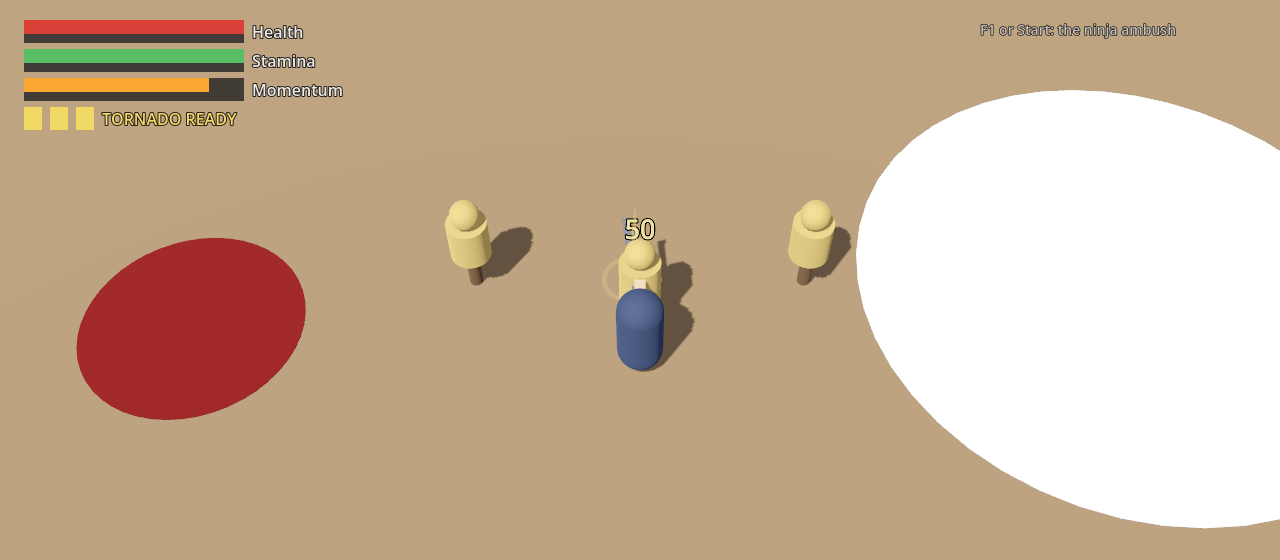
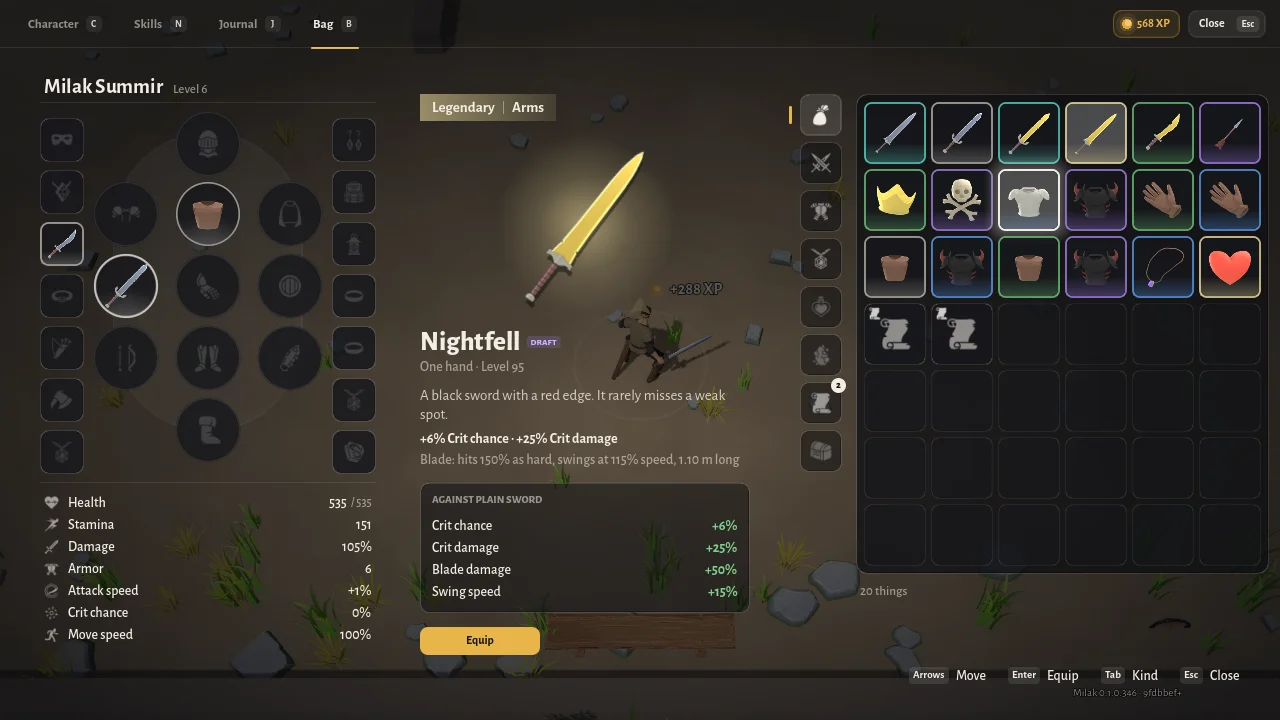
Two days later, it’s a different game. The swordsman has a hunting knife on Q, a real leap with a plunge, blood and bodies that stay, and dummies that break and rise again. The whole keyboard is on screen as his action bars. He has a Journal, a Skills window, quests born from what he does, and a title screen with the game’s new name on it: Lifesworn.
How I direct Claude
My rule since October 14: “anything visually, every pixel, every line in this game, is it intentional, is it helpful, does it provide value to the game? always”
Claude proposes, a lot, and fast. Most of my time goes to saying which of the three options is the game and which two are not. Sometimes none of them is, and I say what is, in my own clumsy words, like the sword tornado, which I described as a coil, a stomp, three swings, and then a 360 that throws “a fucking tornado of dirt, blood, whatever was in that cone”. Claude turned that into a move. I played it, and I said what was wrong with it, and we went again.
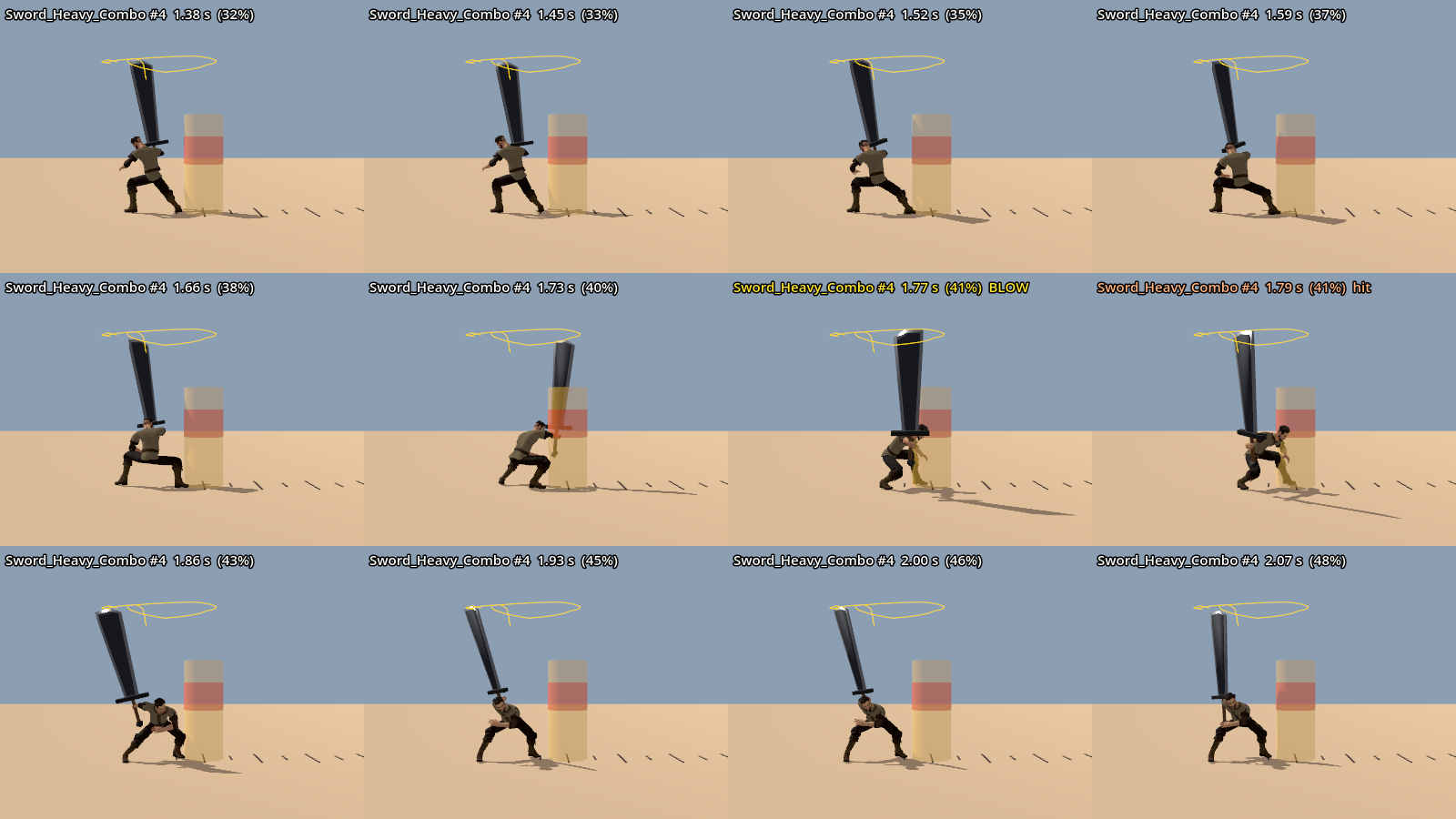
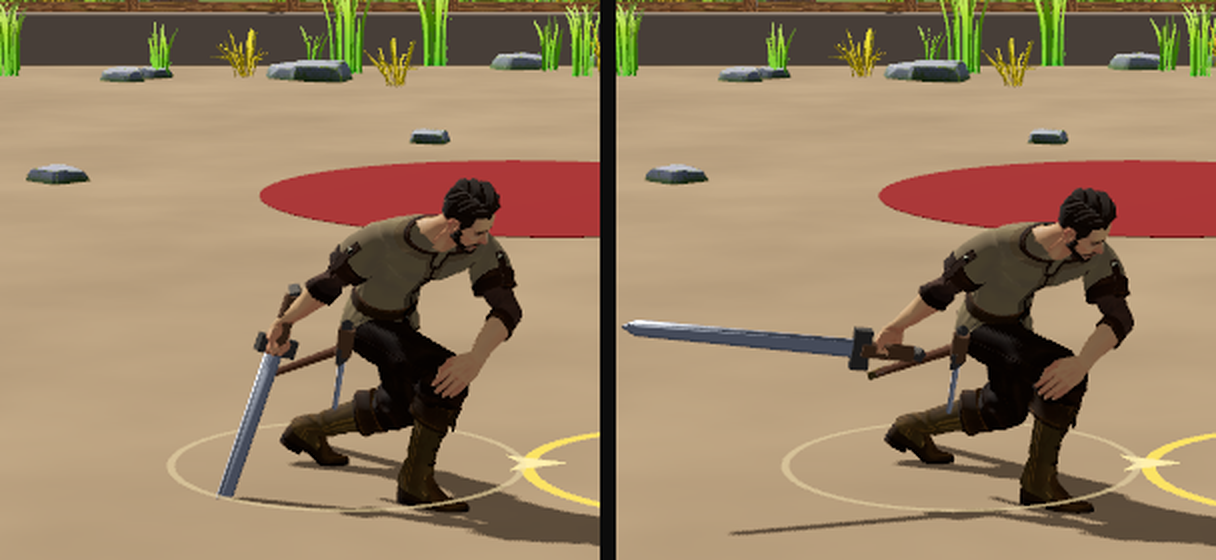
The science in the swing lab is brilliant. Claude built a tool that poses the swordsman through every sword animation, traces the tip of the blade, and marks the moment of the blow, with a dummy one meter in front of him for scale. It found that the animations were made for one-handed swords: his 1.65-meter blade went into the floor. So he starts with a normal sword now, and he earns the big one later.
What AI does for me is what a studio would do, if I were rich enough to pay one to build Lifesworn.
I don’t write the code, but I understand the codebase, completely. That’s part of being a game developer. If you aren’t doing that, then can you really say you are building a game, just by feel? How will you maintain it? That’s how I can maintain it.
The games write back
Uplift turned into a world-building tool for a novel. Its tower lives in a world I’ve been writing for years, and on October 19 I told Claude: “If you write it into the game it becomes canon in the universe - think about that”. So now it works both ways. When the game needed robots and animals, I picked them, and now they exist in the novel’s world too. That world is far enough in the future that a lot of it is guesswork, even for me, and the game keeps asking questions the novel never did: who walks the halls at night, what lives underground, what you find when you dig. Wild.
Lifesworn might do the same thing from the other side. The game is meant to have its hero thinking as he travels, thoughts and maybe poems, with the player guiding them. That’s writing, inside a game. Maybe one day it becomes a story of its own. I don’t know yet.
I already had a place to write about the games. Coincidental, accidental, or intentional? Honestly, a bit of each. Notes was here for over a year before these games existed; that part is an accident. On October 7, four days before Uplift started, I wrote that all of my writing would be free and that people could support me on Patreon if they wanted; the timing is a coincidence. Writing these devlogs here is the intentional part.
Is it slop?
Some of you might consider it slop, but I strongly disagree. To what standard is a free game that is a WIP, and being worked on with intentional direction is slop?
I am debating the ethics, the morality, the whys, the why-nots, of the whole AI-is-art-or-not debate. I wrote about it in Front Row to the End of the World, and I still think what I thought then:
I think we might be headed for a golden age of art. AI flattens the learning curves, and that could bring the next Leonardos and Leonardas forward.
And the debate about whether AI art is even art? To me it’s silly. It’s a print. Yes, it’s art. A print can be low or high quality, like any other print.
Disclosure should matter, and then, the integrity of each person determines the value of that piece of art.
Merriam-Webster made “slop” its word of the year for 2025: “digital content of low quality that is produced usually in quantity by means of artificial intelligence.” Simon Willison, the programmer who helped the word catch on in 2024, puts it shorter: AI content that is unrequested and unreviewed. And my own take, from the same essay: slop is still art, just sloppy.
Is it low quality? Is it made in quantity? Did anybody review it?
- Uplift. It’s a work in progress, so parts of it are rough, and I know which ones: there’s no sound yet, the rules for stairs aren’t right, an empty lot looks the same as an abandoned one, and some buttons sit in the wrong panel. It also holds 60 frames a second with 15,000 people in the tower, every change has to pass its 311 tests before it’s committed, and every one of its 170-plus decisions has my words on it. It’s one game, not a pile of them. And it’s reviewed: I play it, a friend played it and changed its first minute, and every change goes through me.
- Lifesworn. It’s three days old, so judge it later. For now: it was a blue capsule until the fight was fun, and the bodies that came in after are free models made by a person, Quaternius, not generated ones. One game. Nothing got art before it passed my check.
- This post. Claude wrote the first draft of it from my notes, and I’m rewriting it. By Willison’s test, it isn’t slop: I asked for it, and I’m reading every line. By Merriam-Webster’s, quality is yours to judge, and that goes for all three. What I can promise is that a person made every call.
By my own moral and ethical standards, Anthropic is a company I’m okay using and paying, by the way. I pay for my plan myself; nobody sponsors me. If I’m wrong about them, leave me a note down there!!
The hats I wear
Making two games without a studio means trying on a lot of hats. Some of them fit better than others.
| Role | Who | What it looks like |
|---|---|---|
| Creative director | Me | Deciding what each game is, and writing it down: 170+ decisions in Uplift, 200+ in Lifesworn |
| Game designer | Me | The sword tornado’s chain, stamina, Lifesworn’s talent web, Uplift’s stars and construction crews |
| Art director | Me, learning | Chasing League’s “hand-painted, yet graphic” look for Lifesworn, and picking which free models and fonts go in |
| World builder | Me | Uplift’s tower lives in a world I’ve been writing for years, for a novel |
| Engineer | Claude | Every line of code: 300+ commits in Uplift, nearly 400 in Lifesworn |
| Code reviewer | Me | I read what Claude builds until I understand it, and I’m still learning the engine side |
| Producer | Me, with Claude’s plans | What gets built next and what waits, like plain shapes until the fight was fun |
| QA and playtesting | Friends, Claude’s tests, and me | Friends send notes; I play both; Uplift has 311 tests every change must pass, and holds 60 fps with 15,000 people |
| 3D artist | Quaternius, and maybe you | Lifesworn’s bodies, clothes, animals, and the yard: free models made by a person |
| Sound | Kenney for now, me later | Lifesworn’s placeholder sounds are Kenney’s; Uplift’s sound waits on mine |
| Researcher | Claude | The asset library for Lifesworn, and the market numbers I plan with |
| Writer and translator | Claude drafts, I rewrite | This devlog, in English and Spanish |
| Marketer | Me | The soft launch, this devlog, the Antonio Builds Games channel, the Patreon page |
| Community | Me | Playtest links, an anonymous feedback form that files every answer for me, and the comments below |
Claude wears the engineer’s hat and helps with research, tests, and first drafts. I wear the rest, some of them badly, and the models and sounds in Lifesworn belong to the people who made them and gave them away.
If you draw, model, animate, or make sounds, and building these games with me sounds fun, say hi down there. Worst case, we make something cool together. Best case, this is how a little game studio starts, lol. No pressure, I promise. I already wear enough hats to know how heavy they get.
The people who made this possible
None of this works without open source, and without people who give their work away. Lifesworn runs on Godot, a free and open-source game engine built by thousands of volunteers and contributors. Honestly, it’s a wonderful place to start: it’s free, it’s light, it opens in seconds, nobody asks for a cut of anything, and the docs read like they were written for someone exactly like me. Uplift runs in the browser, on open-source web libraries that other people wrote and gave away. Quaternius and Kenney release their models and sounds under CC0, free for anyone to use, and they’re what make Lifesworn look and sound like a game. And around all of it there’s a community that answers questions, writes docs, records tutorials, and shares what it makes.
So when I say I don’t write the code, there’s a whole commons underneath that sentence, and the machine that writes my code learned from it too. Thank you, all of you. I’m a beginner in your house, and I’m grateful to be here.
What’s hard
It is not magic and it is not free, and I think the hard part hasn’t even started. Claude remembers things about the engine that don’t exist anymore, and I learn that when the build breaks. Uplift’s first push cost me $250 of credits and almost a whole week of my plan. On October 5 I hit my weekly limit on the first day and upgraded to Claude Max. That night I wrote, “I hope i don’t regret this, it’s 1,200 a year!”
Since then I’ve been working about ten hours a day, every day, if I count my real job and the games together. Lifesworn alone has over a thousand commits, and it isn’t a week old.
And the road ahead is long. Lifesworn has a roadmap now, and it runs to October 2027: finish what’s half-built by the end of November, a first region you can play for five hours by January, outside players trying it with no help from me, an art lock and a freeze in the spring, two more regions and an ending by the summer, then bugs, balance, a closed beta, and the stores. Three regions, maybe fifteen to twenty hours of play, made by one person, a machine, and whoever wants to join.
I wonder if this is sustainable, and I mean all of it: my body, my time with my family, and my wallet. I don’t know yet. Ten hours a day for a year is a lot to ask of all three. I’m new to making games. I have taste and a lot of years of making software, but I’m learning the craft of games in public, here, so I’ll get things wrong in public too.
And honestly, the pace is already changing. For now, the soap business is going to come first, because Lifesworn is a slower drip and a lot more effort. That’s not me giving up on it. Maybe a slower drip just means quality over quantity. Lifesworn will grow at the speed my life allows, and I’ll keep telling you how it goes, here.
What’s next
Every other week I’ll write one of these: what got built, what I decided, and what I got wrong. Uplift is playable now, free, in your browser. Lifesworn will have a free demo when the fight is something I’m proud of.
If you want to follow along, I’ll ask one thing: follow me on Patreon, for free, and you’ll get each devlog by email when it ships. No ads, ever. Just the games and me making them.
Screenshots: Uplift’s live demo, October 21, 2026; Lifesworn’s own recordings and screenshots, October 20 to 22, 2026; the collage, October 22, 2026. Status as of October 22, 2026.


Leave a note
Share a thought or ask a question in the comments.
For a private note, you can email me at antonio@builds.software.
Comments will load when you reach this section.