"Crimson Desert" Game Review
After 230 hours on PS5, Crimson Desert felt like a near-masterpiece: deep systems, unforgettable exploration, some repetitive quest structures, and a world worth living in.
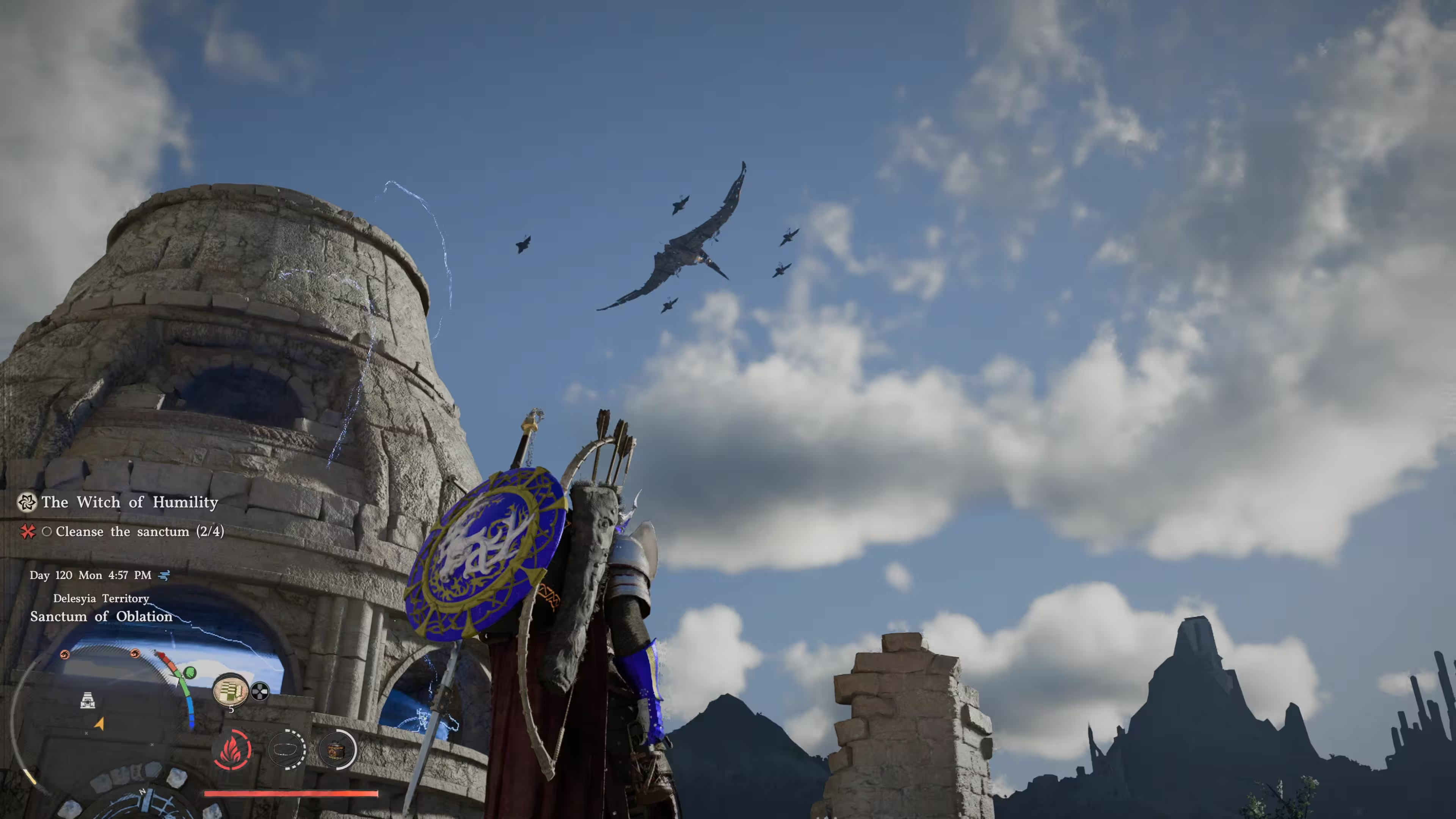
I just finished Crimson Desert’s main questline at around 230 hours on the PS5 and I thought to myself, “holy macarena, you write so much shit and you have never written a game review, let’s do one for Crimson Desert because it deserves so.” And here we are, it’s actually my first time “formally” reviewing a game. What I think makes me a valid reviewer? I’ve been a gamer for over 30 years and have played most of these games, indie, AAAs, I’ve probably played and finished it. My favorites tell you the kind of taste I’m bringing to this: Bioware games, Fallout, GTA, World of Warcraft, League of Legends, Minecraft, the Zelda series. I’ve been playing since the NES and SNES days, still have both consoles, so when I say this game is a 9 out of 10, that’s against three decades of context.
Crimson Desert is a masterclass of video gaming and entertainment. Let’s get that out of the way. It’s a masterpiece, it’s a classic, it’s a game that, even if you do not enjoy it, sold extremely well. I just learned it crossed 5 million copies sold by April 15, 2026, the fastest pace ever for a Korean-developed console game, and the favorable reviews keep coming in because it’s a game that’s meticulous, fun, and ultimately, the developers and the implementers show that they care about gamers and the experience.
I give this game an “Excellent!” score, or 9 out of 10, or 4.5 out of 5, whichever you like the most. It delivers in fun, in mechanics, some people will say the story is bland or uninteresting, I disagree, it delivers in UI and UX, the updates are coming in frequently. It’s one of the best games I have played in years, and most people who give it a real shot will get hooked, especially if exploration is what pulls you into a game in the first place. That was the hook for me, and it is what kept me coming back night after night for months, just like Zelda’s BOTW and TOTK kept me hooked for years.
Thank you Pearl Abyss for your work and this beautiful adventure of a game, for all the details and the expansive map!
I do have to knock on the launch experience because for PS5 we had a day 1 patch that had me waiting for a patch to download, install, to actually play, so waiting for the PS5 countdown to complete to play was futile and frustrating. Other than this, let’s dive into the review.
Combat and Movement
Combat and movement shared the learning curve for me, and I think and have heard of people leaving the game and leaving negative reviews because of the initial awkwardness of the momentum and the animations. So yeah, those players that quit before they get to the good part because they were spending their first ten or twenty hours fighting the controls more than the enemies, I get it. But dude, once you got past that point, the controls are on-point and make sense with the type of game. Once I slowed down and realized I could keep my attack commands pressed and the thing would just keep chaining, for example, it’s these game-changing moments in a game that make the game more fun, “This! This is what the developer intended,” and truly, the game has minimal tutorials on these things. I enjoyed that discovery aspect of movement and combat, and it truly never ended even after the 230 hours I played. Kinda cool.
We got stamina, parries, dodges, enhanced dodges, enhanced parries, magic attacks, magic defenses (some passive, some by item, some by talent - which need to be unlocked through hidden progression in the Abyss), weapon swaps, special moves, finishers, unarmed combat is deep, goes into wrestling and martial arts territory, plus a movement system that asks you to think about physics, momentum, weight, and traversal as its own skill tree, it’s so much and there’s so much depth to be stacked on top of each other and again the game does not hold your hand through any of it, literally. I found myself watching YouTube guides and insight videos, reading patch notes, and practicing combos in the open road with the skill tree open as my guide. The learning curve was real but that comes with combat and movement player expression which ultimately, makes the learning worth it, and fun.
Once your hands stop thinking about the buttons though, both systems (combat and movement) really open up and the game becomes a blast because you will start reading enemies and chaining moves and combos and then you pick fights you would have run from in week one, with a strategy. Again, the expression that the deep combat and movement mechanics give you kept me thinking about and coming back to the game for fun. Clearing out hordes of enemies had a different combat and movement flow than against bosses, each boss their own tactic, very stimulating.
I focused on sword and shield as I always mostly do with my games in first playthroughs. My trusty 2-hander longsword also accompanied me into the late game. In the early game I messed around with all sorts of weapons but the 2-hander sword won me over with its animations and responsiveness. Plus, once you go deep into upgrading a weapon, it’s kinda hard work to level up another one. I got lazy once I found my critical-rating 2-hander and stayed there and modified Abyss gears as I needed, since the game lets you do so cost free (very clever mechanism, gives you replay and playstyle variety).
Some fights would be about stagger through heavy combos, other fights I needed to stagger through evasiveness and bow attacks, sometimes I would have to go and change my Abyss gears, food, and resistances to complete a boss. Sometimes it was easier to MOVE away from enemy attacks than to try to dodge or parry, all of these were heavy on trial and error and slowing down to actually understand what the hell was happening. I imagine all Sekiro/Souls-like players and gamers go through this process but for me honestly, it’s been a long time since I invested so much time, energy, and depth into understanding combat in a game, and I’m not able to break it. In Dragon Age Veilguard for example, I was able to break combat using specific builds and concentrating skills in a specific way very early, but in this game, things seem to balance out very cleverly, very well.
After maybe 100 hours (I suck so bad, I know) I realized how strong some skills like the Force Palm and Nature’s Snare were they changed the game again for me, meaning, they gave me a layer to fights that I had no idea about. For example, with Nature’s Snare I was able to trap gas, or projectiles, or debris, during fights… then i could either push all that in AOE or push it into the boss or an enemy, think about all of the expression I’m speaking about in real-time with my PS5 controller, so fun.
Even with the hundreds of hours on the clock I still did not learn every combo or skill, and the ones I did learn were not the most complex in the game. The Axiom Force for example, I had the upgraded skills but I didn’t fuck with it because I ended up messing up my damage rotations, so I never learned or integrated it into my combat. I think about how much more layer of combat expression and movement that one skill about teleporting would’ve given me and it kinda makes me want to boot up the PS5 to play. Hah! In actuality I rotated through a small set of combo chains and kept the inputs pretty straightforward. I did a ton of R1 (hold) to R2, R1 + R2 for most of the game, and I’m super fine with that because my real effort went into exploring and farming gear and upgrading gear, which made up for my lack of combat skill. My stat priority changed over the course of the game but as I understood the combat mechanics I favored movement speed, health, stamina, and critical rate, in that order. I got my movement speed up to 12 and my crit rate hovered around 12 to 14, which is double damage on every successful crit, and the RNG was reliably on my side.
I liked the skill tree. It was very confusing at first, but once the patch came in and I went deep on YouTube and tutorials, it was a breeze. I’ll admit that with only the in-game guide I was barely able to push through the skill tree in a way that made sense, my earlier builds had no freaking sense. So I don’t feel like I can write much about the skill tree other than it’s bonkers and I made it work.
If you are starting this game, the simplest tip I can give you is this. Being able to move away from enemy attacks with the joystick is more useful than any combo you will memorize. Faster movement, easier game. Stack movement speed first, crit rate second, and the combat opens up around that. Also, stack on stamina and health early to get your confidence and practice things, then re-spec as you get more comfortable and understand the combat and movement mechanics more and more.
That build philosophy made exploration and combat much easier than they probably should have been, which is the main reason I ended the game kinda overpowered (?I think so). So when I say combat is engaging once you push through, weight that against this. I engaged with maybe sixty percent of what the system offers, and sixty percent was already enough to carry a 200-plus hour run, IMHO these are mind-blowing numbers for a single-player game, at least for me. I was also playing pretty intentionally, I never felt I was grinding, it was all fun, and the exploring and the questing and the knowledge system kept it feeling fresh. Every time the blue outline would glow around me (“hey, you learned something new, let’s read about it”) I felt that little hit of curiosity. Very, very cool.
Same confession on movement: I never mastered the advanced flight techniques or the traversal Axion Force moves. My traversal was three force pumps and fly forward, then spam stamina, then land somewhere reasonable. I LOVED my Eratrima horse, level 5, with his full gear, very pretty. I tried the tree-bending thing but I ended up breaking more trees than was useful, so yeah, that was it. I have seen videos online of players doing things that look like a different game entirely, full expressive flight with chained inputs and acceleration tricks I never even unlocked, and I don’t regret not learning that layer because I enjoyed my game time, but oh boy, those videos do look like a different game. Even at my basic version, traversal was a blast. The map gave me so many ways to get from here to there that I rarely picked the same path twice. If a system is that fun at sixty percent depth, it is probably very well designed at one hundred.
One final note about combat: the Hordes of enemies: Crimson Desert does something specific that most games do badly, which is letting you actually fight a crowd and letting you feel powerful. Charging into a pile of enemies and coming out the other side with the screen still legible and your inputs still meaningful. Most open-world games turn crowd combat into a numbers blur or a stagger lock. Crimson Desert lets it stay a fight, you can combine, flow, combo your way out of it, and in one wrong turn or move, you are toast, the game gives you several ways out through the palmar pills, the checkpoints, etcetera, but overall, combat is a blast. I never got tired of it. I’m still not tired of it and if I had unlimited days, like Goku has for training, I would mess around with multiple builds and weapon types.
Exploration Is the Reason
I do think exploration is what kept me in the game past the first hundred hours. The biomes are immersive, and each one feels like the team built it from a different design philosophy, not from the same template with a different color filter swapped on top. New systems show up in new regions. New mechanics. New monsters that fight in ways the old ones did not. New small economies of resources and crafting and side activities you only encounter because you wandered. Very freaking cool. One time I stumbled upon a deadly mushroom forest, I panicked, ran randomly and I ended up in a spider-infested castle/factory place I had no idea about. Again, very freaking cool, and the encounters are very varied.
The world rewards curiosity, which is the only test of an open world that actually matters. If I am going to spend so many hours somewhere, the place itself has to be interesting. Crimson Desert’s world is interesting. I climbed things just to see what was on top, followed roads just to see where they ended, and the game kept paying off that behavior. I even stopped using the blinding flash technique to find points of interest and just went exploring in literal roleplay mode. Think about how immersed one can get when you take this kind of trip yourself, inside this game.
The map itself is outstanding. Every section has its own architecture, its own flora and fauna, its own feeling. The weather system layered on top adds real drama. The number of times someone walked through my living room while a storm was rolling in or a snow squall was breaking over a cliff face and stopped to ask “wow, that game is so beautiful” was higher than I can count. People who do not play games can tell when a world is doing something good and this world does.
Maybe the only thing I missed was an “underground” like the Zelda games. Hey, we got a “sky zone” in the form of the Abyss so why not have an underground section in there too? haha a gamer can dream.
The Quests Are Repetitive, and I Have a Suggestion
Now the criticism, because a 9 out of 10 still has a missing point.
The quests become repetitive for me at some point. Not catastrophically or in a way that ruins the game, but after a hundred hours you start seeing the seams of the templates. You see the structures the designers built and reused, and you start predicting the beats before they happen. Go here, kill the thing, escort the person, retrieve the artifact, talk to the giver, read the note, read this other note, repeat. The variety of dressing is high but the variety of underlying structure could expand to give the players more fresh air.
Here is what I keep thinking about as someone who builds software for a living: If you are going to ship repetitive quests, why not generate them? Hand the system a seed and let it compose new combinations of objectives, locations, enemy types, loot tables, narrative wrappers. You already have the parts, every biome and every enemy and every structure. A procedural quest layer on top of the hand-authored campaign would have given the late game a reason to stay alive in a way the static quest list does not. Perhaps I’m talking shit and have no idea how hard it is to pull a system like this in a game like this, perhaps, but just an idea, food for thought.
Also, please note that I am not saying replace the hand-crafted work, the marquee story moments need to be authored, and the set pieces need authorial intent and it was lovely. Thank you for such a thorough and brilliant experience.
On Pacing, A Self-Critique
Before I move on from the repetition complaint, I have to land one honest hit on myself. I played those two hundred something hours too condensed and now I think that if I had spread them across months or years, with real breaks between chapters, the repetition would have stung less. A repeated quest structure feels stale when you saw it three nights ago but it barely registers when you saw it a week ago.
Some of what I felt as repetition is real and would still apply at any pace, so the procgen suggestion still stands but some of it was self-inflicted, and I want to name that. The game is too good to put down and my addictive tendency made me play so much, so often, that I kinda feel I disserviced the game in this aspect. I feel I left a lot of texture on the table by not letting the world breathe between sessions.
If you are starting Crimson Desert now, take this as advice: Play it slowly and treat it like a long novel and not a binge.
The Variety of Moments Saves It
Despite the structural repetition, I kept playing. The variety of moments is enormous even when the structure of quests is not.
Scenarios bleed into each other. Vehicles, dragons, mounted charges. Set pieces that feel like the game decided to spend the budget specifically to make you feel something for ten minutes and then move on. A boss fight that reframes a system you thought you understood. Random people coming to you to give you information or quests. The random encounters are so well-spaced and so varied, with so many views that make you stop the controller and just look. I thank the Universe I didn’t find the Photo Mode tool until very late, otherwise I don’t know how many hours I would’ve spent becoming a Crimson photographer, hah! Crimson Desert has more of these moments than most open-world games of similar scale (is there even a contest? I can only think of the Assassin’s Creed games as competition honestly, and they still feel very thin against this game), and they are spaced well enough that you usually hit one right around the time the repetition was about to wear you down. Very, freaking, cool. I’m adding a gallery below of my favorite moments for your enjoyment. Apologies for any spoilers.
1 / 68
The Story Worked Better Than I Expected
The narrative is good and well done. The story, like most stories, begins in fury and tragedy.
You start weak, and then after the first power spikes. You might save a castle or fight off some powerful beast. The opening hours give you the kind of hero arc most fantasy games would milk for the entire campaign. But Crimson Desert spends that capital early in several scenarios and chapters, and then the rest of the game pivots into something I did not expect. After the spike, you stop being the savior and you start being the helper. You go to the small towns. You talk to the people whose lives were ruined by the conflict you barely affected. You help everybody, one quest at a time, working through a country that is trying to put itself back together. And it scales outward and outward, from Hernand to the last place I found in the map in the top right corner, Varnia I believe it was called. The flux and flow of scale of these quests and stories is so freaking cool. The building aspect also felt fresh and kept me coming back with curiosity and childlike joy.
I honestly don’t know how people can say the story sucks. You have the main problem statement and antagonist that opens up a “worldwide” crisis and not only are you solving for that, you are rebuilding the Greymanes, literally, since you are rebuilding the camp, rescuing your fellow bannermen, making relationships with nation states, with houses, with courts, with guilds, with clans. My point is, if you look at “the story” as a single questline, and examine the game at the single quest level, yeah sure, it’s more of the same, but it’s not, because all of the quests and progress build upon each other, from the Greymane camp to the Pailune and Marni arcs, everything is interwoven even down to your settlement vendors and unlocks being tiered and dependent on trust and prestige with all of these parties and factions. Like, the story is deep if you understand it. I’d challenge these players that say “the story sucks” to look again, they did not catch this bigger picture context. And then when you add the mess that the Abyss is, and all that lore, and that final battle… was that a (spoiler alert)… was the Avatar a freaking Angel?! The story is dope. Y’all need to touch grass.
That structure is refreshing, and it is also down to earth in a way most fantasy games refuse to be. The genre loves chosen ones. Crimson Desert lets you be a chosen one for the first ten hours and then asks you to be a worker for the next two hundred, then to end up being the one (and still everybody’s helper and friend). I found that pivot moving in a way I did not expect, and it kept the world feeling earned rather than handed to me. Also, the amount of hugs that I received after helping out someone was very evident and is going to stay with me forever. The writers made helping others rewarding and felt human.
The Abyss, whatever it is, I didn’t fully understand it (talking about gamers not reading and understanding things in the story), is that heaven? Well, anyways, the Abyss zone is not a combat marathon. It is a refresher zone. Lore, puzzles, mysticism, mind twisters. Kinda reminded me of the sky zones in recent Zelda games. Some players will hate the puzzly aspect of this area, oh no I have to think, but I found it a satisfying counterweight to the dozens of hours of fighting that came before and after it. The weaving in and out of the Abyss was kinda like a test of loyalty to the game. It was fine for me, very engaging and stimulating.
What I Left on the Table
I should be upfront about the corners of this game I never engaged with. There are three notable ones, and naming them is part of being honest about what my two hundred something hours actually covered.
I played as Kliff for the entire run (unless I was made to not play as him). The game gives you three playable characters, each with their own skill trees and customization and ways of moving through the world. I touched one. If you went obsessive on it and unlocked every skill on every character and dialed in three full builds, I cannot guess what that would add. Maybe 400 more hours of a game I have no idea exists.
I never used the party system either. You can take companions like Oongka and Damiane along on missions, but the AI seemed dumb enough that they would mostly take damage I did not want to manage, and I preferred fighting solo. That is another corner of the game I left unexplored. If their AI is better than my impression, or if a future patch sharpens it, that opens a tactical layer I never saw.
I also skipped the trading layer almost entirely. I finished the main quests but trading is clearly a rich subsystem running underneath the campaign, and from the outside it looked like a whole second game. If you want to play merchant, Crimson Desert has something serious for you. I cannot speak to it.
What I will say about the economy itself, since I touched it adjacent to trading. From the start I parked everything in the bank for the 2 percent interest, and once I had a few thousand I switched into a high-risk investment loop with scum saves to lock in good rolls. That pushed me past 100k gold very quickly, earlier than the game expected. Being rich did not break anything honestly, the game stayed balanced because buying things is pretty much tied to relationship and quest progress. So being rich did not let me skip the legwork as I still had to explore and fight and gather and upgrade. The economy is decoration on top of an experience that runs on time and effort, not gold. Good design, and rare in open-world games of this scale, I honestly thought I was breaking the game in my favor.
Take my repetition critique earlier with these three skips weighing against it. Someone who plays differently will see a different game for sure.
Customization and Role-Play
The dye and haircut customization is excellent. Once you unlock enough of it, you can paint your entire ensemble in any direction you want and commit to a visual identity that is your own. My daughter dyed mine blue at first, then super green from top to bottom, and for a stretch of the game I was role-playing as either Sonic the Greymane (hah!) or the Emerald Knight. That was her contribution and one of my favorite memories from my playthrough (you probably already saw this stuff in the gallery above, ridiculous and beloved).
This depth did not surprise me after learning about the company that built this game. Pearl Abyss runs Black Desert Online, which I have not played, and it seems that BDO is famous in MMO circles for having one of the most absurdly deep character creators ever shipped. That DNA carries over here evidently. The dye system, the wardrobe layers, the haircut options, all of it has the texture of a studio that has been thinking about character expression for over a decade. See the recurrent theme? Character and player expression, same as with combat, or the economy of the game, of the traversal of the map, player expression is what makes this such a good game.
The customization is also functionally deep, not just cosmetic. I ended up running multiple wardrobes for different activities. A treasure-hunting kit with a pirate cap that boosted my odds of finding loot. A main combat loadout for fights. A farming set with bonuses to ore and item drops. The game lets you swap between these on the fly, and once I had the loadouts dialed in my play sessions felt cleaner. I knew what mode I was in by what I was wearing.
If you play for role-play, this game has a lot more to offer than I personally tapped into. Combine the customization with the trading layer and the dense social systems and the variety of NPC interactions, and you have a sandbox that can absorb hundreds of additional hours of pure character expression. I play mostly for combat and exploration and progression, and I still found the visual customization satisfying. If your playstyle leans toward inhabiting a character rather than optimizing one, Crimson Desert can keep you for a very long time.
Without spoiling any more of the hidden mechanics, the game has more in it than the main quest reveals. You could keep playing, and keep playing, and keep playing.
Systems on Systems
The thing I keep underestimating about Crimson Desert is the sheer number of subsystems. The skill tree alone is large enough to be its own progression game, like I mentioned earlier. The knowledge system tracks everything you learn about the world. The challenge system gives you long-running goals across all activities. There are recipes I have not cooked, ultimate tools I have not built, Abyss gears I have only seen referenced, dice mechanics I never played, memory fragments I just started uncovering. There is even a notification tab in the menu that exists because the game generates more events than your average session can keep up with. It’s bonkers, in the best way.
This is where the Pearl Abyss MMO heritage shines through, I think. I’ve learned through the writing of this review that Crimson Desert was originally conceived as a Black Desert Online prequel before they pivoted to single-player around 2021, and you can feel that genealogy in how every subsystem has its own depth, its own progression curve, its own lore page. MMO studios think about systems differently than single-player studios do. They build for hundreds of hours of engagement on day one, because they have to. That habit shows up here in the best possible way.
Audio
The music and audio are well done, atmospheric work. The fighting sounds, the animal calls, the weather and ambient layers across biomes are all dialed in. Around 8 out of 10 for sound design for me.
Honest admission though. After several hours I started playing my own music in the background. The grunting and clanking and ambient layers had taught my brain what the world felt like, and at some point my own playlist served the long sessions better than the in-game score. That is more about how I play than about the quality of the audio. If you do not have that habit, the soundtrack will carry you fine.
Technical Performance
I played on PS5. Most of the time the game ran cleanly and looked excellent. The draw distance and field of view are impressive. You can see a distant city long before you reach it, and that kind of horizon holds the world together. (I read some launch-window threads about Intel Arc GPU support being a mess on PC, but on PS5 the experience was clean for me, no crashes, no save corruption, nothing scary that risked my playthrough. Although, if a game messes with my save files, I’m done with that game, I’m with other players on this being a hard situation to be in.)
Where my PS5 system clearly struggled was in the largest fights. Country against country, empire-level battles, hundreds of units, particles and smoke and effects layered on top of each other were dropping my framerate. I did not mind because I know how these things work and the thing was going nuts rendering stuff, numbers, particles, this game brings weight to the word horde. If you are sensitive to performance dips, that is the moment they happen. If you are not, you will feel the chaos as part of the chaos and move on.
The Ending
By the time I hit the last Chapter I felt overpowered. Almost fully upgraded gear, what the fuck is an Aserion scale?, I had my favorite combos nailed down, and the fights still looked cool and the spectacle was there, but the difficulty curve had been left behind a while ago. Partly on me for over-leveling, partly on the game for not scaling around late builds. The devs recently added a Hard mode to the game (Patch 1.04, April 23, 2026) but I wasn’t trying any of that, I have kids, my playtime is limited (that’s my justification for playing in normal or even easy mode).
Then the credits rolled and I told myself I was going to move on but I was wrong about that because I have already spent four or five hours since the credits doing camp missions and upgrade requests, because I want to see the camp progression play out. There is a moment coming where the camp moves to a new location, and I want to see how the developers handled that transition. Apparently this game still has a couple of hooks in me.
My actual plan is this: Finish the camp upgrades, take that arc to whatever payoff the developers built in, and then put the controller down. After that, the save belongs to my daughter. She is six. She mostly walks around the world and runs from combat, which is funny to watch. But the world is so expansive, so open, that I am sure she will love exploring it the way I did. She gave me the Emerald Knight at the beginning of my run and she gets to keep him at the end. I imagine her wandering through the same biomes that ate three hundred evenings of mine, picking flowers and dodging wolves, and that is a beautiful thought to retire on. She will probably jump on my dragon and fly around until her gaming time is over.
What I Want Next
I am curious about content patches, DLCs, whatever Pearl Abyss decides to do with this world as they have already been adding things. Pearl Abyss has publicly committed to a wave of free updates running from April through June 2026, the window I am sitting inside right now, and they have been responsive to player feedback in a way that not every studio is.
Recently they shipped a thorough storage system with multiple containers for different kinds of loot. This update meaningfully changed the inventory experience. If I had that from hour one, my management overhead would have been a third of what it was. I am not bitter about playing without it. I am encouraged that they cared enough to ship it post-launch. I imagine the housing system, which I didn’t even go on about during this review, will keep getting expansions and upgrades. I’ll come back for those for sure.
I have already heard rumblings about a system where hostile factions invade locations you cleared earlier in the game. That is exactly the kind of dynamic layer this map needs. A static post-game world ages quickly. A world that pushes back when you stop paying attention to it earns its longevity. If they actually ship that, the late game becomes interesting in a way it currently is not, and the world starts feeling alive in the way the main campaign hinted it could be.
The foundation they have built deserves to be extended and this engine and this combat system and this map and these characters can do so much more. Give me a reason to come back. A new region, a new faction, a new threat, an endgame loop that puts these systems under higher pressure and I will be there.
Should You Play It
Yes, with one caveat. If you are not someone who gets pulled in by exploration, you may not have the patience to push past the combat learning curve. But if you are someone who wanders, who reads environmental storytelling, who spends an hour climbing something just to see what is on top, this is your game. Possibly your game of the year. Definitely a game that respects the time you put into it, even when it asks too much of the same thing.
The wider world seems to agree, by the way. Crimson Desert sold five million copies in its first month after launch on March 19, 2026, and the reviews so far have landed in the “generally favorable” range across the major outlets. That number tells you both that the marketing worked and that the game holds people once they are inside it. I am one of those five million, and I am writing this at hour 230 of one purchase, which I think is an honest way to measure value.
As of now 230 hours. 9 out of 10. 4.5 out of 5. A near-masterpiece with a finite quest pool inside an infinite-feeling world. I am glad I played it and will cherish its memories, enjoy the gallery and let me know what you think in the comments, thank you for reading!
Reading Signals
35 min read
💬 Join the Conversation
Share your thoughts, ask questions, or simply let me know what resonated with you. I read and respond to every comment personally. Sign in with your favorite social account to participate.