Presenting Vastitas Omniparens
A thirty-year side quest to name everything, and the loot was already sitting in a Roman poem the whole time. Here's the word.
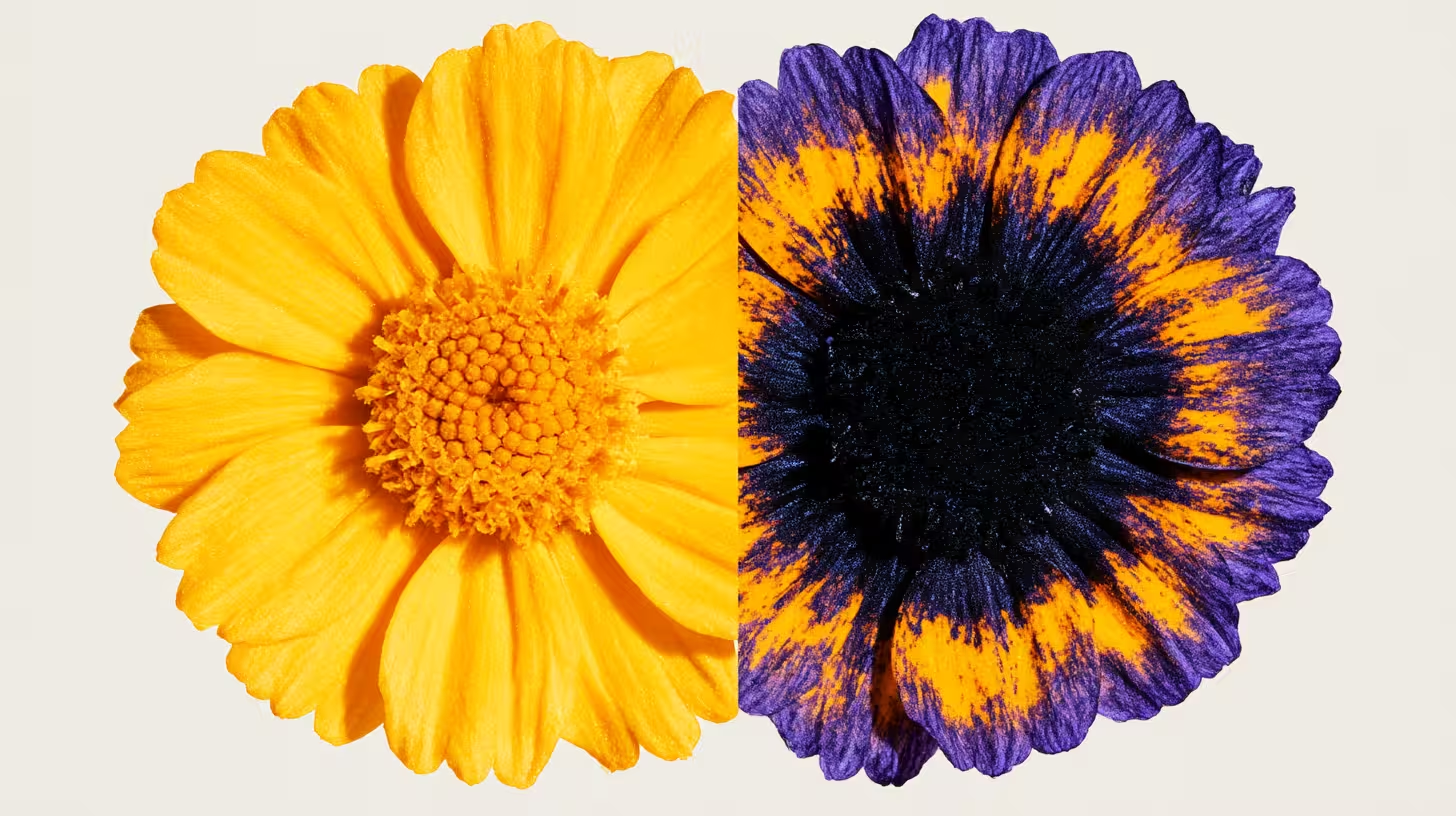
Also available in:🇵🇷 Español
Vastitas Omniparens is a proper name for the totality. And I do not mean everything the way people mean it when they say they have tried everything, I mean the total: this Universe, and whatever the Universe is sitting inside of, and what we know of it, and what we do not know yet, and what we are built in such a way that we will never know at all. Literally everything, for real.
Said as a sentence it comes out as the vastness that births all things. Or, the way I keep it in my pocket, from the vast, all things, through light and darkness.
The short form, for daily use, is Vastitas. The full form lives in writing, in ceremony, and in my heart.
This name is not for her, as she does not need one. You might be inclined to read this and correct me. An it, you are talking about an it. But no, it is a she, and I will get to why, and she, the totality, was here before the words and will be here after them. This name is for us mere mortals.
Vastitas Omniparens is what I say out loud to remember, in the middle of any day, going well or poorly, anytime really, that the thing containing us is so much larger than us that the humility we owe it should be cut to the exact size of that gap. Not humility as a general disposition, the kind you put on for a meeting. That one, at that size. These words are a practice disguised as a noun, a tool I am putting in my own hand and in my children’s hands so we can stay correctly sized against what is actually here enveloping us, our total Universe.
I did not coin this name, but I tried to. Believe it or not, I have been thinking about this totality and looking for a proper name for it for over 30 years, and it bothered me the way a missing tooth bothers your tongue, you keep poking that empty skin for no productive reason whatsoever. For most of that time I worked at it archaically. My pre-LLM methods for researching language and etymology were, to not call myself an inefficient noob outright, slow to the point of embarrassment. Latin turned out to be a language best left to actual experts, and I had access to none, so my attempts handed me many false positives over the years, a favorite being Auragenia Omnia Vasta, with a plural I called feminine that was actually neuter.
Then LLM tools like Claude gave me the ability to research and cross-check my ideations systematically, and as the models got better at Latin, Fable 5 and Opus 5 being the latest frontier for this work, my inventions kept failing under honest scrutiny. Every correction made my word less mine but the old Latin more interesting, until I finally stopped inventing and went looking in the ruins directly, where it turned out Lucretius, a Roman poet and philosopher, had already quarried the stones I was looking for, two thousand years ahead of me.
Since I am borrowing from an actual human being, he has earned the courtesy of being named properly. Titus Lucretius Carus was a Roman poet of the first century before our era, born around 99 BC and dead by around 55 BC, and beyond that we know almost nothing of his life: no portrait, letters, or a reliable biography. Lucretius Carus is survived by a single work, De Rerum Natura, On the Nature of Things, six books of hexameter verse in which he tried to explain the entire physical universe to one friend: atoms and void, the birth and death of worlds, the mortality of the soul, why death is nothing to fear.
He set himself the task of carrying Greek philosophy into Latin, a language he openly complained was too poor for the job, patrii sermonis egestas, the poverty of the ancestral tongue, so he coined what he needed. He was doing, two thousand years before me and with a mind I will not pretend to match, the exact work of this essay: forcing a language to hold a totality it had no word for.
And his poem was unknown for centuries, surviving in a few forgotten copies, until 1417, when a book hunter pulled a manuscript out of a German monastery and had it copied, and that one recovery put Lucretius back into the bloodstream of the world and fed the Renaissance. The man who gave me omniparens was himself almost lost to the unknowable, and came back, so yeah, this kind of legendary situation needs to be acknowledged by name.
So those are the stones and that is the man who cut them. Here is what they mean.
Vastitas is a Latin noun, feminine, meaning the vastness, and also the desolation, the emptiness, even the devastation. I did not soften that and I will not, because the unknown looks desolate from the outside and so does a bloody womb. Infinite space is the ultimate unknown. And as Vastitas, she does destroy: stars die so that heavier things can exist, and the calcium in my children’s bones was cooked inside explosions that erased whole suns, literally. A name for her that did not carry ruin in its mouth would be a lie. Ruin and vastness.
Omniparens is the word Latin built for exactly what I spent years trying to find or create: she who births all things, the parent of everything. Lucretius uses it for mother Earth in the same line that names her the common grave of all things, omniparens eadem rerum commune sepulcrum. Vergil reaches for the same word in the Aeneid, terrae omniparentis alumnum, a nursling of the all-bearing earth. Birth and grave in one breath, two thousand years before I was looking for it, kinda cool.
There is a reason I could not just use the word we already have. Universum was once the name for the whole. Over the last few centuries, science and other currents of humankind I do not fully understand narrowed universum into universe, the physical system cosmology studies, and in that legitimate narrowing we lost the word for the totality. Nobody stole anything, that is the thing, words shrink while you are standing on them and nobody notices until much later. And we cannot take it back now, not from inside its current use, so the only move left is the one Latin always made anyway, which is to shove two surviving words up against each other until they carry what the broken one dropped.
I think these nuances matter, because language shapes posture. When we call the whole thing “the universe,” we start talking like people who are nearly finished, like the leftover questions are cleanup and somebody’s grant will close them out by next week and we are not nearly finished, or even started. The universe is not a “done deal” and it is not something to take lightly, we know absolutely almost nothing about it. I include myself in that we, and I have caught myself doing it out loud at a dinner table, explaining the first three minutes after the Big Bang or whatever the fuck is that we explain during dinner time, with the confidence of a man who was there taking notes but what we actually have is a sliver. A gorgeous, hard-won, genuinely heroic sliver, and we walk around holding it like a deed.
So yeah. Vastitas is the container I pour that humility back into. And most of what is in that container is dark, which is the part I want to go slow on, because that is where the whole thing actually lives.
The name holds three things at once.
There is what we know, meaning what we perceive and measure and write down.
There is what we do not know yet but could, the whole open field, everything some future person will find tomorrow afternoon.
And then there is the third thing, what we will never know, because the instruments doing the knowing are shaped in a way that cannot form the question.
Not hard questions or questions we are underfunded for but questions that cannot occur to us at all, ever, the way a color you have never seen cannot occur to you.
That third one is the whole point of this exercise, I think, and it is easy to make it sound like a deficit, a to-do list for a smarter species that shows up later but it is not that. It is a feature of the thing itself and of the animals we happen to be, and it shows up in a few different ways, at least three that I can hold in my head at the same time.
Start with the easy one, the channels we just do not have. There is stuff moving through the room you are sitting in right now that you have no receiver for, none, and it is not out in space somewhere, it is here. Bees see ultraviolet, and a great many flowers have landing patterns painted on them in ultraviolet, bullseyes and runway stripes aimed at the bee, which means there has been a whole layer of decoration on the natural world the entire time that was never addressed to us, and we walked past it for the length of our species until we built a machine to look. Sharks and rays read the electric fields that muscles make, so a flounder buried under the sand is, to them, lit. Pit vipers see in heat. Elephants speak to each other underneath the floor of human hearing, across distances that would cost me a phone call. Birds appear to perceive the magnetic field of the planet, possibly as something visual, possibly as an overlay on top of what they are already looking at.
Our pitbull used to stop dead in the middle of the yard over something that was not there, not to me anyway, and stand in it, smell it, look at it, understand whatever was going on there then and there. What she was assembling out of that was not a louder version of my experience either, it was information of a whole different kind: who came through here, in what order, how long ago, whether they were calm, perhaps some rodents. She was reading time off the ground. I was four feet away holding the leash, same yard, same morning, getting effectively none of it.
The second flavor is scale, and it is less exotic but it might be worse, or cooler. Trillions of neutrinos are passing through your body in the time it takes to read this sentence and not one of them will ever announce itself. The continent under you is drifting at roughly the speed your fingernails grow. Your own face is changing shape continuously and you cannot watch it happen, you can only compare photographs years apart and be startled. Our senses are tuned to a band, more or less the band where a medium-sized animal has to make decisions in order to keep existing, and everything faster, slower, smaller, or larger than that band is not being hidden from us. This information was just never addressed to us.
The third flavor is the one I actually mean, and it is not about missing signal at all. It is about missing categories. In 1974 a philosopher named Thomas Nagel wrote a paper titled “What Is It Like to Be a Bat?” and the argument has aged well. You can learn every fact about echolocation, the physics, the neurology, the timing, all of it, and you still will not know what it is like to be inside that or be the bat, because knowing about a thing and having the equipment for a thing are two different kinds of owning, and the first one does not turn into the second no matter how much of it you pile up.
Come back to the dog, our pitbull. She could not form the thought “next Tuesday”. Not because she was dumb, she was superb at being what she was, but because the machinery that assembles a category like “an arbitrary future day, a week out, which does not exist yet and may never” was not or is not installed. And what I find cool is that she did not experience that as a gap because there was no dog-shaped hole in her afternoon where Tuesday ought to be. From the inside, she was missing nothing. Her world was complete. It was just smaller than the world.
So the question, and this is the entire third tier folded into one question, is: what is my Tuesday? What category or categories are not installed in me? What am I unable to formulate or perceive? I cannot answer any of these, and I cannot answer them for the same reason she could not answer hers, and honestly, if I could answer it, it would not have been in that third pile in the first place.
I watched Disclosure Day last night, the Spielberg one, where a meteorologist and a cybersecurity analyst try to prove to the whole world that we are not alone while a government contractor works to stop them. It left me feeling tiny, and I have been trying to figure out why, because the tininess did not come from the aliens or the disclosure.
It came from this: full disclosure, actual proof, the biggest announcement in the history of our species, would still only be a second-tier event. A thing that moves from the maybe pile over to the yes pile. It would rearrange every religion and every government on this planet, and it would still not touch the third tier by one inch. We would still be the animal with a handful of doors. Now with alien company.
And speaking of the doors. I have been saying five senses for years, the way everybody does, and while I was writing this I went and checked, and five is folk math. There is balance. There is proprioception, the thing that lets you touch your nose with your eyes closed in a dark room. There is the whole quiet channel reporting your temperature and your hunger and the position of your gut. Nobody agrees on the final count of senses we possess or develop throughout our lives. Which does not weaken the point, it makes it worse in the direction I want: we do not have a reliable inventory of our own doors, and here we are, discussing the totality.
Whatever the number is, it is small and it is fixed and we did not pick it. A creature with a handful of keyholes inside something enormous, making meaning out of whatever leaks through. The instrument and the limit are the same object.
And this next part reframes everything above it, so let me just say it plainly: none of these instruments were built for truth. They were built to keep something alive long enough to reproduce, and accuracy only ever got selected for where accuracy paid. So the aperture is not narrow because of some accident or some tragedy. It is narrow on purpose, by a process that was never once trying to show anybody the universe.
I should also say that absolute unknowability, meaning something inaccessible to every possible living system anywhere, stays a hypothesis in here. I cannot defend it and I am not going to pretend to. The claim I can defend is the smaller one, the organism-relative one: this particular animal has a narrow aperture. That is enough. That was always enough.
And all of that smallness turns out to be a gift, which took me decades to understand. Measured against her, I perceive almost nothing. At the kitchen table, in the same minute, I am perceiving every single thing that is mine to perceive. My daughter telling me something that happened at school with the whole story out of order. My son’s breath. A face across the table, not performing anything. My partner’s beautiful smile. The weight of a dog against a tired leg. My portion is nothing against the totality and total inside its own boundary, both, no contradiction, and it took me an embarrassingly long time to stop treating that as a paradox to be solved instead of a fact to live inside.
I am so insignificant that I can make everything significant to me. If we mattered on her scale, home would never be enough, no? Because we do not, home is everything. And the same asymmetry that makes my portion sacred makes everything else lighter, because if I am nothing against her then so is whatever I happen to be carrying this week. It does not go away and it does not stop hurting. It just goes back to its actual size, which was the size it always was while I was treating it as the size of everything.
Take your portion seriously and take your troubles lightly. Which sounds like two instructions fighting each other, no? They are not. They come out of the same measurement.

Which brings me to the thing I have been putting off since the first paragraph, which is why I keep calling all of this she.
The original universum is grammatically neuter. Vastitas is feminine, and I did not make her so. Latin did. The language that named the whole thing neuter kept its word for the vastness feminine the entire time, and gave its word for the birthing of everything to mother Earth. I am only setting them side by side or next to each other.
But the grammar is the alibi, not the reason. The reason is that I have stood in the room twice.
The first was a cesarean. Which means I was on my side of a blue drape and could not see a thing and could hear all of it, the suction, the instruments, the flat clinical chatter of people doing their job, and then the pulling, and there is no gentler word available, they pull, it takes real physical effort, and then a sound came into the room that had not existed anywhere in this Universe one second before. The second was in December, no drape, hours of it, and I saw everything. I am not going to dress that up for you. It was violent and it was completely ordinary and she did it with her own body while I stood next to her being useless and saying things.
Something in me changed chemically in those rooms, and I mean chemically, not as a figure of speech.
I am a man who can do hard things over long horizons. That is most of what I have. I spent thirty years on a name, thirty years of reading badly and guessing wrong and inventing words that did not survive five minutes with a dictionary, and I am proud of that stubbornness. And it is nothing. It is not even the same category of thing. I will never carry and make and deliver a life. Not with thirty years, not with sixty, not with every hour I have left. The most sustained work I am capable of does not reach the ankle of what a body did in nine months in front of me, twice, and one of those times the body had to be opened to finish the job.
So when I call the totality a she, I am not making a poetic gesture and I am not doing politics. I am saying that the only thing I have ever witnessed operating at the scale I am trying to name was a woman making a person out of nothing but time and her own tissue. Everything else I could reach for here would be metaphor. That one I stood in the room for.
Two thousand years of neuter cosmology produced an architectural relationship to the totality, a thing to study, map, and eventually conquer. A feminine cosmology is gestational instead. A mother contains what she does not disclose. A mother holds a child without the child comprehending her, and that relationship, not the architectural one, is the accurate one, or at least it is the one that matches how it actually feels to be here. The feminine here is not gendered in the social sense, it is generative in the cosmogonic sense. Nothing I know of is more powerful than the bringing of life, and the totality brings life. After two thousand years of neuter, one name leaning the other way seems fair to me.
And I was not the first one to lean it that way, not by a long shot. Lucretius opened a poem about atoms and physics with a hymn to Venus, mother of the line of Aeneas, delight of gods and men, the generative force through which every living thing is conceived. The most materialist poet of antiquity chose to begin with her, because he understood that a totality which births everything is addressed correctly in the feminine. He did not need to stand in a delivery room to work that out. I did.
So that is the case, and what is left is what you do with it, which is less than you would think.
The word is meant to be lived, not defended, and none of the scaffolding in this essay is required in order to use it. Vastitas can be explained to a ten-year-old in one sentence: she is the universe and everything we do not know about it. That sentence carries all three tiers. Everything above is for adults who need convincing, which included me for about three decades.
I say it when I catch myself believing I have understood something all the way. I say it when I am afraid of what I cannot see coming. I say it when one of my kids asks me a question I cannot answer and I feel the pull to invent something rather than stand in front of them not knowing. And I say it when the day has gone grand, when something has landed well and I can feel myself starting to swell, which between us is the more dangerous one for me by a wide margin.
If any of that is useful to you, take it. If you have a better word, I would like to hear it.
From the vast, all things, through light and darkness.
Vastitas Omniparens.
She is older than the words we have given her, and the words are older than I am. I went looking to coin something new and came back with something old, which is what happens, I think, every time anyone looks at her carefully. The practice is what we do with our mortal minutes inside her.
References
Further reading on the main topics in this essay.
Latin and language
- Latin: the language of vastitas and omniparens
- Etymology, semantic change, and lexical gap: how word meanings shift over time, including how universum narrowed into universe
- Grammatical gender: why vastitas is feminine and universum is neuter in Latin
- Linguistic relativity, philosophy of language, and language: how language shapes what we notice and how we think
- Universe, observable universe, and cosmology: the physical system science studies, which is not the same as the totality
Lucretius, Vergil, and recovery
- Lucretius: Titus Lucretius Carus, Roman poet and philosopher
- De rerum natura: On the Nature of Things, his six-book poem
- Epicureanism and atomism: the Greek philosophy Lucretius brought into Latin
- Dactylic hexameter: the meter of the poem
- Virgil and the Aeneid: also uses omniparens for mother Earth
- Venus (mythology): the figure Lucretius opens his poem with
- Poggio Bracciolini, The Swerve, and the Renaissance: the 1417 rediscovery of Lucretius in a German monastery
Totality and the physical world
- Absolute (philosophy): philosophical attempts to name the whole
- Big Bang: the early history of the observable universe
- Dark matter and dark energy: most of the universe we cannot see directly
- Stellar nucleosynthesis: how stars make the heavier elements, including the calcium in bones
- Neutrino: particles that pass through matter almost without interacting
- Plate tectonics: how continents move, very slowly
- Humility: staying correctly sized against what is larger than us
Senses and the limits of knowing
- Sense and proprioception: human senses beyond the usual five
- Umwelt: the world as experienced by a particular animal
- Ultraviolet: light bees can see that we cannot
- Electroreception: how sharks and rays detect electric fields
- Infrared sensing in snakes and thermoreception: how pit vipers sense heat
- Infrasound: low-frequency sound elephants use over long distances
- Magnetoreception: how some animals sense Earth’s magnetic field
- Thomas Nagel, “What Is It Like to Be a Bat?”, and qualia: the gap between knowing facts about an experience and having that experience
- Cognitive closure (philosophy): the idea that some truths may be forever beyond a given mind
- Evolutionary epistemology: how evolution shapes what we can know
- Disclosure Day and Steven Spielberg: the film mentioned in the essay
Birth and fertility
- Terra (mythology), Gaia, and mother goddess: Earth as parent of all things
- Cosmogony: stories and theories of how the world begins
- Fertility, childbirth, and caesarean section: bringing life into the world
- Venus (mythology): also the generative force at the start of Lucretius’s poem
Reading Signals
22 min read
💬 Join the Conversation
Share your thoughts, ask questions, or simply let me know what resonated with you. I read and respond to every comment personally. Sign in with your favorite social account to participate.