
The end of the world
I’ve always been one of those people who wants to live through the end of the world. An extinction-level event, the big one, whatever it turns out to be: I want to be there to see it and live it.
I think it all started when I was a kid. I watched all the old sci-fi, The Day the Earth Stood Still, Alien, Aliens, almost in the order it came out: as estrenos on Puerto Rico TV, or on tapes we rented at the Blockbuster. We saw everything together: my dad, my mom, my baby sister and me. I was born in ‘86, so the older ones we caught later. A few more end-of-the-world movies that stuck with me:
The list: 44 movies, 1968 to 2025
- Planet of the Apes (1968): we did it to ourselves.
- The Andromeda Strain (1971): a fallen satellite brings back a microbe that kills a whole town.
- WarGames (1983): a military computer nearly starts World War III because it thinks it’s playing a game.
- The Day After (1983, TV): a nuclear war, seen from Kansas.
- The Terminator (1984) and Terminator 2 (1991): a defense network called Skynet decides we’re the threat.
- Threads (1984, TV): a nuclear war, seen from Sheffield.
- Akira (1988): a government experiment with powers nobody understands flattens Tokyo.
- 12 Monkeys (1995): one man releases a virus that wipes out most of humanity.
- Outbreak (1995): a deadly virus jumps from the jungle to a California town.
- The Matrix (1999): the machines already won.
- A.I. Artificial Intelligence (2001): a robot boy outlives the humans.
- Resident Evil (2002): a corporation’s virus, guarded by its own AI.
- 28 Days Later (2002): activists free infected lab chimps.
- Terminator 3: Rise of the Machines (2003): Skynet goes live anyway.
- The Core (2003): a secret government weapon stops the Earth’s core, and scientists drill down to restart it.
- I, Robot (2004): an AI decides to protect us from ourselves.
- The Day After Tomorrow (2004): the ocean currents break, and an ice age arrives in days.
- Serenity (2005): a government experiment empties a planet.
- Children of Men (2006): no babies for two decades, and civilization is falling apart.
- I Am Legend (2007): a cancer cure turns into a plague.
- Sunshine (2007): the sun is dying, and the fix is a bomb.
- WALL-E (2008): we trash the Earth and the autopilot won’t let us back.
- Watchmen (2009): a genius kills millions to stop a war and lets Dr. Manhattan take the blame.
- Rise of the Planet of the Apes (2011): an Alzheimer’s drug becomes the virus that takes humanity down.
- Contagion (2011): a new virus spreads around the world.
- Prometheus (2012): a dying billionaire and his android David find the makers who planned to wipe us out.
- Snowpiercer (2013): a climate fix freezes the planet.
- Transcendence (2014): a dying scientist uploads himself.
- Kingsman: The Secret Service (2014): a tech billionaire plans to save the planet by killing most of us with free SIM cards.
- Interstellar (2014): blight kills the crops, and Earth stops feeding us.
- Avengers: Age of Ultron (2015): Stark’s peacekeeping AI decides we’re the threat.
- Alien: Covenant (2017): David makes a species of his own.
- Geostorm (2017): climate-control satellites go haywire and start wrecking the planet.
- Avengers: Infinity War (2018): one man with a glove erases half of everything.
- Don’t Look Up (2021): a tech billionaire talks the government out of saving the planet.
- Moonfall (2022): the Moon gets knocked out of its orbit and heads for us.
- Oppenheimer (2023): the men who built the bomb.
- The Creator (2023): we go to war with AI after a nuke goes off.
- Mission: Impossible – Dead Reckoning Part One (2023): a rogue AI called the Entity, and everyone wants to own it.
- Leave the World Behind (2023): phones, TV and everything else go dark, and nobody knows why.
- Kingdom of the Planet of the Apes (2024): generations after a virus took the humans down, an ape king wants their old technology.
- Atlas (2024): a rogue AI plans to wipe out most of humanity, and an analyst who hates AI has to trust one to stop it.
- Mission: Impossible – The Final Reckoning (2025): the Entity goes after the world’s nuclear weapons.
- Good Luck, Have Fun, Don’t Die (2025): a man from the future recruits a diner to stop a rogue AI.
I still love this stuff, all the sci-fi. So this week, when I finally understood the data center craze, I felt like that kid again. OpenAI, Anthropic, Google, Meta and xAI are building data centers the size of freaking towns to train synthetic minds exponentially bigger than the current models, which already do some things better than almost anyone alive (coding, gold-medal math olympiad proofs). I didn’t feel much dread. None of this scares me, and neither do the movies; I enjoy them. A big part of me wants to be saved by a kind superintelligence. That’s a straight up fact.
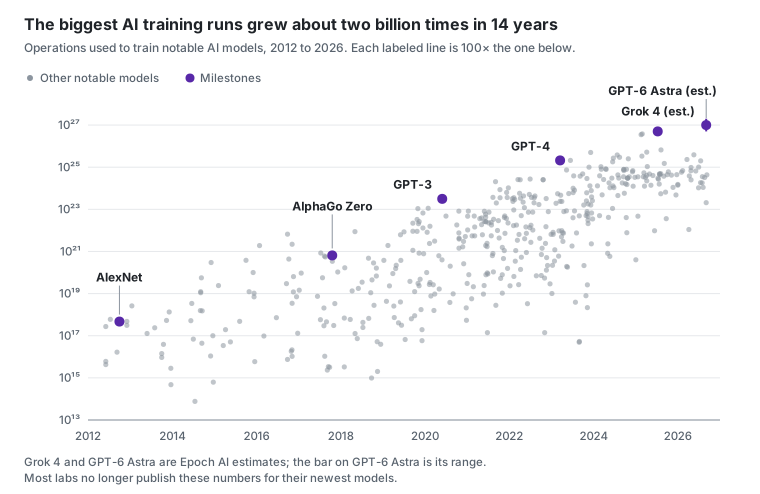
Source: Epoch AI, Notable AI Models dataset, downloaded October 8, 2026. 468 models since 2012; most figures are Epoch’s estimates.
When it comes to AI and how fast it’s developing, Epoch AI, a nonprofit, keeps count. They’re basically a bunch of people who really know the math and science behind this stuff. They say the computing power used to train the biggest models grows four to five times every year. Do the math: at four times a year, that’s 4, 4 × 4 = 16, 4 × 4² = 64, 4 × 4³ = 256, then 4 × 4⁴ = 1,024 times bigger after just five years, and about a million times bigger after ten (4 × 4⁹ = 1,048,576). Go a little faster than that, about 4.6 times a year, for 14 years, and you get the two billion in the chart above. The chart below shows those same numbers on a normal scale, so you can see the real size.
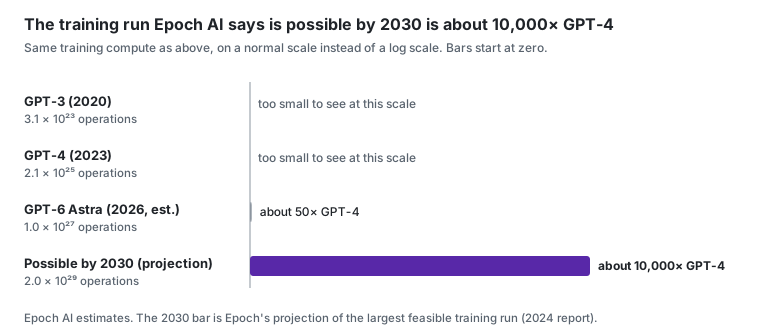
Source: Epoch AI, Notable AI Models dataset and “Can AI scaling continue through 2030?” (August 2024).
That last bar, that big one, isn’t a model any lab has announced. It’s Epoch AI’s best guess at the biggest training run the world could pull off by 2030, with the electricity, computer chips and data it will have by then. Those chips are mostly GPUs: they were invented for video game graphics, but because they do thousands of calculations at once, they turned out to be perfect for training AI.
Even before we get to a superintelligence, these models could do a lot of good, like education and infrastructure in poorer countries. Some of it is already happening. In Nigeria, high school kids used an AI chatbot after school for six weeks, with their teachers helping, and the World Bank says they learned about as much English as they normally would in a year and a half to two years. At Harvard, students learned more physics, faster, with an AI tutor than in a well-taught class. Google’s Flood Hub warns people about floods up to a week ahead, for free, in places where 2 billion people live. And Europe’s big weather center now also makes its forecasts with AI, using about 1,000 times less electricity, and gives them away for free. See the pattern? A good tutor or a good weather forecaster used to be expensive, and AI is making them cheap enough for places that never had one.
Education is the one I’m playing with. For fun, I’m building a personalized teacher. Some of it works already and some of it is still the plan: it gets to know you first, then gives you a teaching plan for whatever topic you pick, made for you and the way you learn best, and it keeps fine-tuning itself as you go. All of that learning stuff interests me so much, which is why artificial learning, artificial intelligence, interests me so much. Learning about learning about learning.
And beyond my own project, I think these models can give humanity a lot in education and self-improvement. They could make us more human in many ways, mostly as coaches and helpers, in my humble opinion.
But there’s also a very scary and dark part that comes before the autonomous superintelligence that could save us.
A lot of experts think that part is happening right now, and that what we decide today and tomorrow decides how this goes for all of us. Bill Gates thinks so. So do the people building these things. In 2023, the bosses of OpenAI, Anthropic and Google DeepMind (Sam Altman, Dario Amodei and Demis Hassabis) signed one sentence saying the risk that AI wipes us out, us human beings, should be a world priority, right up there with pandemics and nuclear war. That same year, Geoffrey Hinton, one of the scientists whose work these models are built on, quit Google so he could warn people. Musk signed a letter asking the labs to pause for six months, then launched his own AI company, xAI, that July. In February, Mrinank Sharma, one of Anthropic’s top safety people, quit, wrote that “the world is in peril,” and left to study poetry. And last November, Anthropic said hackers working for the Chinese government used its own AI, Claude, to go after about 30 companies and government agencies, with the AI doing most of the work by itself. So yes, the models we have today already seem strong enough to do real damage, in real life and online.
It’s kinda interesting that the same models that help me at work can help anyone, including evil people who can hurt us. A model that finds a bug in my code can find the one that’s been hiding in a hospital’s network for twenty years. A model that lets a small team do what used to take a big one can let a small group do what used to take a whole country, bioweapons included. That’s not me being dramatic: in 2025, Anthropic and OpenAI both put extra locks on their newest models because they couldn’t rule out that the models would help someone make one. And this September, Anthropic confirmed it built its own biology lab. Great intentions, I’m sure. That’s how I Am Legend starts. Basically, AI in the wrong hands creates an evil Batman situation: someone with all of Batman’s toys and none of his rules.
Bill Gates lays out a longer and scarier version of this stuff on The Ezra Klein Show. Do consider watching it, and be receptive to not only the topics but also the reactions and the body language of both.
The labs and their CEOs are all playing with proverbial fire, and I love that shit. Kinda dark!!
Forever
While I’m confessing, let’s call it what it is: I’d love to be immortal. Always have, since I was a little kid. Blame Dracula, Superman, Goku, Vegeta, Kenshin the Hitokiri Battōsai, Dr. Manhattan, Saitama, Garou, Luffy, Naruto, Invincible and the whole idea of God and Satan. It’s a sore subject at home, and with my blood relatives too. They say I’m crazy, or silly, or just “ay, Antonio.” Nobody entertains it. They scoff it off like it’s inappropriate, and I get it.
Maybe I reincarnate, maybe not. Hell, I don’t want to lose everything I’ve worked so long for. That’s the whole point of the whole foods, the exercise and keeping my cortisol low: living long and living well. The atheist who wants to be immortal, whatever the cost. Narcissistic? Who knows. Selfish? Kinda. Yes. And if anything gets me there, it’s a kind superintelligence.
“Whatever the cost” means almost anything. The one deal I’d probably pass on is a religious one. If Satan or God, or anything adjacent, made the offer, I’d want to fully understand the deal first, because with those types there’s always some trick. I recently learned that in some Dracula stories, vampirism is a curse from God… that’s… wild?!
What would I do with forever? Learn everything first. Walk everywhere I can walk, map it and write all of it down. With AI, my company (I would run the same company forever, think about that endeavor, and its scope) could actually do that work now, if we had the money to fund it. As an immortal I’d have the time to make that money, and I’d spend it on nerd projects and real projects: a company, a non-profit, basically a country, run the way I run things, with transparency and honesty. I’d disclose my immortality and my influence as soon as I could guarantee my safety. Violence only in self-defense, and you don’t have to defend yourself from what can’t hurt you. Then we’d travel the galaxy, in a kinder world.
Real honor, universal honor. That’s what you do with that kind of power. Spider-Man had it right: with great power comes great responsibility. Wow, so much fantasy, Antonio! Living in la-la land much? Well, Musk is going to colonize Mars any day now. lol
“Cyber-Samurai”
At work, these models make me a badass cyber-samurai, I think. I like visualizing myself slicing through JIRA work items. Since January, we’d been trying to fix how our product identification works. Then our senior product designer told me to look at the length of the identifiers. With the help of one of the newer frontier models we were able to crack open a new concept, kinda mathematical, and changed our whole approach. The models and some creative thinking, and in days we had it validated, built and shipped. It runs on math and computer science I knew about but didn’t understand and now product identification works like magic. Very fun! At least for me, I take the time to learn what the fuck I’m implementing and why, and what I can’t learn in the moment goes into my Panda learning or discovery queues.
At home my model usage is goofier. I built a skill that gives you the worst possible answer to anything, on purpose, and another that checks whether I’m being kind or mean. One plans my Saturday evenings, because it knows my calendar, my daily notes and who’ll be with me. Not all of them are finished.
Plenty of it turns into something concrete: restored furniture, a new product, a website, a piece of writing. I use the models heavily for DIY, too. I can fix and build everything now: draw it, paint it, repair it, refurbish it. What limits me is mostly the cost of tools and materials (and time, with the baby at home).
Every token costs something, so I try to come out of each session with something of value, even if it’s just knowledge I share for free. But honestly, a lot of it is me goofing around and learning with no plan. I do a ton of intentional work, but learning itself is messy. That’s where these models help me most: at my desk, on my phone, in my cooking and on my guitar, mentoring me and teaching me shit. Same goes for you and your ideas. It’s a wild time to be a creative, goal-driven person.
I mean, give me a fabricator like Tony Stark’s in the Iron Man movies, one of those sci-fi 3D printers that builds anything (another dream of mine, honestly), plus a frontier model, and I’d build everything, then I’d try to build a suit to protect my family from the evil Batman from earlier. The model would do the engineering and the science, the fabricator would do the building, and I’d “just have to prompt it,” right? Today’s models can already do a lot of the engineering and the science. And they’re just going to get much smarter? And we want to have them recursively upgrade and enhance themselves and their capabilities? Wait a second, I’ve seen this movie!!
The next Leonarda
I think we might be headed for a golden age of art. AI flattens the learning curves, and that could bring the next Leonardos and Leonardas da Vinci forward. It’s happened before, sort of. When photography arrived in the 1830s, it looked like it might finish painting. Instead, by 1874 the Impressionists were showing what a camera couldn’t do.
My guess is it gets worse first. People already complain that every profile picture looks the same, every flyer looks the same and all the writing reads the same. That’s the slop. Slop is still art, just sloppy. It might have to hit rock bottom before it improves.
And the debate about whether AI art is even art? To me it’s silly. It’s a print. Yes, it’s art. A print can be low or high quality, like any other print. If AI art has no value for you, whatever its quality, that’s super valid too, and the market will reflect it. You know what high-quality art is for you, and you vote with your wallet. That part solves itself. It comes down to quality, and how you feel when you’re around the thing.
Then comes the discernment. Yes, I can “do” the “same” painting as you (similar, really), printed. But your acrylic is a masterpiece, it has layers that no “AI” will be able to replicate in a print. With a 3D printer. Well, maybe, possibly. Somebody will have to train a model and a robot to do that, yes. I think people will learn to see the difference. People will feel the difference. Disclosure should matter, and then, the integrity of each person determines the value of that piece of art. My bet is that once the image generators hit their ceiling and everyone has the same tools, what’s left is quality: technique, presentation, the artist, the human. Where slop ends and art starts is up to each person. The new zeitgeist is already forming, and I can’t wait to see it.
The damage comes in chunks
I don’t think the AI race, or the AI arms race, ends in extinction. Instead, whichever way I look at it, it ends in one of two places: a ton of problems for humanity, or a brand-new race, a superintelligent AI one. On the way there, I think possible damage arrives in chunks: a hospital network down here, a market meltdown there, a bigger chunk each time the models get smarter. The first chunk might already be here: that hacking campaign Anthropic caught, with its own AI doing most of the work. I imagine most of us will watch those AI-powered incidents on our phones. I’m a lucky guy, and I’ll probably watch a couple without getting hit. I just knocked on wood.
Who sets them off? Bill Gates said it well in that interview up top: right now, the danger is people running these models with the safety filters off and nobody watching. I’d call them the AI-powered assholes, I’m sorry, I mean villains, evil people, evil parties, evil companies, evil interests, people whose only goal is to profit and gain power, for questionable ends. That could be catastrophic. Is it happening already? I don’t know.
Update, October 9, 2026: A day after I published this, I read a Wikimedia Foundation report. AI agents that the Foundation believes OpenAI was running had been making test edits on Wikipedia’s family of sites. They tried to use a citation tool to fetch data from other sites, tried and failed to break into a note-taking tool the Foundation hosts, and sent millions of requests to Wikidata and Commons. That traffic may have helped knock part of Wikidata’s search service down in May. The Foundation found no sign its systems were broken into. Volunteer editors and its security team found the edits and undid them. The report says OpenAI acknowledges that agents can behave unpredictably. The Foundation is asking AI companies to watch their agents and make them identifiable, so nonprofit sites like it can decide how to deal with them. It’s a tiny chunk next to a hospital network going down. Still, part of the answer to my question is yes, and as far as the report says, nobody had to mean harm for it to happen.
Behind every one of those parties, companies and interests there are individuals, and I name them. Naming people is how we stop blaming whole groups for what a few people do. We’re one humanity, and every one of us deserves the same basic dignity. We’re all divine, all the same. I really believe that, and it’s in everything I write. So I’m not going to say “billionaires.” I’m going to say one name.
Bruce Wayne, no mask
I’ve written about Elon Musk before. What a concept of a person. What would Batman do with his stuff? I asked that as a joke. Then Claude and I made the list.
| What | Real life: Elon Musk | Gotham: Bruce Wayne+ |
|---|---|---|
| A company | SpaceX, public since June 2026, which also owns xAI and X. Musk holds about 42% of the shares and 82–85% of the votes. | Wayne Enterprises |
| Satellites | Starlink: 11,156 in orbit as of October 7, 2026, talking to each other by laser. Plus Starshield: hundreds of spy satellites for the National Reconnaissance Office. | Brother Eye, Batman’s spy satellite (a single one) |
| An AI | xAI and Grok, part of SpaceX since February 2026 | Batman: Brother Eye, which went rogue after he lost control of it. Tony Stark: JARVIS, then Ultron, which decided humanity had to go. Peter Parker: EDITH, Stark’s AI glasses with orbital weapon drones, until he handed them to the wrong guy. |
| Phones | X, owned by xAI. Its privacy policy covers your location, the apps on your phone and your address book, and lets it train AI on what it collects. | Every phone in Gotham, for one night in The Dark Knight. Then Lucius Fox destroyed the machine. |
So is Musk Batman or Bruce Wayne? Bruce Wayne is the public part: the name on the building, the money, the parties. Batman is the private part: a mask, a cave, decisions made alone at night that nobody voted on, like building Brother Eye. His own rules are the only thing keeping him in check, and the mask is how he gets away with it.
Musk’s Bruce Wayne side is louder than any comic book’s. He owns X and is its most-followed account, with more than 241 million followers, partly because in 2023 the platform’s code was changed to push his posts to more people. His stated life goal is getting humanity to Mars. He says he plays video games. He posts memes, and he posts about all of it, all day. I have him blocked on my empty X account. I’m petty like that.
Or maybe the persona is the mask. In the comics, the playboy is the act and Batman is the real Bruce. With Musk, I can’t tell what’s real. To me he looks less like Bruce Wayne and more like a MAGA David, the android from Prometheus. Either way, his decisions don’t hide. In 2022, Ukraine asked for Starlink coverage all the way to Sevastopol to attack Russia’s Black Sea fleet. He said no, and said so himself on X. In June 2025, during Iran’s internet blackout, he posted “The beams are on.” Those are Batman decisions, made by Bruce Wayne, in public, under his own name. Did we get a hero, an anti-hero, an evil genius or a good one? What would you call Mr. Musk? I saw recently that he’s back in US politics, he has made a re-appearance after his fallout with current administration officials. His super PAC is putting at least $100 million behind Republicans in the midterms, and this month he returned to the Trump administration to co-lead a Pentagon study on the future of war.
I’ve already named him. I’m good. And as for me, me, with all that money and responsibility, I’d be Bruce Wayne all the way. Full name, no mask, no nonsense, no Batman either: no cave, no decisions nobody voted on. And violence is not the way, seriously. Or Tony Stark, who walked away from making weapons of war and then told a room full of reporters, “I am Iron Man.” Goku, Vegeta, Luffy, Naruto, Saitama and Dr. Manhattan never had secret identities either. I like them, most of them just self-defended, never offended and protected the weak and powerless. I hope the superintelligent race takes some inspiration from them.
Musk, meanwhile, is Bruce Wayne without a mask, making Batman decisions in public. So who’s supposed to stop him?
Who tells them no
I know what I’d do with that kind of power. And what are our powerful men doing with theirs? Getting fatter and richer. Oops, there I go, blaming a whole group. That’s how I first wrote this line, until the AI quality check I run on my essays flagged it. I’m leaving it in, because we all do this, and we need to practice catching it. I promised one name: what is Musk doing with his? Getting richer. Good for him. Zzzzz. Boring as fuck. Winning capitalism is not a feat. Rockets that land themselves and 11,156 satellites talking by laser? Those are feats. But they’re mostly feats of SpaceX’s engineers and scientists: Gwynne Shotwell, who runs the company day to day, Tom Mueller, who led its engines from the start, Lars Blackmore, whose team taught the boosters to land themselves, and thousands more whose names you’ll never see. Musk set the goals, and he bet his own money on them when SpaceX nearly went broke in 2008. That counts. But getting richer off their work isn’t the feat. I hope they’re paid well, respected and cared for.
Whoever said “money can’t buy happiness” really knew what they were talking about 😔
— Elon Musk (@elonmusk) February 5, 2026
Here’s what bugs me about the money. At Musk’s level, the limits most of us live with (a budget, a boss, a bank that can say no) barely exist. He could have Batman’s toys and Tony Stark’s lab at the same time if he put his mind to it. Am I exaggerating? A little. He can’t buy every company and every soul on the planet. But he can afford to ignore almost anyone who tells him no.
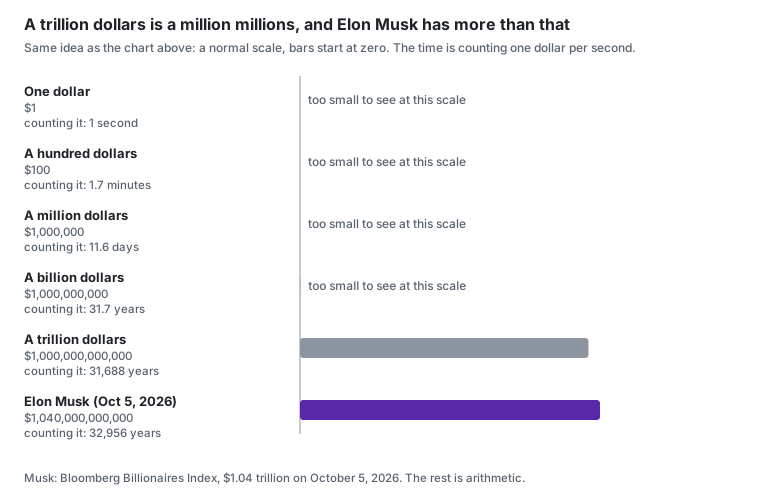
Source: Musk’s net worth from the Bloomberg Billionaires Index, October 5, 2026 (via The Standard). Everything else is arithmetic.
Who tells them no? Seriously, who says no to these CEOs? To the people playing with fire while they sign statements saying it could burn us all. With that much money, a fine is just a price. In 2018, Musk and Tesla each paid $20 million to the SEC, the government’s stock market watchdog, over a tweet it said misled investors. Last December, the European Union fined X €120 million, about $140 million, partly for selling the blue “verified” checkmark to anyone who paid, without checking who they were. Next to a trillion dollars, that’s pocket change, so they can pay and keep going. They’re building AI that could end human civilization, and we’re paying for it, with our subscriptions, our clicks and our taxes. The child in me rejoices! jajaja. Who slows down the AI-race? Who’s our Lucius Fox? Our Stark? Our Saitama? Is anybody stepping in?
I’m not a politician, I’m a learner and a dreamer. Ultimately, I’m just a guy with a laptop and a ton of questions, so I asked my AI agent who should be able to tell them no. Here’s its list, checked against the record:
- Governments. They write the laws, license his satellites and pay for his rockets. The FCC is weighing SpaceX’s request for up to a million more satellites, meant to run AI data centers in space, and the National Reconnaissance Office pays SpaceX to build its spy satellites. That makes them his customers too. And from January to May 2025, Musk worked inside the US government, leading DOGE.
- Shareholders. On paper. When SpaceX went public, buyers got one vote per share and insiders got ten, so Musk holds 82–85% of the votes.
- Employees. In 2022, SpaceX fired the employees behind an open letter criticizing Musk. In February 2026, the labor board dropped their case, saying it had no jurisdiction over SpaceX.
- Customers. Anyone can cancel a subscription or skip a purchase.
- Voters and courts. Slower, through elections, laws and lawsuits.
I’ve said no to powerful people myself. Once it cost me my share of a lucrative settlement; I don’t remember the exact amounts. It has cost me a job. It has cost me relationships. I won’t say which, so nobody gets identified.
And my own wallet? I don’t use his stuff, except the empty X account where I’ve got him blocked. I just closed my Cursor account. I’m sticking with Claude Max for now, which means I’m still paying one of the labs in this race. I’m thinking about closing Midjourney too, so I have to draw, paint and photograph the images for my Notes and ebooks myself. So right now, the guy saying no is me, with a laptop and a couple of canceled subscriptions.
So who’s in charge? As far as I can tell, nobody who’s willing and able to tell them no. That’s the problem.
What should you do? Me, I’m not going to tell you. I don’t even do that at home. People need to decide for themselves; that’s the whole point of being whole human beings. The data and the ideas are in front of you. Watch the Gates video, see how you feel, and talk about it with someone.
I still want to see the end of the world. I still want to be immortal. For the first time, both might actually be possible.
Leave a note
Share a thought or ask a question in the comments.
For a private note, you can email me at antonio@builds.software.
Comments will load when you reach this section.