Sometimes I cry at the idea of war. Not at a movie about war, not at a documentary, just at the idea of it, the plain fact that it’s 2026 and we’re still killing each other. I don’t know how else to say it: it’s barbaric, and it’s embarrassing. We carry supercomputers in our pockets, we can talk to a machine that talks back, and we still settle our arguments by blowing up each other’s children. If you wake up as a human being in this world and that doesn’t embarrass you even a little bit, I think that’s worth looking at, deep inside.
What sits under the crying is heavy. It’s desesperación, sadness, and grief all mixed together, and the thought that I’ll probably live my whole life, and my kids will probably live theirs, in a world ruled by war and violence. That feels like insanity to me. I know it’s not a sophisticated position. I’m not a historian or a strategist, and I’m sure people who study this for a living could tell me why it’s more complicated. But I don’t think you need credentials to feel that something is very wrong here.
I people-watch. Always have. And now, with the internet and cameras everywhere, I get to watch the faces of world leaders too, all of them. You can open Wikipedia and browse general after general, president after president, and I promise you it’s not a fun task. Almost every one of them is a man. Very few women show up in those pictures, so I guess the modern world has been ruled by warlords. Excuse me, statesmen. Sometimes I wish we’d tried a matriarchy, but that’s a topic for another essay.
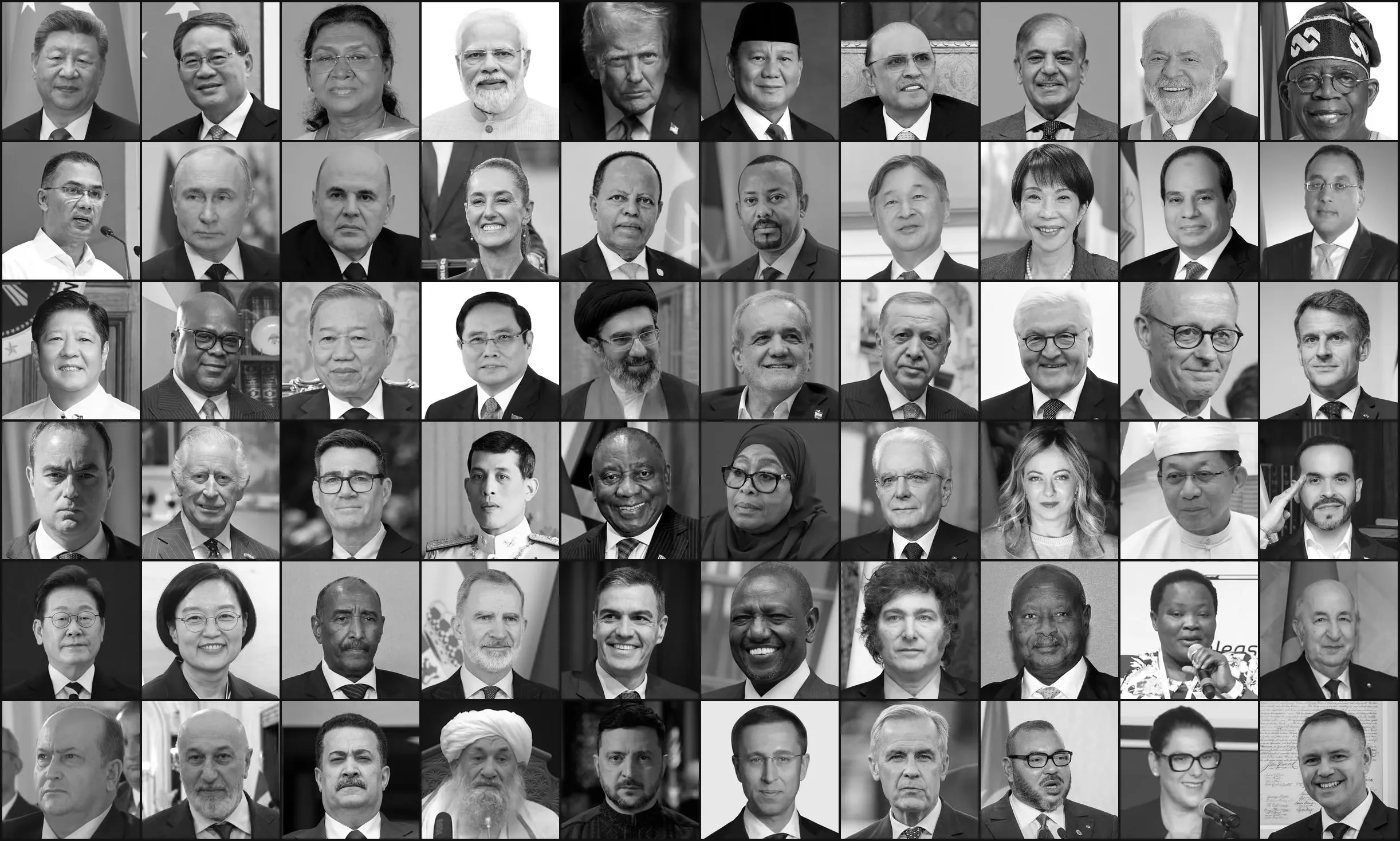
Sixty current heads of state and government, taken in order from the world’s most populous countries as Wikidata listed them on October 25, 2026. Eight of them are women.
Who’s in the grid, and photo credits
Left to right, top to bottom. Photos were cropped and converted to grayscale. Because some of them are CC BY-SA, the collage itself is shared under CC BY-SA 4.0.
- Xi Jinping (People’s Republic of China): photo by Presidencia de la República del Ecuador, Public domain, via Wikimedia Commons
- Li Qiang (People’s Republic of China): photo by European Union, Attribution, via Wikimedia Commons
- Droupadi Murmu (India): photo by President’s Secretariat, GODL-India, via Wikimedia Commons
- Narendra Modi (India): photo by Prime Minister’s Office, GODL-India, via Wikimedia Commons
- Donald Trump (United States): photo by Daniel Torok, Public domain, via Wikimedia Commons
- Prabowo Subianto (Indonesia): photo by Darwis Triadi & Ministry of State Secretariat, Public domain, via Wikimedia Commons
- Asif Ali Zardari (Pakistan): photo by Press Service of the President of the Republic of Azerbaijan, CC BY 4.0, via Wikimedia Commons
- Shehbaz Sharif (Pakistan): photo by Press Service of the President of the Republic of Azerbaijan, CC BY 4.0, via Wikimedia Commons
- Luiz Inácio Lula da Silva (Brazil): photo by Palácio do Planalto from Brasilia, Brasil, CC BY 2.0, via Wikimedia Commons
- Bola Tinubu (Nigeria): photo by Nosa Asemota, CC BY-SA 4.0, via Wikimedia Commons
- Tarique Rahman (Bangladesh): photo by Press Information Department, Public domain, via Wikimedia Commons
- Vladimir Putin (Russia): photo by Пресс-служба Президента РФ, CC BY 4.0, via Wikimedia Commons
- Mikhail Mishustin (Russia): photo by duma.gov.ru, CC BY 4.0, via Wikimedia Commons
- Claudia Sheinbaum (Mexico): photo by Bryan Berlin, CC BY-SA 4.0, via Wikimedia Commons
- Taye Atske Selassie (Ethiopia): photo by Ministry of Foreign Affairs of Ethiopia, Public domain, via Wikimedia Commons
- Abiy Ahmed (Ethiopia): photo by Ethiopia Prime Minister’s Office, Public domain, via Wikimedia Commons
- Naruhito (Japan): photo by Presidencia de Guatemala, Public domain, via Wikimedia Commons
- Sanae Takaichi (Japan): photo by Immediate source: MOFA/Japanese Embassy to South Africa, probable source: Cabinet Public Affairs Office, CC BY 4.0, via Wikimedia Commons
- Abdel Fattah el-Sisi (Egypt): photo by Ministry of Communications and Information Technology in Egypt, CC BY 4.0, via Wikimedia Commons
- Mostafa Madbouly (Egypt): photo by Office of the Prime Minister of Egypt, Public domain, via Wikimedia Commons
- Bongbong Marcos (Philippines): photo by Office of the President of the Philippines, Public domain, via Wikimedia Commons
- Félix Tshisekedi (Democratic Republic of the Congo): photo by U.S. Department of State, Public domain, via Wikimedia Commons
- Tô Lâm (Vietnam): photo by Stanislav Krasilnikov, CC BY-SA 3.0, via Wikimedia Commons
- Phạm Minh Chính (Vietnam): photo by Cục An toàn thông tin – Bộ Thông tin và Truyền thông, CC BY-SA 4.0, via Wikimedia Commons
- Mojtaba Khamenei (Iran): photo by khamenei.ir, CC BY 4.0, via Wikimedia Commons
- Masoud Pezeshkian (Iran): photo by khamenei.ir, CC BY 4.0, via Wikimedia Commons
- Recep Tayyip Erdoğan (Turkey): photo by PRESIDENT OF UKRAINE VOLODYMYR ZELENSKYY Official website, CC BY 4.0, via Wikimedia Commons
- Frank-Walter Steinmeier (Germany): photo by Press Service of the President of the Republic of Azerbaijan, CC BY 4.0, via Wikimedia Commons
- Friedrich Merz (Germany): photo by Sandro Halank, Wikimedia Commons, CC BY-SA 4.0, via Wikimedia Commons
- Emmanuel Macron (France): photo by Nebojša Tejić, Public domain, via Wikimedia Commons
- Sébastien Lecornu (France): photo by U.S. Secretary of Defense, Public domain, via Wikimedia Commons
- Charles III (United Kingdom): photo by White House, Public domain, via Wikimedia Commons
- Andy Burnham (United Kingdom): photo by Prime Minister’s Office, OGL 3, via Wikimedia Commons
- Rama X of Thailand (Thailand): photo by The Public Relations Department (กรมประชาสัมพันธ์), CC BY 3.0 th, via Wikimedia Commons
- Cyril Ramaphosa (South Africa): photo by Ricardo Stuckert, CC BY 4.0, via Wikimedia Commons
- Samia Suluhu Hassan (Tanzania): photo by Kremlin.ru, CC BY 4.0, via Wikimedia Commons
- Sergio Mattarella (Italy): photo by Unknown authorUnknown author, Attribution, via Wikimedia Commons
- Giorgia Meloni (Italy): photo by Governo Italiano, CC BY 3.0 it, via Wikimedia Commons
- Min Aung Hlaing (Myanmar): photo by Zawzawaungthwin, CC BY-SA 4.0, via Wikimedia Commons
- Abelardo de la Espriella (Colombia): photo by Abelardo de la Espriella, CC0, via Wikimedia Commons
- Lee Jae Myung (South Korea): photo by Republic of Korea from Seoul, Republic of Korea, CC BY-SA 2.0, via Wikimedia Commons
- Han Seong-sook (South Korea): photo by 대한민국 국회, KOGL Type 1, via Wikimedia Commons
- Abdel Fattah al-Burhan (Sudan): photo by Press Service of the President of the Republic of Azerbaijan, CC BY 4.0, via Wikimedia Commons
- Felipe VI of Spain (Spain): photo by Saeima, CC BY-SA 2.0, via Wikimedia Commons
- Pedro Sánchez (Spain): photo by Foto: Nebojša Tejić/STA, Public domain, via Wikimedia Commons
- William Ruto (Kenya): photo by Presidenza della Repubblica, Attribution, via Wikimedia Commons
- Javier Milei (Argentina): photo by Quirinale, Attribution, via Wikimedia Commons
- Yoweri Museveni (Uganda): photo by U.S. Department of State, Public domain, via Wikimedia Commons
- Nabbanja Robinah (Uganda): photo by Ugandan Convention, CC BY 3.0, via Wikimedia Commons
- Abdelmadjid Tebboune (Algeria): photo by State Duma of the Russian Federation, CC BY 4.0, via Wikimedia Commons
- Sifi Ghrieb (Algeria): photo by Algeria Press Service, CC BY 4.0, via Wikimedia Commons
- Nizar Amidi (Iraq): photo by المكتب الإعلامي لرئيس الوزراء (يوتيوب), CC BY 4.0, via Wikimedia Commons
- Muhammad Shia’ al-Sudani (Iraq): photo by U.S. Secretary of Defense, Public domain, via Wikimedia Commons
- Mohammad Hasan Akhund (Afghanistan): photo by Uranus TV Kunduz, CC BY 3.0, via Wikimedia Commons
- Volodymyr Zelenskyy (Ukraine): photo by Press Service of the President of Ukraine, CC BY 4.0, via Wikimedia Commons
- Serhii Koretskyi (Ukraine): photo by НАК «Нафтогаз України», CC BY 4.0, via Wikimedia Commons
- Mark Carney (Canada): photo by Bryan Berlin, CC BY-SA 4.0, via Wikimedia Commons
- Mohammed VI of Morocco (Morocco): photo by UN Climate Change, CC BY 2.0, via Wikimedia Commons
- Fatima Ezzahra El Mansouri (Morocco): photo by Anfas Press, CC BY 4.0, via Wikimedia Commons
- Karol Nawrocki (Poland): photo by The White House, Public domain, via Wikimedia Commons
I’m not studying these faces, though. I don’t have a method. It’s more that my body reacts before my head does, some kind of pattern matching I can’t fully explain, and I feel it most in the photos where their eyes are exposed and looking straight into the camera. Something is off. It’s eerie. Religious people might say they look like they sold their soul, but I’m an atheist, and I don’t have that framework, or that kind of authority to judge anyone. All I have is the feeling, like the light behind the eyes went somewhere else. Sadness, death, genocide, wanton destruction, all of it sitting in one face. I could be wrong about every single one of them. I’ve started to think the eeriness isn’t something I’m discovering in them so much as my own grief running into the people whose decisions keep it going.
So why do we still kill each other? I keep landing on money and power. Somebody profits, somebody gets to stay in charge, and the rest of us get handed a story about why it was necessary. I’m sure that’s too simple. But every time I peel back the complicated version, money and power are sitting right there underneath it.
And whatever the reason, anyone who takes part in it, whether they pull the trigger or approve the mission from a safe, carpeted distance, has to carry two truths at the same time:
- Life is sacred.
- Life can be ended on command.
I’ve tried to make those two sentences live in the same moral universe and I can’t do it. “Civilization” seems to manage it, but only by never saying both out loud at the same time. Life is sacred. Life can be ended on command. Pick one.
What really gets me is how old and how simple the rule is. In the Abrahamic world, which shaped a lot of the men in those Wikipedia photos, it’s about as clear as a rule can be: thou shalt not kill. Plenty of modern translations say “you shall not murder” instead, which, if you think about it, is the loophole already sneaking into the translation. And then, in very small print, *Certain restrictions apply. Self-defense. Justice. National security. “Necessary force,” two words carrying centuries of blood. Get out of here, man. We kept the slogan and industrialized the loophole, and plenty of us, me included, have preached the rule and cheered its exceptions at one point or another. I’m not holding anyone to scripture, since I don’t hold myself to it either. I just notice that the one rule almost every tradition agrees on is also the one we’ve built the most exceptions for.
Still, I keep wondering if anyone really gets away with it. Can a person kill, or order killing, and come out whole on the other side, just because the paperwork said it was allowed? I needed to know if I was crazy for feeling that they can’t, so I went looking, and it turns out people have spent whole careers on that question. Dave Grossman’s On Killing (1995) describes how hard militaries have to work to train ordinary people past their resistance to killing, and what that costs them afterward. Bessel van der Kolk’s The Body Keeps the Score (2014) is four hundred pages about the body holding on to what the mind won’t. Drone operators develop PTSD at rates comparable to pilots who fly manned aircraft, some of them without ever leaving Nevada. I’m not a scientist and I don’t want to stretch any of that into a theory about faces. It just makes me feel a little less alone in sensing that the killing leaves something behind, even when it happens through a screen, a signature, or a vote.
And before this turns into me judging generals from the cheap seats: I haven’t killed anyone, and I don’t want to. The deadliest thing I’ve ever authorized is a production deploy. But my face has its own ledger. I spent years saying one thing and living another, suppressing instead of feeling, keeping a cold-war peace that looked calm on the surface while everything churned underneath. I can see that season in old photos of myself, and it’s not subtle. So I’m not looking at these faces from some clean place. Maybe that’s part of why they get to me.
Which is why I can’t look at these men with pure hatred. Los rostros del dolor, les digo yo. The faces of pain. The faces of sadness. The faces of defeat. The faces of weakness. The faces of fear. I don’t see strength in them, no matter how many medals get pinned underneath. I see what it might cost a person to live that far from the one rule, decade after decade, with applause instead of help. And I keep wanting to ask every one of them the same thing: what do you value? I mean the thing you decided was worth more than a life. It’s a question I’d better keep asking myself too.
The faces of humanity
I don’t have anything to add here. These are public photos, put side by side, and you can arrive at whatever you arrive at.
The top uniformed military officer of each country, most populous first. 34 people, 2 of them women.
Who’s in these grids, and photo credits
Military chiefs, left to right, top to bottom:
- Anil Chauhan (Chief of Defence Staff, India): photo by Ministry of Defence, GODL-India, via Wikimedia Commons
- Dan Caine (Chairman of the Joint Chiefs of Staff, United States): photo by U.S. Department of Defense, Public domain, via Wikimedia Commons
- Agus Subiyanto (Commander of the Indonesian National Armed Forces, Indonesia): photo by Indonesian National Armed Forces, Public domain, via Wikimedia Commons
- Asim Munir (Chief of Defence Forces, Pakistan): photo by Inter Services Public Relations Pakistan, CC BY-SA 4.0, via Wikimedia Commons
- Birhanu Jula Gelalcha (Chief of General Staff, Ethiopia): photo by Office of the Prime Minister, Ethiopia, Public domain, via Wikimedia Commons
- Hiroaki Uchikura (Chief of Staff, Joint Staff, Japan): photo by Chairman of the Joint Chiefs of Staff from Washington D.C, United States, CC BY 4.0, via Wikimedia Commons
- Selçuk Bayraktaroğlu (Chief of the Turkish General Staff, Turkey): photo by REAL TV, CC BY 3.0, via Wikimedia Commons
- Fabien Mandon (Chief of Staff of the Armed Forces, France): photo by État-Major des Armées – Cabinet Communication, Licence Ouverte, via Wikimedia Commons
- Richard Knighton (Chief of the Defence Staff, United Kingdom): photo by Andrew Wheeler, OGL 3, via Wikimedia Commons
- Jacob John Mkunda (Chief of Defence Forces, Tanzania): photo by Ministry of Defence, GODL-India, via Wikimedia Commons
- Yasser al-Atta (Chief of the General Staff of the Sudanese Armed Forces, Sudan): photo by Ashorooq Tv, CC BY 3.0, via Wikimedia Commons
- Saïd Chengriha (Chief of Staff of the People’s National Army, Algeria): photo by U.S. Secretary of Defense, CC BY 2.0, via Wikimedia Commons
- Qari Fasihuddin (Chief of General Staff, Afghanistan): photo by Sayfullah Al Maslul, CC0, via Wikimedia Commons
- Mykhailo Drapatyi (Commander-in-Chief of the Armed Forces of Ukraine, Ukraine): photo by Міністерство оборони України, Public domain, via Wikimedia Commons
- Jennie Carignan (Chief of the Defence Staff, Canada): photo by Chairman of the Joint Chiefs of Staff, CC BY 2.0, via Wikimedia Commons
- Shukhrat Kholmukhamedov (Chief of the General Staff, Uzbekistan): photo by Chairman of the Joint Chiefs of Staff, CC BY 2.0, via Wikimedia Commons
- Mark Hammond (Chief of the Defence Force, Australia): photo by U.S. Navy photo by Mass Communication Specialist 2nd Class Dart D. De La Garza, Public domain, via Wikimedia Commons
- Mei Chia-shu (Chief of the General Staff, ROC, Taiwan): photo by 軍聞社, Attribution, via Wikimedia Commons
- Frederik Vansina (Chief of Defence, Belgium): photo by Ministerie van Defensie, CC0, via Wikimedia Commons
- Michael Claesson (Supreme Commander of the Swedish Armed Forces, Sweden): photo by Nils Levi Lundin, CC BY-SA 3.0, via Wikimedia Commons
- Eyal Zamir (Chief of the General Staff, Israel): photo by IDF Spokesperson’s Unit photographer, CC BY-SA 3.0, via Wikimedia Commons
- Emil Eftimov (Chief of the Defence, Bulgaria): photo by Chairman of the Joint Chiefs of Staff, CC BY 2.0, via Wikimedia Commons
- Aaron Beng (Chief of Defence Force, Singapore): photo by Chairman of the Joint Chiefs of Staff from Washington D.C, United States, CC BY 2.0, via Wikimedia Commons
- Janne Jaakkola (Chief of Defence, Finland): photo by Chairman of the Joint Chiefs of Staff from Washington D.C, United States, CC BY 2.0, via Wikimedia Commons
- Eirik Kristoffersen (Chief of Defence of Norway, Norway): photo by Chairman of the Joint Chiefs of Staff from Washington D.C, United States, CC BY 2.0, via Wikimedia Commons
- Rudolph Haikal (Commander of the Lebanese Armed Forces, Lebanon): photo by House Foreign Affairs Committee Dems, Public domain, via Wikimedia Commons
- Prince C. Johnson III (Chief of Staff of the Armed Forces, Liberia): photo by USAFRICOM from Stuttgart, Germany, CC BY 2.0, via Wikimedia Commons
- Tihomir Kundid (Chief of the General Staff, Croatia): photo by NATO/ IMS, CC BY 4.0, via Wikimedia Commons
- Rodolfo Pereyra Martínez (Chief of the Defence Staff of Uruguay, Uruguay): photo by Unknown authorUnknown author, CC0, via Wikimedia Commons
- Dovchinsurengiin Ganzorig (Chief of General Staff of Mongolia, Mongolia): photo by Manaital, CC BY-SA 4.0, via Wikimedia Commons
- Edward Asryan (Chief of the General Staff, Armenia): photo by Chairman of the Joint Chiefs of Staff, CC BY 2.0, via Wikimedia Commons
- Antonette Wemyss Gorman (Chief of Defence Staff, Jamaica): photo by U.S. Naval War College, CC BY 2.0, via Wikimedia Commons
- Robert Glavaš (Chief of the General Staff, Slovenia): photo by Chairman of the Joint Chiefs of Staff from Washington D.C, United States, CC BY 2.0, via Wikimedia Commons
- Falur Rate Laek (Chief of Defence Force, Timor-Leste): photo by Verteidigungsministerium Osttimors, Public domain, via Wikimedia Commons
Defence ministers, left to right, top to bottom:
- Dong Jun (Minister of National Defense of the People’s Republic of China, People’s Republic of China): photo by Photographer: Eng Chin An, CC BY 4.0, via Wikimedia Commons
- Rajnath Singh (Minister of Defence, India): photo by U.S. Secretary of War, Public domain, via Wikimedia Commons
- Pete Hegseth (Secretary of Defense (Secretary of War), United States): photo by U.S. Department of Defense, Public domain, via Wikimedia Commons
- Sjafrie Sjamsoeddin (Minister of Defence, Indonesia): photo by U.S. Secretary of War, Public domain, via Wikimedia Commons
- Khawaja Muhammad Asif (Federal Minister for Defence, Pakistan): photo by USAID Pakistan, Public domain, via Wikimedia Commons
- José Múcio (Minister of Defense of Brazil, Brazil): photo by Ministério da Defesa, CC BY 2.0, via Wikimedia Commons
- Christopher Gwabin Musa (Minister of Defence of Nigeria, Nigeria): photo by Kambai Akau, CC BY-SA 4.0, via Wikimedia Commons
- Andrei Belousov (Minister of Defense of Russia, Russia): photo by Ministry of Defence, CC BY 4.0, via Wikimedia Commons
- Ricardo Trevilla Trejo (Secretary of National Defense, Mexico): photo by Gobierno de México, CC0, via Wikimedia Commons
- Abraham Belay (Minister of Defence of Ethiopia, Ethiopia): photo by Office of the Prime Minister of Ethiopia, Public domain, via Wikimedia Commons
- Shinjirō Koizumi (Minister of Defense of Japan, Japan): photo by Ministry of Defense, CC BY 4.0, via Wikimedia Commons
- Abdel Majeed Saqr (Minister of Defence, Egypt): photo by channel1eg, CC BY 3.0, via Wikimedia Commons
- Gilbert Teodoro (Secretary of National Defense, Philippines): photo by Philippine Department of National Defense, Public domain, via Wikimedia Commons
- Mehrdad Akhlaghi-Ketabachi (Minister of Defense and Armed Forces Logistics, Iran): photo by This is a file from https://mehrnews.com (or https://tehrantimes.com), which state in their footer, “All Content by Mehr News Agency is licensed under a Creative Commons Attribution 4.0 International License.”This image may have previously contained a watermark, which may have been removed from the image and its author and source attributed in the file page description instead. To use this image, ensure that you comply with its licensing conditions and attribute the original author appropriately. This file is licensed under the Creative Commons Attribution 4.0 International license.Attribution: Mehr News Agency You are free: to share – to copy, distribute and transmit the work to remix – to adapt the work Under the following conditions: attribution – You must give appropriate credit, provide a link to the license, and indicate if changes were made. You may do so in any reasonable manner, but not in any way that suggests the licensor endorses you or your use. https://creativecommons.org/licenses/by/4.0CC BY 4.0 Creative Commons Attribution 4.0 truetrue, CC BY 4.0, via Wikimedia Commons
- Boris Pistorius (Federal Minister of Defence, Germany): photo by Sandro Halank, Wikimedia Commons, CC BY-SA 4.0, via Wikimedia Commons
- Catherine Vautrin (Minister of the Armed Forces, France): photo by G.Garitan, CC BY-SA 4.0, via Wikimedia Commons
- Wes Streeting (Secretary of State for Defence, United Kingdom): photo by UK Government, OGL 3, via Wikimedia Commons
- Adul Boonthumjaroen (Minister of Defence of Thailand, Thailand): photo by Department of Defense, Public domain, via Wikimedia Commons
- Angie Motshekga (Minister of Defence and Military Veterans, South Africa): photo by eNCA, CC BY 3.0, via Wikimedia Commons
- Guido Crosetto (Italian Minister of Defence, Italy): photo by Ministero della Difesa, CC BY 4.0, via Wikimedia Commons
- Margarita Robles (Defence Minister of Spain, Spain): photo by La Moncloa - Gobierno de España, Attribution, via Wikimedia Commons
- Roselinda Soipan Tuya (Cabinet Secretary for Defence, Kenya): photo by Michele Spatari / European Union, 2023 / EC - Audiovisual Service, CC BY 4.0, via Wikimedia Commons
- Carlos Alberto Presti (Minister of Defence, Argentina): photo by Ministerio de Defensa de la Nación Argentina, CC BY-SA 4.0, via Wikimedia Commons
- Thabet Abbassi (Minister of Defense, Iraq): photo by Arlington National Cemetery, Public domain, via Wikimedia Commons
- Yevhenii Khmara (Minister of Defense of Ukraine, Ukraine): photo by Unknown authorUnknown author, CC BY 4.0, via Wikimedia Commons
- David McGuinty (Minister of National Defence, Canada): photo by SECWAR, Public domain, via Wikimedia Commons
- Abdellatif Loudiyi (Defence minister of Morocco, Morocco): photo by Ministry of Defence, GODL-India, via Wikimedia Commons
- Władysław Kosiniak-Kamysz (Minister of National Defence, Poland): photo by Krzysztof Niedziela (Verconer), CC BY-SA 4.0, via Wikimedia Commons
- João Ernesto dos Santos (Minister of National Defence of Angola, Angola): photo by U.S. Secretary of Defense, Public domain, via Wikimedia Commons
- Mohamed Khaled Nordin (Minister of Defence, Malaysia): photo by U.S. Secretary of Defense, CC BY 2.0, via Wikimedia Commons
- Rafael Belaúnde Llosa (Minister of Defence of Peru, Peru): photo by Revista CARETAS, CC BY 3.0, via Wikimedia Commons
- Khalid bin Salman bin Abdulaziz Al Saud (Minister of Defence, Saudi Arabia): photo by U.S. Department of State, Public domain, via Wikimedia Commons
- Cristóvão Artur Chume (Defence Minister of Mozambique, Mozambique): photo by Alfredo Júnior (VOA), Public domain, via Wikimedia Commons
- Richard Marles (Minister for Defence, Australia): photo by Ministry of Defence, GODL-India, via Wikimedia Commons
- Wellington Koo (Minister of National Defense, Taiwan): photo by Ring Chang, CC BY-SA 4.0, via Wikimedia Commons
- Murhaf Abu Qasra (Minister of Defense of Syria, Syria): photo by Presidential Executive Office of Russia, CC BY 4.0, via Wikimedia Commons
- Aidos Myrzahmetov (Minister of Defence of Kazakhstan, Kazakhstan): photo by Prime Minister of the Republic of Kazakhstan, CC BY 4.0, via Wikimedia Commons
- Ambrose Lufuma (Defence Minister, Zambia): photo by U.S. Air Force photo by Senior Airman Elijah Dority, Public domain, via Wikimedia Commons
- Fernando Barros (minister of National Defence of Chile, Chile): photo by Gobierno de Chile, CC BY 3.0 cl, via Wikimedia Commons
- Ștefan Oprea (Minister of National Defence, Romania): photo by gov.ro (Romanian Government), Attribution, via Wikimedia Commons
- Birame Diop (Minister of the Armed Forces of Senegal, Senegal): photo by MONUSCO Photos, CC BY-SA 2.0, via Wikimedia Commons
- Ahmed Moalim Fiqi (Minister of Defence of Somalia, Somalia): photo by AMISOM Public Information, CC0, via Wikimedia Commons
- Gian Carlo Loffredo (Minister of National Defence, Ecuador): photo by Michelleav89, CC0, via Wikimedia Commons
- Oppah Muchinguri (Defence Minister of Zimbabwe, Zimbabwe): photo by UK government photographer, OGL 3, via Wikimedia Commons
- Theo Francken (Minister of Defence of Belgium, Belgium): photo by Wikadvisor21, CC BY-SA 4.0, via Wikimedia Commons
- Álvaro López Miera (Minister of the Revolutionary Armed Forces of Cuba, Cuba): photo by Ministry of Defense of the Russian Federation, CC BY 4.0, via Wikimedia Commons
- Jaromír Zůna (Minister of Defence of the Czech Republic, Czech Republic): photo by Úřad vlády ČR a Ministerstvo obrany ČR, CC BY-SA 4.0, via Wikimedia Commons
- Pål Jonson (Minister for Defence, Sweden): photo by U.S. Secretary of Defense, Public domain, via Wikimedia Commons
- Nikos Dendias (Minister for National Defence, Greece): photo by C.Stadler/Bwag, CC BY-SA 4.0, via Wikimedia Commons
- Zakir Hasanov (Minister of Defense, Azerbaijan): photo by Press Service of the President of the Republic of Azerbaijan, CC BY 4.0, via Wikimedia Commons
- Israel Katz (Minister of Defense of Israel, Israel): photo by ששון תירם. The original uploader was Yarondvash at Hebrew Wikipedia. (Original text: צילום: ששון תירם), CC BY 4.0, via Wikimedia Commons
- Emomali Sobirzoda (Minister of Defence of Tajikistan, Tajikistan): photo by Mil.ru, CC BY 4.0, via Wikimedia Commons
- Romulusz Ruszin-Szendi (Minister of Defence of Hungary, Hungary): photo by Kölcsey Televízió, CC BY 3.0, via Wikimedia Commons
- Viktar Khrenin (Defence Minister of Belarus, Belarus): photo by Министерство обороны Российской Федерации, CC BY 4.0, via Wikimedia Commons
- Klaudia Tanner (Federal minister of National Defence, Austria): photo by Bundesministerium für Finanzen, CC BY 2.0, via Wikimedia Commons
- Abd al-Hamid Al-Dabiba (Minister of Defence, Libya): photo by © European Union, 2024, CC BY 4.0, via Wikimedia Commons
- Chansamone Chanyalath (Minister of Defence of Laos, Laos): photo by U.S. Secretary of Defense, CC BY 2.0, via Wikimedia Commons
- Dimitar Stoyanov (Minister of Defense, Bulgaria): photo by Unknown authorUnknown author, CC BY 4.0, via Wikimedia Commons
- Chan Chun Sing (Minister for Defence, Singapore): photo by SECWAR, Public domain, via Wikimedia Commons
- Antti Häkkänen (Minister of Defence of Finland, Finland): photo by Lauri Heikkinen, valtioneuvoston kanslia, CC BY 4.0, via Wikimedia Commons
Arms company CEOs, left to right, top to bottom:
- James D. Taiclet (CEO of Lockheed Martin Corp.): photo by U.S. House Armed Services Committee, CC BY 3.0, via Wikimedia Commons
- Kathy J. Warden (CEO of Northrop Grumman Corp.): photo by Maryland GovPics, CC BY 2.0, via Wikimedia Commons
- Kelly Ortberg (CEO of Boeing): photo by Senate Committee on Commerce, Science, and Transportation, Public domain, via Wikimedia Commons
- Guillaume Faury (CEO of Airbus): photo by Xavier Lejeune, CC BY 4.0, via Wikimedia Commons
- Vimal Kapur (CEO of Honeywell International): photo by World Economic Forum, CC BY 3.0, via Wikimedia Commons
- Micael Johansson (CEO of Saab): photo by Ministério da Ciência, Tecnologia e Inovações from Brasília - DF, Brasil, CC BY 2.0, via Wikimedia Commons
- H. Lawrence Culp Jr. (CEO of GE Aerospace): photo by Daniel Torok, The White House, Public domain, via Wikimedia Commons
- Éric Trappier (CEO of Dassault Aviation Group): photo by Aerolegende, CC BY-SA 3.0, via Wikimedia Commons
- Tom Enders (CEO of KNDS): photo by Matti Blume, CC BY-SA 4.0, via Wikimedia Commons
- Brendan Bechtel (CEO of Bechtel Corp.): photo by Maryland GovPics, CC BY 2.0, via Wikimedia Commons
- Miguel Ángel López Borrego (CEO of ThyssenKrupp): photo by Presse thyssenkrupp AG, CC BY-SA 4.0, via Wikimedia Commons
- Elon Musk (CEO of SpaceX): photo by Gage Skidmore, CC BY-SA 4.0, via Wikimedia Commons
- Geir Håøy (CEO of Kongsberg Gruppen): photo by Europäische Kommission - Audiovisueller Dienst, Bogdan Hoyaux, Yügen, CE - Service audiovisuel, EC - Audiovisual Service, CC BY 4.0, via Wikimedia Commons
Nobel Peace laureates, left to right, top to bottom:
- Navanethem Pillay (Nobel Peace Prize 2026, South Africa): photo by US Mission Geneva, Public domain, via Wikimedia Commons
- María Corina Machado (Nobel Peace Prize 2025, Venezuela): photo by Kevin Payravi, CC BY-SA 4.0, via Wikimedia Commons
- Narges Mohammadi (Nobel Peace Prize 2023, Iran, Pahlavi Iran): photo by VOA, Public domain, via Wikimedia Commons
- Ales Bialiatski (Nobel Peace Prize 2022, Belarus, Soviet Union): photo by Mariusz Kubik, CC BY 4.0, via Wikimedia Commons
- Dmitri Muratov (Nobel Peace Prize 2021, Russia): photo by Lymantria, CC BY-SA 3.0, via Wikimedia Commons
- Maria Ressa (Nobel Peace Prize 2021, United States, Philippines): photo by Jaramo81, CC BY 4.0, via Wikimedia Commons
- Abiy Ahmed (Nobel Peace Prize 2019, Ethiopia): photo by Ethiopia Prime Minister’s Office, Public domain, via Wikimedia Commons
- Denis Mukwege (Nobel Peace Prize 2018, Belgium, Democratic Republic of the Congo): photo by Foreign and Commonwealth Office, CC BY 2.0, via Wikimedia Commons
- Nadia Murad (Nobel Peace Prize 2018, Iraq): photo by Bundesministerium für europäische und internationale Angelegenheiten, CC BY 2.0, via Wikimedia Commons
- Juan Manuel Santos (Nobel Peace Prize 2016, Colombia): photo by File:Luiz Inacio Lula da Silva and Juan Manuel Santos.jpg: Image Luiz Inacio Lula da Silva and Juan Manuel Santos (Wilson Dias/ABr) derivative work: Coronades (talk), CC BY 3.0 br, via Wikimedia Commons
- Kailash Satyarthi (Nobel Peace Prize 2014, India): photo by Leandro Uchoas, CC BY 4.0, via Wikimedia Commons
- Malala Yousafzai (Nobel Peace Prize 2014, Pakistan): photo by Adam Chitayat, CC BY-SA 4.0, via Wikimedia Commons
- Ellen Johnson Sirleaf (Nobel Peace Prize 2011, Liberia): photo by U.S. Institute of Peace, CC BY 2.0, via Wikimedia Commons
- Leymah Gbowee (Nobel Peace Prize 2011, Liberia): photo by Fronteiras do Pensamento, CC BY-SA 2.0, via Wikimedia Commons
- Tawakkol Karman (Nobel Peace Prize 2011, Yemen): photo by Jindřich Nosek (NoJin), CC BY-SA 4.0, via Wikimedia Commons
- Barack Obama (Nobel Peace Prize 2009, United States): photo by Official White House Photo by Pete Souza, Public domain, via Wikimedia Commons
- Martti Ahtisaari (Nobel Peace Prize 2008, Finland): photo by Johannes Jansson, CC BY 2.5 dk, via Wikimedia Commons
- Al Gore (Nobel Peace Prize 2007, United States): photo by Unknown photographerUnknown photographer, Public domain, via Wikimedia Commons
- Muhammad Yunus (Nobel Peace Prize 2006, Bangladesh): photo by University of Salford Press Office, CC BY 2.0, via Wikimedia Commons
- Mohamed ElBaradei (Nobel Peace Prize 2005, Egypt): photo by IAEA, CC BY-SA 2.0, via Wikimedia Commons
- Wangari Muta Maathai (Nobel Peace Prize 2004, Kenya, Kenya Colony): photo by Kingkongphoto & www.celebrity-photos.com from Laurel Maryland, USA, CC BY-SA 2.0, via Wikimedia Commons
- Shirin Ebadi (Nobel Peace Prize 2003, Iran): photo by Nashirul Islam, CC BY-SA 4.0, via Wikimedia Commons
- Jimmy Carter (Nobel Peace Prize 2002, United States): photo by Department of Defense. Department of the Navy. Naval Photographic Center, Public domain, via Wikimedia Commons
- Kofi Annan (Nobel Peace Prize 2001, Ghana): photo by US Mission in Geneva, Public domain, via Wikimedia Commons
- Kim Dae-jung (Nobel Peace Prize 2000, South Korea): photo by 대한민국 국가기록원, KOGL Type 1, via Wikimedia Commons
- David Trimble (Nobel Peace Prize 1998, United Kingdom): photo by Chris McAndrew, CC BY 3.0, via Wikimedia Commons
- John Hume (Nobel Peace Prize 1998, United Kingdom): photo by Sharon Farmer, Public domain, via Wikimedia Commons
- Jody Williams (Nobel Peace Prize 1997, United States): photo by Justin Hoch photographing for Hudson Union Society: cropped by Beyond My Ken (talk) 04:42, 16 June 2017 (UTC), CC BY 2.0, via Wikimedia Commons
- Carlos Filipe Ximenes Belo (Nobel Peace Prize 1996, Timor-Leste): photo by José Fernando Real, CC BY-SA 4.0, via Wikimedia Commons
- José Ramos-Horta (Nobel Peace Prize 1996, Timor-Leste): photo by Ministro da Defesa Dr. Filomeno da Paixão de Jesus, Public domain, via Wikimedia Commons
- Joseph Rotblat (Nobel Peace Prize 1995, Poland, United Kingdom): photo by Unknown, Public domain, via Wikimedia Commons
- Shimon Peres (Nobel Peace Prize 1994, Israel, Second Polish Republic, Mandatory Palestine): photo by Avi Ohayon, CC BY-SA 3.0, via Wikimedia Commons
- Yasser Arafat (Nobel Peace Prize 1994, Palestine): photo by Gideon Markowiz, CC BY 4.0, via Wikimedia Commons
- Yitzhak Rabin (Nobel Peace Prize 1994, Israel): photo by Yaakov Saar, CC BY-SA 3.0, via Wikimedia Commons
- F. W. de Klerk (Nobel Peace Prize 1993, South Africa): photo by Walter Rutishauser, Photographer, CC BY-SA 4.0, via Wikimedia Commons
- Nelson Mandela (Nobel Peace Prize 1993, South Africa): photo by Kingkongphoto & www.celebrity-photos.com from Laurel, CC BY-SA 2.0, via Wikimedia Commons
- Rigoberta Menchú (Nobel Peace Prize 1992, Guatemala): photo by Gobierno de Guatemala, Public domain, via Wikimedia Commons
- Aung San Suu Kyi (Nobel Peace Prize 1991, Myanmar): photo by Cabinet Public Relations Office of the Cabinet Secretariat, CC BY 4.0, via Wikimedia Commons
- Mikhail Gorbachev (Nobel Peace Prize 1990, Russia, Soviet Union): photo by Leo Medvedev/Лев Леонидович Медведев, CC BY-SA 4.0, via Wikimedia Commons
- Tenzin Gyatso (Nobel Peace Prize 1989, Tibet): photo by Christopher Michel, CC BY-SA 4.0, via Wikimedia Commons
- Óscar Arias Sánchez (Nobel Peace Prize 1987, Costa Rica): photo by MadriCR, CC BY-SA 4.0, via Wikimedia Commons
- Elie Wiesel (Nobel Peace Prize 1986, United States, Israel, Kingdom of Romania, Kingdom of Hungary, statelessness): photo by David Shankbone, CC BY 3.0, via Wikimedia Commons
- Desmond Tutu (Nobel Peace Prize 1984, South Africa): photo by Benny Gool, Public domain, via Wikimedia Commons
- Lech Wałęsa (Nobel Peace Prize 1983, Poland): photo by MEDEF, CC BY-SA 2.0, via Wikimedia Commons
- Alfonso García Robles (Nobel Peace Prize 1982, Mexico): photo by Marcel Antonisse, CC BY-SA 3.0 nl, via Wikimedia Commons
- Alva Myrdal (Nobel Peace Prize 1982, Sweden): photo by Unknown authorUnknown author, CC BY-SA 3.0 nl, via Wikimedia Commons
- Adolfo Pérez Esquivel (Nobel Peace Prize 1980, Argentina): photo by Asamblea Nacional del Ecuador, CC BY-SA 2.0, via Wikimedia Commons
- Mother Teresa (Nobel Peace Prize 1979, Albania, India, Ottoman Empire, Dominion of India): photo by Túrelio, CC BY-SA 2.0 de, via Wikimedia Commons
- Anwar Sadat (Nobel Peace Prize 1978, Egypt, Sultanate of Egypt, Kingdom of Egypt, Republic of Egypt, United Arab Republic): photo by Press, Public domain, via Wikimedia Commons
- Menachem Begin (Nobel Peace Prize 1978, Poland, Israel, Russian Empire): photo by Menachem Begin 1978.jpg: USAF personnel derivative work: Ladislav Faigl (talk), Public domain, via Wikimedia Commons
- Betty Williams (Nobel Peace Prize 1976, United Kingdom): photo by Kingkongphoto & www.celebrity-photos.com from Laurel Maryland, USA, CC BY-SA 2.0, via Wikimedia Commons
- Mairead Maguire (Nobel Peace Prize 1976, United Kingdom): photo by Mairead_Corrigan_Gaza.jpg: Free Gaza movement derivative work: Materialscientist, CC BY-SA 2.0, via Wikimedia Commons
- Andrei Sakharov (Nobel Peace Prize 1975, Soviet Union, Russian Socialist Federative Soviet Republic): photo by Vladimir Fedorenko / Владимир Федоренко, CC BY-SA 3.0, via Wikimedia Commons
- Eisaku Satō (Nobel Peace Prize 1974, Japan): photo by 内閣官房内閣広報室, CC BY 4.0, via Wikimedia Commons
- Seán MacBride (Nobel Peace Prize 1974, Ireland, France): photo by Bogaerts, Rob / Anefo, CC0, via Wikimedia Commons
- Henry Kissinger (Nobel Peace Prize 1973, United States, German Reich): photo by U.S. Department of State from United States, Public domain, via Wikimedia Commons
- Le Duc Tho (Nobel Peace Prize 1973, Vietnam): photo by Associated Press, Public domain, via Wikimedia Commons
- Willy Brandt (Nobel Peace Prize 1971, Norway, Germany, German Empire): photo by Engelbert Reineke, CC BY-SA 3.0 de, via Wikimedia Commons
- Norman Borlaug (Nobel Peace Prize 1970, United States): photo by Unknown, Public domain, via Wikimedia Commons
- René Cassin (Nobel Peace Prize 1968, France): photo by Unknown authorUnknown author, Public domain, via Wikimedia Commons
Education ministers, left to right, top to bottom:
- Huai Jinpeng (Minister of Education of the People’s Republic of China, People’s Republic of China): photo by Ambassador Nicholas Burns, Public domain, via Wikimedia Commons
- Dharmendra Pradhan (Minister of Education, India): photo by Ministry of Petroleum and Natural Gas, GODL-India, via Wikimedia Commons
- Linda McMahon (United States Secretary of Education, United States): photo by US Government, Public domain, via Wikimedia Commons
- Abdul Mu’ti (Minister of Primary and Secondary Education, Indonesia): photo by Ryuji takeda, CC0, via Wikimedia Commons
- Khalid Maqbool Sidique (Federal Minister for Education and Professional Training (Pakistan), Pakistan): photo by Voice of America, Public domain, via Wikimedia Commons
- Leonardo Barchini (minister of Education of Brazil, Brazil): photo by Fábio Nakakura, CC BY 3.0, via Wikimedia Commons
- Sergei Kravtsov (Minister of Education, Russia): photo by Пресс-служба Минпросвещения России, CC BY 4.0, via Wikimedia Commons
- Mario Delgado (Secretary of Public Education, Mexico): photo by Mario Delgado, CC BY 2.0, via Wikimedia Commons
- Berhanu Nega (Minister of Education of Ethiopia, Ethiopia): photo by Ethioinfo, CC BY 3.0, via Wikimedia Commons
- Yoshihiro Seki (Minister of Education, Culture, Sports, Science and Technology of Japan, Japan): photo by 内閣官房内閣広報室, CC BY 4.0, via Wikimedia Commons
- Juan Edgardo Angara (Secretary of Education, Philippines): photo by Aureño, Public domain, via Wikimedia Commons
- Hoàng Minh Sơn (Minister of Education and Training of Vietnam, Vietnam): photo by Người lạ dưới gió xuân, CC BY-SA 4.0, via Wikimedia Commons
- Alireza Kazemi (Minister of Education (Iran), Iran): photo by Hamed Jafarnejad, CC BY 4.0, via Wikimedia Commons
- Yusuf Tekin (Minister of National Education, Turkey): photo by The President’s Office, Maldives, CC BY 4.0, via Wikimedia Commons
- Karin Prien (Federal Minister for Education, Family Affairs, Senior Citizens, Women and Youth, Germany): photo by Sandro Halank, Wikimedia Commons, CC BY-SA 4.0, via Wikimedia Commons
- Édouard Geffray (French Education Minister, France): photo by Ministère de l’Éducation Nationale, Licence Ouverte, via Wikimedia Commons
- Lucy Powell (Secretary of State for Education, United Kingdom): photo by ©House of Commons / Laurie Noble, CC BY 3.0, via Wikimedia Commons
- Prasert Jantararuangtong (Minister of Education of Thailand, Thailand): photo by U.S. Embassy, Bangkok, Public domain, via Wikimedia Commons
- Siviwe Gwarube (Minister of Basic Education, South Africa): photo by eNews Channel Africa (eNCA), CC BY 3.0, via Wikimedia Commons
- Giuseppe Valditara (Italian Minister of Education, Italy): photo by European Union, Attribution, via Wikimedia Commons
- Zaw Wai Soe (Minister of Education (Myanmar), Myanmar): photo by Um1kopyae, CC BY-SA 4.0, via Wikimedia Commons
- Choi Kyo-jin (Minister of Education, South Korea): photo by 대한민국 국회, KOGL Type 1, via Wikimedia Commons
- Milagros Tolón (Minister of Education and Vocational Training, Spain): photo by Emiliano García-Page Sánchez from Toledo, España, CC BY-SA 2.0, via Wikimedia Commons
- Mohamed Seghir Saâdaoui (Minister of National Education, Algeria): photo by Rhelmo, CC0, via Wikimedia Commons
- Oksen Lisovyi (Minister of Education and Science, Ukraine): photo by Денис Верменко, CC BY-SA 4.0, via Wikimedia Commons
- Mohamed Saad Berrada (Minister of Education, Morocco): photo by RNI, CC0, via Wikimedia Commons
- Fadhlina Sidek (Minister of Education, Malaysia): photo by United States Embassy Kuala Lumpur, Public domain, via Wikimedia Commons
- José Antonio Chang (Minister of Education of Peru, Peru): photo by José*Antonio_Chang.jpg: Congreso de la República del Perú derivative work: Athenchen (talk), CC BY 2.0, via Wikimedia Commons
- Yousef Al-Benyan (Minister of Education, Saudi Arabia): photo by World Economic Forum, CC BY 3.0, via Wikimedia Commons
- Haruna Iddrisu (Minister for Education, Ghana): photo by United Nations Industrial Development Organization (UNIDO), CC BY 2.0, via Wikimedia Commons
- Koffi N’Guessan (Minister of Education, Ivory Coast): photo by Ange 077, CC0, via Wikimedia Commons
- Laurent Serge Etoundi Ngoa (Minister of Basic Education of Cameroon, Cameroon): photo by Minette Lontsie, CC BY-SA 4.0, via Wikimedia Commons
- Jason Clare (Minister for Education, Australia): photo by Yu Chu Chin, CC BY-SA 4.0, via Wikimedia Commons
- Harini Amarasuriya (Minister of Education, Sri Lanka): photo by Delegation of the European Union to Sri Lanka and the Maldives, Attribution, via Wikimedia Commons
- María Paz Arzola (Minister of Education of Chile, Chile): photo by Ministerio de Educación - Gobierno de Chile, CC BY 3.0 cl, via Wikimedia Commons
- Robert Plaga (Minister of Education, Youth and Sports, Czech Republic): photo by RobPla, CC BY-SA 4.0, via Wikimedia Commons
- Simona Mohamsson (Minister for Education and Science, Sweden): photo by Lowe Lilliehorn, CC BY 4.0, via Wikimedia Commons
- Sofia Zacharaki (Minister of Education, Greece): photo by European Union, Attribution, via Wikimedia Commons
- Fernando Alexandre (Minister of Education, Science and Innovation, Portugal): photo by Agência Lusa, CC BY 3.0, via Wikimedia Commons
- Yoav Kisch (Education Minister of Israel, Israel): photo by Shlomi Amsalem, CC BY-SA 4.0, via Wikimedia Commons
- Andrej Ivaniec (Minister of Education of the Republic of Belarus, Belarus): photo by БНТУ, CC BY 4.0, via Wikimedia Commons
- Christoph Wiederkehr (Federal Minister of Education, Austria): photo by C.Stadler/Bwag, CC BY-SA 4.0, via Wikimedia Commons
- Georgi Valchev (Minister of Education and Science, Bulgaria): photo by Unknown authorUnknown author, CC BY 4.0, via Wikimedia Commons
- Desmond Lee (Minister for Education, Singapore): photo by Sgconlaw., CC BY-SA 4.0, via Wikimedia Commons
- Anna-Maja Henriksson (Minister of Education, Finland): photo by Lauri Heikkinen, valtioneuvoston kanslia, CC BY 4.0, via Wikimedia Commons
- Kari Nessa Nordtun (Minister of Education and Research, Norway): photo by Arbeids- og inkluderingsdepartementet, CC BY 2.0, via Wikimedia Commons
- Tomáš Drucker (Minister of Education, Research, Development and Youth, Slovakia): photo by Bratislavský kraj (BSK), CC BY 2.0, via Wikimedia Commons
- Rima Karami Akkary (Minister of Education, Lebanon): photo by AUB, CC BY 4.0, via Wikimedia Commons
- Helen McEntee (Minister for Education (Ireland), Ireland): photo by Bogdan Hoyaux, CC BY 4.0, via Wikimedia Commons
- Radovan Fuchs (Minister of Science and Education, Croatia): photo by Davorin Višnjić/PIXSELL, CC BY 3.0, via Wikimedia Commons
- José Carlos Mahía (Minister of Education and Culture, Uruguay): photo by Ignacio Turell, CC BY-SA 4.0, via Wikimedia Commons
- Zhanna Andreasyan (Minister of Education and Science, Armenia): photo by Mohsen Ranginkaman, CC BY 4.0, via Wikimedia Commons
- Raminta Popovienė (Minister of Education, Science and Sport, Lithuania): photo by European Union, Attribution, via Wikimedia Commons
- Dan Perciun (Minister of Education and Research, Moldova): photo by Parlamentul Republicii Moldova | Pagina oficială, CC0, via Wikimedia Commons
- Alpha Bacar Barry (Minister of National Education, Gabon): photo by AConde11, CC BY 4.0, via Wikimedia Commons
- Anda Čakša (Minister of Education and Science, Latvia): photo by Saeima, CC BY-SA 2.0, via Wikimedia Commons
- Claude Meisch (minister for Education, Children and Youth, Luxembourg): photo by Demokratesch Partei, CC0, via Wikimedia Commons
Health ministers, left to right, top to bottom:
- Lei Haichao (Director of the National Health Commission, People’s Republic of China): photo by 中国新闻社, CC BY 4.0, via Wikimedia Commons
- Jagat Prakash Nadda (Minister of Health and Family Welfare, India): photo by President’s Secretariat, GODL-India, via Wikimedia Commons
- Robert F. Kennedy Jr. (United States Secretary of Health and Human Services, United States): photo by U.S. Department of Health and Human Services, Public domain, via Wikimedia Commons
- Budi Gunadi Sadikin (Minister of Health, Indonesia): photo by Kementerian Kesehatan, Public domain, via Wikimedia Commons
- Alexandre Padilha (Minister of Health, Brazil): photo by Palácio do Planalto from Brasilia, Brasil, CC BY-SA 2.0, via Wikimedia Commons
- Muhammad Ali Pate (Coordinating Minister of Health and Social Welfare, Nigeria): photo by Cropped from World Economic Forum from Cologny, Switzerland, CC BY-SA 2.0, via Wikimedia Commons
- Mikhail Murashko (Russian Minister of Health, Russia): photo by council.gov.ru, CC BY 4.0, via Wikimedia Commons
- David Kershenobich Stalnikowitz (Secretary of Health, Mexico): photo by EneasMx, CC BY-SA 4.0, via Wikimedia Commons
- Kenichiro Ueno (Minister of Health, Labour and Welfare, Japan): photo by Cabinet Public Relations Office of the Cabinet Secretariat, CC BY 4.0, via Wikimedia Commons
- Khaled Abd el-Ghaffar (Minister of Health of Egypt, Egypt): photo by القناة الأولى المصرية, CC BY 3.0, via Wikimedia Commons
- Samuel Roger Kamba Mulamba (Minister of Health of the Democratic Republic of the Congo, Democratic Republic of the Congo): photo by Hardy BOPE / European Union, 2026 / EC - Audiovisual Service, CC BY 4.0, via Wikimedia Commons
- Đào Hồng Lan (Minister of Health, Vietnam): photo by Truyền hình Đà Nẵng I DaNangTV, CC BY 3.0, via Wikimedia Commons
- Mohammad Reza Zafarghandi (Minister of Health and Medical Education, Iran): photo by Fatemeh Amuzad, CC BY 4.0, via Wikimedia Commons
- Kemal Memişoğlu (Minister of Health, Turkey): photo by VOA TÜRKÇE, Public domain, via Wikimedia Commons
- Nina Warken (Federal Minister of Health, Germany): photo by Steffen Prößdorf, CC BY-SA 4.0, via Wikimedia Commons
- Stéphanie Rist (Minister of Health, France): photo by Antoine Lamielle, CC BY-SA 4.0, via Wikimedia Commons
- Yvette Cooper (Secretary of State for Health and Social Care, United Kingdom): photo by Lauren Hurley / No 10 Downing Street, OGL 3, via Wikimedia Commons
- Pattana Promphat (Minister of Public Health, Thailand): photo by U.S. Embassy Bangkok, Public domain, via Wikimedia Commons
- Aaron Motsoaledi (Minister of Health, South Africa): photo by Chatham House, CC BY 2.0, via Wikimedia Commons
- Orazio Schillaci (Italian Minister of Health, Italy): photo by Ministero della Salute, CC BY 3.0 it, via Wikimedia Commons
- Jeong Eun-kyeong (Minister of Health and Welfare, South Korea): photo by 14F 일사에프 via YouTube, CC BY 3.0, via Wikimedia Commons
- Mónica García Gómez (Minister of Health, Spain): photo by La Moncloa - Gobierno de España, Attribution, via Wikimedia Commons
- Mario Lugones (Minister of Health, Argentina): photo by Embajada de EEUU en Argentina, CC BY 2.0, via Wikimedia Commons
- Aceng Jane Ruth Ocero (Minister of Health of Uganda, Uganda): photo by CDC Global, CC BY 2.0, via Wikimedia Commons
- Viktor Liashko (Minister of Healthcare, Ukraine): photo by Суспільне. Тернопіль, CC BY 3.0, via Wikimedia Commons
- Amine Tehraoui (Minister of Health and Social Protection, Morocco): photo by RNI, CC0, via Wikimedia Commons
- Jolanta Sobierańska-Grenda (Minister of Health, Poland): photo by Unknown authorUnknown author, CC BY 3.0 pl, via Wikimedia Commons
- Mustapha Ferjani (Minister of Health, Tunisia): photo by Foreign, Commonwealth & Development Office, CC BY 2.0, via Wikimedia Commons
- Dzulkefly Ahmad (Minister of Health, Malaysia): photo by SNN95, CC BY-SA 4.0, via Wikimedia Commons
- Kwabena Mintah Akandoh (Minister for Health, Ghana): photo by Acephoto, CC BY-SA 4.0, via Wikimedia Commons
- Pierre Dimba (Minister of Health of Côte d’Ivoire, Ivory Coast): photo by Jean Yves ESSIGAN, CC0, via Wikimedia Commons
- Manaouda Malachie (Minister of Public Health of Cameroon, Cameroon): photo by Ayebson, CC BY-SA 4.0, via Wikimedia Commons
- Mark Butler (Minister for Health, Australia): photo by Yu Chu Chin, CC BY-SA 4.0, via Wikimedia Commons
- Robert Lucien Jean-Claude Kargougou (Minister of Health of Burkina Faso, Burkina Faso): photo by Bamjo226, CC0, via Wikimedia Commons
- Sylvia Masebo (Minister of Health of Zambia, Zambia): photo by Chalo Chatu, CC BY-SA 4.0, via Wikimedia Commons
- May Chomali (Chilean minister of Health, Chile): photo by Ministerio de Salud - Gobierno de Chile, CC BY 3.0 cl, via Wikimedia Commons
- Alexandru Rogobete (Minister of Health of Romania, Romania): photo by gov.ro (Romanian Government), Attribution, via Wikimedia Commons
- Madalitso Chidumu Baloyi (Minister of Health and Population, Malawi): photo by Chimwemwe Padatha Linord Moudou for VOA, Public domain, via Wikimedia Commons
- Khaité Sall (Minister of Health of Guinea, Guinea): photo by AConde11, CC BY 4.0, via Wikimedia Commons
- Benjamin Hounkpatin (Minister of Health of Benin, Benin): photo by IAEA Imagebank, CC BY 2.0, via Wikimedia Commons
- Frank Vandenbroucke (Minister of Social Affairs and Health, Belgium): photo by Belgian Presidency of the Council of the EU 2024 from Belgium, CC BY 2.0, via Wikimedia Commons
- Adam Vojtěch (Minister of Health of the Czech Republic, Czech Republic): photo by Ministerstvo zdravotnictví České republiky, Public domain, via Wikimedia Commons
- Adonis Georgiades (Minister of Health, Greece): photo by European Union, Attribution, via Wikimedia Commons
- Ana Paula Martins (Minister of Health, Portugal): photo by European Union, Attribution, via Wikimedia Commons
- Zsolt Hegedűs (Minister of Health, Hungary): photo by European Commission Audiovisual Service, CC BY 4.0, via Wikimedia Commons
- Alexander Khadzhayew (Minister of Health of the Republic of Belarus, Belarus): photo by Информационное агентство БелТА, CC BY 3.0, via Wikimedia Commons
- Katya Ivkova (Minister of Health, Bulgaria): photo by Unknown authorUnknown author, CC BY 4.0, via Wikimedia Commons
- Ong Ye Kung (Minister for Health, Singapore): photo by G20 Argentina, CC BY 2.0, via Wikimedia Commons
- Kaisa Juuso (Minister of Social Affairs and Health, Finland): photo by Lauri Heikkinen, valtioneuvoston kanslia, CC BY 4.0, via Wikimedia Commons
- Jan Christian Vestre (Norwegian Minister of Health and Care Services, Norway): photo by SKRØDAL, CC BY-SA 4.0, via Wikimedia Commons
- Kamil Šaško (Minister of Health of the Slovak Republic, Slovakia): photo by European Union, Attribution, via Wikimedia Commons
- Jennifer Carroll MacNeill (Minister for Health (Ireland), Ireland): photo by House of the Oireachtas, CC BY-SA 4.0, via Wikimedia Commons
- Naha Mint Mouknass (Minister of Health, Mauritania): photo by Pascal belda, CC BY-SA 4.0, via Wikimedia Commons
- Mikheil Sarjveladze (Minister of Internally Displaced Persons from the Occupied Territories, Labour, Health and Social Affairs of Georgia, Georgia): photo by იაპონიის საგარეო საქმეთა სამინისტრო, CC BY 4.0, via Wikimedia Commons
- Linas Kukuraitis (Minister of Health of Lithuania, Lithuania): photo by Augustas Didžgalvis, CC BY-SA 4.0, via Wikimedia Commons
- Evis Sala (Minister of Health and Social Welfare, Albania): photo by StivMello, CC0, via Wikimedia Commons
- Emil Ceban (Minister of Health, Moldova): photo by Parlamentul Republicii Moldova | Pagina oficială, CC0, via Wikimedia Commons
- Tadej Ostrc (Minister of Health of Slovenia, Slovenia): photo by gov.si, Public domain, via Wikimedia Commons
- Hosams Abu Meri (Minister of Health, Latvia): photo by European Commission - Lukasz Kobus, CC BY 4.0, via Wikimedia Commons
- Élia António de Araújo dos Reis Amaral (Minister of Health, Timor-Leste): photo by Ministery for Health, East Timor, Public domain, via Wikimedia Commons
Every grid was built from Wikidata and Wikimedia Commons on October 25, 2026, then checked by hand. Apart from the Nobel laureates, they show whoever held the job that day. Official records go stale fast, so a few faces may already be out of date. Photos were cropped and converted to grayscale, and these collages are shared under CC BY-SA 4.0.
These days the face I look at most belongs to my youngest. Nothing is written there yet. All softness, all signal, a ledger with no entries. I can’t keep the world from writing on him forever, and I can’t end a single war. But I can teach him the rule the way it sounds before anyone adds the small print. Thou shalt not kill. No asterisk. No restrictions. And when he’s old enough to ask me why the grown-ups keep doing it anyway, I hope I’m still embarrassed enough to cry when I answer.






Leave a note
Share a thought or ask a question in the comments.
For a private note, you can email me at antonio@builds.software.
Comments will load when you reach this section.